Explained
Jigsaws, Explained
After reading, you'll know why the fastest-quoted jigsaw can be the slowest cutting one, and which blade fitting to insist on.
In this guide
Jigsaw listings lead with strokes per minute. That is half of the cutting rate, and the other half, how far the blade moves each stroke, is where these tools actually differ.
The 30-second version
- Stroke times speed is the cutting rate, so a saw quoting 3,200 SPM on a 3/4 inch stroke removes less than one quoting 3,100 on a full inch.
- T-shank is the standard now, with the widest blade selection, while U-shank is the legacy fitting and its range keeps narrowing.
- A saw taking both shanks keeps more blades open to you, which can be worth more than a small speed advantage over the life of the tool.
- Orbital action trades finish for speed, swinging the blade forward on the up stroke to bite harder, which cuts faster and splinters more.
- The straight setting is the one for finished faces, since any orbital action will tear veneer and laminate on the show side.
The products this guide is about
Our verdict on each, with the full reasoning on the companion review.
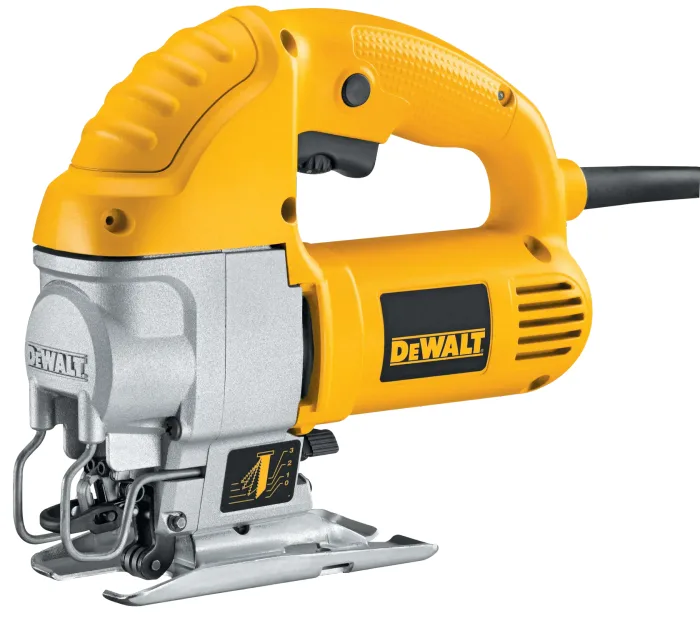
- Buy DEWALT DW317K 5.5 Amp Corded Variable Speed Orbital Jig Saw The only saw here that accepts both T-shank and U-shank blades, with a full inch of stroke behind it. Amazon
- Buy DEWALT DCS334B 20V MAX XR Brushless Cordless Top-Handle Jigsaw The same stroke and orbital geometry as its corded sibling, without the cord and without U-shank compatibility. Amazon
- It depends Makita XVJ03Z 18V LXT Lithium-Ion Cordless Jig Saw Full stroke length and a well-made shoe, held back by the lowest speed ceiling and one fewer orbital setting. Amazon
- Skip CRAFTSMAN CMES612 6 Amp Corded Variable Speed Jig Saw A quarter less stroke than everything else here, and the only saw locked to the shrinking half of the blade market. Amazon
What actually matters
- Stroke length - how far the blade travels per stroke, usually 3/4 or 1 inch. Multiply by strokes per minute to get the real cutting rate rather than comparing either alone.
- Blade shank - T-shank locks tool-lessly and dominates current blade ranges; U-shank clamps with a screw or lever and is the shrinking legacy fitting. Some saws take both.
- Orbital settings - usually three or four positions plus straight. More positions is finer control; the presence of a genuine straight setting is the part that matters.
- Strokes per minute - variable on all serious saws, typically topping out between 2,600 and 3,200. Useful only against stroke length.
- Handle style - top-handle is gripped above the tool and suits awkward positions; barrel-grip is held around the body for finer control on curves. Personal and worth testing.
- Shoe and bevel - the base plate tilts for bevelled cuts, and how solidly it locks decides whether the angle holds through a long cut.
The specs, in plain English
Green flags vs red flags
Green flags
- Stroke length is published in inches or millimetres.
- The blade shank type is stated explicitly, ideally as accepting both.
- Orbital settings are counted and a straight or zero position is named.
- The speed range is given from zero rather than as a single maximum.
- Handle style is described so top-handle and barrel-grip can be told apart.
Red flags
- Strokes per minute leads and no stroke length appears anywhere.
- Amperage is emphasised on a saw with a short stroke.
- The blade fitting is not named, or is described only as tool-less.
- Orbital action is claimed with no setting count.
- A high SPM figure sits next to a 3/4 inch stroke without comment.
Who's who: the brands
- DEWALT - Its cordless XR jigsaw is T-shank only, per DEWALT's manual, and its corded DW317K is the one in our review we list as accepting both shank types.
- Makita - Cordless LXT jigsaws on the 18V platform. The XVJ03Z in our review is listed by Makita as discontinued.
- Bosch - Long-standing reputation in jigsaws, and the originator of the T-shank fitting that became the industry standard.
- CRAFTSMAN - Budget corded saws, such as the CMES612 in our review, where the stroke length and shank type should be checked before buying.
- Festool - Barrel-grip saws built around dust extraction and blade guidance, aimed at cabinetmakers and priced accordingly.
How to read a listing without getting fooled
Find the stroke length and multiply it by the quoted speed before comparing anything. Then find the blade shank type, and treat a U-shank-only saw as a narrowing commitment rather than a neutral choice. Check that a straight orbital setting exists if you will cut anything with a finished face. Read amperage last, since a larger motor driving a shorter stroke does not produce a faster cut.
How much should you spend?
Budget buys a corded saw that may have a short stroke and a legacy blade fitting, which is fine for occasional thin-stock work. Mid-range buys a full inch of stroke, four cutting positions and, on some saws, compatibility with both blade shanks. Premium buys cordless freedom and brushless run time, and generally commits you to T-shank, which is where the blade market is going anyway.
Questions, answered
Can I use T-shank blades in a U-shank saw?
No. The two fittings are physically different, and no adapter makes a T-shank blade sit properly in a U-shank clamp. This is why the shank question is a purchase decision rather than an accessory one: a U-shank-only saw is limited to a range that continues to shrink, while a saw taking both, or a T-shank saw, has the current market available to it.
Why does my jigsaw splinter the top surface?
Because the blade cuts on the up stroke, so it tears fibres out of the face that is pointing at you. The fixes are to cut with the good face down, use a down-cut blade that reverses the tooth direction, drop the orbital setting to straight, or put masking tape over the line. A splinter guard insert in the shoe helps too, if the saw takes one.
How thick can a jigsaw cut?
The blade length sets the theoretical limit and blade deflection sets the practical one. Most jigsaws will nominally cut two inches or more of softwood, but past about an inch and a half the blade starts wandering and the cut bevels on the underside. For thick stock a bandsaw or a circular saw will give you a squarer cut with far less effort.
Is orbital action ever a bad thing?
On finished surfaces, yes. Orbital action makes the teeth bite harder, which cuts faster and tears more, so on veneered ply, laminate or anything that will be seen it produces exactly the splintering you are trying to avoid. That is what the straight or zero setting is for. Use the orbital settings for rough cuts and construction material, and turn them off for anything with a show face.
Or jump to the head-to-head: DEWALT DW317K 5.5 Amp Corded Variable Speed Orbital Jig Saw vs DEWALT DCS334B 20V MAX XR Brushless Cordless Top-Handle Jigsaw.