

Tools & DIY
The Best Jigsaws: 4 Compared (and One to Skip)
Four jigsaws compared on the two specifications that decide what they can cut and what blades they will ever accept: stroke length and shank type.
The short version
Buy the DEWALT DW317K. It is the one saw here we list as accepting both T-shank and U-shank blades, which would put the wider blade range within reach, and it pairs that with a full 1 inch stroke, 0 to 3,100 strokes per minute and four cutting positions from a 5.5 amp corded motor. Buy the DEWALT DCS334B if you want the same cutting geometry without a cord: identical 1 inch stroke and four cutting positions, slightly faster at 0 to 3,200 SPM, brushless, and T-shank only. The Makita XVJ03Z is the it-depends, with the same 1 inch stroke and a well-regarded shoe but a noticeably lower ceiling at 0 to 2,600 SPM, and Makita lists it as discontinued. Skip the CRAFTSMAN CMES612 unless it is a spare: its 3/4 inch stroke is 25 percent shorter than everything else here, so it cuts more slowly at any speed, and it takes U-shank blades only, which is the shrinking half of the blade market. Best for: anyone comparing jigsaws on strokes per minute, which is the number least connected to how fast the saw gets through the wood.
Our picks at a glance
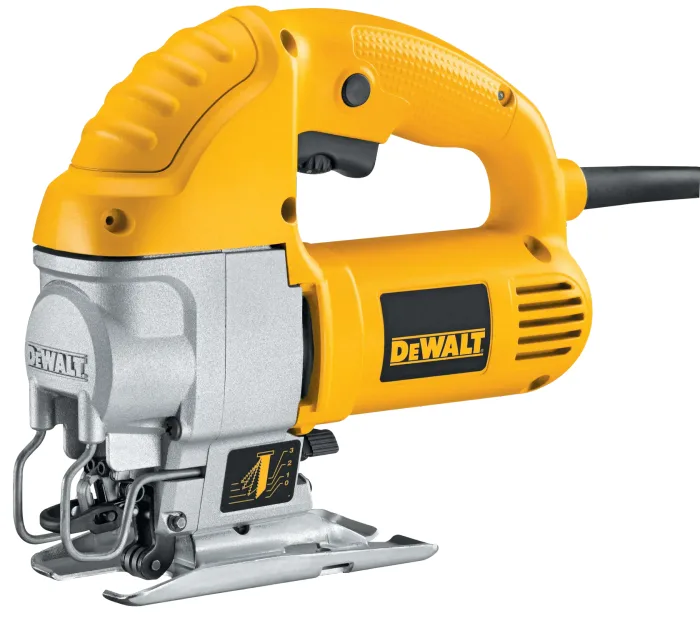
- DEWALT DW317K 5.5 Amp Corded Variable Speed Orbital Jig Saw - Buy. The only saw here that accepts both T-shank and U-shank blades, with a full inch of stroke behind it.
- DEWALT DCS334B 20V MAX XR Brushless Cordless Top-Handle Jigsaw - Buy. The same stroke and orbital geometry as its corded sibling, without the cord and without U-shank compatibility.
- Makita XVJ03Z 18V LXT Lithium-Ion Cordless Jig Saw - It depends. Full stroke length and a well-made shoe, held back by the lowest speed ceiling and one fewer orbital setting.
- CRAFTSMAN CMES612 6 Amp Corded Variable Speed Jig Saw - Skip. A quarter less stroke than everything else here, and the only saw locked to the shrinking half of the blade market.
The verdict in 30 seconds
What mattered most
- Stroke length
- Blade shank accepted
- Strokes per minute
- Orbital settings
- Power
- Motor type
A jigsaw is bought on speed and sold on speed, and strokes per minute is close to the least useful thing about one. What decides how fast it actually cuts is stroke length, how far the blade travels on each of those strokes, and the spread here is a quarter: three of these saws move the blade a full inch and one moves it three quarters. The second thing, and the one that can strand a tool, is the blade shank. T-shank is the modern standard and U-shank is the legacy fitting, and the choice is not always yours: one saw here takes both, two take T only, and one takes U only. That last one is a narrowing problem that gets worse over time, because the blade wall in the shop is not going to grow more U-shank options.
The only saw here that accepts both T-shank and U-shank blades, with a full inch of stroke behind it.
Best for: Anyone who wants the widest possible blade choice and does not want cordless run time deciding when a cut stops.
- Listed here as accepting both T-shank and U-shank blades (DEWALT's page does not state the shank types), which would leave a wider range of blades open to it.
- A full 1 inch stroke length, matching the cordless models and a third more than the Craftsman.
- Four cutting positions, three orbital and one straight per DEWALT's manual, so the aggressiveness can be matched to the material rather than fixed.
- 0 to 3,100 SPM from a 5.5 amp corded motor, which holds its speed through thick stock in a way batteries do not.
- Corded, which on a jigsaw means the lead is dragging across the workpiece on every curve.
- 5.5 amps is modest against larger corded saws, though ample for the 1 inch stroke it drives.
- Sold as a kit with a case, which is fine value but leaves no bare-tool option for those already equipped.
- Brushed motor, so there is a wear item the cordless XR model does not have.
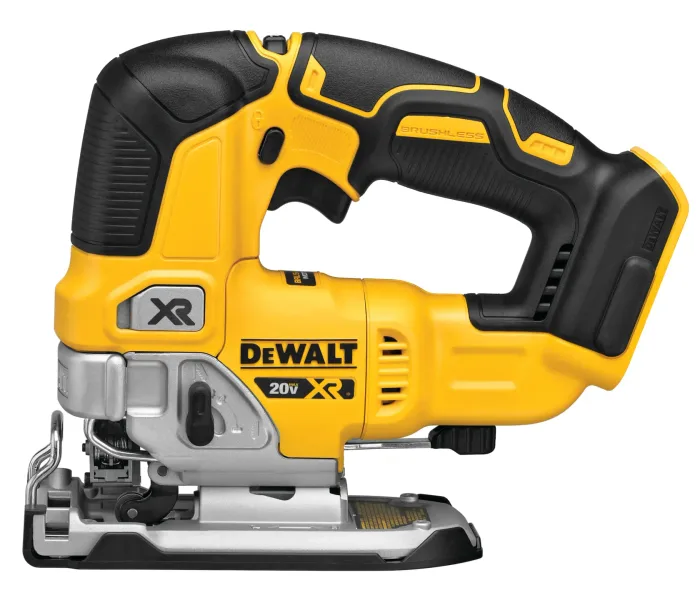
The same stroke and orbital geometry as its corded sibling, without the cord and without U-shank compatibility.
Best for: Cutting curves and cut-outs away from a bench, where the cord is the thing that spoils the line.
- Four cutting positions, matching the corded DW317K, and 0 to 3,200 SPM.
- 0 to 3,200 SPM, marginally the fastest here, from a brushless motor.
- Cordless, which removes the cord snagging on the workpiece during curved cuts, the main annoyance of corded jigsaws.
- Brushless, so there are no brushes to wear and more run time per charge.
- T-shank blades only, where the corded DEWALT accepts both types, so a drawer of older U-shank blades is stranded.
- Bare tool, so batteries and a charger are a separate and significant cost.
- Battery weight sits at the back of a top-handle saw, which changes the balance on long freehand curves.
- Sustained cutting in thick hardwood will drain a pack faster than the job takes.
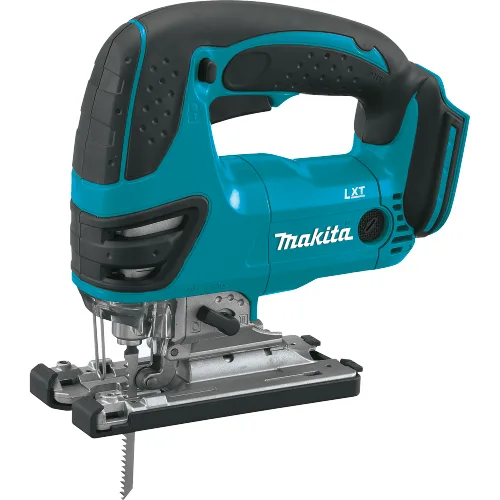
Full stroke length and a well-made shoe, held back by the lowest speed ceiling and one fewer orbital setting.
Best for: Existing Makita owners doing controlled work in sheet goods, where the lower speed ceiling rarely becomes the limit.
- A full 1 inch stroke length, matching the two DEWALTs and well ahead of the Craftsman.
- Offers a straight-cutting position, so delicate work in veneer or laminate has a proper setting.
- T-shank blades, the current standard, with tool-less changing.
- Cordless on the LXT platform, which is the widest 18V range if you already own Makita tools.
- 0 to 2,600 SPM is the lowest ceiling in this comparison, roughly 16 to 19 percent below the DEWALTs.
- Makita lists this model as discontinued, so a replacement is the better purchase.
- Bare tool, so the platform cost applies unless you are already on LXT.
- Brushed motor in this model, where the cordless DEWALT is brushless.
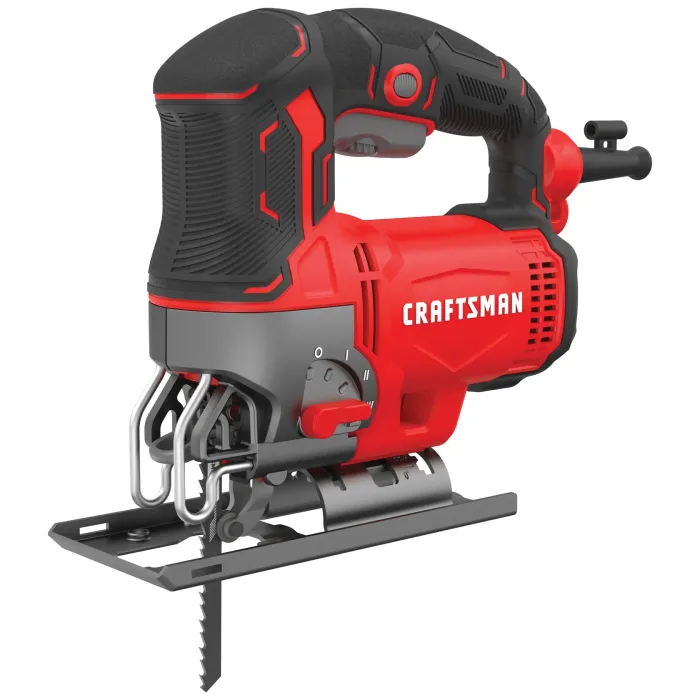
A quarter less stroke than everything else here, and the only saw locked to the shrinking half of the blade market.
Best for: Occasional cuts in thin sheet material where the saw lives in a cupboard and blade choice never comes up.
- 0 to 3,200 SPM, level with the fastest saw here on the number people compare.
- Four cutting positions, matching the DEWALTs on adjustability.
- A 6 amp motor, nominally the largest corded motor in this comparison.
- Variable-speed trigger and a beveling shoe that pivots to 45 degrees.
- A 3/4 inch stroke length, 25 percent shorter than the other three, so each stroke removes less and the saw cuts slower despite the high SPM figure.
- U-shank blades only, which is the legacy fitting and the half of the blade market that keeps shrinking.
- The short stroke and the shank limitation compound: slower cutting now, and a narrowing choice of blades to improve it with.
- The 6 amp figure flatters, since a bigger motor driving a shorter stroke does not produce a faster cut.
| Criteria | DW317K 5.5 Amp Corded Variable Speed Orbital Jig Saw Top pick | DCS334B 20V MAX XR Brushless Cordless Top-Handle Jigsaw | XVJ03Z 18V LXT Lithium-Ion Cordless Jig Saw | CMES612 6 Amp Corded Variable Speed Jig Saw |
|---|---|---|---|---|
| Verdict | Buy it | Buy it | It depends | Skip it |
| Best for | Anyone who wants the widest possible blade choice and does not want cordless run time deciding when a cut stops. | Cutting curves and cut-outs away from a bench, where the cord is the thing that spoils the line. | Existing Makita owners doing controlled work in sheet goods, where the lower speed ceiling rarely becomes the limit. | Occasional cuts in thin sheet material where the saw lives in a cupboard and blade choice never comes up. |
| Price tier | $$ · mid-range | $$$ · premium | $$$ · premium | $ · budget |
| Stroke length | 1 in. | 1 in. | 1 in. | 3/4 in. |
| Blade shank accepted | T-shank and U-shank | T-shank only | T-shank | U-shank only |
| Strokes per minute | 0 to 3,100 | 0 to 3,200 | 0 to 2,600 | 0 to 3,200 |
| Orbital settings | 4 positions, 3 orbital plus straight | 4 positions | Includes straight | 4 positions, 3 orbital plus straight |
| Power | 5.5 amp corded | 20V brushless | 18V brushed | 6 amp corded |
| Motor type | Brushed | Brushless | Brushed | Not stated |
| Bare tool available | Sold as kit | Yes | Yes | Sold as tool |
Which one is right for you?
- Anyone who wants the widest possible blade choice and does not want cordless run time deciding when a cut stops. Buy it DEWALT DW317K 5.5 Amp Corded Variable Speed Orbital Jig Saw
- Cutting curves and cut-outs away from a bench, where the cord is the thing that spoils the line. Buy it DEWALT DCS334B 20V MAX XR Brushless Cordless Top-Handle Jigsaw
- Existing Makita owners doing controlled work in sheet goods, where the lower speed ceiling rarely becomes the limit. It depends Makita XVJ03Z 18V LXT Lithium-Ion Cordless Jig Saw
- Occasional cuts in thin sheet material where the saw lives in a cupboard and blade choice never comes up. Skip it CRAFTSMAN CMES612 6 Amp Corded Variable Speed Jig Saw
How we judged the field
Stroke length first, because it is half of the cutting-rate equation and the half that actually varies here. Three of these move the blade a full inch and one moves it three quarters, a 25 percent difference that no amount of extra strokes per minute makes up. Then blade shank, because it is the only decision in this group with consequences that outlast the tool: T-shank is the current standard with the deepest selection, U-shank is legacy and shrinking, and one saw here is locked to the shrinking side while another accepts both. Then orbital settings, and specifically whether there is a genuine straight-cut position for veneer and laminate. Speed we read last and only alongside stroke, since the fastest quoted saw in this comparison is also the slowest cutting one.
DEWALT DW317K 5.5 Amp Corded Variable Speed Orbital Jig Saw
Buy itThe DEWALT DW317K is the pick for a reason that has nothing to do with performance and everything to do with what you can feed it. It accepts both T-shank and U-shank blades, which makes it the only saw here with the entire blade wall available to it, including the specialist patterns that appear in one fitting and not the other. Behind that it has the geometry that matters: a full 1 inch stroke, four cutting positions, and 0 to 3,100 SPM from a 5.5 amp corded motor that will hold speed through thick stock rather than sagging as a battery drains. Five and a half amps sounds modest next to the Craftsman’s six, and it is ample for the stroke it drives, which is the point. The costs are ordinary: it is corded, and on a jigsaw specifically that means the lead drags across the workpiece on every curve, which is more annoying here than on a circular saw. It is a brushed motor, and it is sold as a kit, so there is no cheap bare-tool route for someone already equipped.
DEWALT DCS334B 20V MAX XR Brushless Cordless Top-Handle Jigsaw
Buy itThe DEWALT DCS334B is the second buy and the cordless version of the same argument. It matches the corded model on cutting positions and, as listed, a 1 inch stroke, and edges slightly ahead on speed at 0 to 3,200 SPM. It is brushless, so there are no brushes to wear and more run time per charge. And it removes the cord, which on a jigsaw is worth more than on most tools, because freehand curve cutting is precisely where a trailing lead catches the workpiece and pulls the line off. What it gives up is the thing that makes its corded sibling the pick: T-shank only. If you have a drawer of U-shank blades, they are now decoration. As a bare tool it needs batteries and a charger, and the pack sits at the back of a top-handle saw where it changes the balance on long freehand work.
Makita XVJ03Z 18V LXT Lithium-Ion Cordless Jig Saw
It dependsThe Makita XVJ03Z is the it-depends. It has the full 1 inch stroke, so it is on the right side of the specification that separates this group, and it offers a straight-cutting position, which is the setting that matters for veneer and laminate. The shoe and general build are what you expect from Makita. Two things hold it back. Its 0 to 2,600 SPM ceiling is the lowest here, so on straightforward cuts in softwood it is slower than either DEWALT. Makita also lists this model as discontinued. And it is a brushed motor where the cordless DEWALT is brushless, which costs run time on a platform where run time is the constraint. It is a bare tool, so it makes most sense to someone already on LXT, and for that person doing controlled work in sheet goods the speed ceiling will rarely be what stops them.
CRAFTSMAN CMES612 6 Amp Corded Variable Speed Jig Saw
Skip itThe CRAFTSMAN CMES612 is the skip, and it is a good example of a listing that reads well and specifies badly. It quotes 0 to 3,200 SPM, level with the fastest saw here, four cutting positions matching the DEWALTs, and a 6 amp motor that is nominally the largest corded motor in the group. Then you find the stroke length: 3/4 inch, a quarter shorter than every other saw here. Speed times stroke is the cutting rate, so the saw that looks fastest on the box removes materially less wood per second than the ones that look slower. Compounding it, the blade fitting is U-shank only, which is the legacy standard and the half of the blade market that continues to shrink, so the obvious remedy of buying a better blade is the one most constrained. It will cut plywood and thin stock perfectly well and it costs very little, which is a real argument for a saw that lives in a cupboard. It is not one to buy expecting to grow into.
Sources
Specs in this review come from these pages.
DEWALT DW317K 5.5 Amp Corded Variable Speed Orbital Jig Saw vs DEWALT DCS334B 20V MAX XR Brushless Cordless Top-Handle Jigsaw: which should you buy?
The two DEWALTs isolate the cordless question cleanly, since they share a stroke length, an orbital design and very nearly a speed range. What separates them is a cord and a blade fitting, and the second is the more consequential. The corded DW317K takes both T-shank and U-shank, so every blade made for a jigsaw fits it. The cordless DCS334B takes T-shank only, which is the modern standard and where nearly all new blade development happens, but it does close the door on older stock and on the occasional specialist pattern that appears in U-shank. Set against that, cutting curves freehand with no cord catching the workpiece is a genuine improvement in the quality of the line, not just in convenience. If the saw lives on a bench, take the corded one for the blade access. If it is carried to the work, take the cordless and accept T-shank.
What to look for
- Stroke length: typically 3/4 or 1 inch, and the half of the cutting-rate equation that actually varies. A shorter stroke cuts less per stroke regardless of the speed quoted.
- Blade shank type: T-shank is the standard with the deepest selection, U-shank is legacy and narrowing, and a saw that accepts both closes off nothing.
- A true straight or zero orbital setting: the one that cuts cleanly in veneer, laminate and finished surfaces, where any orbital action splinters the face.
- Speed multiplied by stroke, not speed alone: the fastest-quoted saw in this comparison is also the slowest cutting, because its stroke is a quarter shorter.
- Top-handle against barrel-grip: a strong personal preference that changes control on tight curves, and worth handling before buying rather than after.
- Motor type on cordless models: brushless buys run time on a tool whose limit is usually the battery rather than the cut.
Our final take
Jigsaws are compared on strokes per minute and decided by stroke length and blade fitting. Multiply the two speed figures together before believing any listing, and check the shank type before you buy rather than when you next need a blade that does not exist in the fitting your saw takes.
Questions, answered
Why does stroke length matter more than strokes per minute?
Because the two multiply into how much blade passes through the material each second, and stroke length is where these saws actually differ. Three of them move the blade a full inch and the Craftsman moves it three quarters, which is 25 percent less cutting per stroke. Since the Craftsman also quotes 3,200 SPM, level with the fastest here, its listing looks competitive while its actual cutting rate is materially lower. Multiply the two figures rather than comparing either alone.
What is the difference between T-shank and U-shank blades?
They are two ways of holding the blade. U-shank has a U-shaped notch clamped by a screw or lever and is the older fitting. T-shank has a tang that locks into a tool-less holder, changes faster, and holds the blade more precisely, which is why it became the standard. The practical consequence is availability: T-shank blades are now the bulk of what is stocked, in far more tooth patterns and materials, and U-shank selection keeps shrinking. A saw that takes both, like the corded DEWALT here, closes off nothing.
What does orbital action actually do?
It swings the blade slightly forward on the up stroke and back on the down stroke, so the teeth bite into the material rather than simply scraping past it. Higher orbital settings cut much faster and leave a rougher edge with more splintering; the zero or straight setting cuts slowly and cleanly, which is what you want in veneer, laminate and finished surfaces. Having a true straight setting matters more than the count of positions.
Does a top-handle or barrel-grip jigsaw cut better?
Neither cuts better; they are held differently. Top-handle saws, like all four here, are gripped above the tool with the trigger under a finger, which most people find intuitive and which suits overhead and awkward positions. Barrel-grip saws are held around the body with the hand lower and closer to the blade, which gives finer control on tight curves and is preferred by many cabinetmakers. It is worth trying both before committing, since the preference is strong and personal.
Why does my jigsaw cut at an angle instead of square?
Usually blade deflection rather than the saw being out of adjustment. Jigsaw blades are supported only at the top, so in thick or hard material the blade wanders and the cut bevels away from vertical on the underside. Slowing down, using a thicker or wider blade, dropping the orbital setting and letting the saw cut at its own pace all help. If the cut is consistently off in the same direction with no load, then check the shoe adjustment.
Deciding between the top two? See our head-to-head: DEWALT DW317K 5.5 Amp Corded Variable Speed Orbital Jig Saw vs DEWALT DCS334B 20V MAX XR Brushless Cordless Top-Handle Jigsaw.
More Tools & DIY reviews
 The Best Work Knee Pads: 4 Compared (and One to Skip)
  The Best Laser Levels: 4 Compared (and One to Skip)
  The Best Locking Pliers: 4 Compared (and One to Skip)
  The Best Log Splitters: 4 Compared (and One to Skip)
  The Best Miter Saws: 4 Compared (and One to Skip)
  The Best Moisture Meters: 4 Compared (and One to Skip)