

Tools & DIY
The Best Infrared Thermometers: 4 Compared (and One to Skip)
We compared four non-contact infrared thermometers on how each maker states its accuracy, whether the distance-to-spot ratio is qualified or just asserted, and whether emissivity can be adjusted at all.
The short version
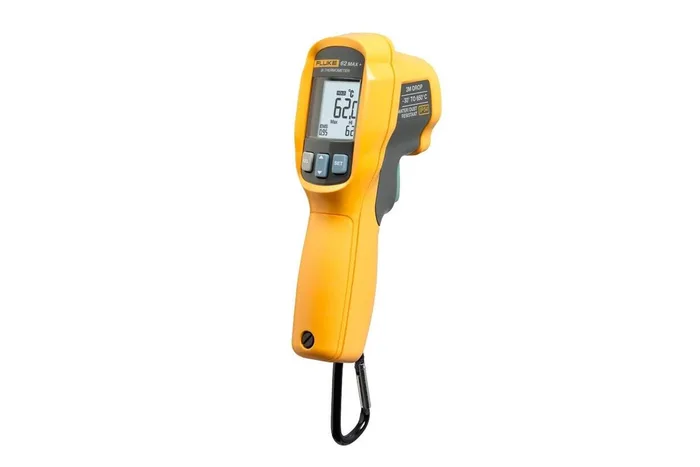
The Fluke 62 MAX+ is the pick, mostly because Fluke publishes its 12:1 optic as calculated at 90 percent energy rather than leaving the ratio unqualified, and states accuracy as the greater of 1.0 C or 1.0 percent of reading with separate looser bands below freezing. The Klein Tools IR10 is the value buy: a tighter 20:1 optic, the same 0.10 to 1.00 emissivity adjustment, and a K-type probe in the box for the air, gas and liquid temperatures the infrared sensor physically cannot read. The ThermoWorks IR-GUN-S is the depends pick, worth it if you want accuracy broken into three target bands and a certificate of conformance traceable to a national measurement lab, and wrong for you if you need to read past 550 C or take an internal temperature. Skip the Etekcity Lasergrip 774 Upgrade: its emissivity is fixed at 0.95, so every shiny surface reads low with no way to correct it. None of these are for reading body temperature, and Etekcity says so explicitly. Best for: anyone measuring surfaces on electrical gear, HVAC ducting, engines, roofs or cookware who wants a number they can defend.
Our picks at a glance
- Fluke 62 MAX+ - Buy. The one that tells you what its distance-to-spot ratio actually means.
- Klein Tools IR10 Dual-Laser Infrared Thermometer - Buy. Tightest optic here, plus the contact probe that covers what infrared cannot.
- ThermoWorks Industrial IR Gun (IR-GUN-S) - It depends. Paperwork and banded accuracy, in exchange for a low temperature ceiling.
- Etekcity Lasergrip 774 Upgrade Infrared Thermometer - Skip. Emissivity locked at 0.95, which quietly breaks every reading on shiny metal.
The verdict in 30 seconds
What mattered most
- Temperature range
- Stated accuracy above freezing
- Distance-to-spot, as published
- Emissivity
- Contact probe input
- Drop and ingress rating
An infrared thermometer reads the energy radiating off a surface and turns it into a number. That sounds simple until you point one at bare aluminum and get a reading that is wildly cold, or stand too far back and average a hot breaker in with the cool panel around it. The specs that decide whether you get a useful number are emissivity adjustment, the distance-to-spot ratio, and whether the maker will tell you the conditions its accuracy figure was measured under. We picked four currently sold guns that split cleanly on exactly those three points.
The one that tells you what its distance-to-spot ratio actually means.
Best for: Electricians and HVAC techs who need a rugged spot reading they can put in a report.
- Fluke publishes the 12:1 optic as calculated at 90 percent energy, so the ratio has a defined basis instead of being an unexplained number.
- Accuracy is the greater of 1.0 C or 1.0 percent of reading, with separate 2.0 C and 3.0 C bands stated for the sub-zero ranges.
- Rated IP54 per IEC 60529, tested to a 3 meter drop, and runs on a single AA alkaline cell.
- No contact probe input, so air, gas, liquid and internal temperatures are out of reach entirely.
- The 12:1 optic reads a wider spot at any given distance than the Klein's 20:1 optic.
- Fluke rates it at 8 hours with laser and backlight on, the shortest of the three MAX-series guns on the same datasheet.
- Sits at the premium end of this group without a spec sheet that makes the gap obvious.
Amazon had no buyable listing for this when we last checked. The link still works if it returns.
Check price on Amazon Read our detailed assessment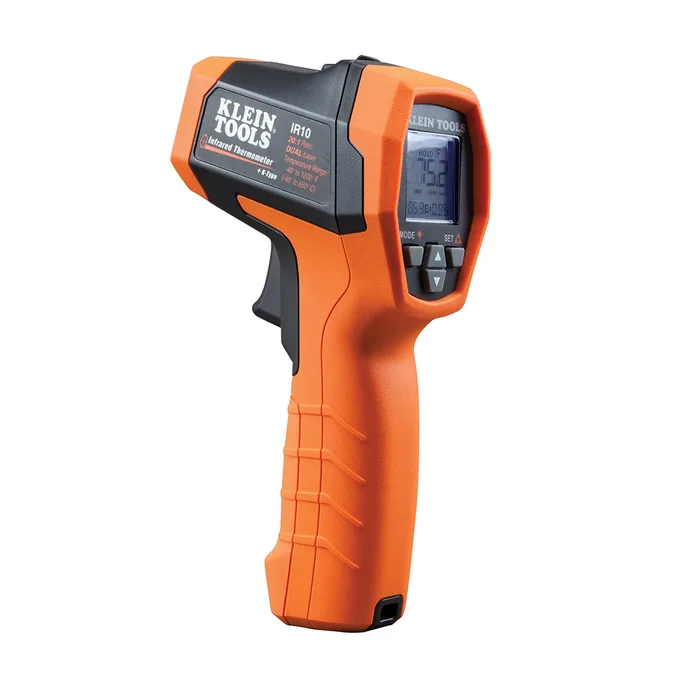
Tightest optic here, plus the contact probe that covers what infrared cannot.
Best for: Tradespeople who want one tool that reads both a hot surface and the air coming out of a vent.
- 20:1 optical resolution, the tightest of the four, and the manual charts the spot diameter at 10, 20, 40 and 80 inches.
- A K-type probe is included for what Klein calls bulk temperatures of air, gas, or liquids, which the infrared sensor cannot measure.
- Emissivity adjusts 0.10 to 1.00 and the printed manual carries an emissivity chart for asphalt, brick, concrete, glass, marble, copper, sheet aluminum and cold rolled steel.
- The 20:1 figure is published as a bare ratio with no energy fraction stated, unlike the Fluke.
- Infrared accuracy is 3 F (1.5 C) or 1.5 percent whichever is greater, looser than the Fluke's 1.0 C or 1.0 percent.
- The bundled K-type probe is rated only to 356 F (180 C); anything hotter needs a separate high-temp probe.
- Uses a 9V battery rather than AA or AAA cells, rated at 8 hours continuous with laser and backlight on.
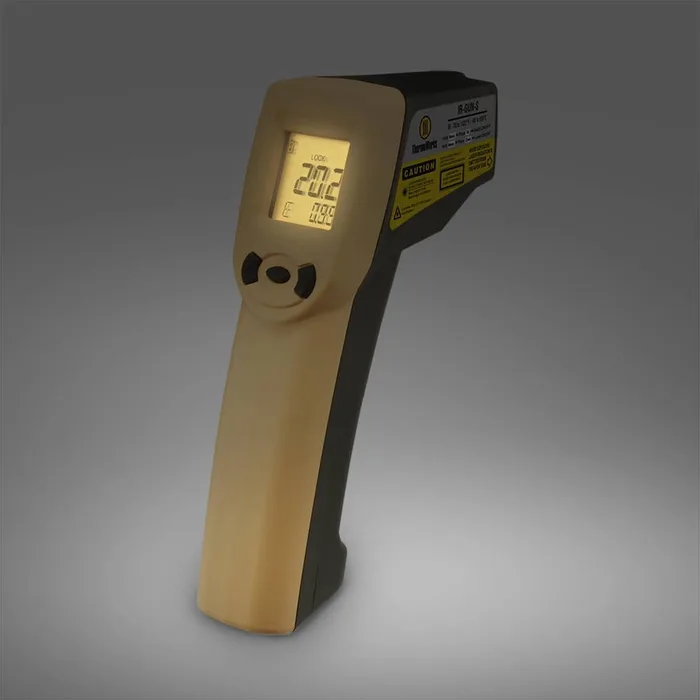
Paperwork and banded accuracy, in exchange for a low temperature ceiling.
Best for: Cooks and lab-adjacent users who want banded accuracy and a traceability certificate more than a high ceiling.
- Accuracy is split into three target bands, including 1.5 C between 15 and 35 C, rather than a single figure covering the whole range.
- Ships with a certificate of conformance stating calibration against standards traceable to the National Measurement Laboratory of Taiwan.
- The manual names what degrades a reading: emissivity setting, target spot size and rapid changes in ambient temperature, plus a stated error under a 3 V per meter RF field.
- Tops out at 550 C, the second-lowest ceiling of the four, so hot exhaust and furnace work are off the table.
- The 12:1 optic is stated geometrically as a 1 inch target at 12 inches, with no energy fraction given.
- No contact probe input, and ThermoWorks describes it plainly as an instrument for measuring surface temperatures, so it will not tell you whether food is cooked through.
- No drop rating or ingress protection rating is published.
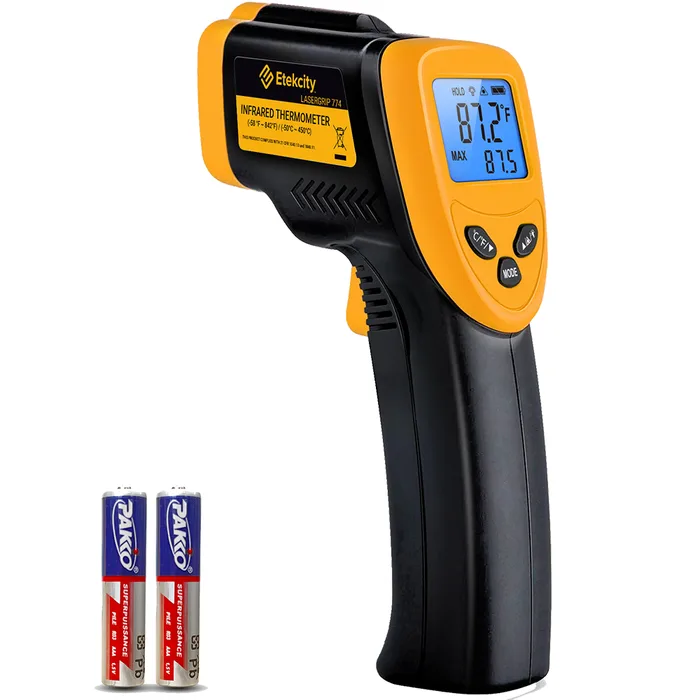
Emissivity locked at 0.95, which quietly breaks every reading on shiny metal.
Best for: Almost nobody, unless every surface you will ever point it at is matte and dark.
- The -50 to 450 C (-58 to 842 F) range covers most household, cooking and light automotive surfaces.
- The 12:1 distance-to-spot ratio matches the Fluke's on paper.
- Runs on two AAA cells rather than a 9V battery.
- Emissivity is published as a fixed 0.95, so polished aluminum, stainless and copper read low and there is no setting to correct it.
- Fluke, Klein and ThermoWorks all publish adjustable emissivity on their guns in this group, so a fixed value is a limit of the model.
- Accuracy is stated as 2 percent above 100 C and 2 C below it, with no ambient conditions, no sub-zero band and no note on what affects it.
- No drop rating, no ingress protection rating and no contact probe input appear in the published specifications.
| Criteria | 62 MAX+ Top pick | IR10 Dual-Laser Infrared Thermometer | Industrial IR Gun (IR-GUN-S) | Lasergrip 774 Upgrade Infrared Thermometer |
|---|---|---|---|---|
| Verdict | Buy it | Buy it | It depends | Skip it |
| Best for | Electricians and HVAC techs who need a rugged spot reading they can put in a report. | Tradespeople who want one tool that reads both a hot surface and the air coming out of a vent. | Cooks and lab-adjacent users who want banded accuracy and a traceability certificate more than a high ceiling. | Almost nobody, unless every surface you will ever point it at is matte and dark. |
| Price tier | $$$ · premium | $$ · mid-range | $$ · mid-range | $ · budget |
| Temperature range | -30 to 650 C (-22 to 1202 F) | -40 to 650 C (-40 to 1200 F) | -60 to 550 C (-76 to 1022 F) | -50 to 450 C (-58 to 842 F) |
| Stated accuracy above freezing | 1.0 C or 1.0% of reading, greater of | 3 F (1.5 C) or 1.5%, greater of | 4 F (2 C) or 2% from 0 to 550 C; 1.5 C from 15 to 35 C | 2 C below 100 C, 2% above |
| Distance-to-spot, as published | 12:1, calculated at 90% energy | 20:1, bare ratio | 12:1, 1 in target at 12 in | 12:1, no method stated |
| Emissivity | Adjustable 0.10 to 1.00 | Adjustable 0.10 to 1.00 | Adjustable 0.1 to 1, default 0.95 | Fixed at 0.95 |
| Contact probe input | None | K-type probe included, rated to 356 F (180 C) | None | None |
| Drop and ingress rating | 3 m drop, IP54 per IEC 60529 | 3 m drop, IP54 | Not published | Not published |
| Power | 1 x AA alkaline, 8 h with laser and backlight | 1 x 9V alkaline, 8 h continuous | 2 x AAA, 180 h typical | 2 x AAA |
| Calibration paperwork | Verification procedure published in the manual | Stated accurate for one year | Certificate of conformance, traceable to NML Taiwan | None published |
Which one is right for you?
- Electricians and HVAC techs who need a rugged spot reading they can put in a report. Buy it Fluke 62 MAX+
- Tradespeople who want one tool that reads both a hot surface and the air coming out of a vent. Buy it Klein Tools IR10 Dual-Laser Infrared Thermometer
- Cooks and lab-adjacent users who want banded accuracy and a traceability certificate more than a high ceiling. It depends ThermoWorks Industrial IR Gun (IR-GUN-S)
- Almost nobody, unless every surface you will ever point it at is matte and dark. Skip it Etekcity Lasergrip 774 Upgrade Infrared Thermometer
How we judged the field
Five things decide whether an infrared thermometer gives you a number worth acting on. First, emissivity adjustment, because the sensor is measuring radiated energy and every material radiates differently; without a setting to match the surface, readings on anything shiny are systematically low. Second, the distance-to-spot ratio, because it defines how big an area the reading is averaged over at your working distance. Third, how the accuracy figure is stated: a single number with no ambient conditions, no target bands and no caveats is a weaker claim than the same number split into ranges with its limitations spelled out. Fourth, whether there is a contact probe input, since infrared reads surfaces and nothing else. Fifth, physical ratings, because these tools live in bags and get dropped.
The field splits along a line that is not the price line. Adjustable emissivity is not a premium feature: Fluke’s entry 62 MAX has the same 0.10 to 1.00 range as the 62 MAX+, and Klein and ThermoWorks both publish 0.1 to 1.0 on mid-priced tools. What actually varies is brand discipline. So we picked the Fluke 62 MAX+ for qualifying its optic at 90 percent energy, the Klein IR10 for pairing the tightest optic here with a contact probe and a printed emissivity chart, and the ThermoWorks IR-GUN-S for banded accuracy and a traceability certificate. Against them we set the Etekcity Lasergrip 774 Upgrade, a widely sold budget gun whose emissivity is nailed to 0.95.
Fluke 62 MAX+
Buy itThe Fluke 62 MAX+ is not the widest-ranging or the tightest-optic tool in this group, and it still wins, because of how Fluke writes its spec sheet. The distance-to-spot ratio is published as 12:1 calculated at 90 percent energy, which tells you the fraction of the signal that ratio accounts for; a bare 20:1 from another brand does not tell you that, and the two numbers therefore are not directly comparable. Accuracy is the greater of 1.0 C or 1.0 percent of reading, with 2.0 C stated separately from -10 C to 0 C and 3.0 C from -30 C to -10 C, so the cold end is not quietly folded into a single headline figure. Emissivity runs 0.10 to 1.00, spectral response is 8 to 14 microns, and it is rated IP54 per IEC 60529 with a 3 meter drop test, on one AA cell. The trade-off is real: no probe input at all, and a wider spot than the Klein at the same distance. For anyone who has to write the reading down and stand behind it, that is a fair swap.
Klein Tools IR10 Dual-Laser Infrared Thermometer
Buy itThe Klein Tools IR10 is the one to buy if you want the most measurement capability for the money. Its 20:1 optic is the tightest here, and Klein does the useful thing of charting what that means: a 0.5 inch spot at 10 inches out to a 4 inch spot at 80 inches. Emissivity adjusts 0.10 to 1.00, and the printed manual includes an emissivity chart running from commercial sheet aluminum at 0.09 up to smooth ice at 0.97, which is the single most useful page most owners will never read. The K-type probe in the box matters more than the spec list suggests, because it covers what Klein calls bulk temperatures of air, gas, or liquids, the exact readings an infrared sensor cannot take. Against that, infrared accuracy is 3 F or 1.5 percent whichever is greater, looser than the Fluke, the 20:1 ratio is published without any energy fraction, and the included probe stops at 356 F. It shares the Fluke’s 3 meter drop and IP54 ratings.
ThermoWorks Industrial IR Gun (IR-GUN-S)
It dependsThe ThermoWorks IR-GUN-S is the outlier, and whether that suits you depends entirely on what you measure. Its accuracy is not one number: 1.5 C for targets between 15 and 35 C, 2 C or 2 percent whichever is greater from 0 to 550 C, and a widening band below freezing. The manual footnotes that infrared accuracy can be affected by the emissivity setting, target spot size and rapid changes in ambient temperature, and even publishes the error it will show inside a 3 V per meter radio field. It ships with a certificate of conformance stating calibration traceable to the National Measurement Laboratory of Taiwan. That is more disclosure than anything else here. The cost is a 550 C ceiling (the Etekcity’s is lower still), no published drop or ingress rating, and, most importantly, surfaces only: ThermoWorks calls it a non-contact infrared thermometer for measuring surface temperatures. Griddle plates and pizza stones yes, the inside of a roast no. That is a different instrument, and we cover fast internal-read probes separately.
Etekcity Lasergrip 774 Upgrade Infrared Thermometer
Skip itThe Etekcity Lasergrip 774 Upgrade is the one to walk away from, and the reason is a single line in its own specifications: emissivity 0.95, stated as a value rather than a range. Every reading it gives you assumes the surface radiates like matte paint. Point it at stainless, polished aluminum or copper pipe and it will read low, sometimes dramatically, and there is no menu to fix it. Adjustable emissivity is common on the other guns here, so a locked value is a real gap. The rest of the sheet is thin in the same way: accuracy given as 2 percent above 100 C and 2 C below, with no ambient conditions, no sub-zero band, and no note on what degrades it, plus no drop rating and no ingress rating published at all. It measures -50 to 450 C at 12:1, which is fine. It just cannot tell you when it is wrong.
Sources
Specs in this review come from these pages.
- Fluke 62 MAX and 62 MAX+ Users Manual (media.fluke.com)
- Fluke 64 MAX, 62 MAX+ and 62 MAX Technical Data (media.fluke.com)
- Klein Tools IR10 Instruction Manual, including the emissivity chart (data.kleintools.com)
- Klein Tools IR10 product page (kleintools.com)
- ThermoWorks IR-GUN-S Operating Instructions and Certificate of Conformance (thermoworks.com)
- Etekcity Lasergrip 774 Upgrade product page (etekcity.com)
Fluke 62 MAX+ vs Klein Tools IR10 Dual-Laser Infrared Thermometer: which should you buy?
Choosing between the Fluke 62 MAX+ and the Klein IR10 comes down to whether you value a tighter number or a broader tool. The Klein reads a smaller spot at every distance thanks to its 20:1 optic against the Fluke’s 12:1, and it adds a K-type probe that opens up air, gas and liquid temperatures the Fluke cannot touch. The Fluke answers with a tighter accuracy spec, 1.0 C or 1.0 percent against the Klein’s 1.5 C or 1.5 percent, and with an optic ratio that is qualified at 90 percent energy rather than left as a bare figure. Both are rated IP54 and tested to a 3 meter drop, so ruggedness is a wash.
The practical rule: if your readings end up in a report, a compliance log or an argument with a contractor, take the Fluke, because a tighter published accuracy stated against a known ambient is the thing you can point at. If you are working through a building measuring supply air out of registers, water at a tap and the surface of a compressor in the same afternoon, take the Klein, because the probe means one tool instead of two and the 20:1 optic lets you stand further back from a live panel. Buyers who mostly measure cookware, and who want banded accuracy with a traceability certificate, should look at the ThermoWorks instead of either.
What to look for
- Adjustable emissivity, not a fixed value: a spec line that reads 0.95 with no range is a locked setting, and it will read shiny surfaces low forever.
- A qualified distance-to-spot ratio: Fluke states 12:1 calculated at 90 percent energy, which is a stronger claim than a bare 20:1 from a brand that does not say what fraction of the signal it counted.
- Accuracy split into bands: one number covering an entire range is doing less work than three numbers covering the ranges you actually measure in, plus a separate figure for sub-zero targets.
- A stated operating ambient: ThermoWorks publishes 0 to 50 C operating range and notes that rapid ambient change degrades readings, which tells you the number was measured under defined conditions.
- A contact probe input if you measure anything but surfaces: infrared cannot read air, gas, liquid or internal temperature, and Klein’s K-type jack is the cheapest way to cover that gap.
- Drop and ingress ratings in writing: the two tools here that publish 3 meter drop and IP54 are the two built for a tool bag, and the two that publish neither are not making that claim.
Our final take
Buy the Fluke 62 MAX+ if your readings have to hold up to scrutiny; it earns that on disclosure, not on headline numbers. Buy the Klein IR10 if you want the tightest optic in this group plus a contact probe that covers everything infrared cannot see, and can live with a slightly looser accuracy spec. The ThermoWorks IR-GUN-S is the one to choose deliberately: banded accuracy, a traceability certificate and a low ceiling, which suits cooking and bench work more than furnace work. Skip the Etekcity Lasergrip 774 Upgrade, because a fixed 0.95 emissivity turns every metal surface into a guess, and adjustable emissivity is standard on the other guns here.
Questions, answered
Can I use one of these to check somebody's temperature?
No, and Etekcity says so itself, stating the Lasergrip is intended for use on inanimate objects only and that measuring the temperature of a human or animal is unsafe. Clinical forehead and ear thermometers are a separate class of device, calibrated for skin emissivity at a fixed short distance and cleared for that use. An industrial gun pointed at a forehead is reading a small, sweaty, variably reflective patch from an arbitrary distance, which is exactly the situation these tools are worst at.
Why does my reading go wrong on shiny metal?
Emissivity. A surface that radiates efficiently, like matte black paint at 0.96 in Klein's chart, gives the sensor plenty of signal. Polished metal barely radiates at all: Klein lists commercial sheet aluminum at 0.09 and matte copper at 0.22, so the gun is mostly seeing reflected energy from the room. Klein's own warning says to be cautious with reflective materials because the instrument may indicate they are cooler than they actually are. If the tool lets you set emissivity you dial it to match the material; if it is locked at 0.95 you cannot, which is the core problem with the Etekcity here. The field workaround is a patch of matte tape or flat paint on the target, measured once it has come to the same temperature.
How far back can I stand?
That is what the distance-to-spot ratio answers, and it is a ratio, not a maximum range. At 20:1 the Klein manual charts a 0.5 inch spot at 10 inches, 1 inch at 20 inches, 2 inches at 40 inches and 4 inches at 80 inches. At 12:1 the ThermoWorks manual puts a 1 inch target at 12 inches. Whatever the spot works out to at your working distance, the target has to be bigger than it, or the reading is an average of the target and whatever surrounds it. Notice that Fluke qualifies its ratio as calculated at 90 percent energy while others publish a bare number, which means the figures are not strictly comparable across brands.
Does the laser do the measuring?
It does not. Fluke's technical data says the 62 MAX+ has dual rotating lasers to help you identify the area to be measured and that the measurement area is the spot between the dots. Klein's manual says the IR10 features dual lasers to assist in targeting, and that the distance between the two laser spots approximates the diameter of the circular area the sensor is collecting from. The sensor itself is a separate infrared window. You can prove it on the tools that let you switch the laser off: Klein disables the lasers automatically when the K-type probe is plugged in, and the ThermoWorks lets you toggle the laser from the trigger, and both keep measuring.
I already own a thermal camera or a probe thermometer. Do I need this too?
They answer different questions. A thermal imager shows you a whole scene at once so you can find the anomaly, which we cover separately, while a spot gun gives you one number for one place. A probe thermometer reads internal temperature by physically going inside the thing, which is the only way to know whether food is cooked. An infrared gun reads the outside only: ThermoWorks describes the IR-GUN-S as a non-contact infrared thermometer for measuring surface temperatures, full stop. If your work is checking a breaker lug, a duct register, a griddle plate or a bearing housing, the spot gun is the right tool and the others are not substitutes.
Deciding between the top two? See our head-to-head: Fluke 62 MAX+ vs Klein Tools IR10 Dual-Laser Infrared Thermometer.
More Tools & DIY reviews
 The Best Insulated Hand Tools: 4 Compared (and One to Skip)
  The Best Jigsaws: 4 Compared (and One to Skip)
  The Best Work Knee Pads: 4 Compared (and One to Skip)
  The Best Laser Levels: 4 Compared (and One to Skip)
  The Best Locking Pliers: 4 Compared (and One to Skip)
  The Best Log Splitters: 4 Compared (and One to Skip)