

Tools & DIY
The Best Insulated Hand Tools: 4 Compared (and One to Skip)
We compared 1000 V insulated hand tools on the standards each maker actually claims, the markings on the tool, the insulation construction, and how easy it is to see damage before you pick the tool up.
The short version
The Knipex 00 20 13 five piece set is the pick: Knipex states the tools are VDE tested in conformance to DIN EN and IEC 60900 at 1000 V and that all its insulated tools meet ASTM F1505, and the red over yellow construction makes a nick obvious. The Klein Tools 33526 eight piece kit is the value choice and covers more of a real day, with pliers, a cable cutter, a stripper and screwdrivers, all in one zip case; Klein says it meets or exceeds IEC 60900:2012 and ASTM F1505-10. The Wiha 43449 slimVario set suits anyone who wants one insulated handle and swappable insulated bits instead of a fistful of screwdrivers, but Wiha lists IEC 60900 only, so check it against your employer's spec before you rely on it. Skip the Klein D213-9NE lineman's pliers for anything energized: Klein's own page says the plastic dipped handles are for comfort and identification and are not intended for protection against electrical shock. Buy an insulated lineman's plier instead, such as Klein's 20009NEEINS, if you want that plier shape with insulation. None of these replace deenergizing the circuit, which OSHA requires first. Best for: electricians and maintenance techs buying their first properly marked 1000 V set.
Our picks at a glance
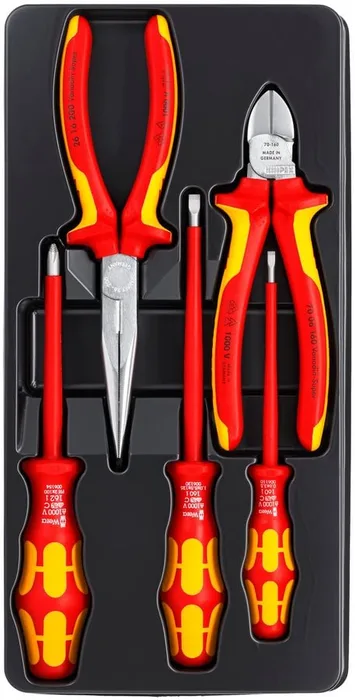
- Knipex 00 20 13 5 Pc 1000V Insulated Pliers and Screwdriver Set - Buy. A small, honest, fully marked set from a maker that publishes exactly what it tests and how.
- Klein Tools 33526 Basic 1000V Insulated Tool Kit, 8-Piece - Buy. Eight properly marked insulated tools in one zip case, which is closer to what an actual service call needs.
- Wiha 43449 Screwdriver Set SoftFinish slimVario electric - It depends. One insulated handle plus insulated slimBits, which halves what you carry and doubles what you have to inspect.
- Klein Tools D213-9NE Lineman's Pliers, New England Nose, 9-Inch - Skip. A superb plier that is not an insulated tool, and Klein says so in plain language on its own product page.
The verdict in 30 seconds
What mattered most
- Standards the maker claims
- Third party mark named by the maker
- Pieces
- Tool types covered
- Insulation construction
- 1000 V double triangle marking
Insulated hand tools are one of the few purchases where the marketing word and the safety word are not the same thing. A tool that is safe to hold near an energized conductor has been proof tested one at a time, carries a specific set of marks, and is built so that damage is visible before it matters. A tool with a plastic handle has a plastic handle. We looked at what IEC 60900 and ASTM F1505 cover, what OSHA actually requires, and then picked four tools that show the difference clearly, including one excellent plier that is bought by mistake more often than almost anything else in this category.
A small, honest, fully marked set from a maker that publishes exactly what it tests and how.
Best for: Someone who wants the marking, the paperwork and the visual damage indicator to all be unambiguous, and is happy to add tools around it.
- Knipex states the tools are VDE tested in conformance to DIN EN and IEC 60900 at 1000 V and that all its insulated tools meet the requirements of ASTM F1505.
- Knipex says every insulated tool goes through a dielectric strength test at 10,000 V AC one by one before it is sold, giving a ten times margin over the 1000 V working rating.
- The red over yellow multi component insulation means a cut or gouge exposes a contrasting colour instead of hiding in a single tone.
- Five pieces is a starter set, not a full electrician's roll, and there is no cable cutter or stripper in it.
- The set covers long nose pliers and diagonal cutters, so you still need combination or lineman's pliers separately.
- The set has no pliers beyond the two included, so a stripper or combination plier is a separate purchase.
- Premium tier, and the plastic tray is workbench storage rather than something you can carry to a panel.
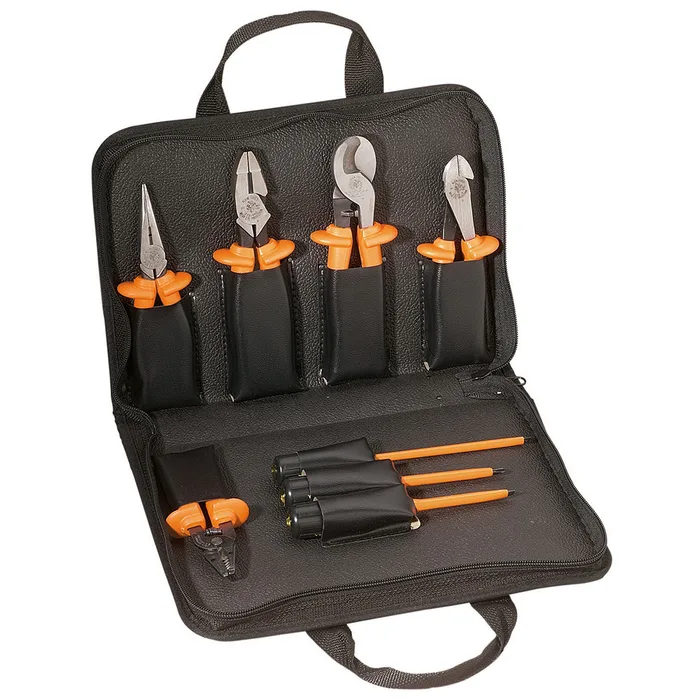
Eight properly marked insulated tools in one zip case, which is closer to what an actual service call needs.
Best for: A first insulated kit for someone who wants breadth of tool types in one marked, cased purchase.
- Klein states the kit meets or exceeds IEC 60900:2012 and ASTM F1505-10, the two standards a US spec is most likely to name.
- Covers three pliers, a cable cutter, a wire stripper and cutter and three screwdrivers, so one purchase handles most of a panel job.
- The orange over white two layer insulation makes damage visible, and Klein says to destroy the tool if the insulation becomes damaged in any way.
- Klein's page for this kit cites IEC 60900:2012 and ASTM F1505-10, both superseded editions, so ask your supplier what the tools in the box are actually marked to.
- The kit page does not name a third party certifier.
- Bright orange handles are easy to spot but harder to keep clean, and Klein warns that moisture, films and surface contaminants are conductive.
- Nylon case with tool pockets is fine for a truck but offers little impact protection for the insulation in a crowded bag.
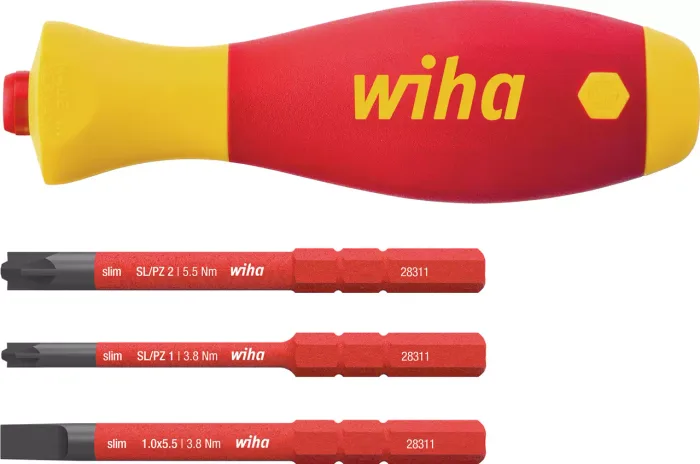
One insulated handle plus insulated slimBits, which halves what you carry and doubles what you have to inspect.
Best for: Someone already carrying insulated pliers who wants the screwdriver half of the kit to stop taking up half the pouch.
- Wiha states each insulated tool is individually tested at 10,000 V AC for safe working up to 1,000 V AC, and lists the set as manufactured according to IEC 60900.
- Wiha's slimBits are insulated slim blades, which suit deep set screws and spring terminals.
- Four pieces cover slotted, and PlusMinus SL/PZ1 and SL/PZ2 profiles, replacing three separate insulated screwdrivers in a pouch.
- Wiha lists this set as manufactured according to IEC 60900 and does not claim ASTM F1505 on the product page, which matters if your employer's procedure names the ASTM standard.
- Interchangeable systems mean more insulated surfaces to inspect before every use, and a lost or damaged bit takes a profile out of service.
- You can only have one profile mounted at a time, so swapping is a real cost on a job with mixed screw heads.
- Screwdrivers only, so it is an addition to an insulated plier set rather than a replacement for one.
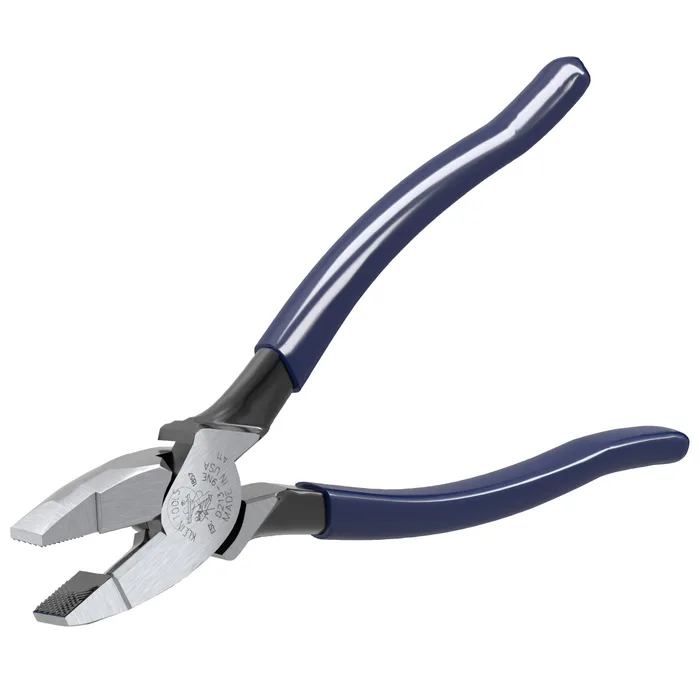
A superb plier that is not an insulated tool, and Klein says so in plain language on its own product page.
Best for: Dead work, rough-in and general construction, where its cutting power is the point and there is nothing energized nearby.
- Klein's high leverage design puts the rivet closer to the cutting edge for what the company states is 46 percent greater cutting and gripping power.
- Induction hardened cutting knives and a hot riveted joint make it a genuinely good general purpose lineman's plier.
- Made in USA, 9.35 inches long, with cross hatched knurled jaws and a 1.375 inch jaw capacity.
- Klein's own page states: NOT insulated. Plastic-dipped or slip-on plastic handles are NOT intended for protection against electrical shock.
- It carries no 1000 V double triangle mark, because it was never proof tested as an insulated tool.
- The blue dipped handles are a single layer, so there is no contrasting inner colour to warn you when the covering is cut.
- Klein's insulated tool literature warns directly that not all tools with plastic coatings or plastic handles protect against electrical shock, which is exactly this tool.
| Criteria | 00 20 13 5 Pc 1000V Insulated Pliers and Screwdriver Set Top pick | 33526 Basic 1000V Insulated Tool Kit, 8-Piece | 43449 Screwdriver Set SoftFinish slimVario electric | D213-9NE Lineman's Pliers, New England Nose, 9-Inch |
|---|---|---|---|---|
| Verdict | Buy it | Buy it | It depends | Skip it |
| Best for | Someone who wants the marking, the paperwork and the visual damage indicator to all be unambiguous, and is happy to add tools around it. | A first insulated kit for someone who wants breadth of tool types in one marked, cased purchase. | Someone already carrying insulated pliers who wants the screwdriver half of the kit to stop taking up half the pouch. | Dead work, rough-in and general construction, where its cutting power is the point and there is nothing energized nearby. |
| Price tier | $$$ · premium | $$ · mid-range | $$ · mid-range | $ · budget |
| Standards the maker claims | DIN EN and IEC 60900 at 1000 V, plus ASTM F1505 | Meets or exceeds IEC 60900:2012 and ASTM F1505-10 | Manufactured according to IEC 60900 | None claimed; maker states it is not insulated |
| Third party mark named by the maker | VDE tested | Not named on this kit's page | VDE GS mark shown on the product page | None |
| Pieces | 5 | 8 | 4 (handle plus 3 slimBits) | 1 |
| Tool types covered | Long nose pliers, diagonal cutters, 3 screwdrivers | 3 pliers, cable cutter, stripper and cutter, 3 screwdrivers | Screwdriver handle plus interchangeable insulated bits | Lineman's pliers only |
| Insulation construction | Red over yellow multi component | Orange over white, two layer moulded | Insulation on handle and on each bit | Single layer plastic dip |
| 1000 V double triangle marking | Yes | Yes | Yes | No |
| Screwdriver approach | Fixed shaft insulated drivers | Fixed shaft insulated drivers | One handle, swappable insulated bits | Not applicable |
| Fits a spec that names ASTM F1505 | Yes, maker states F1505 | Yes, maker states F1505 | Not stated; IEC 60900 only | No |
Which one is right for you?
- Someone who wants the marking, the paperwork and the visual damage indicator to all be unambiguous, and is happy to add tools around it. Buy it Knipex 00 20 13 5 Pc 1000V Insulated Pliers and Screwdriver Set
- A first insulated kit for someone who wants breadth of tool types in one marked, cased purchase. Buy it Klein Tools 33526 Basic 1000V Insulated Tool Kit, 8-Piece
- Someone already carrying insulated pliers who wants the screwdriver half of the kit to stop taking up half the pouch. It depends Wiha 43449 Screwdriver Set SoftFinish slimVario electric
- Dead work, rough-in and general construction, where its cutting power is the point and there is nothing energized nearby. Skip it Klein Tools D213-9NE Lineman's Pliers, New England Nose, 9-Inch
How we judged the field
Five things decide whether an insulated hand tool is worth owning. First, which standard the maker actually claims: IEC 60900:2018 is the international one, covering insulated, insulating and hybrid hand tools up to 1000 V AC and 1500 V DC, and ASTM F1505 is the North American equivalent, currently ASTM F1505-16(2026), covering the same voltage ceiling for screwdrivers, wrenches, pliers, nippers, strippers, cable cutting tools, cable scissors, knives and tweezers. Second, the marking on the tool, because the double triangle symbol next to 1000 V is the thing OSHA inspectors, safety officers and your own hands can verify. Third, individual proof testing, which is why Knipex and Wiha both publish that each tool goes through a 10,000 V AC test rather than a sampled batch check. Fourth, whether damage is visible, which is a construction question: two contrasting layers mean a cut announces itself. Fifth, whether the set covers the tools you will actually reach for, because a marked screwdriver does not help when you need a stripper.
The field splits along one line that has nothing to do with quality. On one side are tools built and proof tested as insulated tools, which is a small and expensive population. On the other side are excellent, well made hand tools with plastic dipped or moulded grips that were never tested for dielectric strength and never claimed to be. Klein sells both, labels both accurately, and still watches buyers pick the wrong one. So we chose two genuinely insulated sets that state both standards, one insulated system that is a real trade off rather than a compromise, and one dipped handle plier that is a first rate tool and a dangerous purchase for the job people buy it for.
Knipex 00 20 13 5 Pc 1000V Insulated Pliers and Screwdriver Set
Buy itThe Knipex 00 20 13 is the set to buy if you want zero ambiguity about paperwork. The product page states the tools are VDE tested in conformance to DIN EN and IEC 60900 at 1000 V, and separately that all Knipex insulated tools meet the requirements of ASTM F1505, covering both the international and the North American spec in one purchase. Knipex publishes its process too: every insulated tool goes through a dielectric strength test at 10,000 V AC one by one before it is sold, which the company describes as a ten times safety buffer over the 1000 V working limit,. What you get is two pliers, a long nose plier with cutter and a diagonal cutter, plus three screwdrivers, in a plastic tray. The red over yellow insulation is the daily benefit, because a gouge shows yellow. Five pieces is the limitation: no combination pliers, no stripper, no cable cutter. It is the right core for someone who would rather add tools slowly than buy a case of the wrong ones.
Klein Tools 33526 Basic 1000V Insulated Tool Kit, 8-Piece
Buy itThe Klein Tools 33526 is the more useful first purchase for most people, which is a different argument from being the better made tool. Eight pieces means three pliers, a cable cutter, a wire stripper and cutter and three screwdrivers, in a nylon zip case with fitted pockets, roughly the spread of a real service call rather than a starter tray. Klein states the kit meets or exceeds IEC 60900:2012 and ASTM F1505-10, and the orange over white moulding makes damage visible, with a written rule to destroy the tool if the insulation becomes damaged in any way. Two things to check first. The kit page cites superseded editions of both standards, so confirm what the tools in the box are marked to. And the kit page names no third party certifier, so ask if one is part of your spec. For a first properly marked kit, it is the sensible one.
Wiha 43449 Screwdriver Set SoftFinish slimVario electric
It dependsThe Wiha 43449 is a genuine trade off rather than a lesser version of the others, which is why it is a depends. It is one SoftFinish electric slimVario handle plus three insulated slimBits, covering slotted 5.5 mm and PlusMinus SL/PZ1 and SL/PZ2. Wiha’s claim is precise and worth reading carefully: the insulated handle and the slimBits each undergo individual testing at 10,000 V AC, and it lists the set as manufactured according to IEC 60900. The slimBits are insulated slim blades, which help on deep set screws and spring terminals. The costs are real. Wiha lists this set as manufactured according to IEC 60900 and does not claim ASTM F1505, which matters if your procedure names the ASTM standard. You inspect more surfaces, and one profile is mounted at a time. It suits someone who already owns insulated pliers.
Klein Tools D213-9NE Lineman’s Pliers, New England Nose, 9-Inch
Skip itThe Klein D213-9NE is here because it is one of the most commonly bought pliers in the trade and one of the most commonly misunderstood. As a tool it is excellent: high leverage with the rivet closer to the cutting edge for what Klein states is 46 percent greater cutting and gripping power, induction hardened knives, a hot riveted joint, 9.35 inches long, made in USA. It is also, in Klein’s own words on its own product page, NOT insulated, with plastic-dipped or slip-on plastic handles that are NOT intended for protection against electrical shock. The blue dip is for comfort and ease of identification. There is no double triangle mark and no proof test behind it, because it was never submitted as an insulated tool. Klein’s insulated literature makes the same warning generally: not all tools with plastic coatings or plastic handles protect against electrical shock. If you want this shape with insulation, Klein sells insulated lineman’s pliers such as the 20009NEEINS. Buy this one for dead work, and never reach for it near an energized part.
Sources
Specs in this review come from these pages.
- OSHA 29 CFR 1910.335, Safeguards for personnel protection (osha.gov)
- OSHA 29 CFR 1910.333, Selection and use of work practices (osha.gov)
- OSHA 29 CFR 1910.137, Electrical protective equipment (osha.gov)
- IEC 60900:2018, Live working, hand tools for use up to 1 000 V AC and 1 500 V DC (webstore.iec.ch)
- ASTM F1505-16(2026), Standard Specification for Insulated and Insulating Hand Tools (store.astm.org)
- VDE Institute, certified product database and counterfeit mark blacklist (vde.com)
Knipex 00 20 13 5 Pc 1000V Insulated Pliers and Screwdriver Set vs Klein Tools 33526 Basic 1000V Insulated Tool Kit, 8-Piece: which should you buy?
The Knipex 00 20 13 and the Klein 33526 are both correctly marked 1000 V sets, so the choice is not about safety, it is about coverage and paperwork. Knipex wins on documentation and construction. Its page names DIN EN and IEC 60900 at 1000 V and ASTM F1505 in the same breath, it names VDE as the third party, and it publishes the individual 10,000 V AC dielectric test as a process rather than a slogan. The red over yellow insulation gives you a contrasting warning colour under the outer skin. What it does not give you is enough tools. Two pliers and three screwdrivers is a core, not a kit.
Klein wins on what you can do with it the day it arrives. Eight tools including a cable cutter and a stripper and cutter, in a case you can carry, is simply more job covered per purchase, and the orange over white system gives the same visual damage warning with a written retirement rule. Its weaknesses are documentary: the kit page cites older editions of both standards and does not name a certifier for these particular tools. So choose this way. If a written procedure, an inspector or a client is going to ask which standard and which certifying body, buy the Knipex and add tools around it. If you are the one deciding, and you want the widest set of correctly marked tools in one case, buy the Klein.
What to look for
- Double triangle plus 1000 V on the tool: the symbol is IEC 60417-5216, suitable for live working, and it should be moulded or printed on the tool itself with the voltage right next to it, not only on the box.
- A named standard and edition: IEC 60900:2018 is the current fourth edition and ASTM F1505-16(2026) is the current North American one, so a listing citing a much older edition is worth a question to the supplier.
- Two contrasting insulation layers: Klein uses orange over white and Knipex uses red over yellow, and the whole point is that a cut shows a different colour before it shows steel.
- A stated individual proof test: Knipex and Wiha both publish that each tool is tested one by one at 10,000 V AC rather than sampled, and a maker unwilling to say this is telling you something.
- A written retirement rule: Klein says destroy the tool if the insulation becomes damaged in any way, and Knipex says discard any tool whose insulation is damaged in any way, and you want that instruction in the box.
- The word insulated, not comfort: dipped and moulded comfort grips are for grip and identification, and Klein states in its own literature that not all tools with plastic coatings or plastic handles protect against electrical shock.
Our final take
Buy the Knipex 00 20 13 if you want a set whose paperwork answers every question before it is asked, and build outward from it. Buy the Klein Tools 33526 if you want the most correctly marked tools in one carryable case, which for most people is the more useful first purchase. Take the Wiha 43449 only if you already own insulated pliers and the slimVario trade off suits how you work, and check its IEC 60900 only claim against your employer’s spec first. Do not buy the Klein D213-9NE for anything energized; it is a superb plier that Klein itself says is not insulated, and an insulated version exists. And remember what none of these change: OSHA still wants the circuit deenergized first.
Questions, answered
Does buying insulated tools mean I can work on live circuits?
No. OSHA 1910.333(a)(1) says live parts to which an employee may be exposed shall be deenergized before the employee works on or near them, unless the employer can demonstrate that deenergizing introduces additional or increased hazards or is infeasible due to equipment design or operational limitations. Only when that exception applies do you fall back to other safety related work practices under 1910.333(a)(2). Insulated tools are part of that fallback, not a permission slip. Klein puts it bluntly in its own literature: its insulated tools are designed only to reduce the chance of injury where the tool may make contact with an energized source. Treat the tool as the last barrier, not the first one.
Are insulated tools actually required by OSHA, or are they one option among several?
Both, depending on the sentence. OSHA 1910.335(a)(2)(i) is mandatory and specific: when working near exposed energized conductors or circuit parts, each employee shall use insulated tools or handling equipment if the tools or handling equipment might make contact with such conductors or parts. That is not a menu. The same paragraph adds that if the insulating capability is subject to damage, the insulating material shall be protected, and that fuse handling equipment must be insulated for the circuit voltage and ropes near exposed energized parts must be nonconductive. The next paragraph, 1910.335(a)(2)(ii), is the one with options: protective shields, protective barriers or insulating materials shall be used to protect the employee. So the shielding requirement offers alternatives; the insulated tool requirement does not.
If the tools are tested at 10,000 V, why are they only rated 1000 V?
Because the test voltage is a proof test and the rating is a working limit, and the gap between them is the safety margin. Knipex states that every insulated tool undergoes a dielectric strength test at 10,000 V AC one by one before it is sold, and that this gives work up to 1000 V AC a safety buffer of ten times the permitted maximum. Wiha says each of its insulated EVF tools is individually tested at 10,000 V AC and guarantees safe working up to 1,000 V AC. The scope of both IEC 60900:2018 and ASTM F1505 stops at 1000 V AC and 1500 V DC, so that is what the tool may be rated and marked for regardless of what it survived on the test bench.
Do insulated hand tools need an annual retest once they are in service?
There is no OSHA mandated periodic retest interval for insulated hand tools the way there is for rubber goods. OSHA 1910.137 covers electrical protective equipment and names six things: rubber insulating blankets, matting, covers, line hose, gloves and sleeves. Some of those carry test intervals, with gloves tested before first use and every six months thereafter, and blankets and sleeves every twelve months. Insulated hand tools are not in that list, and the control OSHA and the manufacturers both rely on is inspection instead. Knipex tells users to check before every use whether the insulation is damaged in any way and to discard defective tools. Klein tells users to inspect tools before use and to destroy a tool if the insulation becomes damaged in any way. Many employers still schedule periodic dielectric testing as internal policy, so follow your own procedure if it is stricter.
How do I tell a genuine insulated tool from one that just says 1000 V on it?
Look for the full marking set on the tool itself, not the packaging: the double triangle symbol, IEC 60417 symbol 5216, meaning suitable for live working, with 1000 V immediately next to it, plus the standard reference, the maker's name and the tool reference. Klein's guidance is that not all tools with plastic coatings or plastic handles provide protection against electrical shock, and that you should only use tools marked with the official international 1000 volt rating symbol if there is any chance of contact with an energized source. Counterfeit and misused certification marks are a documented problem, not a rumour: the VDE Institute maintains a database of all VDE tested and certified products and publishes a blacklist of manufacturers and distributors caught counterfeiting or making unauthorized use of the VDE mark, so a claimed VDE approval can be checked against the source. Buy from a distributor who will name the actual certificate, and be suspicious of a listing that shows the symbol only in a rendered marketing image.
Deciding between the top two? See our head-to-head: Knipex 00 20 13 5 Pc 1000V Insulated Pliers and Screwdriver Set vs Klein Tools 33526 Basic 1000V Insulated Tool Kit, 8-Piece.
More Tools & DIY reviews
 The Best Jigsaws: 4 Compared (and One to Skip)
  The Best Work Knee Pads: 4 Compared (and One to Skip)
  The Best Laser Levels: 4 Compared (and One to Skip)
  The Best Locking Pliers: 4 Compared (and One to Skip)
  The Best Log Splitters: 4 Compared (and One to Skip)
  The Best Miter Saws: 4 Compared (and One to Skip)