Explained
Impact Wrenches, Explained
After reading, you'll understand why two impact wrenches with the same headline torque figure can be a class apart, and which spec to check first.
In this guide
Impact wrenches are sold on torque, and torque in this category is not one measurement. Manufacturers publish a fastening figure and a breakaway figure, the second is usually larger, and the one printed largest on the packaging is usually the second. Add anvil types nobody explains, an impacts-per-minute number that sounds important and mostly is not, and weight figures quoted with and without a battery, and the spec sheet becomes something you have to decode before you can compare anything.
The 30-second version
- Two torque numbers, and the bigger one is breakaway, which measures loosening rather than tightening.
- The gap is large, running from about a third to nearly 60 percent across the tools on this page.
- Brushless is the baseline now, and a brushed motor on a modern cordless wrench is a signal about where the rest of the tool was built down.
- The anvil decides your day, because it is the part you interact with every time you change a socket.
- An impact wrench never sets torque, so a torque wrench still does the final tightening on anything that matters.
The products this guide is about
Our verdict on each, with the full reasoning on the companion review.
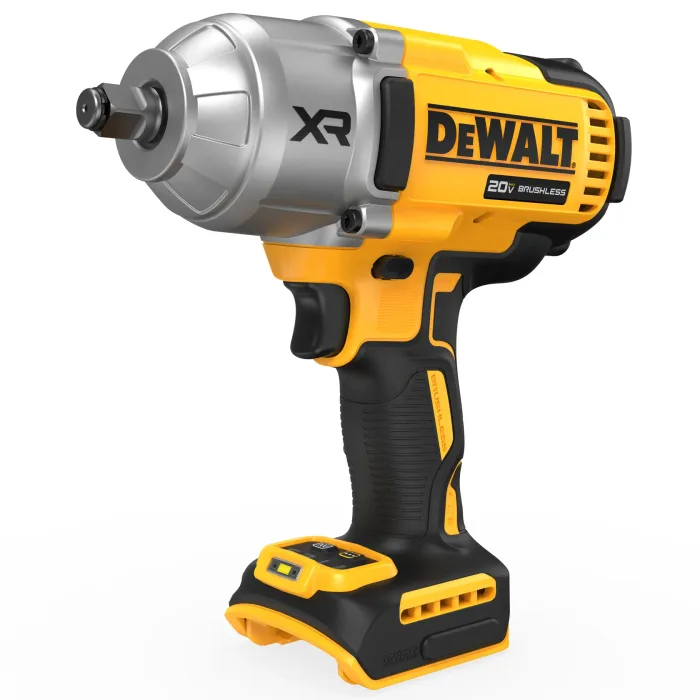
- Buy DeWalt DCF900B 20V MAX XR 1/2 in. High Torque Impact Wrench The highest published torque in the group and the only one here with a mode built to stop you overtightening. Amazon
- Buy Makita XWT08Z 18V LXT Brushless 3-Speed 1/2 in. Impact Wrench Less peak torque than the DeWalt, but a three-speed switch and a friction ring anvil make it the easier one to live with. Amazon
- It depends DeWalt DCF892B 20V MAX XR 1/2 in. Mid-Range Impact Wrench About 3 lbs lighter than the high-torque model and enough for brakes and suspension, as long as you never meet a rusted truck lug. Amazon
- Skip Craftsman CMCF900B V20 1/2 in. Impact Wrench The cheapest way onto a half-inch anvil, and the only one here that will not tell you which torque figure it is quoting. Amazon
What actually matters
- Fastening torque - the sustained twisting force the tool can apply while running a fastener down. This is the figure that describes what the wrench can install, and it is the smaller of the two published numbers.
- Breakaway torque - the peak force available in reverse to get a stuck fastener moving, also sold as nut-busting torque. It is a one-off impulse rather than something the tool sustains, which is why it reads higher.
- Motor type - brushless motors have no wearing contacts, hold output better under load, and run cooler. A brushed motor loses power as the brushes wear and is now unusual outside the budget tier.
- Anvil type - the square drive that holds the socket. Hog ring and friction ring designs let sockets pull off by hand; detent pin designs hold with a spring-loaded ball and need a deliberate push to release.
- Speed settings - a multi-speed switch lets the tool run slower and impact less on small fasteners. Single-speed wrenches only know full power, which is how bolts get sheared.
- Impacts per minute - how many blows per minute the hammer delivers. A higher rate can loosen a fastener faster, but it says nothing about how hard each blow is, so it is a poor stand-in for torque.
- Weight - published either bare or with a battery, and rarely labeled clearly. A high-torque wrench with a large pack fitted can be double the weight of a mid-range tool, which is what makes overhead work miserable.
The specs, in plain English
Green flags vs red flags
Green flags
- Both fastening and breakaway torque published, each named on the spec sheet.
- Brushless motor listed explicitly in the specifications rather than implied by the marketing copy.
- Anvil type stated, so you know what you are getting before the box arrives.
- More than one speed setting, with the RPM and IPM ranges given for each.
- Weight stated with the battery condition made clear.
Red flags
- A single torque figure with no indication of whether it is fastening or breakaway.
- A brushed motor at a price where every competitor is brushless.
- IPM given large billing while torque is quoted vaguely or not at all.
- No anvil type anywhere on the product page.
- A weight figure with no note of whether a battery is included.
Who's who: the brands
- DeWalt - The broadest range of half-inch wrenches on one battery platform, and consistent about publishing both torque figures.
- Makita - Known for multi-speed electronic control and for quoting nut-busting torque alongside fastening torque.
- Milwaukee - The other major professional platform, with a long-running line of high-torque half-inch wrenches aimed at automotive work.
- Craftsman - Budget entry into the V20 cordless platform, with thinner published specs than the premium brands.
- Ingersoll Rand - An air tool company first, with a long history in pneumatic impact wrenches for shops that run a compressor.
How to read a listing without getting fooled
Start at the torque rows and check how many numbers there are. If there are two and each is named, you can compare that tool to any other tool that does the same. If there is one, treat it as the breakaway figure until proven otherwise, because that is the flattering reading and manufacturers do not accidentally publish the smaller number. Then check the motor line, since brushless is now standard everywhere above the budget tier and its absence tells you where the money went. Look for the anvil type next, and if the page does not state it, assume nothing. Finally, read the weight together with whatever the page says about batteries. A 7 lb bare tool with a large pack fitted is a very different object from a 7 lb tool that already includes one.
How much should you spend?
Budget tier wrenches often mean one unlabeled torque figure, and a battery platform chosen for the price rather than the tool. They make sense only if the wrench is a once-a-year item. The mid-range is where brushless starts and where the mid-torque tools live, and for car work in a home garage that tier answers the question with a lighter tool. Premium buys the high-torque class, the electronic modes, and the published specs that let you compare in the first place. The thing worth spending on is not the top of the torque chart but the tier where the manufacturer starts telling you what the numbers mean.
Questions, answered
Is an impact wrench the same as an impact driver?
No. An impact driver has a quarter-inch hex collet for driver bits and is built for screws and small fasteners. An impact wrench has a square drive for sockets and produces far more torque, usually by an order of magnitude. Adapters exist to put a socket on an impact driver, and they will handle light work, but the driver's mechanism is not built for lug nuts.
Why does my wrench struggle even though the torque rating is high?
The most common reason is battery. A high-torque wrench draws heavily, and a small-capacity pack cannot supply the current the motor wants, so the tool delivers well under its rating. Cold packs behave the same way. Beyond that, published torque figures are peak values measured under ideal conditions, and a corroded fastener at an awkward angle is not ideal conditions.
Does a higher IPM mean a stronger wrench?
No. Impacts per minute counts how often the hammer strikes, not how hard. A budget wrench can post the highest IPM figure in a group while sitting at the bottom on torque, which is exactly what happens on this page. Treat IPM as a note about how quickly a stuck fastener will start moving, and read torque for whether it will move at all.
Do I need a torque stick with a cordless impact wrench?
Torque sticks are extension bars that flex at a set torque, and they were designed for the pneumatic wrenches used in tire shops. They are a rough limiter rather than a measurement, and their accuracy depends on the tool's impact rate, so they behave differently on cordless tools than on the air tools they were calibrated around. They are better than nothing for a busy shop. For your own vehicle, a torque wrench is the right answer.
Or jump to the head-to-head: DeWalt DCF900B 20V MAX XR 1/2 in. High Torque Impact Wrench vs Makita XWT08Z 18V LXT Brushless 3-Speed 1/2 in. Impact Wrench.