

Tools & DIY
The Best Impact Wrenches: 4 Compared (and One to Skip)
We compared four cordless half-inch impact wrenches on the two torque figures that manufacturers publish, anvil type, motor, and what the spec sheet leaves out.
The short version
The DeWalt DCF900B is the pick if you want a wrench that will not run out of torque: 1,030 ft-lbs of max fastening and 1,400 ft-lbs of max breakaway, with a Precision Wrench mode that backs off to stop overtightening and fastener run-off. Makita's XWT08Z is the value buy inside the LXT battery system, giving 740 ft-lbs fastening and 1,180 ft-lbs nut-busting through a three-speed switch that makes it usable on small fasteners too. The DeWalt DCF892B is the depends pick: at 600 ft-lbs fastening it handles brakes and suspension in a 4.2 lb body, but its detent pin anvil is slower to change sockets. Skip the Craftsman CMCF900B. It publishes one figure, 350 ft-lbs labeled only Maximum Torque, so you cannot tell whether that is the fastening number or the breakaway number, and either reading puts it far behind the others. Best for: anyone doing wheels, suspension, or structural fasteners who wants the torque figure to mean something.
Our picks at a glance
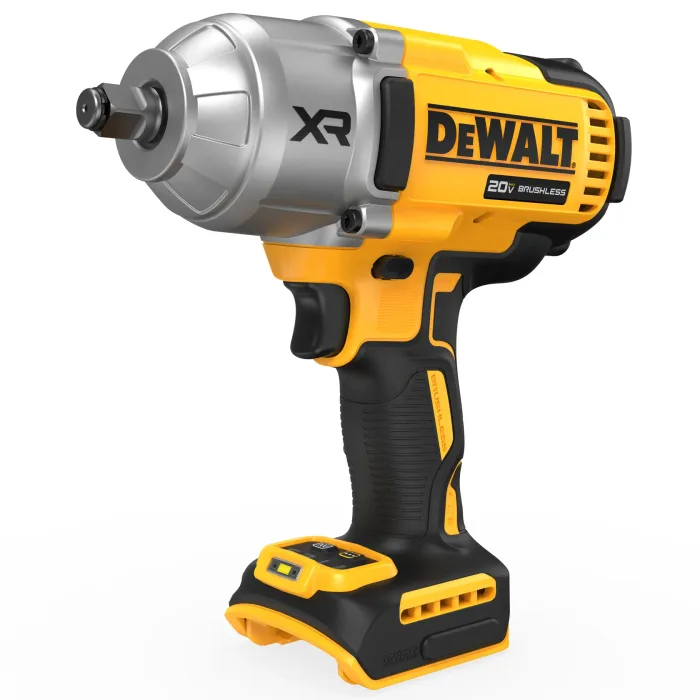
- DeWalt DCF900B 20V MAX XR 1/2 in. High Torque Impact Wrench - Buy. The highest published torque in the group and the only one here with a mode built to stop you overtightening.
- Makita XWT08Z 18V LXT Brushless 3-Speed 1/2 in. Impact Wrench - Buy. Less peak torque than the DeWalt, but a three-speed switch and a friction ring anvil make it the easier one to live with.
- DeWalt DCF892B 20V MAX XR 1/2 in. Mid-Range Impact Wrench - It depends. About 3 lbs lighter than the high-torque model and enough for brakes and suspension, as long as you never meet a rusted truck lug.
- Craftsman CMCF900B V20 1/2 in. Impact Wrench - Skip. The cheapest way onto a half-inch anvil, and the only one here that will not tell you which torque figure it is quoting.
The verdict in 30 seconds
What mattered most
- Max fastening torque
- Max breakaway torque
- How torque is labeled
- Motor
- Anvil
- Speed settings
An impact wrench is the tool that gets a seized lug nut or a rusted suspension bolt moving, and the whole category is sold on one number. The problem is that the number on the box is usually the bigger of two different measurements, and one of these four publishes a single figure without saying which one it is. We pulled the published specs for four cordless half-inch drive wrenches and lined them up on the same rows. What comes out is a field where the honest gap between the top and the bottom is far wider than the marketing suggests.
The highest published torque in the group and the only one here with a mode built to stop you overtightening.
Best for: Truck lug nuts, seized suspension bolts, and concrete anchors where running out of torque is the failure you are trying to avoid.
- 1,030 ft-lbs of max fastening torque and 1,400 ft-lbs of max breakaway, both stated separately on DeWalt's page.
- Precision Wrench mode reduces speed to help prevent overtightening in forward and fastener run-off in reverse.
- Hog ring anvil means sockets pull on and off by hand with no pin to press.
- Four-mode speed settings plus a variable speed trigger.
- At 7.1 lbs bare it is heavy, and a battery adds to that.
- The listed length of 9.94 in makes it awkward inside a wheel well or a tight engine bay.
- Sold as a bare tool, so a battery and charger are extra.
- The hog ring holds sockets by friction, which some people find less secure overhead than a detent pin.
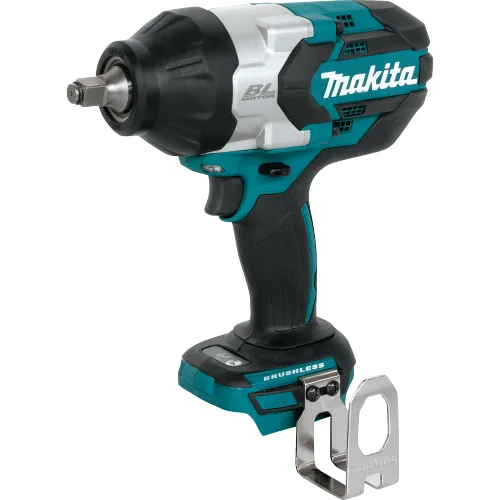
Less peak torque than the DeWalt, but a three-speed switch and a friction ring anvil make it the easier one to live with.
Best for: Anyone already on Makita 18V who wants one wrench that can do lug nuts and still be dialed back for smaller work.
- 740 ft-lbs of fastening torque and 1,180 ft-lbs of nut-busting torque, both published by Makita.
- Three-speed switch runs 0-900, 0-1,000 or 0-1,800 RPM, so it can be dialed down for smaller fasteners.
- Friction ring anvil swaps sockets without tools.
- Runs on the 18V LXT battery platform, which is worth a lot if you already own the packs.
- Makita quotes 8 lbs with a battery.
- Peak breakaway torque is 220 ft-lbs below the DCF900B.
- No mode that limits torque on final tightening.
- Bare tool only, and 18V LXT packs are not cheap to buy into from scratch.
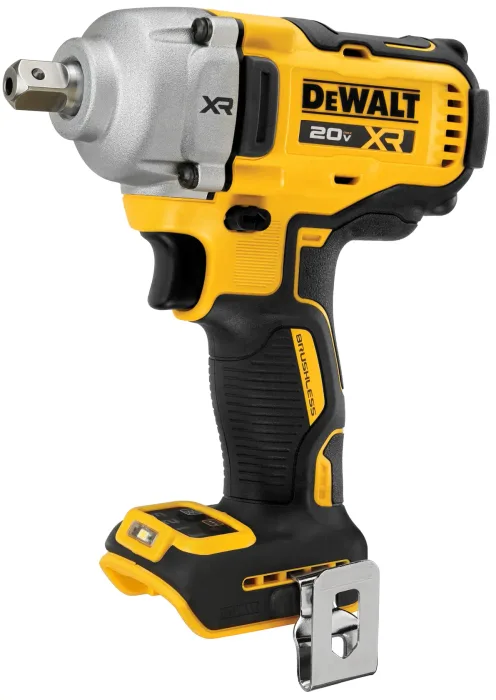
About 3 lbs lighter than the high-torque model and enough for brakes and suspension, as long as you never meet a rusted truck lug.
Best for: Brake jobs, suspension work and general shop fastening on cars rather than trucks, where the weight saving is worth more than the top-end torque.
- 600 ft-lbs of max fastening torque and 800 ft-lbs of max breakaway, both stated.
- 4.2 lbs bare, the lightest brushless option in the group.
- Detent pin anvil holds a socket positively, which matters overhead.
- Same 20V MAX battery platform as the DCF900B.
- Breakaway torque is 600 ft-lbs below the DCF900B, and rusted fasteners are exactly where that gap shows.
- The detent pin needs a punch or a firm push to change sockets, so it is slower than a hog ring.
- No mode for limiting torque on final tightening.
- Bare tool, battery not included.
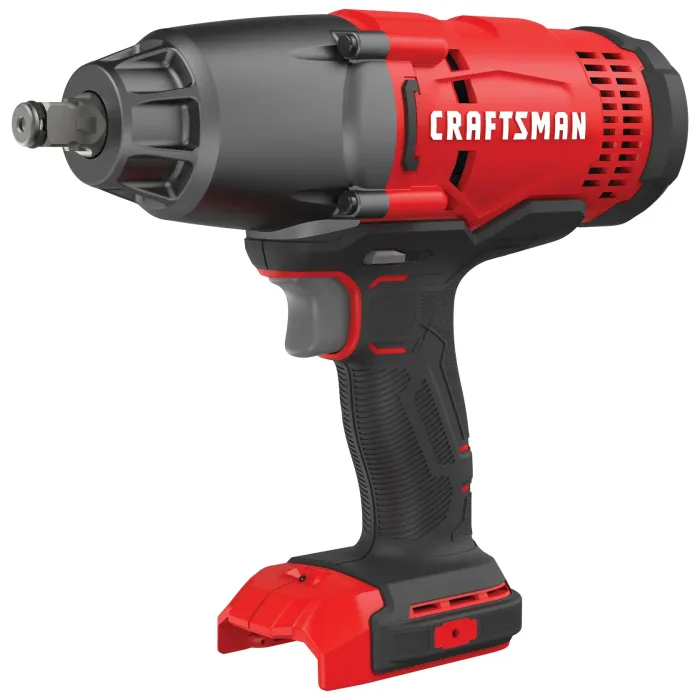
The cheapest way onto a half-inch anvil, and the only one here that will not tell you which torque figure it is quoting.
Best for: Almost nobody. If a half-inch anvil is all you need and torque genuinely is not the point, a mid-range brushless wrench costs more and answers more questions.
- 5.59 lbs bare, lighter than the DCF900B.
- 2,500 IPM is the highest impact rate published in this group.
- Brushless motor and a hog ring anvil, both listed on Craftsman's page.
- Runs on Craftsman's V20 battery platform, which is easy to buy into.
- One torque figure, 350 ft-lbs, labeled Maximum Torque with no indication of whether that is fastening or breakaway.
- If 350 ft-lbs is the breakaway figure, the usable fastening torque is well under half of the Makita's.
- Only 1,700 RPM at maximum, the lowest speed in the group.
| Criteria | DCF900B 20V MAX XR 1/2 in. High Torque Impact Wrench Top pick Buy it Buy | XWT08Z 18V LXT Brushless 3-Speed 1/2 in. Impact Wrench Buy it Buy | DCF892B 20V MAX XR 1/2 in. Mid-Range Impact Wrench It depends Buy | CMCF900B V20 1/2 in. Impact Wrench Skip it Buy |
|---|---|---|---|---|
| Best for | Truck lug nuts, seized suspension bolts, and concrete anchors where running out of torque is the failure you are trying to avoid. | Anyone already on Makita 18V who wants one wrench that can do lug nuts and still be dialed back for smaller work. | Brake jobs, suspension work and general shop fastening on cars rather than trucks, where the weight saving is worth more than the top-end torque. | Almost nobody. If a half-inch anvil is all you need and torque genuinely is not the point, a mid-range brushless wrench costs more and answers more questions. |
| Price tier | $$$ · premium | $$$ · premium | $$ · mid-range | $ · budget |
| Max fastening torque | 1,030 ft-lbs | 740 ft-lbs | 600 ft-lbs | Not stated separately |
| Max breakaway torque | 1,400 ft-lbs | 1,180 ft-lbs (nut-busting) | 800 ft-lbs | Not stated separately |
| How torque is labeled | Two figures, both named | Two figures, both named | Two figures, both named | One figure, 350 ft-lbs, Maximum Torque |
| Motor | Brushless | Brushless | Brushless | Brushless |
| Anvil | Hog ring | Friction ring | Detent pin | Hog ring |
| Speed settings | 4-mode switch, 2,300 RPM max | 3 speeds, 1,800 RPM max | 2,000 RPM max | 1,700 RPM max |
| Impacts per minute | 0-2,200 IPM | Up to 2,200 IPM | Not published | 2,500 IPM |
| Weight | 7.1 lbs bare | 8 lbs with battery | 4.2 lbs bare | 5.59 lbs bare |
Which one is right for you?
- Truck lug nuts, seized suspension bolts, and concrete anchors where running out of torque is the failure you are trying to avoid. Buy it DeWalt DCF900B 20V MAX XR 1/2 in. High Torque Impact Wrench
- Anyone already on Makita 18V who wants one wrench that can do lug nuts and still be dialed back for smaller work. Buy it Makita XWT08Z 18V LXT Brushless 3-Speed 1/2 in. Impact Wrench
- Brake jobs, suspension work and general shop fastening on cars rather than trucks, where the weight saving is worth more than the top-end torque. It depends DeWalt DCF892B 20V MAX XR 1/2 in. Mid-Range Impact Wrench
- Almost nobody. If a half-inch anvil is all you need and torque genuinely is not the point, a mid-range brushless wrench costs more and answers more questions. Skip it Craftsman CMCF900B V20 1/2 in. Impact Wrench
How we judged the field
Five things decide whether an impact wrench is the right one. First, which torque figure it publishes and whether it names it, because fastening and breakaway are different measurements and the larger one is the one marketing prefers. Second, motor type, since brushless is the usual choice on a modern cordless wrench. Third, the anvil, which decides how fast you change sockets and how confidently a socket stays put overhead. Fourth, speed and impact control, because a single-speed wrench that only knows full send is a liability on anything small. Fifth, weight, since the tool that is 3 lbs heavier is the one you stop reaching for.
The field splits cleanly by torque class. High-torque half-inch wrenches sit above about 700 ft-lbs of fastening torque and are built for wheels, suspension and structural work. Mid-range wrenches land between roughly 400 and 700 ft-lbs and trade top-end capability for a much lighter body. Below that sits a budget tier that mostly exists to put a half-inch anvil on a shelf at a low number. We took one tool from each of the top two classes on the two biggest battery platforms, added the mid-range DeWalt to show what the weight saving costs, and included the Craftsman because it is the tool people actually reach for when the price is the deciding factor.
DeWalt DCF900B 20V MAX XR 1/2 in. High Torque Impact Wrench
Buy itThe DCF900B is the tool that makes the fewest excuses. DeWalt publishes both numbers, 1,030 ft-lbs of max fastening torque and 1,400 ft-lbs of max breakaway, and both are the highest here. What separates it from a simple torque contest is Precision Wrench mode, which reduces speed to help prevent overtightening in forward and fastener run-off in reverse. That second half matters more than people expect: run-off is what happens when a nut comes free and the wrench keeps hammering, throwing the fastener across the shop. Four speed modes and a variable trigger give control, and the hog ring anvil means sockets come on and off by hand. The costs are physical. At 7.1 lbs bare it is heavy before a battery goes on, and DeWalt lists it at 9.94 in long, which is enough to make a tight wheel well genuinely awkward. If you are buying an impact wrench because the last one was not enough, this is the answer.
Makita XWT08Z 18V LXT Brushless 3-Speed 1/2 in. Impact Wrench
Buy itThe XWT08Z gives up peak torque and buys back control. Makita publishes 740 ft-lbs of fastening torque and 1,180 ft-lbs of nut-busting torque, so it will move most of what the DeWalt will move, just with less margin on the worst fasteners. The three-speed switch is the reason to pick it: 0-900, 0-1,000 and 0-1,800 RPM, with matching impact rates from 1,800 to 2,200 IPM, which turns a tool that is otherwise all-or-nothing into one you can use on a small bolt without shearing it. The friction ring anvil swaps sockets as fast as the DeWalt’s hog ring. The catch is weight, 8 lbs with a battery, and the 220 ft-lbs it gives away on breakaway. If your batteries are already Makita 18V LXT, the decision is basically made for you.
DeWalt DCF892B 20V MAX XR 1/2 in. Mid-Range Impact Wrench
It dependsThe DCF892B is the one to think hardest about, because on paper it looks like a compromise and in a home garage it often is not. Six hundred ft-lbs of fastening torque and 800 ft-lbs of breakaway will handle passenger car lug nuts, brake caliper brackets and most suspension fasteners without complaint, and it does it at 4.2 lbs bare, which is about 3 lbs lighter than the DCF900B. That difference is the whole argument. The trade-off is the detent pin anvil, which holds a socket positively but needs a punch or a firm shove to release, so socket changes are slower than on either tool above it. And the torque ceiling is real: 800 ft-lbs of breakaway is not much when a lug nut has spent eight winters in road salt. Buy it if you work on cars, in a garage, and value the arm you still have at the end of the day.
Craftsman CMCF900B V20 1/2 in. Impact Wrench
Skip itThe CMCF900B is the one we would leave on the shelf, and the reason is what it does not say. On paper it is a brushless wrench with a hog ring anvil. The problem is that the page publishes exactly one torque figure, 350 ft-lbs, labeled Maximum Torque. Every other tool here names two figures and tells you which is which. If Craftsman’s 350 is a breakaway number, the fastening figure behind it is lower still, and the tool is a light-duty wrench being sold on a half-inch anvil. If it is a fastening number, it is still 390 ft-lbs behind the Makita. It is light at 5.59 lbs and it impacts fast at 2,500 IPM, but it tops out at 1,700 RPM, and if you only ever remove trailer bolts it will do. For anything where the torque figure is the reason you are buying, the ambiguity is disqualifying.
Sources
Specs in this review come from these pages.
DeWalt DCF900B 20V MAX XR 1/2 in. High Torque Impact Wrench vs Makita XWT08Z 18V LXT Brushless 3-Speed 1/2 in. Impact Wrench: which should you buy?
The DCF900B and the XWT08Z are close enough that the deciding factor is usually not the tools. Both are brushless half-inch high-torque wrenches with quick-change anvils, and the DeWalt leads on every torque row: 1,030 against 740 on fastening, 1,400 against 1,180 on breakaway. If your work involves anything seized, that margin is the reason to pick it, and Precision Wrench mode is a genuine feature rather than a spec-sheet entry, because run-off in reverse is a real thing that happens to real fasteners.
The Makita answers with granularity. Three speeds with matched impact rates mean the tool can be dialed down to a setting where it will snug a small fastener rather than twist it off, and there is no equivalent on the DeWalt beyond the mode switch. It also weighs 8 lbs with a battery against the DeWalt’s 7.1 lbs bare, so in the hand the gap narrows or reverses depending on which pack you fit. In practice, buy on battery platform. If you own neither, the DCF900B wins on the numbers. If you own Makita 18V packs, the XWT08Z is not enough of a step down to justify starting a second platform.
What to look for
- Two numbers, not one: a page that names both fastening and breakaway torque is telling you more than a page with a single unlabeled figure, and the gap between them on this page runs from 33 to 59 percent.
- Brushless motor: all four tools here list one, so it is a baseline rather than a differentiator.
- Anvil type stated: hog ring and friction ring change sockets by hand, a detent pin holds more securely and changes slower, and a page that does not say which you are getting has told you something.
- More than one speed: a wrench with a single trigger speed is a tool that can only be used at full power, which is how small fasteners get sheared.
- Weight with a battery, not bare: manufacturers publish whichever is more flattering, and a bare-tool figure can be 2 lbs light of what you actually hold.
- Impact sockets in the right sizes: chrome hand sockets can crack under impact blows, and thick-wall impact sockets do not always clear a recessed lug pocket.
Our final take
This is a category where the marketing number and the useful number are different numbers, and only three of these four tools tell you which is which. The DCF900B is the pick if you want the ceiling: the highest published figures here on both measurements, plus a mode that actually addresses overtightening and run-off. The XWT08Z is the one to buy if you already have Makita packs, and the three-speed switch makes it the more controllable tool of the two. The DCF892B is the honest choice for car work in a home garage, where 3 lbs saved beats 600 ft-lbs you will never call on. The Craftsman is cheap and publishes a single figure it declines to define, which is enough reason to spend more.
Questions, answered
What is the difference between fastening torque and breakaway torque?
Fastening torque is how hard the tool can tighten a fastener. Breakaway torque, which Makita calls nut-busting torque, is how hard it can pull to get a stuck fastener moving in reverse. Breakaway is usually the larger of the two, because a hammer and anvil mechanism can deliver a bigger one-off blow than it can sustain while running a bolt down. On the DCF900B the gap is 1,030 to 1,400, about 36 percent. On the Makita XWT08Z it is 740 to 1,180, about 59 percent. If you compare one tool's breakaway number to another's fastening number you will get the ranking wrong.
Can I use an impact wrench to torque my wheel lug nuts?
Use it to remove them, and to spin them on until they seat. Do the final tightening with a torque wrench set to the figure in your vehicle's manual. An impact wrench has no torque setting in the sense a torque wrench does, so even a tool with a limiting mode like the DCF900B's Precision Wrench is controlling speed and run-on, not measuring the fastener. Overtightened lug nuts stretch studs and warp rotors, and the failure shows up later as a vibration you cannot diagnose.
Do I need impact sockets, or will my regular sockets work?
You need impact sockets. Chrome hand sockets are hardened to resist wear and they are brittle at the wall, so the repeated hammer blows from an impact wrench can crack or shatter them. Impact sockets are made from a softer, tougher steel with thicker walls, which is why they are black and heavier for the same size. The wall thickness also means an impact socket may not fit into a recessed lug pocket that a thin-wall chrome socket clears, so check before you buy the set.
Hog ring or detent pin: which anvil should I get?
A hog ring, also called a friction ring, holds the socket by a spring band you push past, so sockets go on and come off by hand. A detent pin is a spring-loaded ball or pin that drops into a hole in the socket, which holds more positively but needs a press or a punch to release. If you change sockets constantly, take the hog ring. If you work overhead and a dropped socket means climbing down a ladder, the detent pin earns its extra fuss. Choose on how you work, not on strength.
Is a high-torque wrench overkill if I only work on cars?
Often, yes. Passenger car lug nuts are typically specified well under 200 ft-lbs, as are many suspension and brake fasteners, which a 600 ft-lbs mid-range tool like the DCF892B handles with margin. Check your manual. The case for high torque is corrosion, not specification: a fastener that has been on a salted road for eight years can need several times its installed torque to move. If you own a truck, live where roads are salted, or work on other people's vehicles, the extra headroom is the whole point.
Deciding between the top two? See our head-to-head: DeWalt DCF900B 20V MAX XR 1/2 in. High Torque Impact Wrench vs Makita XWT08Z 18V LXT Brushless 3-Speed 1/2 in. Impact Wrench.
More in Tools & DIY
Impact Wrenches, Explained Plain-English guide → DeWalt DCF900B 20V MAX XR 1/2 in. High Torque Impact Wrench vs Makita XWT08Z 18V LXT Brushless 3-Speed 1/2 in. Impact Wrench Head-to-head →  The Best Infrared Thermometers: 4 Compared (and One to Skip)
  The Best Insulated Hand Tools: 4 Compared (and One to Skip)
  The Best Jigsaws: 4 Compared (and One to Skip)
  The Best Work Knee Pads: 4 Compared (and One to Skip)