Explained
Hard Hats, Explained
After reading, you'll understand exactly what a hard hat's Type and Class were tested against, how to read its date stamp, and which common modifications void the certification you paid for.
In this guide
First time buyers usually shop on shape and comfort, then discover that the two most important facts about the product are two characters stamped inside the shell that nobody explained. The confusion is made worse by a wave of climbing style helmets that look like an upgrade and often are not one, at least by the measure the US standard uses. And almost everyone is wrong about expiry, because there is no legal expiry date at all, only manufacturer recommendations that differ from brand to brand.
The 30-second version
- Type is about direction, with Type I tested for a blow to the top of the head and Type II adding front, back and side impact plus off-center penetration and chin strap retention.
- Class is about voltage, and it is a proof test: 2,200 volts for Class G, 20,000 volts for Class E, and no electrical test at all for Class C.
- A chin strap is not a Type upgrade, because retention and lateral impact are tested separately and several premium Type I helmets ship with four point straps.
- There is no legal expiry date, only manufacturer recommendations, which typically run to five years for the shell and twelve months for the suspension from first use.
- Wearing one backwards needs a mark, because reverse donning is an optional test under the standard and only a hat carrying the reverse-wearing label may legitimately be worn that way.
The products this guide is about
Our verdict on each, with the full reasoning on the companion review.
- Buy MSA V-Gard H2 Safety Helmet One of the few mainstream helmets whose own product page states Type II, Class E in plain language, with a chin strap fitted and a Mips option on the shelf. Amazon
- Buy Pyramex Ridgeline T2 Full Brim (HPT256110) A Type II rating in the ordinary full brim shape a site is used to seeing, with a spec sheet that actually prints the numbers. Amazon
- It depends Petzl VERTEX The most thoroughly certified helmet here and the right tool for work at height, but under the US standard it is Type I, not Type II. Amazon
- Skip 3M SecureFit Safety Helmet X5000 (X5001-ANSI) A well built climbing style helmet that a lot of people buy as a Type II upgrade, which 3M's own bulletin says plainly it is not. Amazon
What actually matters
- Impact Type - This is the single most consequential marking on the product and the one most often missed. Type I is tested only for a blow to the top of the head; Type II adds impact energy attenuation from the front, back and sides, off-center penetration resistance and chin strap retention.
- Electrical Class - Class G, E and C are the only claims here backed by a defined proof test rather than a description. If your work goes anywhere near exposed conductors, this is not a preference, it is a selection criterion, and it rules out every vented shell.
- Retention system - OSHA points out that a hat without a strap can come off during a slip or trip and leave the wearer unprotected at the worst moment. A strap that is part of the product gets worn; one that is an accessory in a drawer does not.
- Suspension condition and age - The suspension does the actual energy management, and it is the part that frays, cracks and stretches. Nearly every manufacturer here recommends replacing it every twelve months from first use regardless of how the shell looks.
- Shell degradation - UV, heat and chemicals attack the polymer long before the hat looks broken. Fading, a chalky surface, or a shell that feels stiff and brittle are all replace-now signals, and storing a hat on a dashboard is one of the fastest ways to get there.
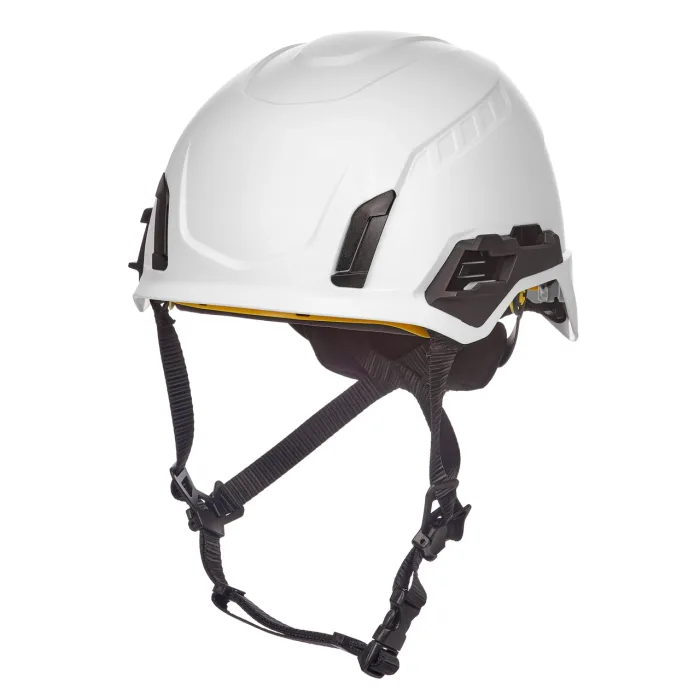
- Accessory integration - Face shields, earmuffs, lamps and visors should attach to slots the manufacturer designed and tested, because drilling or cutting your own mounting points takes the product outside the certification it was tested under.
- Optional markings - LT, HT and HV are real additional tests, for low temperature, high temperature and high visibility respectively, and they appear on the label only if the product passed them.
The specs, in plain English
Green flags vs red flags
Green flags
- The Type and Class are printed on the product page and inside the shell, not just implied by the product name.
- The manufacturer publishes a service life for the shell and the suspension separately, with a stated starting point such as date of first use or date of manufacture.
- A chin strap is included as part of the product rather than sold as an accessory, and the number of attachment points is stated.
- The shell has designed accessory slots for face shields, earmuffs and lamps, with part numbers for the matching accessories.
- Optional markings such as LT, HT or HV are listed explicitly, with the temperatures or colour standard behind them.
Red flags
- A climbing style shell and a chin strap are used to imply side impact protection while the Type marking is never stated.
- European clause numbers are quoted for individual tests without the product actually being certified and marked to that standard.
- The listing gives an electrical class for a vented shell, which cannot be right, since venting rules out Class G and Class E.
- No replacement suspension is offered as a spare part, which suggests the hat is treated as disposable rather than maintained.
- The seller presents the molded date stamp as an expiry date, when it records when the shell was made and nothing else.
Who's who: the brands
- MSA - One of the oldest names in head protection, whose V-Gard line runs from a plain Type I cap to the Type II V-Gard H2 with an optional Mips liner.
- 3M - Publishes unusually detailed technical bulletins, including one that states outright that its SecureFit X5000 climbing style helmet does not meet ANSI Type II.
- Pyramex - The value specialist, and one of the few that prints weight, shell thickness and service life on a public product sheet, including for its Type II Ridgeline T2 line.
- Petzl - Comes from climbing rather than industry, and its VERTEX helmet carries EN 397, EN 12492 and EN 50365 alongside an ANSI Type I Class E rating.
- Milwaukee - Splits its BOLT range explicitly into Type 1 hard hats and Type 2 safety helmets, and publishes its own retirement rule for the helmets.
How to read a listing without getting fooled
Start inside the shell, not on the listing. The label carries the standard and edition, the Type, the Class and any optional markings such as LT, HT or HV, and separately there is a molded date stamp, usually on the underside of the brim, laid out as a clock face with the year in the centre and an arrow pointing to the month of manufacture. On the listing itself, treat the Type and Class as the only two claims that come from a defined test and everything else as description. Watch for two specific traps. First, vented and non-vented versions of the same product often carry different Classes and sometimes different European certifications, so the review or spec you read may not describe the SKU in your cart. Second, a manufacturer listing individual European clause numbers is telling you a lab tested those clauses, which is not the same as the product being certified and marked to that standard; 3M spells that distinction out for its own X5000. Finally, look for whether a replacement suspension is sold as a spare part, because a maintained hat and a disposable one are different purchases.
How much should you spend?
The budget tier gets you a competent Type I cap or full brim hard hat with a ratchet suspension and, increasingly, a Type II option like the Ridgeline T2 if you shop the spec sheet rather than the shelf. The mid-range is where the Type II safety helmets from the big tool brands sit, typically bringing an included chin strap, an accessory ecosystem and published retirement guidance. The premium tier buys one of three things: a rotational impact system such as Mips, an unusually broad certification spread of the kind Petzl offers, or a manufacturer support and accessory programme aimed at fleet buyers. What price does not reliably buy is a higher Type, since some of the most expensive helmets on the market are Type I. Remember to budget for a replacement suspension roughly every twelve months, because on a multi-year hat that recurring part can rival the original outlay.
Questions, answered
Which ANSI edition does OSHA actually require?
This trips up a lot of people, because the standard has moved on and the regulation has not. OSHA's construction and general industry rules at 29 CFR 1926.100(b) and 29 CFR 1910.135(b) name ANSI Z89.1-2009, ANSI Z89.1-2003 and ANSI Z89.1-1997, and allow an employer to use other head protection if they can demonstrate it is at least as effective. The current published edition from ISEA is Z89.1-2014, reaffirmed in 2019, and a revision has been through public review. In practice buying to the current edition satisfies the rule comfortably.
Can I wear my hard hat backwards?
Only if it is marked for it. Reverse donning is an optional test under Z89.1, in which the hat must pass the force transmission test while mounted backwards on the test head form. OSHA's inspection guidance is unambiguous: only head protection having a reverse-wearing label or mark can be worn in reverse. 3M gives the same answer, adding that the suspension must also have been tested in the reverse position. If there is no reverse donning symbol, turning the hat round takes it out of compliance.
Is a bump cap a hard hat?
No, and they are now covered by separate standards. Bump caps fall under ANSI/ISEA 100-2024, which sets minimum performance, testing and labeling criteria for products intended to protect against striking your head on stationary objects and the lacerations or scrapes that follow. ISEA states plainly that the bump cap standard is not a replacement for products covered by Z89.1. If falling objects are a hazard on your site, a bump cap does not address them.
Does a Class E rating protect me from a 20,000 volt shock?
No, and the wording matters. Class E means the shell was proof tested at 20,000 volts AC for three minutes with leakage no greater than 9 mA, and did not burn through at 30,000 volts. That is a laboratory condition on a clean, dry, undamaged shell. It is a screening test for the material, not a rating for contact with live conductors, and it says nothing about the rest of your PPE. It also disappears the moment the shell is vented, cracked, drilled or coated with anything conductive.
Or jump to the head-to-head: MSA V-Gard H2 Safety Helmet vs Pyramex Ridgeline T2 Full Brim (HPT256110).