

Tools & DIY
The Best Hard Hats: 4 Compared (and One to Skip)
We compared four current head protection options on the only things a label can prove: ANSI/ISEA Z89.1 impact Type, electrical Class, retention system, and what each maker publishes about service life.
The short version
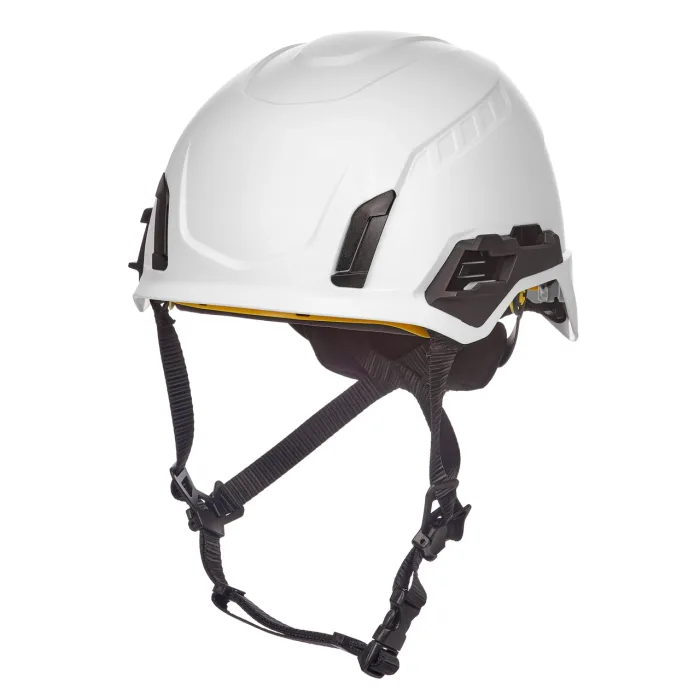
The MSA V-Gard H2 is the pick if you want lateral impact protection without giving anything up, because MSA publishes it as ANSI/ISEA Z89.1-2014 (R2019) Type II, Class E in the non-vented build, with an integrated chin strap and an optional Mips liner. The Pyramex Ridgeline T2 Full Brim gets you the same Type II rating in a conventional full brim shape at the low end of the market, with an ABS shell over EPS halo foam and a published 556 g weight. The Petzl VERTEX is the right answer for rope access, rescue and electrical work rather than general site duty, because it carries EN 397, EN 12492 and EN 50365 plus a two position chin strap, but under the US standard it is Type I, Class E. The one to skip for a side impact hazard is the 3M SecureFit Safety Helmet X5000, and not because it is badly made: 3M's own technical bulletin says in bold that the X5000 series does not meet ANSI Z89.1 Type II requirements. Buyers switch to it expecting a Type II upgrade and do not get one. Before you buy anything, check whether your hazard assessment calls for top impact only or top and side. Best for: anyone who wants the certification on the label to match the hazard they actually face.
Our picks at a glance
- MSA V-Gard H2 Safety Helmet - Buy. One of the few mainstream helmets whose own product page states Type II, Class E in plain language, with a chin strap fitted and a Mips option on the shelf.
- Pyramex Ridgeline T2 Full Brim (HPT256110) - Buy. A Type II rating in the ordinary full brim shape a site is used to seeing, with a spec sheet that actually prints the numbers.
- Petzl VERTEX - It depends. The most thoroughly certified helmet here and the right tool for work at height, but under the US standard it is Type I, not Type II.
- 3M SecureFit Safety Helmet X5000 (X5001-ANSI) - Skip. A well built climbing style helmet that a lot of people buy as a Type II upgrade, which 3M's own bulletin says plainly it is not.
The verdict in 30 seconds
What mattered most
- ANSI/ISEA Z89.1 Type
- Electrical Class
- Shape
- Chin strap
- European certification
- Published weight
Head protection is one of the few product categories where the marketing and the certification can point in opposite directions. A helmet can have a chin strap, a low profile shell and a climbing silhouette and still be certified only for a blow to the top of the head. The line that actually matters is Type I versus Type II, and it is printed inside the shell rather than on the box. We picked four products that are currently sold in the US and read each one against its own published Type, Class and service life.
One of the few mainstream helmets whose own product page states Type II, Class E in plain language, with a chin strap fitted and a Mips option on the shelf.
Best for: A crew whose hazard assessment flags falls, side impacts and low voltage contact, and that wants one helmet to cover all three.
- MSA publishes the non-vented build as ANSI/ISEA Z89.1-2014 (R2019), Type II, Class E, with HT and HV markings where applicable.
- Type II means it was tested for impact energy from the front, back and sides as well as the top, which is what OSHA tells construction employers to consider.
- The chin strap is integrated rather than an accessory, and MSA offers the Mips brain protection system as a factory option for rotational forces.
- The vented version drops to Class C and carries no electrical rating at all, so venting and electrical work are mutually exclusive here.
- MSA counts storage against the clock: its data sheet sets a two year storage life from date of manufacture and says any time beyond that is deducted from the five year service life.
- It sits at the top of the market, and the Mips option costs more again.
- MSA's general guidance is a five year shell and a twelve month suspension from first use, so the running cost is a new suspension every year.
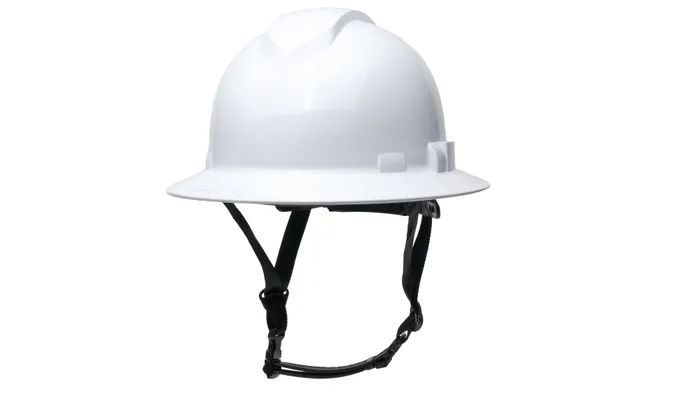
A Type II rating in the ordinary full brim shape a site is used to seeing, with a spec sheet that actually prints the numbers.
Best for: The buyer who wants Type II protection without changing the silhouette their crew or their client is used to, at the bottom of the price range.
- Pyramex's product sheet states ANSI/ISEA Z89.1-2014 Type II with the non-vented model Class E rated for 20,000 volts and the vented model Class C.
- It publishes what most brands hide: 556 g complete, a 1.7 to 3.2 mm ABS shell, EPS halo foam, and a six point swinging ratchet that converts to four point.
- It also carries the optional LT marking to -22 F and HT to 140 F, plus HV on the hi vis colours, and it is certified to CAN/CSA Z94.1-2015 Type II.
- The chin strap is optional on the standard version, so a crew that needs retention has to make wearing it a rule rather than assume it.
- At 556 g it is heavier than the low profile helmets here, which is the price of a full brim over a Type II liner.
- The Mips variant is a separate SKU and Pyramex says it must be worn with the chin strap, so you cannot mix and match.
- Distribution is through safety supply channels rather than the tool aisle, so trying one on before buying is harder.
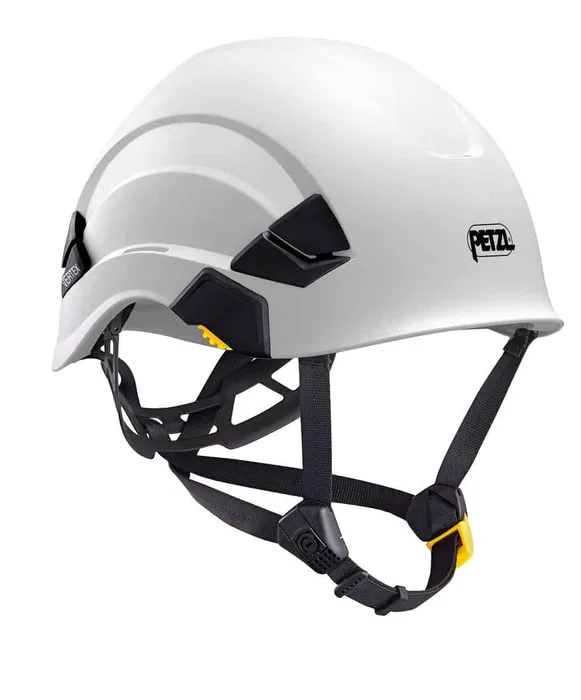
The most thoroughly certified helmet here and the right tool for work at height, but under the US standard it is Type I, not Type II.
Best for: Rope access, rescue, tower and utility work where retention in a fall and EN 50365 electrical insulation matter more than the ANSI Type number.
- Petzl lists CE, EN 397, EN 12492 except the ventilation clause, EN 50365, ANSI Z89.1 Type I Class E, EAC, AS/NZS 1801 and GB 2811 on one product.
- The DUAL chin strap switches between a high strength setting for work at height and a low strength setting that releases at ground level to limit strangulation risk.
- It publishes a 490 g weight, a 53 to 63 cm range and a six point textile webbing suspension with side adjustment wheels.
- It is ANSI Type I, so under the US standard it is certified for a blow to the top of the head only, despite the EN 12492 front, side and rear testing.
- The VERTEX VENT is not the same helmet with holes: it drops to ANSI Class C and loses EN 50365 electrical insulation entirely.
- The guarantee is three years, and Petzl's plastic and textile parts age out on a clock you should check in its technical notice before buying.
- It costs premium money for a Type I rating, which is a hard sell if your hazard assessment calls for Type II.
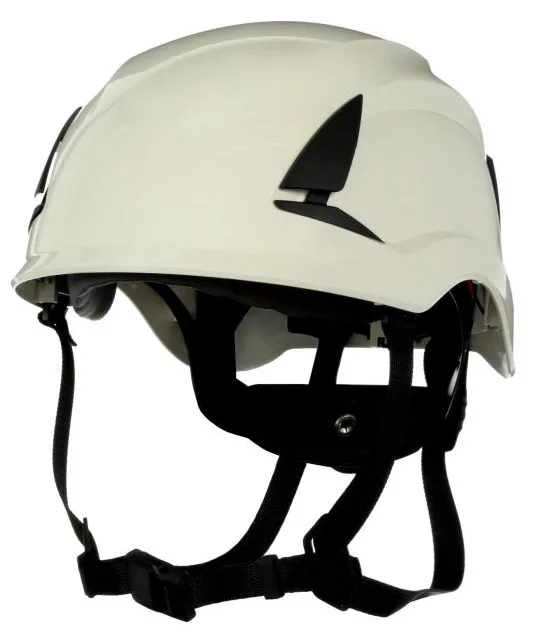
A well built climbing style helmet that a lot of people buy as a Type II upgrade, which 3M's own bulletin says plainly it is not.
Best for: Someone who specifically wants a brimless Type I Class E helmet for overhead clearance and 3M accessory compatibility, and who has confirmed their hazard assessment does not call for Type II.
- 3M states all X5000 models meet ANSI Type I and that non-vented versions also meet Class G and Class E.
- Every model meets the optional ANSI low temperature requirement to -22 F, and the Hi Viz Green meets the optional HV requirement.
- The selectable four point chin strap can be switched between the EN 397 release range and a setting that meets EN 12492 retention strength of 500 N for two minutes.
- 3M's technical bulletin states in bold that the X5000 series does not meet ANSI Z89.1 Type II head protection requirements, and that its EN 12492 test results are not equivalent to Type II front, side or rear energy absorption.
- 3M chose not to certify or mark the US version to EN 12492 at all, so the climbing standard is a set of tested clauses rather than a certification you can point to.
- The chin strap ships in the EN 397 position by default, where it is designed to break free between 150 and 250 N, so out of the box it is not the retention setting most people assume they bought.
- 3M does not publish a weight for the ANSI version, and a premium price for a Type I rating is hard to justify if lateral impact is on your hazard list.
| Criteria | V-Gard H2 Safety Helmet Top pick | Ridgeline T2 Full Brim (HPT256110) | VERTEX | SecureFit Safety Helmet X5000 (X5001-ANSI) |
|---|---|---|---|---|
| Verdict | Buy it | Buy it | It depends | Skip it |
| Best for | A crew whose hazard assessment flags falls, side impacts and low voltage contact, and that wants one helmet to cover all three. | The buyer who wants Type II protection without changing the silhouette their crew or their client is used to, at the bottom of the price range. | Rope access, rescue, tower and utility work where retention in a fall and EN 50365 electrical insulation matter more than the ANSI Type number. | Someone who specifically wants a brimless Type I Class E helmet for overhead clearance and 3M accessory compatibility, and who has confirmed their hazard assessment does not call for Type II. |
| Price tier | $$$ · premium | $ · budget | $$$ · premium | $$$ · premium |
| ANSI/ISEA Z89.1 Type | Type II | Type II | Type I | Type I |
| Electrical Class | Class E non-vented, Class C vented | Class E non-vented at 20,000 V, Class C vented | Class E on VERTEX, Class C on VERTEX VENT | Class G and E on non-vented models |
| Shape | Low profile helmet, no brim | Full brim hard hat | Low profile helmet, no brim | Brimless climbing style |
| Chin strap | Integrated, included | Included, optional to wear unless Mips is fitted | DUAL two position, included | Selectable four point, included, ships in EN 397 position |
| European certification | Chin strap stated EN 12492 compliant; helmet not EN 12492 certified | Not stated; CAN/CSA Z94.1-2015 Type II instead | EN 397, EN 12492 except ventilation, EN 50365 | Tested to EN 12492 clauses, not certified or marked in the US |
| Published weight | 527 g non-vented, 516 g vented | 556 g | 490 g | Not published for the ANSI version |
| Rotational impact option | Mips offered | Mips offered as a separate SKU | Not offered | Not offered |
| Published service life | 5 years maximum service life, plus a 2 year storage life deducted from it | 5 years shell, 1 year suspension, from first use | 3 year guarantee; see Petzl technical notice for lifetime | 3M guidance: shell within 5 years, suspension every 12 months, plus a UVicator sensor |
Which one is right for you?
- A crew whose hazard assessment flags falls, side impacts and low voltage contact, and that wants one helmet to cover all three. Buy it MSA V-Gard H2 Safety Helmet
- The buyer who wants Type II protection without changing the silhouette their crew or their client is used to, at the bottom of the price range. Buy it Pyramex Ridgeline T2 Full Brim (HPT256110)
- Rope access, rescue, tower and utility work where retention in a fall and EN 50365 electrical insulation matter more than the ANSI Type number. It depends Petzl VERTEX
- Someone who specifically wants a brimless Type I Class E helmet for overhead clearance and 3M accessory compatibility, and who has confirmed their hazard assessment does not call for Type II. Skip it 3M SecureFit Safety Helmet X5000 (X5001-ANSI)
How we judged the field
Five things decide whether a hard hat is the right one, and only one of them is comfort. First is the ANSI/ISEA Z89.1 impact Type, because Type I is tested for a blow to the top of the head and Type II adds front, back and side energy attenuation, off-center penetration and chin strap retention. Second is the electrical Class, which is a real proof test rather than a claim: Class G at 2,200 volts, Class E at 20,000 volts, Class C not tested at all. Third is retention, because OSHA points out that a hat without a strap can leave the wearer unprotected the moment they slip. Fourth is what the manufacturer publishes about service life for the shell and the suspension separately, since there is no regulatory expiry date and the only numbers that exist are theirs. Fifth is whether the accessories you need are designed into the shell, because drilling your own holes voids the certification you paid for.
The field splits along a line that has nothing to do with how a product looks. On one side are helmets and hard hats certified to Type II, which now includes both climbing style shells like the MSA V-Gard H2 and conventional full brims like the Pyramex Ridgeline T2. On the other side are Type I products, which still include some of the most expensive and most heavily specified helmets on the market, among them the Petzl VERTEX and the 3M SecureFit X5000. We picked two Type II options at opposite ends of the price range, one Type I helmet that earns its place for a specific kind of work, and one Type I helmet that is widely bought by people who believe they are buying Type II.
MSA V-Gard H2 Safety Helmet
Buy itMSA’s V-Gard H2 is the clean answer to the question most buyers are actually asking. MSA publishes the non-vented build as ANSI/ISEA Z89.1-2014 (R2019), Type II, Class E, with HT and HV markings where applicable, and the vented build as Type II, Class C. That single line covers the two hazards OSHA highlights for construction in its 2024 bulletin: side impact and low voltage contact. The shell is ABS in a low profile climbing shape, the chin strap is integrated rather than sold as an accessory, and the ratchet is designed to be adjusted with a gloved hand. MSA also offers Mips as a factory option, which targets rotational forces that the ANSI drop test does not measure. MSA’s data sheet puts the non-vented shell at 527 g and the vented at 516 g, rising to 558 g with Mips fitted. The vented version gives up its electrical rating entirely, which is a real decision in hot weather. It is for the crew that wants one helmet to cover falls, side impacts and low voltage without a second thought.
Pyramex Ridgeline T2 Full Brim (HPT256110)
Buy itThe Pyramex Ridgeline T2 Full Brim is the most interesting product here because it refuses the trade everyone assumes you have to make. It looks like a normal full brim hard hat, the kind a foreman has worn for thirty years, and it is certified ANSI/ISEA Z89.1-2014 Type II with the non-vented model rated Class E at 20,000 volts, plus CAN/CSA Z94.1-2015 Type II. Pyramex publishes the details others leave out: 556 g complete, a 1.7 to 3.2 mm ABS shell over EPS halo foam, a six point swinging ratchet that converts to four point, and sizing from 6.5 to 8. It also carries LT to -22 F, HT to 140 F, and HV on the hi vis colours. The catch is retention. The chin strap is included but optional on the standard version, and only becomes mandatory on the separate Mips SKU. It is also the heaviest of the four, which is what a full brim over a Type II liner costs. For a crew that wants Type II without changing what a hard hat looks like, at the bottom of the price range, this is the one.
Petzl VERTEX
It dependsThe Petzl VERTEX is the most certified product in this comparison and it is still not a general purpose Type II helmet. Petzl lists CE, EN 397, EN 12492 except the ventilation clause, EN 50365, ANSI Z89.1 Type I Class E, AS/NZS 1801 and GB 2811 on one product. It weighs 490 g, fits 53 to 63 cm, and uses a six point textile webbing suspension with side adjustment wheels. The standout is the DUAL chin strap, a two position clip that switches between a high strength setting for work at height and a low strength setting that releases at ground level to limit strangulation risk if it snags. That is a thoughtful answer to a real conflict between the two European standards. But under the US standard this is a Type I helmet, certified for a blow to the top of the head only. The VERTEX VENT is not the same helmet with holes either: it drops to Class C and loses EN 50365. Buy it for rope access, rescue, tower and utility work, not for general site duty.
3M SecureFit Safety Helmet X5000 (X5001-ANSI)
Skip itThe 3M SecureFit X5000 is a good helmet in the wrong slot on a lot of jobsites, and the clearest evidence comes from 3M itself. Its technical bulletin on climbing style helmets in ANSI markets ends with a bolded line: the X5000 series does not meet ANSI Z89.1 Type II requirements. The same document explains that a third party lab tested the helmet against EN 12492 shock absorption and penetration clauses, but those results are not equivalent to ANSI Type II front, side or rear energy absorption, and 3M chose not to certify or mark the US version to EN 12492. What you do get is a well engineered Type I helmet: non-vented models meet Class G and Class E, every model meets the optional low temperature requirement to -22 F, and the selectable four point chin strap can be moved to a setting that meets EN 12492 retention strength of 500 N. It ships in the EN 397 position, designed to release between 150 and 250 N. If you moved to a climbing style helmet specifically to gain side impact protection, this is not the product that delivers it.
Sources
Specs in this review come from these pages.
- OSHA, Head Protection: Safety Helmets in the Workplace (SHIB 3-6-2024) (osha.gov)
- OSHA, 29 CFR 1910.135 Head Protection (osha.gov)
- ISEA, Head Protection and ANSI/ISEA Z89.1 (safetyequipment.org)
- 3M, Head Protection: Hard Hats 101 technical bulletin (multimedia.3m.com)
- 3M, SecureFit Safety Helmet X5000 climbing style helmets in ANSI markets technical bulletin (multimedia.3m.com)
- CPWR, Preventing Head Injuries in Construction (cpwr.com)
MSA V-Gard H2 Safety Helmet vs Pyramex Ridgeline T2 Full Brim (HPT256110): which should you buy?
The V-Gard H2 and the Ridgeline T2 reach the same place by different routes. Both are certified ANSI Type II, both are Class E in their non-vented builds, and both are honest about dropping to Class C when vented. The difference is shape, weight and how much the manufacturer tells you. MSA gives you a low profile climbing shell with an integrated chin strap and a Mips option, but does not print a weight. Pyramex gives you a conventional full brim, a published 556 g, a published shell thickness and a published service life, but leaves the chin strap optional unless you buy the Mips version.
Choose the V-Gard H2 if retention is the point. An integrated strap that is part of the product is worn far more often than one that is technically included, and if slips, trips and falls are on your hazard list then a helmet that stays on is the whole argument. Choose the Ridgeline T2 if brim coverage matters, if your crew resists anything that looks like a climbing helmet, or if you are buying enough units that the price gap becomes a real number. If your work involves overhead clearance, confined spaces or anything on a ladder where a brim gets in the way, the low profile shell wins. If it involves sun, rain and looking up at a crane all day, the full brim wins.
What to look for
- Read the Type first: Type I is tested only for a blow to the top of the head, while Type II adds front, back and side energy attenuation, off-center penetration and chin strap retention, and the marking is inside the shell rather than on the box.
- Match the Class to the hazard, not the habit: Class G is proof tested at 2,200 volts, Class E at 20,000 volts, and Class C is not tested for electrical insulation at all, which is why OSHA says vented models cannot be used for electrical work.
- Treat retention as a separate question: a chin strap is about keeping the hat on during a slip or fall, and it tells you nothing about whether the shell was tested for lateral impact.
- Check the suspension replacement interval before you buy: most manufacturers here recommend a new suspension every twelve months from first use, so the sticker price is not the running cost.
- Find the date stamp and understand what it is: it is molded into the shell, usually under the brim, as a clock face with the year in the centre and an arrow to the month, and Pyramex states plainly that it records when the shell was molded rather than when it expires.
- Buy the accessory system, not the drill: manufacturers build in slots for face shields, earmuffs and lamps, and 3M’s own warnings say never alter, puncture, modify or engrave the shell or the suspension.
Our final take
Ignore the shape and read the Type printed inside the shell. Type II means the helmet was tested for blows to the sides as well as the top. Type I means it was not, no matter how many chin straps or European clause numbers surround it. On that test the MSA V-Gard H2 and the Pyramex Ridgeline T2 both deliver, at opposite ends of the price range and in opposite silhouettes. The Petzl VERTEX is superb for work at height and a Type I helmet everywhere else. The 3M SecureFit X5000 is the cautionary tale: 3M puts the limitation in bold in its own bulletin and buyers still miss it. Do the hazard assessment first, then buy the label that matches it.
Questions, answered
Do I actually need a Type II hard hat, or is Type I fine?
It depends on your hazard assessment, which OSHA requires the employer to carry out. Type I is tested for a blow to the top of the head only. Type II adds impact energy attenuation from the front, back and sides, off-center penetration resistance and chin strap retention. In its March 2024 bulletin OSHA says that for construction sites with high risks of falling objects and debris, impacts from equipment, awkward working positions or slip, trip and fall hazards, employers should consider Type II head protection with chin straps. OSHA also disclosed that after its own job hazard analysis it selected Type II, Class G safety helmets for its own inspectors. None of that is a new legal requirement, but it is a strong signal about which way the hazard math points.
What do Class G, E and C actually mean?
They are electrical ratings and each one has a specific proof test behind it. Class G, for general, is proof tested at 2,200 volts phase to ground; the shell must withstand 2200 volts AC at 60 Hz for one minute with leakage no greater than 3 mA. Class E, for electrical, is proof tested at 20,000 volts phase to ground for three minutes with leakage no greater than 9 mA, and at 30,000 volts the sample must not burn through. Class C, for conductive, is not tested for electrical insulation at all. A Class E rating does not mean the hat protects you against contact with 20,000 volts in the field; it means the shell did not conduct under those laboratory conditions. Vented shells cannot carry an electrical rating, which is why OSHA says vented hard hats and helmets cannot be used for electrical work.
Is a safety helmet with a chin strap automatically better than a hard hat?
Not automatically, and this is the single most common mistake in the category. A chin strap addresses retention, which is a real problem: OSHA notes that traditional hard hats can fall off if the wearer slips or trips, leaving them unprotected. But retention and lateral impact protection are separate tests. The 3M SecureFit X5000 and the Petzl VERTEX both have four point chin straps and climbing style shells, and both are certified ANSI Type I. Meanwhile the Pyramex Ridgeline T2 is a conventional full brim hard hat and it is Type II. Read the Type marking inside the shell rather than judging by silhouette.
How do I tell how old my hard hat is, and when does it expire?
There is currently no official standard or regulatory requirement for replacing a hard hat or its suspension, only manufacturer recommendations, and 3M says so in as many words. The date of manufacture is stamped or molded into the shell, usually on the underside of the brim, as a clock face with the year in the middle and an arrow pointing to the month. Pyramex is explicit that this date code indicates the month and year the shell was molded and does not indicate service life. Manufacturers publish shell and suspension separately: MSA says shell no longer than five years and suspension after twelve months from first use, Pyramex says five years and one year, Klein gives its own separate figures for the suspension and the helmet, and Petzl publishes a lifetime in its technical notice. The manufacturers quoted here say to retire the hat immediately after any impact, even with no visible damage.
Can I put stickers on it, paint it, or drill holes for accessories?
Stickers are usually fine within limits, paint usually is not, and drilling never is. 3M says pressure sensitive, non-metallic stickers or tape with self-adhesive backing are acceptable on most of today's hard hats, provided you do not use them to cover damage and you keep them at least half an inch from the shell edge. MSA gives the same half inch rule and adds that decals must not be metallic and the adhesive must not attack the shell. On paint, 3M says shells should not be painted unless you get specific approval from the manufacturer, and warns that paints, solvents, chemicals, adhesives and gasoline can degrade the shell's ability to withstand impact and penetration. Drilling is a different category: 3M's warning list says never alter, puncture, modify or engrave the shell or the suspension. Use the accessory slots the manufacturer built in, and fit only that manufacturer's suspension, since MSA warns that parts from another source render the certification void.
Deciding between the top two? See our head-to-head: MSA V-Gard H2 Safety Helmet vs Pyramex Ridgeline T2 Full Brim (HPT256110).
More Tools & DIY reviews
 The Best Heat Guns: 4 Compared (and One to Skip)
  The Best Helping Hands: 4 Compared (and One to Skip)
  The Best Hex Key Sets: 4 Compared (and One to Skip)
  The Best Hole Saws: 4 Compared (and One to Skip)
  The Best Impact Drivers: 4 Compared (and One to Skip)
  The Best Impact Wrenches: 4 Compared (and One to Skip)