

Tools & DIY
The Best Hex Key Sets: 4 Compared (and One to Skip)
Four hex key sets compared on what the maker actually puts in writing: the ball end working angle, the alloy and hardness, the arm length you get to reach a recessed screw, and whether any of them names a standard.
The short version
Buy the Wera 950/9 Hex-Plus Multicolour 1 first. Its Hex-Plus profile moves the load off the corners of the socket and onto the flats, and Wera states that as much as 20 percent more torque can be applied because of it, which is the only published performance number anyone in this group offers about the drive itself. The Bondhus Balldriver BLX13 is the value pick and the better documented tool: Bondhus publishes a 25 degree ball end working angle, an approximate 59 RC typical hardness, and an explicit explanation of why the short arm is a straight hex and the long arm is a ball. The Wiha 33496 T-handle set suits someone turning the same few sizes all day at a bench, where a T-handle beats an L-key for speed and comfort, and suits nobody who has to get into a recessed or obstructed socket. Skip the Klein 70540M folding set as your main hex keys: its own listing gives key lengths of 2 to 2.5 inches and tops out at 8 mm, so it cannot reach into a counterbored socket and cannot turn a 10 mm fastener at all. Read the ball end angle and the arm length before you read anything else, because those two numbers decide what the set can physically do. Best for: anyone who owns socket head screws in both inch and metric and is tired of rounding them out.
Our picks at a glance
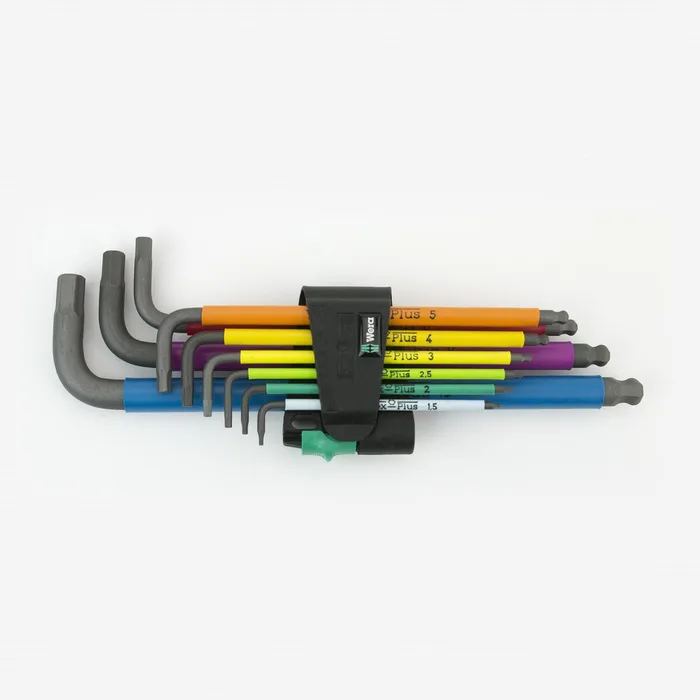
- Wera 950/9 Hex-Plus Multicolour 1 L-key set, metric, BlackLaser, 9 pieces - Buy. The only set here whose drive profile is designed to stop socket screws rounding out, with a published torque figure to go with it.
- Bondhus 10937 Balldriver BLX13 Ball End L-Wrench Set, 13-Piece Inch - Buy. The best documented hex keys you can buy, from the company that invented the ball end and still publishes the numbers behind it.
- Wiha 33496 SoftGrip Hex T-Handle Metric Set, 8 Piece - It depends. A T-handle set that is genuinely faster and more comfortable than L-keys for repetitive bench work, and genuinely worse everywhere else.
- Klein Tools 70540M Compact Folding Hex Key Set, 8-Key, Metric - Skip. A perfectly decent pocket tool that a lot of people buy as their only hex keys, which is the mistake.
The verdict in 30 seconds
What mattered most
- Format and count
- Sizes covered
- Reach, longest arm or blade
- Drive profile
- Ball end working angle stated
- Material and hardness stated
A hex key is about as simple as a tool gets, which is exactly why the marketing has to work so hard. Every set promises hardened steel and a ball end, almost none of them tells you the hardness number or the angle that ball end is actually good for, and the international standard that governs the whole category, ISO 2936, sets a minimum Rockwell hardness and a minimum proof torque that no maker in this comparison mentions on its own product page. The comparison looks for figures rather than adjectives, with particular attention to the two things that quietly ruin socket screws: reaching for a key from the wrong measurement system, and finishing a tightening job on the ball end. The field below is one premium L-key set, one value L-key set, one T-handle set for a specific kind of bench work, and one very widely sold folding set that should not be the only hex keys you own.
The only set here whose drive profile is designed to stop socket screws rounding out, with a published torque figure to go with it.
Best for: Anyone who keeps stripping socket head screws and wants the drive geometry, not just the steel, working in their favour.
- Wera states that the Hex-Plus profile gives a greater contact surface in the screw head and that as much as 20 percent more torque can be applied.
- Arm lengths are published size by size, from 1.5 x 90 mm up to 10 x 224 mm, so you know exactly how far each key reaches before you buy.
- Every key is colour coded by size and laser engraved with its size, which is the practical defence against picking up a near-size key from the wrong system.
- Wera's datasheet names no alloy, no hardness figure and no standard, so you are trusting the brand rather than a number.
- The ball is on the long arm only and Wera publishes no working angle for it, unlike Bondhus, PB Swiss and Klein.
- Metric only in this part number, so an inch set is a second purchase.
- The plastic clip holder is convenient on a bench but bulkier in a bag than a folding set.
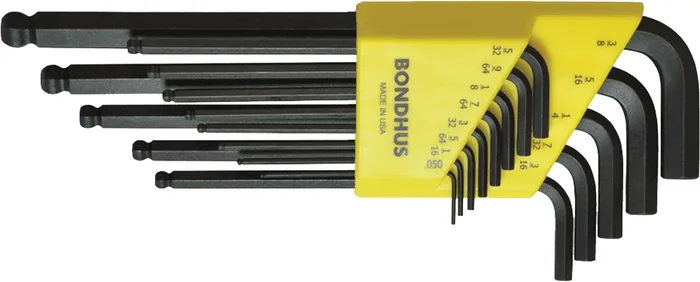
The best documented hex keys you can buy, from the company that invented the ball end and still publishes the numbers behind it.
Best for: The buyer who wants a straightforward, heavily documented working set and does not need colour coding or an exotic profile.
- Bondhus publishes a 25 degree ball end working angle and argues its case, saying tips beyond 25 degrees need a thinner neck and lose strength.
- Bondhus states an approximate typical hardness of 59 RC for a small tool, comfortably above the 52 HRC minimum ISO 2936 sets for keys up to 18 mm.
- Short arm is a straight hex for breaking screws loose and the long arm carries the ball for fast spinning, and Bondhus says so in writing rather than leaving you to guess.
- This part number is inch only, covering .050 to 3/8 inch; the metric equivalent is a separate purchase.
- Bondhus lists arm lengths only in its size chart, where the 3/8 inch long arm is 6.8 inches (171 mm), so the reach is shorter than the Wera 10 mm key.
- The 59 RC figure is described as an average for a small tool, not a guaranteed specification for every key in the set.
- Bondhus cites no standard for the set, so the hardness claim is self-declared rather than certified to ISO 2936.
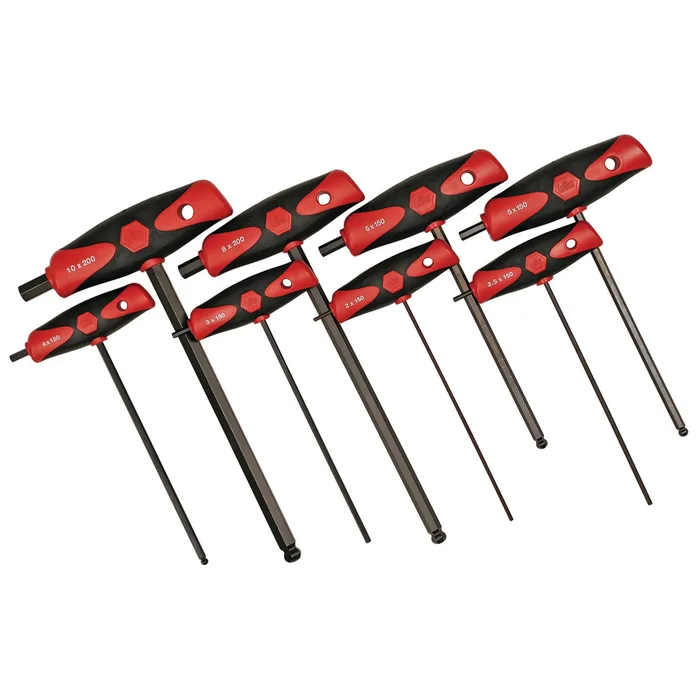
A T-handle set that is genuinely faster and more comfortable than L-keys for repetitive bench work, and genuinely worse everywhere else.
Best for: Someone assembling or servicing the same hardware repeatedly at a bench, where speed and hand comfort matter more than reach.
- Covers 2.0, 2.5, 3.0, 4.0, 5.0, 6.0, 8.0 and 10.0 mm, so it spans the sizes most bench assembly work actually uses.
- Wiha states the blades are made from its Chrome-V-Moly super tool steel and are through hardened, which is more material detail than Wera or Klein give.
- The T-handle puts your palm on the axis of the screw, which is faster to spin and easier on the fingers than an L-key over a long session.
- Wiha backs its hand tools with a guarantee; check its current terms before buying.
- The cross bar means the tool cannot get into a recessed, obstructed or close-quarters socket the way an L-key short arm can.
- Wiha publishes no working angle, no hardness figure and no standard for this set, only the alloy family.
- It starts at 2.0 mm, so there is no 1.5 mm key for small electronics and bike hardware.
- With a full holder and eight T-handles it is the least portable option here by a wide margin.
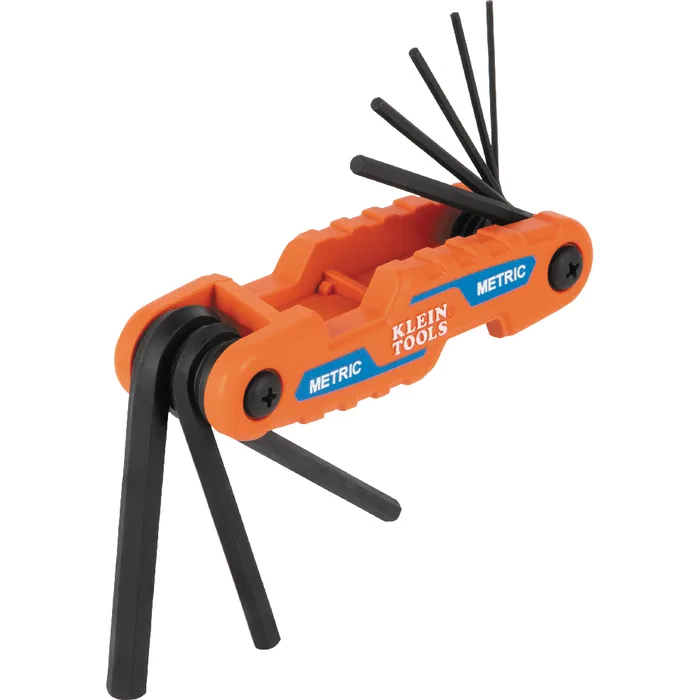
A perfectly decent pocket tool that a lot of people buy as their only hex keys, which is the mistake.
Best for: A glovebox, a bike bag or a jacket pocket as a second set, never as the hex keys you reach for at a bench.
- Klein publishes the numbers that matter for a folding tool: a 4.6 inch handle and key lengths of 2 to 2.5 inches.
- CR-V steel with a black phosphate finish, and square-cut ends that Klein says give a full-depth fit in the socket.
- It folds into a pocket, which no L-key or T-handle set here does.
- Key lengths of 2 to 2.5 inches mean the blade cannot reach a screw down a counterbore, where the Wera set's 10 mm arm is 224 mm long.
- It stops at 8 mm, so the 10 mm fasteners common on bikes, furniture and machine guards are simply out of range.
- The pivot fixes your hand at one offset from the screw, so there is no equivalent of an L-key's short arm for a tight corner.
- Klein publishes no hardness figure, no standard and no working angle for this set, and its own hex key literature quotes 30 degrees only for its L-style ball end keys, not for these straight ones.
| Criteria | 950/9 Hex-Plus Multicolour 1 L-key set, metric, BlackLaser, 9 pieces Top pick | 10937 Balldriver BLX13 Ball End L-Wrench Set, 13-Piece Inch | 33496 SoftGrip Hex T-Handle Metric Set, 8 Piece | 70540M Compact Folding Hex Key Set, 8-Key, Metric |
|---|---|---|---|---|
| Verdict | Buy it | Buy it | It depends | Skip it |
| Best for | Anyone who keeps stripping socket head screws and wants the drive geometry, not just the steel, working in their favour. | The buyer who wants a straightforward, heavily documented working set and does not need colour coding or an exotic profile. | Someone assembling or servicing the same hardware repeatedly at a bench, where speed and hand comfort matter more than reach. | A glovebox, a bike bag or a jacket pocket as a second set, never as the hex keys you reach for at a bench. |
| Price tier | $$$ · premium | $$ · mid-range | $$$ · premium | $ · budget |
| Format and count | L-keys, 9 pieces | L-keys, 13 pieces | T-handles, 8 pieces | Folding, 8 keys in one handle |
| Sizes covered | 1.5 to 10 mm | .050 to 3/8 inch | 2 to 10 mm | 1.5 to 8 mm |
| Reach, longest arm or blade | 10 mm arm is 224 mm | 3/8 inch long arm is 171 mm | Not published | Longest key 2.5 in, about 64 mm |
| Drive profile | Hex-Plus, up to 20 percent more torque per Wera | Standard hex, chamfered tips | Standard hex | Standard hex, square-cut ends |
| Ball end working angle stated | Ballpoint on long arm, angle not published | 25 degrees | Not published for this set | None, straight keys only |
| Material and hardness stated | Neither stated on the datasheet | Protanium steel, about 59 RC typical | Chrome-V-Moly, through hardened, no figure | CR-V steel, black phosphate, no figure |
| Standard cited by the maker | None | None | None | None |
| Country of origin as published | Czech Republic | Holder marked Made in USA | Poland | Not stated |
Which one is right for you?
- Anyone who keeps stripping socket head screws and wants the drive geometry, not just the steel, working in their favour. Buy it Wera 950/9 Hex-Plus Multicolour 1 L-key set, metric, BlackLaser, 9 pieces
- The buyer who wants a straightforward, heavily documented working set and does not need colour coding or an exotic profile. Buy it Bondhus 10937 Balldriver BLX13 Ball End L-Wrench Set, 13-Piece Inch
- Someone assembling or servicing the same hardware repeatedly at a bench, where speed and hand comfort matter more than reach. It depends Wiha 33496 SoftGrip Hex T-Handle Metric Set, 8 Piece
- A glovebox, a bike bag or a jacket pocket as a second set, never as the hex keys you reach for at a bench. Skip it Klein Tools 70540M Compact Folding Hex Key Set, 8-Key, Metric
How we judged the field
Five things separate a hex key set that lasts from one that eats socket screws. First, the fit: the working clearance between a key and the screw walls is tiny, Bondhus puts it at 0.0005 inch, about 0.0127 mm, or less per side, so a burr on the tip or a key from the wrong measurement system is enough to start rounding the socket. Second, the ball end and the angle it will actually hold, because a ball end contacts less material than a straight hex tip and every maker trades neck thickness against angle. Third, the material and any published hardness, because ISO 2936 sets a floor of 52 HRC for sizes up to 18 mm and a minimum proof torque per size, and a maker willing to state a number is a maker who measures. Fourth, reach, which is simply the arm or blade length and is the single spec most often left off a listing. Fifth, whether the set can be told apart at a glance, since colour coding and etched sizes are the only real defence against grabbing a 3/16 inch key for a 5 mm socket.
The field splits by format rather than by price. L-key sets are the general purpose answer and cover the widest size range with the longest reach, so both of our buy picks are L-keys, one premium and one value. T-handles are a specialist tool that beats L-keys at repetitive bench work and loses badly on access, which makes a good T-handle set a genuine depends rather than a recommendation. Folding sets are the format most often bought as a first and only set, and they are the one format whose published dimensions make that a mistake. We also checked what each maker says about standards, and the answer was uniform: none of these four cites one. That is worth knowing before you read any claim about hardness or precision on a listing.
Wera 950/9 Hex-Plus Multicolour 1 L-key set, metric, BlackLaser, 9 pieces
Buy itThe Wera 950/9 Hex-Plus Multicolour 1 is the pick because it is the only set here that changes the geometry of the joint rather than just the steel. The Hex-Plus profile puts a larger contact surface in the screw head, moving the load off the vulnerable corners of the socket, and Wera states that as much as 20 percent more torque can be applied as a result and that the keys fit every standard hexagon socket screw. It is also a well documented set for reach, with arm lengths given size by size: 1.5 x 90 mm, 2 x 101, 2.5 x 112, 3 x 123, 4 x 137, 5 x 154, 6 x 172, 8 x 195 and 10 x 224 mm. The colour coded sleeves and laser engraved sizes matter more than they sound, because grabbing the right key without looking twice is most of the battle. The trade-off is documentation of a different kind: Wera’s datasheet names no alloy, no hardness figure, no standard and no working angle for the ballpoint. It is for the person who has rounded out one socket screw too many.
Bondhus 10937 Balldriver BLX13 Ball End L-Wrench Set, 13-Piece Inch
Buy itThe Bondhus 10937 Balldriver BLX13 is the value pick and, oddly for a cheaper tool, the better documented one. Bondhus publishes a 25 degree ball end working angle and defends the number, arguing that competitors who push past 25 degrees have to thin the neck and lose strength, while those below it give up the access the ball exists for. It states an approximate typical hardness of 59 RC for a small tool, which sits well above the 52 HRC that ISO 2936 sets as a minimum for keys up to 18 mm. Its technical literature also explains the layout honestly: the short arm is a straight hex tip meant for high torque such as breaking screws loose, and the long arm carries the ball for fast removal once the screw turns freely. Tips are chamfered specifically to remove burrs so they seat to full depth. The limits are real. This part number is inch only, .050 to 3/8 inch, the long arm tops out at 171 mm, and the hardness figure is an average rather than a guaranteed spec.
Wiha 33496 SoftGrip Hex T-Handle Metric Set, 8 Piece
It dependsThe Wiha 33496 SoftGrip Hex T-Handle set is where format beats specification. Eight metric sizes from 2.0 to 10.0 mm, blades that Wiha describes as its Chrome-V-Moly super tool steel and through hardened, an industrial black finish, and a manufacturer guarantee. What you are buying is the handle geometry. A T-handle sits your palm on the axis of the screw, so you spin faster and your fingers do not take the load the way they do on an L-key, and over an afternoon of assembly that difference is large. What you give up is access. The cross bar cannot enter a recessed bore or work beside an obstruction, which is exactly the situation an L-key’s short arm was shaped for. Wiha publishes no working angle, no hardness figure and no standard for this set, and it starts at 2.0 mm so there is no 1.5 mm key. With eight T-handles it lives on a bench, not in a bag. It is right for repetitive work at fixed sizes and wrong as a general purpose set.
Klein Tools 70540M Compact Folding Hex Key Set, 8-Key, Metric
Skip itThe Klein 70540M Compact Folding Hex Key Set is a good pocket tool being bought for the wrong job. Klein publishes the figures that condemn it as a primary set: a 4.6 inch handle and individual key lengths of 2 to 2.5 inches, in CR-V steel with a black phosphate finish and square-cut ends that Klein says give a full-depth fit. Two and a half inches of blade cannot reach a screw sitting at the bottom of a counterbore, and there is no way to make it longer. The size range stops at 8 mm, so the 10 mm fasteners on bike cranks, furniture bolts and machine guards are out of reach entirely. The pivot also fixes your hand at one offset, so there is no short-arm equivalent for a corner. Klein’s own hex key literature quotes a 30 degree working angle for its L-style ball end keys, which tells you what the company thinks angled access is worth, and this set does not have it. Carry it in a jacket or a bike bag as a backup. Do not let it be the only hex keys in the house.
Sources
Specs in this review come from these pages.
- ISO 2936:2014, Assembly tools for screws and nuts, Hexagon socket screw keys (iso.org)
- DIN 911 Hexagon socket screw keys, withdrawn status record, DIN Media (dinmedia.de)
- GGG-K-275D Notice 1, Key, Socket Head Screw and Key Sets, cancelled federal specification (webstore.ansi.org)
- Bondhus Ball End L-Wrench Sets, product and technical detail (bondhus.com)
- Wera 950/9 Hex-Plus Multicolour 1 L-key set datasheet (wera.de)
- PB Swiss Tools PB 212 LH hex key L-wrenches (pbswisstools.com)
Wera 950/9 Hex-Plus Multicolour 1 L-key set, metric, BlackLaser, 9 pieces vs Bondhus 10937 Balldriver BLX13 Ball End L-Wrench Set, 13-Piece Inch: which should you buy?
The Wera and the Bondhus solve the same problem from opposite ends. Wera changes the shape of the contact patch: the Hex-Plus profile bears on the flats of the socket rather than crowding the corners, and Wera puts a number on it, as much as 20 percent more torque. That is a fix aimed at the failure most people actually experience, which is a rounded socket rather than a snapped key. Bondhus changes what the key is made of and then tells you about it, publishing a 25 degree working angle, an approximate 59 RC typical hardness, and a candid explanation that a ball end can never match a straight hex tip because its neck is narrower than the tip.
Choose on which failure you keep having. If your screws are getting chewed, especially small ones in aluminium or in fasteners that have been in and out many times, the Wera profile is the more direct answer, and the colour coding plus etched sizes will stop you reaching for a near-size key from the wrong system. If your keys are twisting, rounding at the tip or you want published figures you can hold a maker to, take the Bondhus. Note the units, too: the Wera part number here is metric and the Bondhus part number here is inch, so a workshop that sees both systems is buying two sets regardless of which brand wins. Keep them in visibly different holders, because that is the only reliable protection against the 5/32 versus 4 mm class of mistake.
What to look for
- Published arm length: it is the one spec that decides whether the key physically reaches your screw, and it is missing from most listings, so treat a set that gives it size by size as the more honest listing.
- A stated ball end working angle: makers publish 25 or 30 degrees and Bondhus argues openly that going past 25 costs neck strength, so a set that publishes nothing is asking you to trust an unmeasured tip.
- A straight hex tip somewhere in the set: the short arm of an L-key exists for breaking screws loose and final tightening, and a set where every tip is a ball leaves you nothing to finish on.
- Any hardness figure at all: ISO 2936 sets 52 HRC as the minimum for keys up to 18 mm, so a maker willing to publish a number is a maker who tests, even when the number is described as an average.
- Colour coding and etched sizes: the near-size inch and metric pairs are close enough to insert and round the socket, and legible size marking is the cheap practical defence against picking the wrong one.
- A stamped standard, and its status: ISO 2936 is current, DIN 911 was withdrawn in favour of DIN ISO 2936, and the federal specification GGG-K-275D was cancelled and replaced by commercial item descriptions, yet it is still printed on hex key listings today.
Our final take
Hex keys are a category where the cheap version works fine right up until it does not, and the failure is usually a ruined screw rather than a broken tool. The Wera 950/9 Hex-Plus Multicolour 1 is the pick because its profile attacks that specific failure and Wera puts a figure behind it. The Bondhus 10937 is the value choice and the one that tells you the most about itself, including the parts that are not flattering. The Wiha T-handles are a real upgrade for repetitive bench work and a real downgrade for access. The Klein folding set is a fine backup and a poor primary, and its own published key lengths say so. Whatever you buy, buy the second set in the other measurement system, keep them apart, and finish every tightening job on a straight hex tip.
Questions, answered
Is a 3/16 inch hex key the same as a 5 mm one?
No, and the arithmetic is worth memorising: 3/16 inch is 4.7625 mm, so a 5 mm key is 0.2375 mm larger across the flats. That sounds tiny until you compare it with the working clearance. Bondhus states that the gap between a hex key and the screw walls is typically 0.0005 inch, about 0.0127 mm, or less on each side. Swapping 3/16 for 5 mm adds roughly nine times that clearance per side, which is why the wrong key rattles obviously or will not go in at all. The pairs that genuinely catch people out are the tighter ones: 5/32 inch is 3.96875 mm against 4 mm, 5/16 inch is 7.9375 mm against 8 mm, and 7/32 inch is 5.55625 mm against 5.5 mm. Those seat fully, feel almost right, and round the socket under load.
Can I use the ball end to do the final tightening?
You should not, and the clearest statement of why comes from the company that invented the ball end. Bondhus explains that every ball end has a neck smaller in diameter than the tip size, so it cannot have quite as much strength as a straight hex tip, and it answers its own question about why the ball sits on the long arm rather than the short one by saying the short arm's straight hex tip is meant for high torque work such as breaking screws loose. Bondhus also describes the failure mode: a hex tip begins to yield when maximum torque is reached and you can feel it, whereas a ball end tip gives no warning and breaks suddenly when over-torqued. No maker covered here publishes a percentage figure for how much torque you give up. What they publish instead is a working angle, and the angle is the tradeoff, because a thinner neck buys more angle and less strength.
How hard should a hex key be, and is harder always better?
ISO 2936 sets a minimum Rockwell hardness for hexagon socket screw keys, 52 HRC for sizes up to 18 mm, along with a minimum proof torque for each size. Bondhus is the only maker here that publishes any figure at all, stating that the average hardness for a small tool is approximately 59 RC. Harder is not automatically better, and Bondhus's own technical documentation is unusually blunt about it: as hardness increases ductility decreases, tools lacking ductility can become brittle and shatter when torque is applied, and decreasing hardness increases ductility but means the tool cannot generate maximum torque and wears prematurely. A hex key has to twist a little before it fails, because a key that shatters throws fragments. So treat a published hardness number as evidence the maker is measuring something, not as a score to maximise.
Do I really need both an inch and a metric set?
If you work on anything from both traditions, yes. Bicycles, European cars, furniture and most electronics are metric; a lot of American machinery, firearms hardware and older equipment is inch. There is no key that safely serves both, because the near-size pairs sit close enough to insert but far enough to round the socket. The good news is that the mitigation is cheap. The makers covered here handle the risk of mixing systems in different ways: Wera colour codes each key by size and laser etches the size on the shaft, Bondhus colour codes its holders yellow for inch and red for metric and stamps sizes on the tools, and Klein prints METRIC on the folding handle. Buy the two sets, keep them in visibly different holders, and never mix them in one caddy.
L-keys, T-handles or a folding set: which format should I buy?
L-keys are the default for a reason. They give you two lever arms in one tool, the short arm for high torque in a tight space and the long arm for reach and speed, and the long arm is usually where the ball sits. T-handles put your palm directly on the axis of the screw, which is faster to spin and much kinder to your fingers over a long session, so they earn their space at a bench where you turn the same few sizes repeatedly. Folding sets trade almost everything for pocketability: Klein's own figures for its compact metric folder are key lengths of 2 to 2.5 inches, against a 224 mm arm on the 10 mm key of the Wera set. Bit-and-driver systems are the fourth option and the right one if you already own a torque wrench or ratchet, because a hex bit in a socket is the only format here that lets you tighten to a number.
Deciding between the top two? See our head-to-head: Wera 950/9 Hex-Plus Multicolour 1 L-key set, metric, BlackLaser, 9 pieces vs Bondhus 10937 Balldriver BLX13 Ball End L-Wrench Set, 13-Piece Inch.
More Tools & DIY reviews
 The Best Hole Saws: 4 Compared (and One to Skip)
  The Best Impact Drivers: 4 Compared (and One to Skip)
  The Best Impact Wrenches: 4 Compared (and One to Skip)
  The Best Infrared Thermometers: 4 Compared (and One to Skip)
  The Best Insulated Hand Tools: 4 Compared (and One to Skip)
  The Best Jigsaws: 4 Compared (and One to Skip)