Explained
Heat Guns, Explained
After reading, you'll understand what a heat gun's temperature figure does and does not promise, why the fan speed changes the range, and which lines in a manual are worth more than the whole box.
In this guide
Heat gun listings look simple, which is the trap. One temperature range, maybe a wattage, and you are done. In practice the headline temperature is measured at a point almost nobody works at, the maximum is often available on only one fan setting, and the two facts that most affect whether the tool survives your project, its duty cycle and its overheat behaviour, are usually not on the listing at all. They are in the manual, which is free to download before you buy.
The 30-second version
- The temperature figure is a nozzle figure, and what reaches your work depends on distance, dwell and the fan speed you chose.
- Almost nobody publishes a tolerance, so treat a stated setting as a target the tool aims at rather than a value it guarantees.
- The fan can cap the temperature, and several guns reach their advertised maximum only on the highest airflow stage.
- The duty cycle lives in the manual, and a maker who prints one is telling you the tool was designed for sustained work.
- Two settings are not a poor man's variable, because a low setting of 750 F is still far above what tubing, vinyl and decals want.
The products this guide is about
Our verdict on each, with the full reasoning on the companion review.
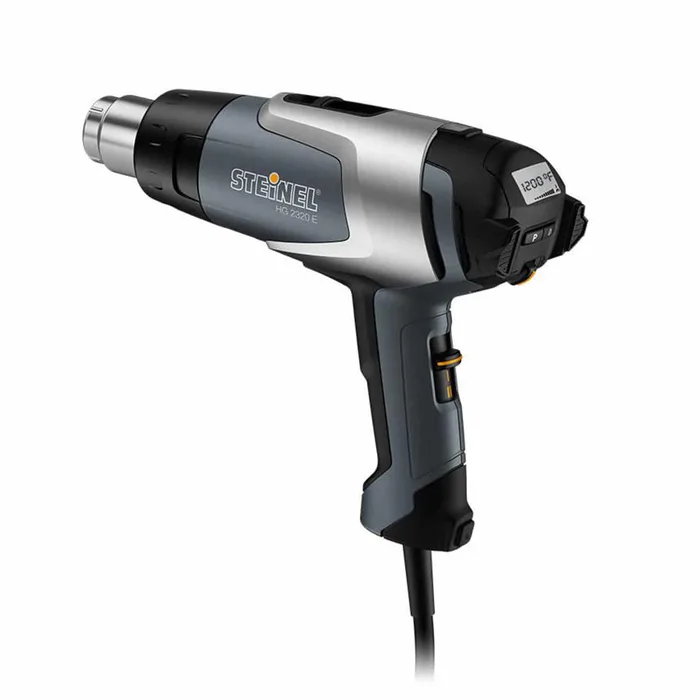
- Buy Steinel HG 2320 Eco Professional Heat Gun The one whose manual states that the number on the display is the actual temperature measured at the nozzle outlet, not just the setting you asked for. Amazon
- Buy DEWALT D26960 LCD Heat Gun The only one of the four that tells you how long you are allowed to run it and what it does when the element gets too hot. Amazon
- It depends Milwaukee M18 Compact Heat Gun 2688-20 A cordless heat gun with one temperature, one airflow and a trigger, which is either exactly enough or nowhere near it. Amazon
- Skip Wagner FURNO 300 Heat Gun Two fixed settings that Wagner's own specification calls approximate, with the low one still hot enough to ruin most of the jobs people buy a cheap heat gun for. Amazon
What actually matters
- Temperature range - the band between the coolest and hottest air the tool will produce, usually measured at the nozzle outlet. Check both ends, because a high maximum is useless if the minimum is still too hot for your material.
- Airflow - stated in cubic feet per minute or litres per minute, this is how much heat the gun actually delivers per second. Two guns at the same temperature but different airflow will heat a workpiece at very different rates.
- Airflow stages - whether the fan has fixed steps or is continuously variable, and crucially whether each stage carries the full temperature range. Some guns cap the low stage hundreds of degrees below the headline figure.
- Setting resolution - the size of the step each button press moves you, commonly 10 or 50 degrees Fahrenheit. Fine steps only matter if the material has a narrow safe window, but when it does they matter a great deal.
- Closed loop control - whether the tool measures the air it is producing and corrects, or simply sets a power level. A display showing actual temperature rather than set temperature is the visible sign of the former.
- Duty cycle - the maker's limit on how long the tool may run continuously and how long it must rest. Its absence is not proof of a weak tool, but its presence is proof that someone tested for it.
- Overheat protection - what happens when the element gets too hot for the airflow it is receiving. Read whether the manual describes a full shutdown or a self resetting element cut-out, because they feel completely different mid job.
The specs, in plain English
Green flags vs red flags
Green flags
- The manual states where the temperature is measured, such as at the nozzle outlet.
- The display shows the actual temperature rather than only the value you selected.
- The full temperature range is available on every airflow stage, or the limits per stage are published.
- A duty cycle or a continuous use limit appears somewhere in the documentation.
- The data sheet names components most makers omit, such as heating element type, motor type or motor life.
Red flags
- The only accuracy language anywhere in the specification is the word approximately.
- No airflow figure is published in any unit, so heat delivery cannot be compared.
- A dramatic maximum temperature with no stated minimum, or a minimum that is still hundreds of degrees above craft and shrink work.
- Overheat protection is named as a bullet point but never described anywhere in the manual.
- The listing quotes a wattage as if it were a performance figure, with no temperature or airflow to go with it.
Who's who: the brands
- Steinel - A German specialist whose whole line is hot air tools, and the one most likely to publish element type, motor life and where a temperature is measured.
- DEWALT - Mainstream corded and cordless guns with LCD control, and unusually clear manuals that state a duty cycle and describe the overload behaviour.
- Milwaukee - Best known here for the compact M18 cordless gun, built around battery platform convenience with a single published temperature and airflow.
- Wagner - The volume brand in home centres, including the two setting FURNO 300 reviewed here.
- Makita - A power tool maker that also sells heat guns; check its manual for the specifics before comparing.
How to read a listing without getting fooled
Start with the manual, not the listing. Download it before you buy, because it is free and it holds the two facts the box never carries: the duty cycle, if there is one, and what the tool does when it overheats. Then read the temperature range and the airflow together rather than separately, and look specifically for whether the range is quoted per airflow stage; if it is, the low stage figure is often much lower than the headline. Note the setting step size, because 10 degrees and 50 degrees are different tools for heat sensitive work. Check whether any tolerance is quoted anywhere, on temperature or airflow, since a maker willing to publish a plus or minus on one number has usually tested the others too. Finally, look for a sentence about where the temperature is measured. Most makers do not include one, and the ones that do are telling you their display means something.
How much should you spend?
Budget tier buys you a two setting gun with a slide switch, a plastic body and no published airflow figure, and it is genuinely fine for softening adhesive or thawing a pipe. The mid-range is where LCD control, multiple airflow stages and a documented overheat behaviour appear, and where a maker is most likely to publish a duty cycle; this is the sensible band for anyone stripping, wrapping or shrinking regularly. The premium tier buys metered control, fine setting steps, programmable presets and a data sheet that names the heating element and the motor life, plus replaceable cords and a nozzle ecosystem. Spending up is worth it when the material has a temperature it will not forgive you for exceeding, and largely wasted when the job is just get it hot.
Questions, answered
Is a heat gun the same as a hot air rework station?
No. A rework station is built for electronics, with a small pencil handpiece, a tight low volume airstream and closed loop control tuned around solder alloy melting points. A heat gun moves far more air over a much wider area and is built for paint, plastic, adhesive and tubing. You can shrink tubing with either, but a general purpose heat gun aimed at a populated board will heat far more than the component you wanted.
Why does the maximum temperature change when I change the fan speed?
Because the element puts out a roughly fixed amount of heat and the air carries it away. Move less air past the same element and each unit of air gets hotter; move more air and each unit gets cooler but you deliver more heat per second overall. Makers set limits per stage so the element is never starved of cooling, which is why a gun advertised at 1100 F may cap at 750 F on its low airflow setting. Check the per stage figures rather than the headline.
Can I use a heat gun instead of a torch for soldering copper pipe?
Several makers list soldering plumbing joints among the applications for their higher temperature guns, so it is a sanctioned use rather than a hack. It is slower than a torch and works best with a reflector nozzle that wraps heat around the pipe. The advantage is no open flame, which matters in a joist bay or near insulation. The limitation is thermal mass: on larger diameters or against a cold run, a heat gun may simply never get the joint hot enough.
Do I really need a heat gun for heat shrink tubing?
For one or two joints a lighter will do it, badly, with a real chance of scorching the tubing or the wire insulation underneath. A heat gun gives you even heat all round without a flame. What matters more than owning one is which one, since a fixed 875 F gun or a 750 F low setting is well above what most tubing needs, leaving distance and dwell as your only controls. A gun that will sit in the low hundreds is far easier to work with.
Or jump to the head-to-head: Steinel HG 2320 Eco Professional Heat Gun vs DEWALT D26960 LCD Heat Gun.