Explained
Fish Tapes, Explained
After reading, you'll understand what a fish tape's material and tip type mean for safety, what its strength rating does and does not promise, and why the eyelet is the part that decides how long the tool lasts.
In this guide
First-time buyers pick a fish tape on length and price and discover the two specs that mattered on the first job. One is what the tape and its tip are made of, because that is the only thing on the listing with a safety consequence. The other is that the big pounds number on the label is not a working load, and the tape is rarely what breaks. Almost every complaint about a fish tape traces back to the tip pulling off, the tape kinking, or the buyer discovering that steel and unknown wiring do not mix.
The 30-second version
- Material is the safety spec, and steel is the one that conducts, which is why non-conductive fiberglass, nylon and polymer tapes exist at all.
- The tip is a separate spec, so a non-conductive tape can still ship with a machined metal eyelet or a steel leader on the leading end.
- Non-conductive is not permission, because the same makers who publish the claim also print do not use on or near live circuits in their own manuals.
- Strength ratings are ceilings, and the same brand can publish one figure for a steel tape and a soft one.
- The eyelet is a spare part, and every serious maker sells replacement eyelets, leaders and adhesive because that is what fails.
The products this guide is about
Our verdict on each, with the full reasoning on the companion review.
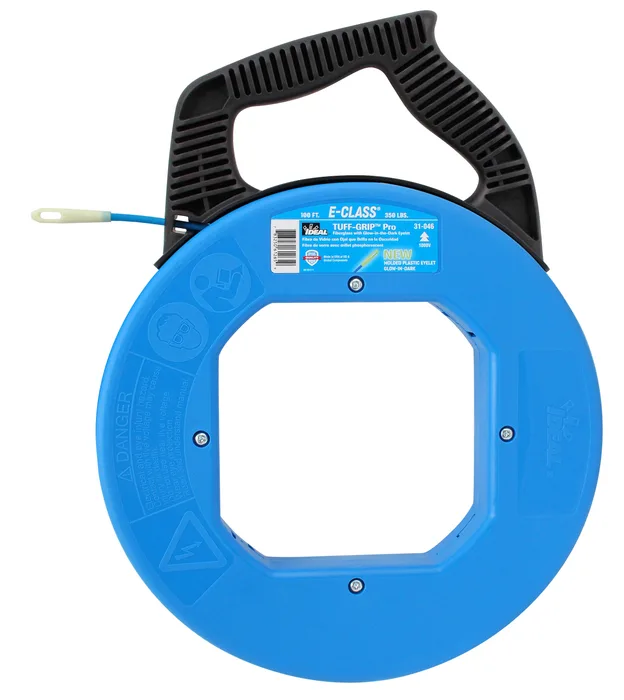
- Buy IDEAL Electrical E-Class Fiberglass Fish Tape, 100-Foot (31-046) The only tape here whose maker puts a voltage number on the tape and a molded plastic eyelet on the end. Amazon
- Buy Klein Tools Multi-Groove Fiberglass Fish Tape with Nylon Tip, 50-Foot (56382) The short, cheap way to get a non-conductive tape with a non-conductive tip, if you can live with fifty feet. Amazon
- It depends Greenlee MagnumPRO 125' Steel Fish Tape (FTS438-125) Still the best pusher in the category, with genuinely replaceable leaders, and still a length of steel going somewhere you cannot see. Amazon
- Skip IDEAL Electrical S-Class Fish Tape with Metal Eyelet, 100-Foot (31-063) IDEAL's stronger fiberglass tape, sold with a machined metal eyelet on the end and left unmarked in IDEAL's own non-conductive table.
What actually matters
- Tape material - Steel conducts, fiberglass, nylon and extruded polymer do not, and that difference is the only one on the spec sheet that can hurt you. It also drives push force, weight, corrosion behaviour and whether the tape holds a coil.
- Tip or end type - Makers list this separately from the tape material, as double loop steel, machined metal eyelet, molded plastic eyelet, nylon eyelet or spiral steel leader. It is the part that reaches an unknown space first and the part most likely to come off.
- Published strength figure - Some makers give a pulling strength, some a maximum design strength, some a raw material tensile in PSI, and some publish nothing. Knowing which kind you are reading is the difference between a useful comparison and a meaningless one.
- Tape width and thickness - On flat steel these two numbers decide which conduit the tape clears and which way it prefers to bend. A wider tape is often the thinner one, which flexes freely in one plane and stiffly in the other.
- Diameter on round tapes - Fiberglass and polymer tapes are quoted as a diameter, typically 3/16 inch, and being round they push equally well in any direction, which is what helps in conduit that bends in more than one plane.
- Repairability - Replacement eyelets, leaders, adhesive, crimp dies and replacement tape without the case are all normal catalogue items. A tape whose tip you can rebuild is a tool; one you cannot is a consumable.
- Case and handle - Case diameter sets how much tape you recover per turn, and drop ratings of 20 or 25 feet onto concrete are published claims worth comparing, because the case is what actually gets thrown off a ladder.
The specs, in plain English
Green flags vs red flags
Green flags
- The listing names the end type separately from the tape material, for example non-conductive nylon eyelet or double loop steel.
- The maker publishes a strength figure and says what kind of figure it is.
- Replacement eyelets, leaders and repair kits have their own catalogue numbers.
- Width and thickness, or a diameter, appear in the specifications rather than only in the marketing copy.
- The maker publishes its own warnings and instructions rather than leaving safety to the retailer.
Red flags
- A non-conductive claim with no statement of what the tip is made of.
- No published tape dimensions of any kind, so you cannot tell what conduit it suits.
- A voltage rating with no note on where the number came from.
- No replacement tip or leader listed anywhere in the maker's catalogue.
- Marketing that presents non-conductive material as making energised work acceptable.
Who's who: the brands
- IDEAL Electrical - Runs the widest non-conductive line, is the only maker here that publishes a voltage figure, and prints a selection table showing which of its own models that figure covers.
- Klein Tools - Grooved fiberglass tapes with a replacement parts catalogue and a plain live circuit warning on the product page.
- Greenlee - The MagnumPRO line publishes a maximum design strength for its steel tape and sells leaders and replacement tape as separate parts.
- Southwire - Sells extruded polymer SIMpull tapes marketed on low friction and on not splintering, and separately publishes the conductor pulling tension tables that tell you how hard you may pull.
- Gardner Bender - Budget steel tapes under the UpperHand name.
How to read a listing without getting fooled
Start at the material line, then find the tape end or leader line, because a listing that gives you one without the other is hiding the more important half. Next look at what units the strength figure is in: pounds of pulling strength, pounds of maximum design strength and PSI of material tensile are not interchangeable, and an absent figure is itself information. Then check the dimensions. A flat steel tape should give you a width and a thickness, a round tape a diameter, and if neither appears you cannot judge what conduit it suits. Finally, scroll to the replacement parts or accessories block. If the eyelet, leader and bare tape all have their own part numbers, the maker expects you to keep the tool for years. If nothing is listed, the maker expects you to buy another one.
How much should you spend?
Budget tapes are almost always steel, usually 1/8 inch, and they get the job done in empty conduit and open walls. Mid-range is where the non-conductive materials start, and it is also where makers begin publishing real specifications and selling replacement tips, which is the step that actually changes what you own. Premium buys length, a bigger case, a nylon jacket over the fiberglass, a drop-rated housing and a lifetime warranty, and occasionally a feature like a digital length readout. The one upgrade worth paying for regardless of tier is a non-conductive tip, because it is cheap, it is a published spec, and it is the part that reaches an unknown space first. Set aside something for wire pulling lubricant too; the makers assume you have it.
Questions, answered
Fiberglass or steel for a first fish tape?
Fiberglass, for most people. It is lighter, it has no coil memory to fight, it pushes in any direction rather than preferring one plane, and its tip is usually non-conductive. Steel still pushes harder over very long empty runs. If you are fishing walls and short conduit in a house, fiberglass is the easier tool to learn on.
Does fiberglass splinter or wear out?
Bare fiberglass can splinter, and the market has responded to that: current fiberglass tapes from the main makers wear a nylon jacket whose stated job is to protect the core and reduce friction, and at least one competitor markets its polymer tape specifically on not splintering. Makers also warn against using any tape with a damaged jacket. Inspect the last few feet before each job, since that is where the wear is.
How long a fish tape should I buy?
Fifty feet handles most residential fishing, one hundred covers longer runs and small commercial work, and two hundred or more is for conduit runs where you would otherwise be splicing tapes together. Longer tapes come in bigger cases, which recover more tape per turn but are heavier and more awkward in a ceiling. Buy for the longest run you actually do rather than the longest you can imagine.
Can I fix a fish tape whose tip pulled off?
Usually yes, and the maker expects you to. Repair kits typically contain replacement eyelets and an industrial adhesive, and the procedure is to cut back the damaged end, strip the jacket to a stated length, glue, and in some cases crimp with a specific die. Cure times of 24 hours are normal, so it is a workshop job rather than a jobsite fix. Buy the kit before you need it.
Or jump to the head-to-head: IDEAL Electrical E-Class Fiberglass Fish Tape, 100-Foot (31-046) vs Klein Tools Multi-Groove Fiberglass Fish Tape with Nylon Tip, 50-Foot (56382).