

Tools & DIY
The Best Fish Tapes: 4 Compared (and One to Skip)
We compared four fish tapes on what their makers actually publish: tape material and size, pulling strength, whether a non-conductive rating exists, and whether the tip can be replaced when it fails.
The short version
The IDEAL E-Class is the pick, because it is the only tape here with a published voltage figure on the tape itself, 1000 V, and a molded plastic eyelet rather than a metal one. Klein's 50 foot multi-groove fiberglass is the value buy for short residential runs, with the same non-conductive nylon tip and a repair kit, though Klein publishes no strength number for it. Greenlee's MagnumPRO steel is the depends pick: it pushes better than anything soft and its leaders are replaceable parts, but it is steel and it goes where you cannot see. Skip the IDEAL S-Class with the machined metal eyelet, because IDEAL's own selection table leaves that model unmarked for the 1000 V rating and the leading inch of the tape is metal. Nobody in this group publishes a dielectric test standard, so treat every non-conductive claim as added protection rather than permission. Best for: anyone fishing conduit or walls who wants to know what the tip of the tape is actually made of.
Our picks at a glance
- IDEAL Electrical E-Class Fiberglass Fish Tape, 100-Foot (31-046) - Buy. The only tape here whose maker puts a voltage number on the tape and a molded plastic eyelet on the end.
- Klein Tools Multi-Groove Fiberglass Fish Tape with Nylon Tip, 50-Foot (56382) - Buy. The short, cheap way to get a non-conductive tape with a non-conductive tip, if you can live with fifty feet.
- Greenlee MagnumPRO 125' Steel Fish Tape (FTS438-125) - It depends. Still the best pusher in the category, with genuinely replaceable leaders, and still a length of steel going somewhere you cannot see.
- IDEAL Electrical S-Class Fish Tape with Metal Eyelet, 100-Foot (31-063) - Skip. IDEAL's stronger fiberglass tape, sold with a machined metal eyelet on the end and left unmarked in IDEAL's own non-conductive table.
The verdict in 30 seconds
What mattered most
- Tape material
- Tape size published
- Pulling or tensile strength
- Voltage rating published
- Tip or leader
- Replaceable tip or leader
A fish tape is a long springy ribbon or rod you push through a wall cavity or a length of conduit so you can drag wire back. It is one of the simplest tools an electrician owns and one of the easiest to buy badly, because the spec that matters most is the one most listings bury. Steel conducts, fiberglass and nylon do not, and the makers themselves are blunter about that than the marketing is. We picked four currently sold tapes where the manufacturer publishes enough to check.
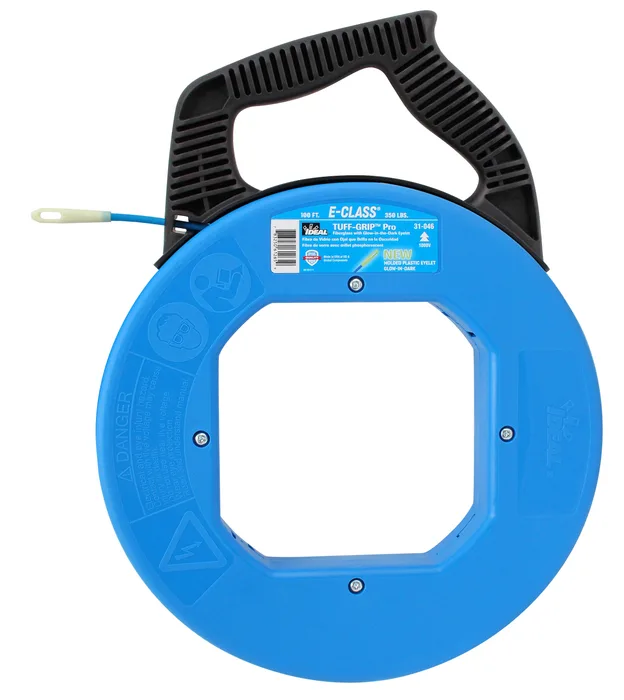
The only tape here whose maker puts a voltage number on the tape and a molded plastic eyelet on the end.
Best for: Anyone who wants the best documented non-conductive tape in the category and cares what the tip is made of.
- IDEAL states the fiberglass core is non-conductive up to 1000 V, the only voltage figure any maker in this group publishes.
- The end is a molded glow-in-the-dark plastic eyelet, so the first part into the box is not metal.
- Published as 3/16 inch tape, 350 lb pulling strength, 100 feet in a 12 inch case, with a documented eyelet repair kit (31-044).
- IDEAL footnotes the 1000 V claim as based on internal testing, so it is the maker's own number and not a third party certification.
- IDEAL's own user guide still warns not to use the tape on or near live circuits or energized equipment.
- 350 lb is the middle of IDEAL's non-conductive line, below the 500 lb S-Class.
- Replacing the eyelet means stripping the jacket, gluing and waiting 24 hours for the adhesive to cure.
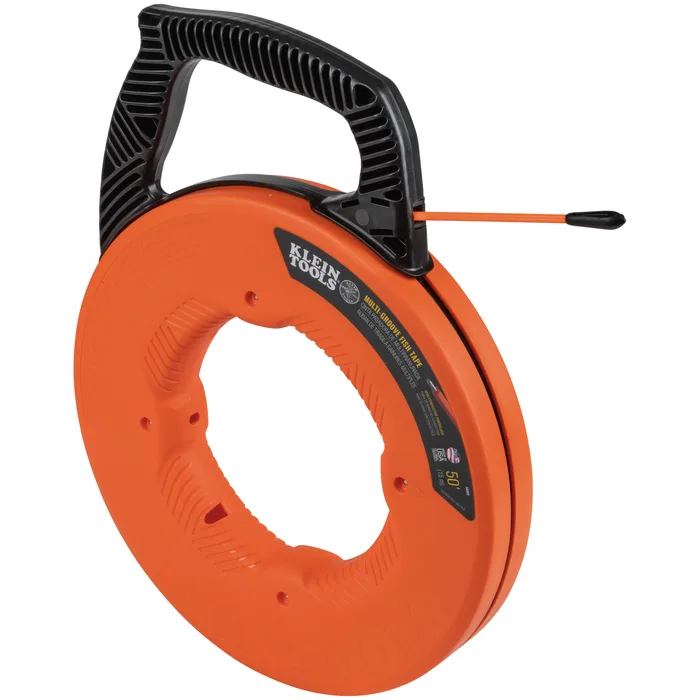
The short, cheap way to get a non-conductive tape with a non-conductive tip, if you can live with fifty feet.
Best for: Residential work and short runs where you want the softer material without stepping up to a flagship reel.
- Klein lists the tape end as a non-conductive nylon eyelet, narrower for feeding and chamfered so it catches less on the pull back.
- The grooved profile puts less surface against the conduit wall, which is the whole argument for buying this shape over a plain rod.
- Light and compact at 2.7 lb in a 13 inch polypropylene case, and the tip is replaceable with Klein's 56025 repair kit.
- Klein publishes no pulling strength or tensile figure for this model, so you cannot compare it on paper with the IDEAL or Greenlee numbers.
- Fifty feet runs out fast on commercial conduit or a long attic run.
- No published voltage or dielectric rating, only the word non-conductive.
- Klein prints the flattest warning in the group: do not use any fish tape on or near live circuits.
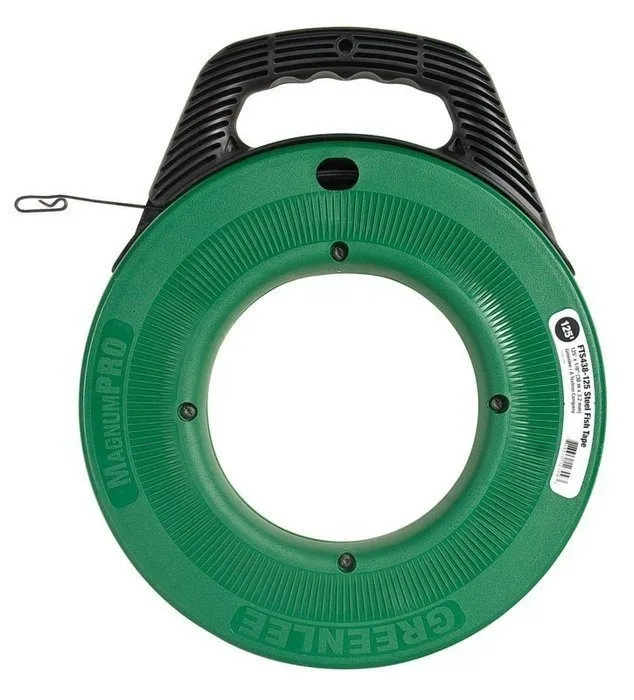
Still the best pusher in the category, with genuinely replaceable leaders, and still a length of steel going somewhere you cannot see.
Best for: Long empty conduit and de-energised work where push force and a rebuildable tip matter more than the material.
- Greenlee publishes 400 lb maximum design strength for the oil-tempered spring steel tape.
- Leaders are ordinary spare parts: a 12 inch flexible leader (439-1), a 12 inch Speed Flex leader (439-2), plus a swivel ball head and a replacement tape.
- The small offset fish eye and low profile tip are designed to clear couplings rather than hang on them.
- It is steel and it conducts, which is the one thing fiberglass and nylon exist to avoid.
- Greenlee does not publish a tape width or thickness for this model on the product page, only that the FTS438 line comes in 1/8 inch, 1/4 inch and flat profiles.
- Spring steel holds its coil, so it wants to go the way it was wound rather than the way you point it.
- No live circuit warning appears on the Greenlee product page, so you are relying on general practice rather than the maker's own text.
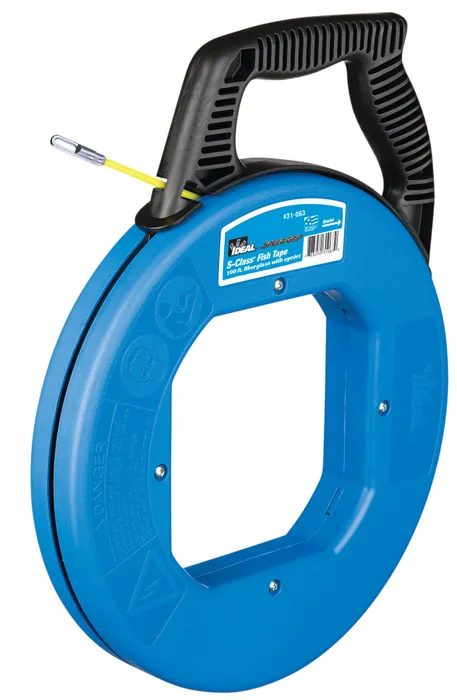
IDEAL's stronger fiberglass tape, sold with a machined metal eyelet on the end and left unmarked in IDEAL's own non-conductive table.
Best for: Someone who specifically wants 500 lb column strength and a metal eye, and who is not buying this tape for the non-conductive claim.
- 500 lb tensile strength, the highest of IDEAL's non-conductive line, in the same 3/16 inch nylon jacketed fiberglass construction.
- Tuff-Grip Pro case and a limited lifetime warranty, the same hardware as the E-Class.
- Eyelets and leaders are replaceable, and IDEAL sells a non-conductive eyelet repair kit (31-203) that fixes the exact problem below.
- IDEAL lists the end type as a machined metal eyelet, so the leading inch of a tape bought for its non-conductive core is metal.
- The Non-Conductive Fish Tape Selection Guide in IDEAL's user guide marks the E-Class and Helix as non-conductive up to 1000 V and leaves the S-Class row unmarked.
- The S-Class product page still describes non-conductive tapes as the safest choice for working near live circuits, which reads oddly next to the metal eyelet on the same page.
- Replacing the eyelet is a crimping job needing a crimp tool, adhesive and a 24 hour cure, not a field swap.
| Criteria | E-Class Fiberglass Fish Tape, 100-Foot (31-046) Top pick | Multi-Groove Fiberglass Fish Tape with Nylon Tip, 50-Foot (56382) | MagnumPRO 125' Steel Fish Tape (FTS438-125) | S-Class Fish Tape with Metal Eyelet, 100-Foot (31-063) |
|---|---|---|---|---|
| Verdict | Buy it | Buy it | It depends | Skip it |
| Best for | Anyone who wants the best documented non-conductive tape in the category and cares what the tip is made of. | Residential work and short runs where you want the softer material without stepping up to a flagship reel. | Long empty conduit and de-energised work where push force and a rebuildable tip matter more than the material. | Someone who specifically wants 500 lb column strength and a metal eye, and who is not buying this tape for the non-conductive claim. |
| Price tier | $$ · mid-range | $ · budget | $$ · mid-range | $$$ · premium |
| Tape material | Fiberglass core, nylon jacket | Multi-groove fiberglass | Oil-tempered spring steel | Fiberglass core, nylon jacket |
| Tape size published | 100 ft, 3/16 in | 50 ft, 3/16 in | 125 ft, width not published | 100 ft, 3/16 in |
| Pulling or tensile strength | 350 lb | Not published | 400 lb maximum design strength | 500 lb |
| Voltage rating published | Up to 1000 V, based on internal testing | None, non-conductive only | None, steel tape | None, row unmarked in IDEAL's own table |
| Tip or leader | Molded glow-in-the-dark plastic eyelet | Non-conductive nylon eyelet | Offset fish eye, low profile tip | Machined metal eyelet |
| Replaceable tip or leader | Yes, repair kit 31-044 | Yes, repair kit 56025 | Yes, leaders 439-1 and 439-2 | Yes, eyelets 31-158 or non-conductive kit 31-203 |
| Case | 12 in Tuff-Grip Pro, 25 ft drop claim | 13 in polypropylene | MagnumPRO with viewing port | 12 in Tuff-Grip Pro, 20 ft drop claim |
| Maker's live circuit warning | Do not use on or near live circuits | Do not use any fish tape on or near live circuits | None on the product page | Do not use on or near live circuits |
Which one is right for you?
- Anyone who wants the best documented non-conductive tape in the category and cares what the tip is made of. Buy it IDEAL Electrical E-Class Fiberglass Fish Tape, 100-Foot (31-046)
- Residential work and short runs where you want the softer material without stepping up to a flagship reel. Buy it Klein Tools Multi-Groove Fiberglass Fish Tape with Nylon Tip, 50-Foot (56382)
- Long empty conduit and de-energised work where push force and a rebuildable tip matter more than the material. It depends Greenlee MagnumPRO 125' Steel Fish Tape (FTS438-125)
- Someone who specifically wants 500 lb column strength and a metal eye, and who is not buying this tape for the non-conductive claim. Skip it IDEAL Electrical S-Class Fish Tape with Metal Eyelet, 100-Foot (31-063)
How we judged the field
Five things decide whether a fish tape is worth owning. What the tape is made of, because steel conducts and fiberglass, nylon and polymer do not, and that is the only property in this category with a safety consequence. What the tip is made of, because the eyelet or leader is the first thing into an unknown space and the first thing to break. The size of the tape, width and thickness on flat steel or diameter on a round rod, because that is what decides which conduit it will negotiate and how tight a bend it will round. Whether the maker publishes a strength figure at all, and what kind of figure it is. And whether the tip is a spare part you can buy, because the tip is what fails.
The field splits four ways and the split is genuinely about material. Flat spring steel pushes hardest and holds its coil, which is both its strength and its memory problem. Round fiberglass is lighter, has no coil memory, and pushes in any direction, which helps in conduit that bends in more than one plane, but bare fiberglass can splinter with age, which is why almost every current fiberglass tape now wears a nylon jacket. Nylon on its own is soft and curl resistant. Then there are extruded polymer tapes, which are marketed on not splintering. We picked two non-conductive tapes worth buying, one steel tape that is right for a specific job and wrong for others, and one tape we would pass on for reasons that come entirely off its own maker’s paperwork.
IDEAL Electrical E-Class Fiberglass Fish Tape, 100-Foot (31-046)
Buy itIDEAL is the only maker in this group that puts a voltage figure on the tape itself. The E-Class is a fiberglass core inside a smooth nylon jacket, 3/16 inch across, 100 feet in a 12 inch case, and IDEAL states it is non-conductive up to 1000 V. Read the footnote before you lean on that: the sell sheet marks the claim as based on internal testing, so it is IDEAL’s own number rather than a certification to a published test standard. The end is a molded glow-in-the-dark plastic eyelet, which matters more than it sounds, because the eyelet is what reaches into the box first and glows when you are looking down a dark ceiling void for it. Pulling strength is 350 lb, the middle of IDEAL’s non-conductive line. The round jacket pushes omni-directionally, which is the real advantage over flat steel in multi-plane runs, and the eyelet comes off and back on with repair kit 31-044, adhesive and a 24 hour cure. IDEAL’s user guide still says do not use on or near live circuits. Buy it if you want the most documented tape here.
Klein Tools Multi-Groove Fiberglass Fish Tape with Nylon Tip, 50-Foot (56382)
Buy itKlein’s multi-groove fiberglass tape is the same idea in a smaller package. Fifty feet of 3/16 inch grooved fiberglass in a 13 inch polypropylene case, 2.7 lb, with a non-conductive nylon eyelet Klein describes as narrower for easier feeding and chamfered so it catches less on the way back. The grooves are the point rather than styling: less surface touching the wall of a crowded conduit means less drag, which is what you feel at forty feet. Fifty feet covers most residential fishing, a wall cavity, a panel to a nearby box, a basement ceiling, and the 100 foot version (56383) is the same tape if you need the reach. What Klein does not give you is any pulling strength or tensile figure on either model, so it cannot be compared on paper with the IDEAL and Greenlee numbers. Klein does print the bluntest warning of anyone: do not use any fish tape on or near live circuits. Repair kit 56025 replaces the tip. Buy it for short runs where you want the softer material.
Greenlee MagnumPRO 125’ Steel Fish Tape (FTS438-125)
It dependsSteel is still the best pusher and Greenlee’s MagnumPRO is a clean example of it. Oil-tempered spring steel, 125 feet, published at 400 lb maximum design strength, with a small fish eye bent off axis and a low profile tip meant to clear couplings rather than hang on them. What sets it apart is the parts list. A 12 inch flexible leader (439-1), a 12 inch Speed Flex leader (439-2), a swivel ball head, a replacement tape without the case, and case and handle kits. When something goes on this tape, and it is the leader that goes, you replace the part rather than the tool. The catch is the obvious one: it is steel, it conducts, and it travels somewhere you cannot see. Greenlee also publishes no width or thickness for this model on its page, only that the FTS438 line comes in 1/8 inch, 1/4 inch and flat profiles. Get it for long empty conduit and confirmed de-energised work, and leave it in the van near a panel you have not proved dead.
IDEAL Electrical S-Class Fish Tape with Metal Eyelet, 100-Foot (31-063)
Skip itThis is IDEAL’s stronger fiberglass tape, 500 lb against the E-Class’s 350, the same 3/16 inch nylon jacketed core, the same Tuff-Grip Pro case, and it is the one people reach for because the bigger number is the one on the label. Two things in IDEAL’s own paperwork argue against this particular version. First, the published end type is a machined metal eyelet, so the leading inch of a tape bought for a non-conductive core is metal. Second, the Non-Conductive Fish Tape Selection Guide printed in IDEAL’s user guide marks the E-Class and the Helix as non-conductive up to 1000 V and leaves the S-Class row unmarked, while the S-Class product page still describes non-conductive tapes as the safest choice for working near live circuits. IDEAL sells the fix itself: kit 31-203 puts non-conductive eyelets on an S-Class, and 31-061 ships with a leader instead. Skip the metal eyelet version unless the tip material genuinely does not matter to you.
Sources
Specs in this review come from these pages.
- IDEAL Electrical, Fish Tape Line User Guide (p1.aprimocdn.net)
- IDEAL Electrical, E-Class Fiberglass Fish Tape product page (idealelectricalinc.com)
- Klein Tools, Multi-Groove Fiberglass Fish Tape with Nylon Tip 50-Foot (56382) (kleintools.com)
- Greenlee, 125' Steel Fish Tape (FTS438-125) (greenlee.com)
- Southwire, Maximum Pulling Tension for Electrical Conductors (southwire.com)
- OSHA 29 CFR 1910.333, Selection and use of work practices (osha.gov)
IDEAL Electrical E-Class Fiberglass Fish Tape, 100-Foot (31-046) vs Klein Tools Multi-Groove Fiberglass Fish Tape with Nylon Tip, 50-Foot (56382): which should you buy?
The two buys are the same material with different amounts of documentation behind them. The IDEAL E-Class publishes a 350 lb pulling strength, a 1000 V non-conductive claim with an honest internal-testing footnote, a 12 inch case, a 25 ft drop claim and a printed eyelet replacement procedure. The Klein 56382 publishes the tape size, the case, the weight and the fact that the eyelet is non-conductive nylon, and stops there. If you want to be able to defend your choice from a spec sheet, the IDEAL wins on paper and it is not close.
What pushes people the other way is length and money. Klein’s is a fifty foot reel at the budget end of the category, and fifty feet is enough for the overwhelming majority of residential fishing. If your work is a house, a garage, a basement ceiling, buy the Klein and put the difference into wire lubricant and a proper voltage tester. If your work is commercial conduit, long runs, multi-plane bends, or anywhere you want the tape’s own rating written down, buy the E-Class in 100 or 200 feet. Both give you a non-metal tip, which is the single spec most buyers never check and the one that decides what touches a conductor first.
What to look for
- Check the tip, not just the tape: a fiberglass or polymer tape with a metal eyelet or a steel leader puts metal at the exact point that reaches an unknown space first, and makers publish the end type as a separate spec for that reason.
- Treat non-conductive as added protection: IDEAL and Klein both print do not use on or near live circuits in their own documentation for tapes they market as non-conductive, so the material is a second layer behind proving the circuit dead.
- Ask what kind of strength number it is: 350 lb pulling strength and 400 lb maximum design strength are different measurements, and one maker in this group publishes no figure at all for its fiberglass tape.
- Width and thickness decide what it will negotiate: on flat steel the wider tape is often the thinner one, bending easily in one plane and resisting in the other.
- Buy a tape whose tip is a spare part: the makers here sell eyelets or leaders separately, and a tape you can rebuild for the cost of a repair kit outlasts one you replace whole.
- Budget for lubricant and know the cable’s limit: IDEAL’s fishing instructions call for a wire pulling lubricant, and Southwire’s own tables cap a single 12 AWG copper conductor at 52 lb of pulling tension, far below any tape rating.
Our final take
Buy the IDEAL E-Class if you want the most checkable tape in the category: a published 1000 V figure with an honest footnote about where it came from, a molded plastic eyelet, a stated 350 lb, and a repair kit part number. Buy the Klein 56382 if fifty feet is enough and you want the same non-conductive tip for less. Keep a Greenlee steel tape for long empty conduit and de-energised work, and accept what it is. Skip the S-Class with the machined metal eyelet, or fit IDEAL’s own non-conductive eyelet kit to it. Whatever you buy, the tape is not the safety device. Proving the circuit dead is.
Questions, answered
Is a steel fish tape actually dangerous?
It is a long conductor you are pushing into a space you cannot see, so yes, the risk is real rather than theoretical. Klein prints the warning on its fish tape product page in plain language: do not use any fish tape on or near live circuits. IDEAL's user guide says the same thing and adds that electrical shock may occur causing injury or death, so make sure all power is off. OSHA 1910.333(c)(6) also requires that conductive materials and equipment in contact with any part of an employee's body be handled so they cannot contact exposed energized conductors. The honest summary is that the tool is fine and the practice is what kills people, which is why our [non-contact voltage tester comparison](/best-non-contact-voltage-testers) spends its length on how you prove a circuit dead before you go anywhere near it.
Does non-conductive fiberglass mean I can fish a live panel?
No, and the makers say so themselves. IDEAL sells the E-Class with a published 1000 V rating and still prints do not use on or near live circuits in the user guide for that exact tape. Klein carries the same warning on its non-conductive fiberglass reels. Added protection is the right phrase. Treat non-conductive as a second layer behind proving the circuit dead, not as a substitute for it.
What does the pulling strength number on a fish tape actually tell me?
Less than you would hope, for two reasons. First, the makers are not all measuring the same thing: IDEAL publishes 350 lb and 500 lb pulling strengths, Greenlee publishes 400 lb maximum design strength for its steel tape, and Klein publishes no figure at all for this fiberglass reel. Second, the tape is almost never the weak link. The number is a design ceiling, not a working load.
What usually breaks first on a fish tape?
The tip. The makers in this comparison sell the eyelet or leader as a spare part, which tells you how often it goes: IDEAL sells eyelet kits 31-044, 31-158, 31-159 and 31-203, Klein sells repair kits 56025 and 56115 plus replacement eyelets 56116 and leaders 56120, and Greenlee sells the 439-1 and 439-2 leaders. The second failure mode is a kink or a damaged jacket rather than a clean break. IDEAL's guide warns against using pliers or other tools that may kink, damage or weaken the tape, and against using any tape that is fractured, has multiple ends or has a damaged jacket.
Do I need wire pulling lubricant, and how hard can I actually pull?
Lubricant is expected, not optional. IDEAL's own fishing instructions say to use a wire pulling lubricant for best results, to reduce pulling effort and protect the wires, and Klein lists a pulling lubricant as a companion item on its fish tape pages. On tension, the limit that matters is the cable's, not the tape's. Southwire publishes maximum allowable pulling tension for its conductors using 0.008 lb per circular mil for copper and 0.006 for aluminium, which works out at 52 lb for a single 12 AWG copper conductor and 157 lb for three of them. Southwire also caps sidewall bearing pressure at 1,000 lb for 8 AWG and larger and 500 lb for 14, 12 and 10 AWG. Those numbers sit well below any tape's rating, which is the real reason a hard pull damages wire before it breaks tape.
Deciding between the top two? See our head-to-head: IDEAL Electrical E-Class Fiberglass Fish Tape, 100-Foot (31-046) vs Klein Tools Multi-Groove Fiberglass Fish Tape with Nylon Tip, 50-Foot (56382).
More Tools & DIY reviews
 The Best Framing Nailers: 4 Compared (and One to Skip)
  The Best Grease Guns: 4 Compared (and One to Skip)
  The Best Hard Hats: 4 Compared (and One to Skip)
  The Best Heat Guns: 4 Compared (and One to Skip)
  The Best Helping Hands: 4 Compared (and One to Skip)
  The Best Hex Key Sets: 4 Compared (and One to Skip)