

Tools & DIY
The Best Framing Nailers: 4 Compared (and One to Skip)
Four framing nailers compared on a choice that can fail an inspection: collation angle decides head shape, and some building codes do not accept clipped head nails.
The short version
Buy the Makita AN924. It is a 21 degree pneumatic driving full round head nails from 2 to 3-1/2 inches with shanks up to .148, which covers 16d framing and satisfies codes that require a full round head. Pneumatic also means no battery to manage on a tool that fires all day. Buy the DEWALT DCN920B if the hose is the problem: it is a 20V brushless cordless running the same 21 degree full round head nails from 2 to 3-1/2 inches and .113 to .148 gauge, at the cost of a 36 nail magazine. The Metabo HPT NR90AD(S1) is the it-depends, a 7.0 lb 30 degree paper strip pneumatic that drives 2 to 3-1/2 inch nails up to .148, but its manual lists clipped-head nails only, so it is the right tool only where the code accepts them. Skip the DEWALT DCN930B unless you already run 30 degree nails: it is the same cordless body as the DCN920B with a 55 nail magazine, but it takes clipped or offset round head nails and stops at .131 shanks, so it gives up the head shape and the heavy fastener for a few more nails per strip. Best for: anyone choosing a framing nailer on magazine capacity without checking what head shape their inspector accepts.
Our picks at a glance
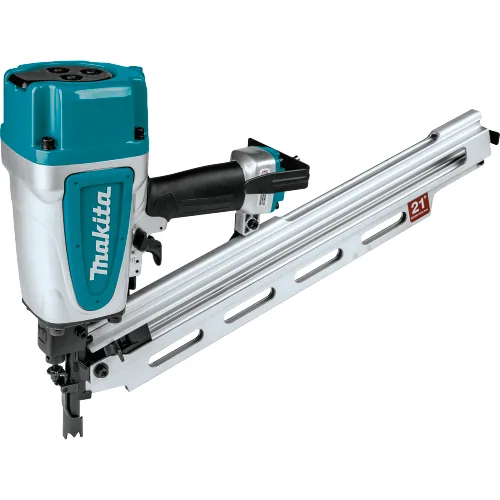
- Makita AN924 21 Degree Full Round Head Framing Nailer - Buy. Full round head nails to a full 3-1/2 inches, which is the combination that satisfies codes that reject clipped heads.
- DEWALT DCN920B 20V MAX XR Brushless Cordless 21 Degree Plastic Collated Framing Nailer - Buy. Full round head nails to 3-1/2 inches with no hose, the code-safe collation in a cordless body.
- Metabo HPT NR90AD(S1) 3-1/2 Inch 30 Degree Paper Collated Framing Nailer - It depends. A 7.0 lb, 30 degree paper strip pneumatic that drives the full 3-1/2 inch range, on clipped head nails only.
- DEWALT DCN930B 20V MAX XR Brushless Cordless 30 Degree Paper Collated Framing Nailer - Skip. The 30 degree twin of the DCN920B, giving up the full round head and the heaviest shanks for a bigger magazine.
The verdict in 30 seconds
What mattered most
- Collation angle
- Collation material
- Head shape
- Nail length range
- Shank diameter
- Power source
Two of these four nailers are DEWALT cordless twins that differ only in collation, which is deliberate. The two decisions in this category are collation angle and power source, and a matched pair is the cleanest way to see what the angle costs. The collation decision is the one with consequences beyond the tool. Twenty-one degree magazines use plastic strip and take full round head nails. Thirty degree magazines use paper tape and, in the great majority of cases, take clipped head nails, where a portion of the head is cut away so the nails sit closer together. Clipped heads hold less, and some building codes do not permit them at all, particularly in high wind and seismic areas. That makes the angle on the magazine a code question rather than a preference, and it is worth settling before you buy rather than at inspection.
Full round head nails to a full 3-1/2 inches, which is the combination that satisfies codes that reject clipped heads.
Best for: Framing where the inspector requires full round heads and the shop already runs air.
- Twenty-one degree plastic collation takes full round head nails, which hold better and are accepted in jurisdictions that prohibit clipped heads.
- Drives 2 in. to 3-1/2 in. with shank diameters up to .148, so 16d framing nails are within range.
- Pneumatic, so there is no battery to run down on a tool that fires continuously through a day.
- Makita states the head type explicitly in the product name rather than leaving it to be inferred from the angle.
- Needs a compressor, hose and fittings, none of which appears in the price comparison.
- Plastic collation shatters on firing and throws fragments, which is a real argument for eye protection and a nuisance to clean up.
- Twenty-one degree magazines are bulkier than 30 degree ones and awkward between close studs.
- Plastic collated nails can cost more than paper tape equivalents.
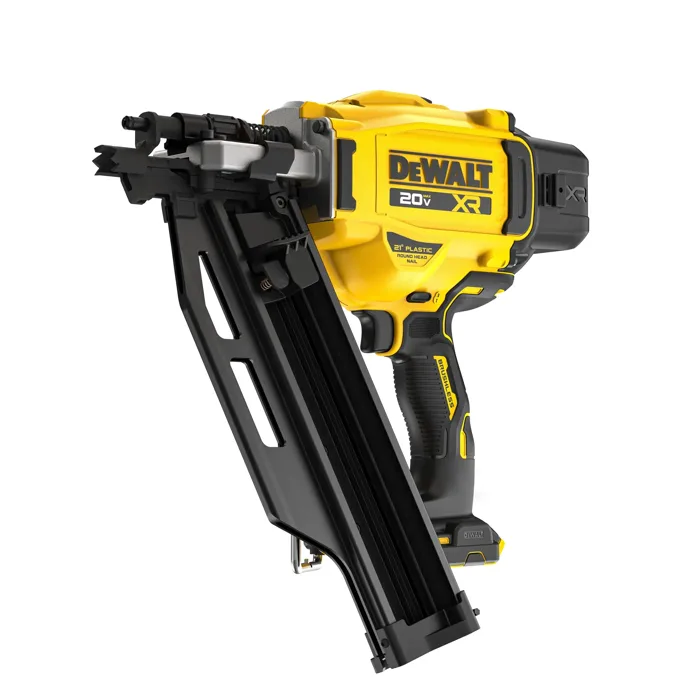
Full round head nails to 3-1/2 inches with no hose, the code-safe collation in a cordless body.
Best for: Framing and remodelling away from a compressor, including jurisdictions that require full round head nails.
- Drives 2 in. to 3-1/2 in. nails in .113 to .148 gauge, matching the Makita on both length and shank.
- Twenty-one degree plastic collation with full round head nails, the head shape codes that reject clipped heads accept.
- Cordless and brushless, so there is no compressor, hose or fittings and no line dragged across a deck.
- DEWALT states 8.65 lb tool only, and the flywheel stays spinning for 6 seconds after the trigger is released to cut the wait between shots.
- A 36 nail magazine, the smallest here, so it reloads more often than any other tool in the group.
- Bare tool, so batteries and charger are a separate and significant cost.
- Plastic collation throws fragments on firing, with the same debris and eye protection issue as the Makita.
- Cordless framing nailers are heavier at the nose than pneumatic and slower between shots on production runs.
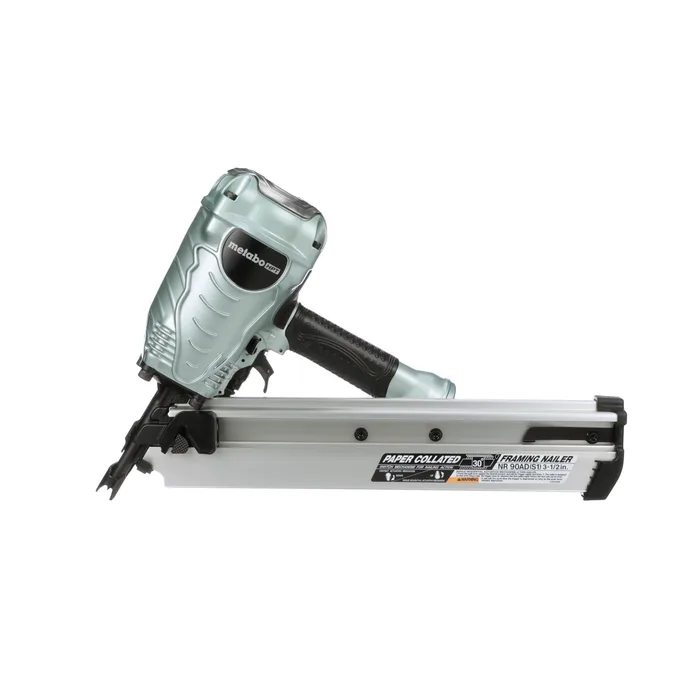
A 7.0 lb, 30 degree paper strip pneumatic that drives the full 3-1/2 inch range, on clipped head nails only.
Best for: Production framing in jurisdictions that accept clipped heads, where a light tool and the full 3-1/2 inch range matter more than head shape.
- Drives 2 in. to 3-1/2 in. nails with shanks from .113 to .148 in., so 16d framing nails are within range.
- Metabo HPT states 7.0 lb, against 8.65 lb for the DEWALT cordless pair.
- Paper collation leaves no plastic fragments, and the magazine holds 50 to 74 nails.
- Selective actuation switches between sequential and contact nailing, with tool-less depth adjustment, 70 to 120 PSI operation and a 5-year warranty.
- Metabo HPT's manual lists clipped-head nails only for this model, the head shape some building codes do not accept.
- Pneumatic, so a compressor, hose and fittings are part of the real cost.
- The spec table lists no dry-fire lockout, so the magazine can run empty without the tool stopping.
- Paper collation degrades if it gets damp, which is a genuine issue on an open frame.
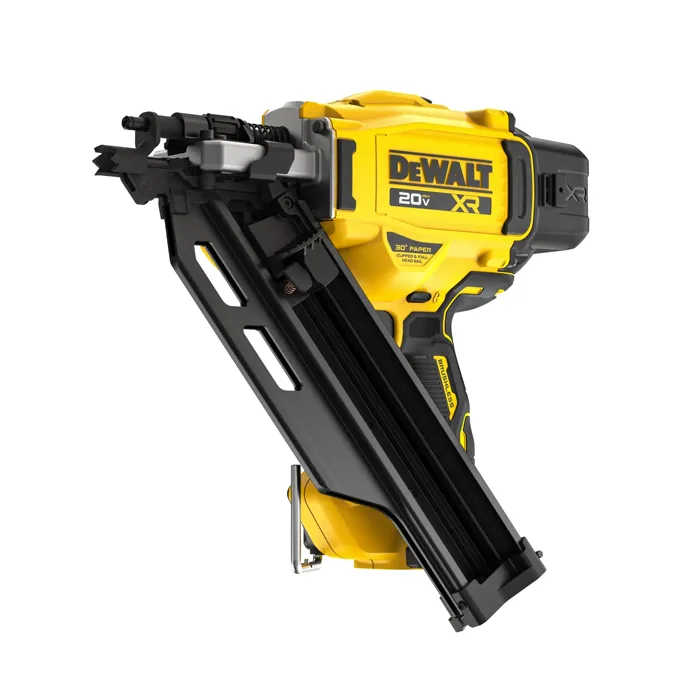
The 30 degree twin of the DCN920B, giving up the full round head and the heaviest shanks for a bigger magazine.
Best for: Crews already stocked with 30 degree paper tape nails, in jurisdictions that accept clipped or offset heads.
- Drives 2 in. to 3-1/2 in. nails, the same length range as its 21 degree sibling.
- A 55 nail magazine, with an optional extended magazine that holds two strips.
- Paper collation shears cleanly, so there is no plastic debris underfoot.
- Cordless and brushless, so no compressor, hose or fittings.
- DEWALT's manual lists clipped or offset round head nails at 30 to 34 degrees, the head shapes some building codes do not accept.
- Shanks top out at .131 in., short of the .148 in. its 21 degree twin and the Makita take.
- Same body and the same 8.65 lb stated weight as the DCN920B, so the 30 degree magazine buys no real size advantage.
- Bare tool, so batteries and charger are extra on an already premium price.
| Criteria | AN924 21 Degree Full Round Head Framing Nailer Top pick Buy it Buy | DCN920B 20V MAX XR Brushless Cordless 21 Degree Plastic Collated Framing Nailer Buy it Buy | NR90AD(S1) 3-1/2 Inch 30 Degree Paper Collated Framing Nailer It depends Buy | DCN930B 20V MAX XR Brushless Cordless 30 Degree Paper Collated Framing Nailer Skip it Buy |
|---|---|---|---|---|
| Best for | Framing where the inspector requires full round heads and the shop already runs air. | Framing and remodelling away from a compressor, including jurisdictions that require full round head nails. | Production framing in jurisdictions that accept clipped heads, where a light tool and the full 3-1/2 inch range matter more than head shape. | Crews already stocked with 30 degree paper tape nails, in jurisdictions that accept clipped or offset heads. |
| Price tier | $$$ · premium | $$$ · premium | $$ · mid-range | $$$ · premium |
| Collation angle | 21 degrees | 21 degrees | 30 degrees | 30 to 34 degrees |
| Collation material | Plastic strip | Plastic strip | Paper tape | Paper tape |
| Head shape | Full round head | Full round head | Clipped head | Clipped or offset round head |
| Nail length range | 2 to 3-1/2 in. | 2 to 3-1/2 in. | 2 to 3-1/2 in. | 2 to 3-1/2 in. |
| Shank diameter | Up to .148 in. | .113 to .148 in. | .113 to .148 in. | .113 to .131 in. |
| Power source | Pneumatic | 20V brushless | Pneumatic, 70 to 120 PSI | 20V brushless |
| Magazine capacity | 73 nails | 36 nails | 50 to 74 nails | 55 nails |
Which one is right for you?
- Framing where the inspector requires full round heads and the shop already runs air. Buy it Makita AN924 21 Degree Full Round Head Framing Nailer
- Framing and remodelling away from a compressor, including jurisdictions that require full round head nails. Buy it DEWALT DCN920B 20V MAX XR Brushless Cordless 21 Degree Plastic Collated Framing Nailer
- Production framing in jurisdictions that accept clipped heads, where a light tool and the full 3-1/2 inch range matter more than head shape. It depends Metabo HPT NR90AD(S1) 3-1/2 Inch 30 Degree Paper Collated Framing Nailer
- Crews already stocked with 30 degree paper tape nails, in jurisdictions that accept clipped or offset heads. Skip it DEWALT DCN930B 20V MAX XR Brushless Cordless 30 Degree Paper Collated Framing Nailer
How we judged the field
Head shape first, because it is the only thing in this comparison that can fail an inspection. Collation angle determines it: 21 degree plastic strip takes full round head nails and 30 degree paper tape is predominantly clipped head, and some building codes do not accept clipped heads, particularly where high wind or seismic loads are designed for. Then nail length, because framing schedules specify sizes and a 16d common nail is 3-1/2 inches, so a tool stopping at 3-1/4 cannot drive it. Then collation material, which is a debris and weather question rather than a safety one. Then power source, weighed against what a pneumatic tool actually costs once a compressor, hose and fittings are added. Two of the four are DEWALT cordless twins that differ only in collation, which is deliberate, because the pair isolates the collation variable rather than confounding it with brand.
Makita AN924 21 Degree Full Round Head Framing Nailer
Buy itThe Makita AN924 is the pick because it is the only pneumatic here that combines the code-safe head shape with the full length range. Twenty-one degree plastic collation means full round head nails, which hold better and are accepted in jurisdictions that prohibit clipped heads, and it drives 2 to 3-1/2 inches with shanks up to .148, so a 16d framing nail is within range rather than just outside it. Makita puts the head type in the product name rather than leaving you to infer it from the magazine angle, which is more useful disclosure than it sounds given how many buyers do not know the angle implies the head. Being pneumatic, it fires continuously without a battery to manage. The costs are the familiar pneumatic ones plus one specific to the collation: a compressor, hose and fittings are part of the real price, plastic strip shatters on firing and throws fragments that make eye protection non-optional, and the 21 degree magazine is bulkier and more awkward between close studs than a 30 degree one.
DEWALT DCN920B 20V MAX XR Brushless Cordless 21 Degree Plastic Collated Framing Nailer
Buy itThe DEWALT DCN920B is the second buy and the right answer when the hose is the problem. It runs the same 21 degree plastic strip as the Makita, so it drives full round head nails, and DEWALT’s manual lists the same 2 to 3-1/2 inch length range with shanks from .113 to .148, which puts a 16d framing nail in range without a compressor. On a remodel or a repair away from power that is the difference between working and not. It is brushless, DEWALT states 8.65 pounds tool only, and the flywheel keeps spinning for 6 seconds after the trigger is released so repeat shots do not wait on spin-up. The costs: the 36 nail magazine is the smallest here and means more reloads, it is a bare tool so batteries and a charger are a real additional cost, plastic collation throws the same fragments as the Makita, and it is nose-heavy compared with pneumatic.
Metabo HPT NR90AD(S1) 3-1/2 Inch 30 Degree Paper Collated Framing Nailer
It dependsThe Metabo HPT NR90AD(S1) is the it-depends, and the whole case turns on your code. On the numbers it is strong: Metabo HPT lists a 30 degree paper strip magazine holding 50 to 74 nails, a 2 to 3-1/2 inch length range with shanks from .113 to .148, 70 to 120 PSI operation, selective actuation, tool-less depth adjustment, a 5-year warranty and a stated 7.0 pounds. Paper collation means no plastic fragments. The catch is in the owner’s manual, which lists clipped-head nails as the only nails for this model. Where the code accepts clipped heads, it covers 16d framing on a light tool for much less than either cordless gun. Where the inspector wants full round heads, no spec on the page makes up for that. It is also pneumatic, so a compressor, hose and fittings are part of the cost, the spec table lists no dry-fire lockout, and paper strips go soft when they get damp on an open frame.
DEWALT DCN930B 20V MAX XR Brushless Cordless 30 Degree Paper Collated Framing Nailer
Skip itThe DEWALT DCN930B is the skip, and the reason is its own sibling. It shares a body, a manual and an 8.65 pound stated weight with the DCN920B, and it drives the same 2 to 3-1/2 inch nails. What changes is the magazine: 30 to 34 degree paper collation, which DEWALT’s manual pairs with clipped or offset round head nails, and a shank range that stops at .131 inches. In return you get a 55 nail magazine against 36, an optional extended magazine that holds two strips, and paper collation that leaves no plastic debris. That is a thin return for giving up the head shape some codes require and the heaviest fastener in the group, and the 30 degree angle does not buy a lighter tool here: the pneumatic Metabo HPT takes 30 degree nails up to .148 at a stated 7.0 pounds. If your crew already stocks 30 degree nails and your inspector accepts clipped or offset heads, it is a capable gun. For anyone choosing a cordless DEWALT from scratch, the 21 degree twin is the better buy.
Sources
Specs in this review come from these pages.
- Makita USA, AN924 21 degree full round head framing nailer (makitatools.com)
- Metabo HPT, NR90AD(S1) 3-1/2 inch 30 degree paper collated framing nailer (metabo-hpt.com)
- Metabo HPT, NR90AD(S1) owner's manual, nail selection (metabo-hpt.com)
- DEWALT DCN920B 20V MAX XR 21 degree plastic collated cordless framing nailer (dewalt.com)
- DEWALT DCN930B 20V MAX XR 30 degree paper collated cordless framing nailer (dewalt.com)
- DEWALT DCN920 and DCN930 instruction manual, fastener specifications (assets.dewalt.com)
- On framing nailer collation angles, head shape and code acceptance (finepowertools.com)
- Why framing nail guns have differing angles (nailgundepot.com)
Makita AN924 21 Degree Full Round Head Framing Nailer vs DEWALT DCN920B 20V MAX XR Brushless Cordless 21 Degree Plastic Collated Framing Nailer: which should you buy?
Both tools run 21 degree plastic strip with full round head nails from 2 to 3-1/2 inches and shanks up to .148, so the code question is settled either way and the split is power source. The Makita is pneumatic, carries 73 nails to the DEWALT’s 36, and fires all day without a battery to manage, at the cost of a compressor, hose and fittings. The DEWALT removes the hose and adds a battery and charger to the real price. For production framing on an open frame, where a hose is barely noticed, the Makita is the safer default. For remodel work in an occupied house, where dragging a hose through finished rooms is genuinely disruptive, the cordless DEWALT earns its place.
What to look for
- The collation angle, read as a head shape question: 21 degree plastic means full round head, 30 degree paper tape usually means clipped head, and some codes reject the latter.
- Your local code before the tool: the head shape restriction is a jurisdiction question, most common in high wind and seismic areas, and it settles the angle for you.
- Maximum nail length against the schedule: a 16d common nail is 3-1/2 inches, and a tool stopping at 3-1/4 cannot drive it however good it otherwise is.
- Shank diameter range: heavier shanks carry more load, and .148 is the top of this group.
- Collation material as a site question: plastic throws fragments and shrugs off weather, paper is tidy and goes soft when damp.
- The full cost of pneumatic: a compressor, hose and fittings are part of the purchase and never part of the shelf price.
Our final take
Framing nailers are compared on magazine capacity and weight, and decided by the head shape their collation angle commits you to. Find out what your inspector accepts, let that choose the angle, then check the tool reaches 3-1/2 inches before anything else. A gun with the right head shape and the wrong length range solves half a problem.
Questions, answered
What is a clipped head nail and why would a code prohibit it?
A clipped head nail has part of its head cut away so the nails can sit tighter together in the strip, which is what allows a 30 degree magazine to be compact. Less head means less bearing area against the timber and less withdrawal and shear resistance in a connection. Some building codes do not permit clipped head or offset head nails at all, and the restriction is most common in high wind and seismic regions where connection strength is designed for. Since the head shape follows from the collation angle, the tool you buy determines which nails you can use, so the code question is a purchase decision.
Does 21 degree always mean full round head?
In practice yes for the framing nailers sold in North America. Plastic strip collation holds nails far enough apart that the full head fits, which is why 21 degree guns take full round head nails. Thirty degree paper tape needs the nails closer together, and clipping the head is how that is achieved, so most 30 degree nails are clipped. There are exceptions and offset full round head nails exist, so read the nail box rather than assuming from the angle alone, but the general rule holds and it is the reason the two systems exist.
Paper tape or plastic collation?
Paper shears cleanly when the nail fires and the remnant is usually driven into the wood with it, so nothing is left on the ground. Plastic shatters and throws small fragments, which is unpleasant without eye protection and leaves debris across a site. Paper's weakness is water: a damp strip goes soft and jams. So plastic is more robust in the weather and messier in use, and paper is tidier and less tolerant of an exposed frame. Neither is a safety difference in the way head shape is.
Why does the maximum nail length matter so much?
Because framing schedules specify nail sizes, and a 16d common nail is 3-1/2 inches. A tool that stops at 3-1/4 covers a great deal of framing, sheathing and blocking, but it cannot drive the longest fasteners that connection details often call for. That is why the two tools here that reach 3-1/2 inches with full round heads are the two buys. Length alone is not enough, though: the Metabo HPT reaches 3-1/2 inches too, but on clipped-head nails only.
Is cordless good enough for framing now?
For remodelling, repairs and moderate volume, comfortably. For production framing, pneumatic still wins on cycle rate and on weight at the nose, because the power source is at the other end of a hose rather than on the tool. Cordless framing nailers also cost considerably more once batteries are counted. The honest test is how far you are from a compressor and how many nails you drive in a day: a hose across a finished floor is a nuisance, a hose across an open frame is barely noticed.
Deciding between the top two? See our head-to-head: Makita AN924 21 Degree Full Round Head Framing Nailer vs DEWALT DCN920B 20V MAX XR Brushless Cordless 21 Degree Plastic Collated Framing Nailer.
More in Tools & DIY
Framing Nailers, Explained Plain-English guide → Makita AN924 21 Degree Full Round Head Framing Nailer vs DEWALT DCN920B 20V MAX XR Brushless Cordless 21 Degree Plastic Collated Framing Nailer Head-to-head →  The Best Grease Guns: 4 Compared (and One to Skip)
  The Best Hard Hats: 4 Compared (and One to Skip)
  The Best Heat Guns: 4 Compared (and One to Skip)
  The Best Helping Hands: 4 Compared (and One to Skip)