

Tools & DIY
The Best Circular Saws: 4 Compared (and One to Skip)
Four 7-1/4 inch circular saws compared on the cut depth figure nobody quotes: the one at 45 degrees, which runs roughly 25 to 30 percent below the number in the listing where it is published at all.
The short version
Buy the DEWALT DWE575SB. It lists 2-9/16 inches of cut at 90 degrees and 1.9 inches at 45, which is the deepest bevel capacity here and the smallest collapse among the saws that publish both, about 25 percent. It is a 15 amp corded saw with an electric brake, and the brake matters more than the amperage does. Buy the Makita 5007MG if you want magnesium construction and a 56 degree bevel: it gives up only a little, 2.5 inches at 90 and 1.75 at 45, and has no electric brake. The DEWALT DCS570P1 is the it-depends and the cordless case: identical 2-9/16 inch capacity at 90 degrees and a 57 degree bevel range with no cord, but DEWALT does not publish a 45 degree figure for it, so buy it if the cord is the bigger problem than an unknown bevel depth. Skip the CRAFTSMAN CMES510 if bevel work is why you are buying: it publishes a 2-1/8 inch capacity for 2x material and no 45 degree depth figure at all, so the specification that decides bevelled cuts is simply missing. Best for: anyone who has been comparing circular saws on amps and blade diameter, which are the two numbers that barely differ.
Our picks at a glance
- DEWALT DWE575SB 7-1/4 in. Lightweight Circular Saw with Electric Brake - Buy. The deepest bevel capacity in this comparison, and the smallest gap between its 90 and 45 degree figures.
- Makita 5007MG 7-1/4 in. Magnesium Circular Saw - Buy. Magnesium construction and a 56 degree bevel range, giving up only a small amount of bevel depth to get there.
- DEWALT DCS570P1 20V MAX XR 7-1/4 in. Brushless Circular Saw Kit - It depends. The same 90 degree capacity as its corded sibling and no cord, but DEWALT does not publish a 45 degree figure for it.
- CRAFTSMAN CMES510 15 Amp 7-1/4 in. Electric Circular Saw - Skip. Quotes a capacity for 2x material and never publishes a 45 degree depth, which is the figure bevel work actually needs.
The verdict in 30 seconds
What mattered most
- Cut depth at 90 degrees
- Cut depth at 45 degrees
- Loss from 90 to 45
- Power
- Electric brake
- Maximum bevel
Circular saw listings lead with a cutting capacity, and that figure is measured at 90 degrees with the shoe flat. Tilt the shoe to 45 for a bevel and the usable depth collapses, by about a quarter on the best saw here and by 30 percent on the next. The gap is not consistent between models: two saws quoting almost identical 90 degree capacity differ by 0.15 in. once bevelled. Two of the four do not publish a 45 degree figure at all. Since bevelling is most of why anyone buys a circular saw rather than a track saw or a mitre saw, that is the number the decision should turn on.
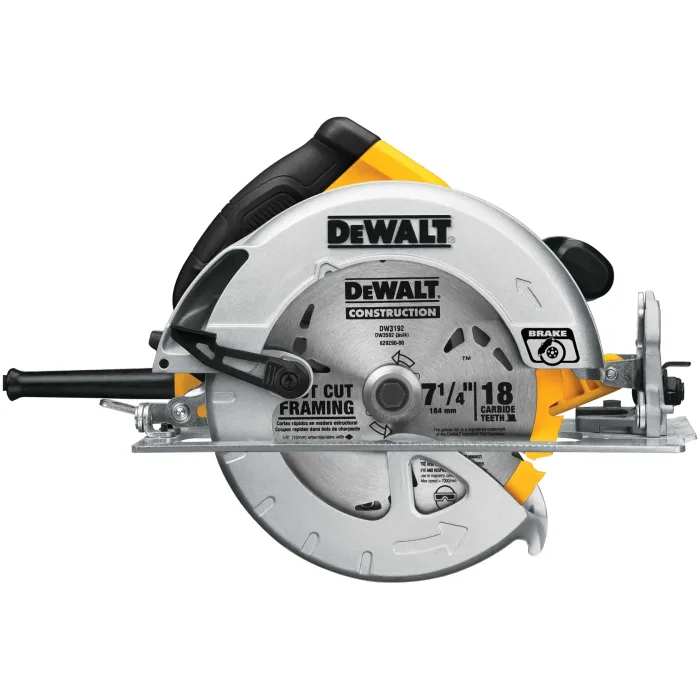
The deepest bevel capacity in this comparison, and the smallest gap between its 90 and 45 degree figures.
Best for: Anyone whose work includes bevelled cuts in thicker stock and who wants the depth figure that actually governs them.
- Lists 2-9/16 in. of cut at 90 degrees and 1.9 in. at 45, the deepest bevel figure here.
- The collapse between the two is about 25 percent, against 30 percent on the Makita, the only other saw here with both figures published.
- Electric brake stops the blade after the trigger releases, which matters far more for safety than any amperage figure.
- 15 amp motor with a 57 degree bevel range and stops at 45 and 22.5.
- Corded, so the cord is in the cut on every job and an extension lead is part of the kit.
- No magnesium construction like the Makita, though DEWALT lists the DWE575 at 8.8 lbs against the Makita's 10.6 lbs.
- Bevel capacity matches the cordless DEWALT at 57 degrees, so there is no range advantage either way.
- Amperage is quoted prominently and tells you almost nothing, since three of the four saws here are 15 amp.
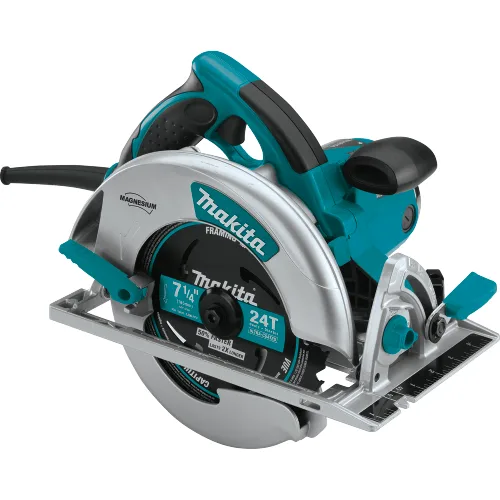
Magnesium construction and a 56 degree bevel range, giving up only a small amount of bevel depth to get there.
Best for: Framing and repetitive cutting where magnesium durability and a 56 degree bevel matter more than a brake.
- Magnesium components for jobsite toughness, at 10.6 lbs on Makita's page.
- 2.5 in. at 90 degrees and 1.75 in. at 45, close behind the corded DEWALT.
- Built-in LED lights and a dust blower to clear the line of cut.
- Makita publishes both depth figures, so the bevel capacity can be compared rather than assumed.
- 1.75 in. at 45 degrees is 0.15 in. behind the corded DEWALT, which is the difference on thicker bevels.
- The most expensive saw in this comparison, and the premium buys magnesium construction rather than capacity.
- Corded, with the same cord management problem as the DEWALT.
- No electric brake on this model; Makita lists a separate version that has one.
- Magnesium is stiff but less forgiving of a hard drop than aluminium or composite.
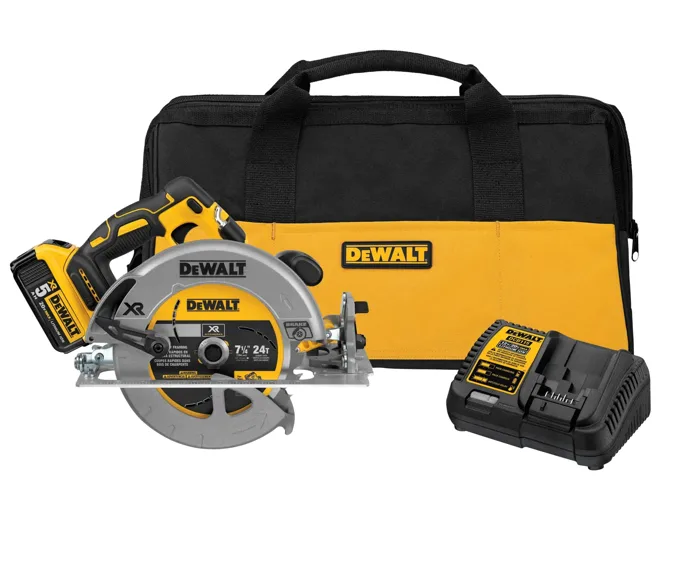
The same 90 degree capacity as its corded sibling and no cord, but DEWALT does not publish a 45 degree figure for it.
Best for: Roof, ladder and remote work where dragging a cord costs more than the uncertainty over bevel depth.
- 2-9/16 in. of cut at 90 degrees, matching the corded DEWALT, from a brushless motor rated at 5,500 RPM.
- Bevels to 57 degrees, the same range as the corded DEWALT.
- No cord, which on a roof or a ladder is worth more than any depth specification.
- Brushless motor that DEWALT says maintains speed under load.
- DEWALT does not publish a 45 degree figure for it, on the product page or in the manual, so its bevel depth cannot be checked against the corded saw's 1.9 in.
- DEWALT now sells it as a kit with one 5.0Ah battery, a charger and a bag, so owners of 20V MAX packs pay for a battery they may not need.
- Battery weight sits high on the tool, which changes the balance against a corded saw.
- Run time under sustained ripping is a real constraint that no corded saw has.
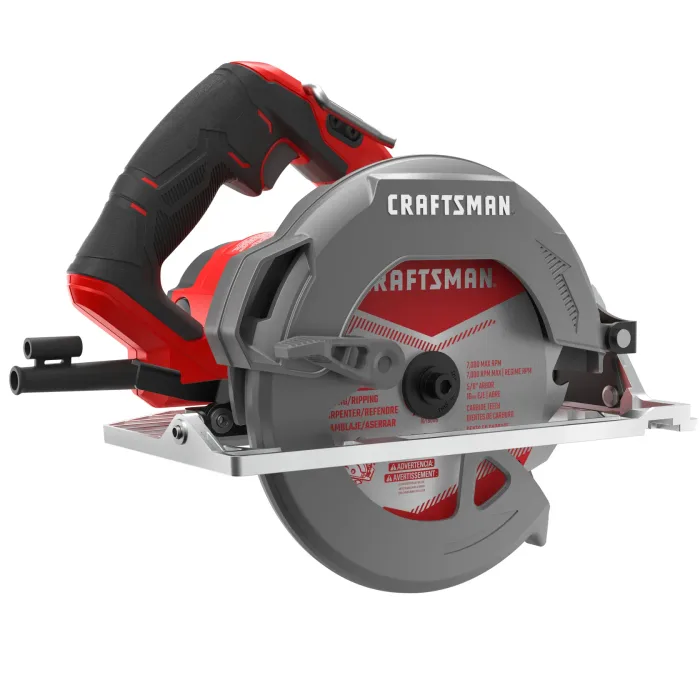
Quotes a capacity for 2x material and never publishes a 45 degree depth, which is the figure bevel work actually needs.
Best for: Straight cross-cutting in 2x material on a budget, where bevels are rare and the missing figure never comes up.
- 5,500 RPM no-load speed from a 15 amp motor.
- Tool-free bevelling shoe to 55 degrees with detents at 22.5 and 45.
- Magnesium shoe at a budget price, which is unusual at this end of the market.
- Full-size 7-1/4 in. saw with an 18T carbide tipped blade included.
- No 45 degree depth of cut figure is published, so the specification that governs bevelled cuts cannot be checked before buying.
- The quoted 2-1/8 in. capacity for 2x material is below the 2-1/2 in. and 2-9/16 in. the others list at 90 degrees.
- No electric brake mentioned.
- RPM is quoted prominently, and blade speed matters far less than depth and braking.
| Criteria | DWE575SB 7-1/4 in. Lightweight Circular Saw with Electric Brake Top pick | 5007MG 7-1/4 in. Magnesium Circular Saw | DCS570P1 20V MAX XR 7-1/4 in. Brushless Circular Saw Kit | CMES510 15 Amp 7-1/4 in. Electric Circular Saw |
|---|---|---|---|---|
| Verdict | Buy it | Buy it | It depends | Skip it |
| Best for | Anyone whose work includes bevelled cuts in thicker stock and who wants the depth figure that actually governs them. | Framing and repetitive cutting where magnesium durability and a 56 degree bevel matter more than a brake. | Roof, ladder and remote work where dragging a cord costs more than the uncertainty over bevel depth. | Straight cross-cutting in 2x material on a budget, where bevels are rare and the missing figure never comes up. |
| Price tier | $$ · mid-range | $$$ · premium | $$$ · premium | $ · budget |
| Cut depth at 90 degrees | 2-9/16 in. | 2.5 in. | 2-9/16 in. | 2-1/8 in. in 2x material |
| Cut depth at 45 degrees | 1.9 in. | 1.75 in. | Not published | Not published |
| Loss from 90 to 45 | About 25 percent | About 30 percent | Cannot be calculated | Cannot be calculated |
| Power | 15 amp corded | 15 amp corded | 20V brushless | 15 amp corded |
| Electric brake | Yes | Not on this model | Not confirmed | Not stated |
| Maximum bevel | 57 degrees | 56 degrees | 57 degrees | 55 degrees |
| Notable construction | Lightweight housing | Magnesium components | Brushless motor | Magnesium shoe |
Which one is right for you?
- Anyone whose work includes bevelled cuts in thicker stock and who wants the depth figure that actually governs them. Buy it DEWALT DWE575SB 7-1/4 in. Lightweight Circular Saw with Electric Brake
- Framing and repetitive cutting where magnesium durability and a 56 degree bevel matter more than a brake. Buy it Makita 5007MG 7-1/4 in. Magnesium Circular Saw
- Roof, ladder and remote work where dragging a cord costs more than the uncertainty over bevel depth. It depends DEWALT DCS570P1 20V MAX XR 7-1/4 in. Brushless Circular Saw Kit
- Straight cross-cutting in 2x material on a budget, where bevels are rare and the missing figure never comes up. Skip it CRAFTSMAN CMES510 15 Amp 7-1/4 in. Electric Circular Saw
How we judged the field
We compared these on the depth figure at 45 degrees rather than the one in the headline, because bevelling is the operation where a circular saw runs out of capacity and the 90 degree number gives no warning of it. Only two of the four publish both figures, and even between those two the proportion lost differs, about a quarter on one and 30 percent on the other, which is not something you could infer from the shelf. After that we looked at whether an electric brake is stated, since that is the one safety feature in this category with an unambiguous mechanism and we could confirm it on only one of the four. Then weight and shoe material, which decide how the tool feels by the end of the day. Amperage we discounted, because three of these are 15 amp and the number has stopped telling anyone apart.
DEWALT DWE575SB 7-1/4 in. Lightweight Circular Saw with Electric Brake
Buy itThe DEWALT DWE575SB is the pick because it wins the comparison that the listings do not run. At 2-9/16 inches of cut at 90 degrees it is barely ahead of the Makita, and on a shelf the two look interchangeable. Tilt them both to 45 and the DEWALT still gives 1.9 inches where the Makita gives 1.75, and it has lost only about a quarter of its capacity where the Makita loses 30 percent. That is the deepest published bevel figure in this group and the smallest published collapse. It is a 15 amp corded saw with an electric brake, and the brake is worth more attention than the motor: without one the blade coasts for seconds after the trigger releases. What it does not offer is the Makita’s magnesium construction, though DEWALT lists the DWE575 at 8.8 lbs against the Makita’s 10.6 lbs, and its bevel range is 57 degrees. For anyone whose work involves bevelled cuts in anything thicker than a 2x, it is the right default.
Makita 5007MG 7-1/4 in. Magnesium Circular Saw
Buy itThe Makita 5007MG is the second buy and the answer to a different question. Its magnesium components make it a tough jobsite saw at 10.6 lbs, and it adds built-in LED lights and a dust blower. It gives up very little to get there: 2.5 inches at 90 degrees and 1.75 at 45, a drop of 30 percent, against the DEWALT’s quarter. It has no electric brake, since Makita lists the brake version as a separate model, but it publishes both depth figures. The costs are that it is the most expensive saw here and the money buys magnesium construction rather than capability, that the 45 degree figure is 0.15 inches behind the DEWALT which shows up on thicker bevels, and that magnesium is stiff but less tolerant of being dropped off a scaffold than aluminium.
DEWALT DCS570P1 20V MAX XR 7-1/4 in. Brushless Circular Saw Kit
It dependsThe DEWALT DCS570P1 is the it-depends, and the reason is what DEWALT leaves out. On paper it matches its corded sibling exactly at 90 degrees, 2-9/16 inches, and bevels to the same 57 degrees, so a buyer comparing the two on the listed figures would conclude they are equivalent. DEWALT does not publish a 45 degree figure for it, on the product page or in the manual, and the numbers circulating in retailer listings disagree with each other, so its bevel depth against the corded saw’s 1.9 inches is an open question. What you get for accepting that uncertainty is real: no cord and a brushless motor rated at 5,500 RPM. On a roof or a ladder, not dragging a cord is worth more than a bevel figure you cannot check; for thick bevelled stock, the corded saw is the one with a published answer. DEWALT now lists it only as a kit with a 5.0Ah battery, charger and bag, rated for 330 crosscuts in 2x4 pine per charge, which helps a first cordless buyer and adds a battery an existing 20V MAX owner does not need. The battery sits high enough to change how the saw balances.
CRAFTSMAN CMES510 15 Amp 7-1/4 in. Electric Circular Saw
Skip itThe CRAFTSMAN CMES510 is the skip, and the reason is an absence that goes further than the cordless DEWALT’s. It publishes a 5,500 RPM no-load speed, a 15 amp motor, a magnesium shoe which is unusual in a budget saw, and a tool-free bevel to 55 degrees with detents. What it does not publish is a depth of cut at 45 degrees. The capacity it does quote, 2-1/8 inches in 2x material, is below the 2.5 inches and more that the others state at 90 degrees, and it is stated as a capacity in 2x stock rather than as a maximum depth. So where the DCS570P1 at least matches a saw with a published bevel figure at 90 degrees and on bevel range, the Craftsman starts lower and gives nothing to compare once the shoe tilts. It also makes no mention of an electric brake, so the blade presumably coasts. As a saw for straight cross-cuts in 2x stock at the lowest price it is a reasonable object, and the magnesium shoe is a real feature. It just cannot be compared on the thing that separates circular saws.
Sources
Specs in this review come from these pages.
- DEWALT DWE575SB 7-1/4 in. circular saw with electric brake (dewalt.com)
- DEWALT DCS570P1 20V MAX XR 7-1/4 in. brushless circular saw kit (dewalt.com)
- DEWALT DCS570 instruction manual (assets.dewalt.com)
- Makita 5007MG magnesium circular saw product page (makitatools.com)
- CRAFTSMAN CMES510 15 amp 7-1/4 in. electric circular saw (craftsman.com)
- Circular saw depth of cut geometry and why bevel capacity falls (mathscinotes.com)
DEWALT DWE575SB 7-1/4 in. Lightweight Circular Saw with Electric Brake vs Makita 5007MG 7-1/4 in. Magnesium Circular Saw: which should you buy?
These are the only two saws here that publish both depth figures, which is why they are the pair that can be compared properly. At 90 degrees they are nearly identical, 2-9/16 inches against 2.5. At 45 the DEWALT gives 1.9 inches and the Makita 1.75, a loss of about a quarter against 30 percent, and that 0.15 inch is what decides a bevel in stock near the limit. The DEWALT also states an electric brake, weighs less on its maker’s figures, and bevels a degree further to 57. The Makita answers with magnesium components, LED lights and a dust blower, and it costs more. If bevel depth and braking matter most, buy the DEWALT. If the saw lives on a jobsite and durability is the priority, the Makita gives up little to get it.
What to look for
- The depth of cut at 45 degrees: the figure that governs bevel work, absent from many listings, and roughly 25 to 30 percent below the headline number on the two saws here that publish it.
- The proportion lost between 90 and 45: two saws with nearly the same headline capacity differ by 0.15 in. once tilted here, and only the pair of figures reveals it.
- A stated electric brake: the blade coasts for seconds without one, and that is the window in which a saw set down early does damage.
- Shoe and housing material: magnesium costs more and is a durability feature, so check the listed weight rather than assuming.
- Maximum bevel angle: 45 degrees is standard and anything past it is a real extra, though a wide bevel range means nothing if the depth at 45 is already short.
- Amperage, read as a formality: most full-size corded saws are 15 amp because that is what a household circuit allows, so it rarely separates two tools.
Our final take
Circular saw listings compete on amperage and blade diameter, and both have converged to the point of uselessness. The number that still discriminates is the depth at 45 degrees, which the makers publish inconsistently and buyers almost never compare. Find it, work out what proportion of the headline figure it represents, and the ranking looks quite different from the one on the shelf.
Questions, answered
Why is the cut depth so much less at 45 degrees?
Because tilting the shoe changes the geometry between the blade and the material. The blade's radius is fixed, so as the shoe rotates, less of the blade projects perpendicular to the workpiece surface. Every saw loses depth this way, but they do not lose the same proportion: the corded DEWALT here drops about 25 percent from 2-9/16 in. to 1.9, while the Makita drops 30 percent from 2.5 in. to 1.75. Since the listings all lead with the 90 degree figure, two saws that look identical on the shelf can differ substantially on the cut that matters.
Does amperage tell me anything about a circular saw?
Very little, once you are comparing full-size saws. Three of the four here are 15 amp, which is simply the practical ceiling for a standard household circuit, so the number has converged and stopped discriminating between tools. What varies is cut depth, whether there is an electric brake, the shoe material and the weight. Amperage describes what the motor draws, not what the saw can do with it.
Is an electric brake worth paying for?
It is the safety feature with the clearest mechanism in this category. Without one, the blade coasts for several seconds after you release the trigger, which is the window in which a saw set down too early bites into something. A brake stops it in a fraction of that. Of the four saws here, the DEWALT DWE575SB states one. We could not confirm one for the cordless DEWALT, Makita lists its electric brake saw as a separate model from the 5007MG, and the Craftsman does not mention it. If you are choosing between two otherwise similar saws, the brake is a better tiebreaker than any performance number.
Sidewinder or worm drive?
All four saws here are sidewinders, where the motor sits alongside the blade. Worm drive saws put the motor behind the blade, which makes them longer, heavier and higher-torque, and puts the handle further back for plunge and rip work. Framers on the US west coast favour worm drives; most other work is done with sidewinders. The bevel depth question applies to both equally, and worm drives generally give up some depth at 45 degrees for the same reason.
Do I need 7-1/4 inch, or will a smaller saw do?
Seven and a quarter is the size that cuts through 2x material in a single pass at 90 degrees with room to spare, which is why it became the standard. Smaller cordless saws at 6-1/2 in. are lighter and cheaper and will still clear a 2x flat, but their bevel capacity is proportionally smaller and often falls below what a bevelled 2x needs. If you only ever cut sheet goods, the smaller saw is easier to handle.
Deciding between the top two? See our head-to-head: DEWALT DWE575SB 7-1/4 in. Lightweight Circular Saw with Electric Brake vs Makita 5007MG 7-1/4 in. Magnesium Circular Saw.
More Tools & DIY reviews
 The Best Clamp Meters: 4 Compared (and One to Skip)
  The Best Cordless Drills: 4 Compared (and One to Skip)
  The Best Cordless Ratchets: 4 Compared (and One to Skip)
  The Best Crimping Tools: 4 Compared (and One to Skip)
  The Best Cut-Resistant Gloves: 4 Compared (and One to Skip)
  The Best Digital Calipers: 4 Compared (and One to Skip)