Explained
Angle Grinders, Explained
After reading, you'll understand how to match a wheel to a grinder, why the guard and the switch matter more than the motor, and which markings on a wheel are required rather than decorative.
In this guide
Most first-time buyers compare amps or volts and stop there, which is roughly like choosing a car on engine size. The thing that hurts people is a wheel coming apart, and everything that governs that lives in three places: the speed marked on the wheel, the guard, and the switch. The wheel itself carries a small block of required markings that almost nobody reads, including a maximum speed in two units and, on resinoid wheels for hand-held tools, an expiry date. Once you know what those mean, the rest of the spec sheet gets much easier.
The 30-second version
- The wheel's rated speed must be at least the maximum speed marked on the tool, and that comparison comes before anything else.
- Resinoid wheels for hand-held machines expire, with an expiry date at the longest three years from manufacture, marked as a month and year.
- The guard on a portable grinder must leave no more than 180 degrees exposed, with the top half of the wheel enclosed at all times.
- Cut-off wheels are built for their rim only, so side force is what makes them shatter, and a Type 27 wheel is the one made for surface grinding.
- A lock-on button defeats the deadman switch, and without published restart protection that combination is the one to avoid.
The products this guide is about
Our verdict on each, with the full reasoning on the companion review.
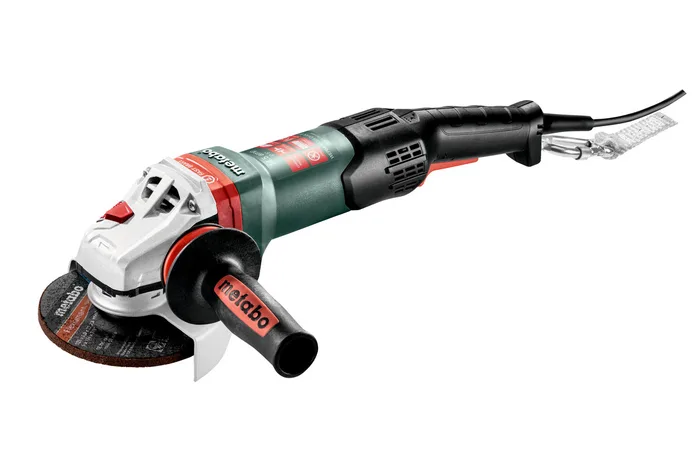
- Buy Metabo WEPBA 17-125 Quick RT DS Angle Grinder The only one of the four whose US spec sheet prints a vibration figure and a noise figure you can plan a workday around.
- Buy Makita GA5053R 4-1/2 in. / 5 in. Paddle Switch Angle Grinder with Non-Removable Guard Makita states the guard is designed to stay permanently attached, which removes the single most common shortcut people take with these tools. Amazon
- It depends Bosch GWX18V-50PCN 18V X-LOCK Angle Grinder with No Lock-On Paddle Switch The most electronics of the four and the fastest wheel changes, but it will only take X-LOCK wheels. Amazon
- Skip DEWALT DWE402 4-1/2 in. (115mm) Small Angle Grinder A capable grinder sold in two versions, and this is the one with the button that latches the paddle on. Amazon
What actually matters
- Maximum operating speed - the peripheral speed the wheel is built and tested for, marked in metres per second, most commonly 80 m/s for hand-held cutting and grinding wheels. It is the figure the wheel's burst testing is derived from, so it is the real limit and not a suggestion.
- Maximum permissible speed of rotation - the same limit expressed as revolutions per minute for that specific diameter, so 115 mm and 125 mm wheels get different numbers from the same peripheral speed. This is the number you compare against the tool's no-load speed.
- Expiry date - required on abrasive products for hand-held machines with bond type B or BF, and set at the longest three years from manufacture. Resin bonds age, and an out of date wheel is not a stock rotation nicety but a documented limit.
- Restart protection - electronics that stop the motor from starting on its own after the supply is interrupted, so the tool does not come to life on the floor when a breaker is reset. Some makers name it explicitly; if a maker does not, assume it is absent.
- Deadman switch - a paddle that must be held for the tool to run, which stops the grinder if you drop it or let go. A lock-on button turns the deadman switch back into an ordinary on switch.
- Guard type - the open Type 27 guard in the box is for depressed centre grinding wheels; cutting wheels need a closed, two-sided Type 1 guard, which is usually a separate purchase. Using the wrong guard is not a paperwork issue, it is the difference between a shielded wheel and an unshielded one.
- Hand-arm vibration - the m/s2 figure that determines how long you can safely hold the tool. The European daily action value is 2.5 m/s2 and the limit value is 5 m/s2 averaged over eight hours, which is why a published figure is useful to have.
The specs, in plain English
Green flags vs red flags
Green flags
- The spec sheet names restart protection or an equivalent, in the maker's own words.
- The switch is described as a paddle or deadman switch with no lock-on, or the maker sells a no-lock variant and says so.
- A vibration figure in m/s2 and a noise figure in dB(A) appear on the technical data, with an uncertainty of measurement alongside them.
- The guard adjusts without tools, and the maker states how it is secured.
- The brake is described as mechanical, or with a stated stopping time in seconds.
Red flags
- A lock-on button on a paddle switch with no published restart protection.
- A tool no-load speed that meets or exceeds the marked RPM of the wheel size it is sold for.
- Wheels with no EN 12413 mark, no legible speed marking, or no expiry date where one is required.
- A listing that quotes only amps, volts or wattage and says nothing about the switch, guard or brake.
- A cutting wheel being used with the open grinding guard that came in the box.
Who's who: the brands
- Metabo - Publishes the most complete technical data of the mainstream brands, including vibration, uncertainty of measurement and both noise figures, and builds a mechanical brake and torque limiting clutch into the WEPBA 17-125 Quick RT DS.
- Makita - Unusually, offers models such as the GA5053R with a guard designed to remain permanently attached to the tool.
- Bosch - Leans hardest on named electronic behaviours such as KickBack Control, drop control and restart protection, and drives the X-LOCK quick-change wheel mount.
- DEWALT - Widely stocked and well documented in its manuals, though it sells both lock-on and no-lock-on versions of the same grinder and publishes little safety electronics detail.
- Milwaukee - A major cordless power tool brand that also sells angle grinders. Check each model's manual for switch and brake details.
How to read a listing without getting fooled
Start at the bottom of the spec table rather than the top. The amp or volt figure tells you almost nothing useful; the switch line, the guard description and any named electronics tell you what the tool does when things go wrong. Look for the words lock-on and lock-off explicitly, since some makers list them as separate yes or no fields, and check whether the model number you are looking at is the lock-on or no-lock variant, because they often differ by a single letter. Then look for a technical data block with vibration and noise, and note that most US listings simply do not have one. Finally, open the instruction manual, which is where the guard pairings, the wheel types and the restart behaviour are actually written down, and which most makers publish as a free PDF before you buy.
How much should you spend?
Budget grinders get you a motor, a guard and a switch, and usually nothing else documented: no brake, no restart protection and no published vibration or noise figures. Mid-range is where the safety features start appearing by name, and it is also where you find the interesting design decisions, such as a guard that will not come off or a switch with no lock-on option at all. Premium buys you measurement and stopping: published vibration and noise data, a mechanical brake with a stated stopping time, a torque limiting clutch and an autobalancer. Cordless models sit a tier higher than their corded equivalents once you account for batteries and a charger, and quick-change systems add a hidden cost because you will be replacing your abrasive stock as well as the tool.
Questions, answered
Can I put a 5 inch wheel on a 4-1/2 inch grinder?
Not safely, and the guard is the first reason. The guard is sized to the wheel it was designed for, so a larger wheel will not be properly enclosed and you lose the 180 degree limit the guard exists to provide. The second reason is speed: a smaller grinder often spins faster, and a wheel sized for a larger machine is not rated for it. Manufacturers warn specifically against using worn down wheels from larger tools for exactly this reason.
Is a cordless grinder good enough for real work?
For intermittent work, yes, and the good ones publish braking and kickback behaviour that some corded models do not. The trade-offs are speed and runtime: cordless grinders often list lower no-load speeds than their corded equivalents, and heavy grinding drains batteries quickly. If the tool lives at a bench near an outlet, corded is the simpler answer. If it moves around a site or up a ladder, cordless earns its place.
What is the ring test and should I be doing it?
It is a check for cracks: you tap the wheel gently and listen for a clear ring rather than a dull thud. OSHA's construction rule requires that all abrasive wheels be closely inspected and ring-tested before mounting to ensure they are free from cracks or defects. It works on vitrified bonded wheels and is less meaningful on the thin resinoid wheels most angle grinders use, where a careful visual inspection for damage and stains matters more. Either way, inspecting the wheel before it goes on is the habit worth keeping.
Do I need a different guard for cutting?
Yes, if you are using a Type 1 cutting wheel. The open guard supplied with most grinders is a Type 27 grinding guard, and cutting calls for a closed, two-sided Type 1 guard that shields both faces of the wheel. Makers generally sell it as a separate part rather than including it, so it is worth budgeting for at the same time as the tool. Some thinner Type 27 wheels are labelled for cutting as well, in which case the label tells you which guard applies.
Or jump to the head-to-head: Metabo WEPBA 17-125 Quick RT DS Angle Grinder vs Makita GA5053R 4-1/2 in. / 5 in. Paddle Switch Angle Grinder with Non-Removable Guard.