Explained
Belt Sanders, Explained
After reading, you'll understand what belt size and belt speed actually buy you, and how to tell when a spec sheet is quoting the wrong unit.
In this guide
Belt sanders look like the simplest power tool in the shop: a motor, two drums and a loop of abrasive. The specs are where it gets muddy. Belt speed should be a surface speed in feet per minute, but not every manufacturer publishes it that way, and at least two large brands store it in a data field named for orbital sanders. Add belt sizes that are quoted differently in the title and the spec table, and grit numbering that changes meaning depending on the standard, and comparing two machines takes more work than it should.
The 30-second version
- Belt speed is a surface speed, measured in feet per minute, and it is what determines how fast the abrasive cuts.
- OPM is the wrong unit here, because it counts orbits, which is a random orbital sander's measurement and not a belt's.
- 3 by 21 is the default size, and it is the one to own if you are only owning one.
- Variable speed is not a luxury, because full speed burns softwood and gums paint into the abrasive.
- Weight cuts both ways, helping you keep the platen flat on a bench and working against you on anything vertical.
The products this guide is about
Our verdict on each, with the full reasoning on the companion review.
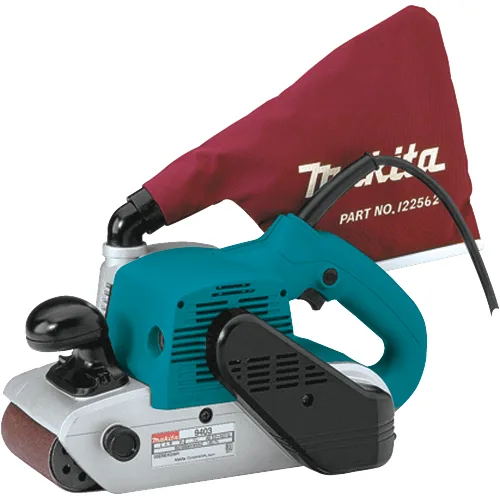
- Buy Makita 9403 4 in. x 24 in. Belt Sander The biggest belt and the fastest published speed in the group, and the only one that tells you how loud it is. Amazon
- Buy Makita 9903 3 in. x 21 in. Variable Speed Belt Sander The 3 by 21 that most people should buy, and the only corded machine here with a real speed range. Amazon
- It depends DeWalt DCW220B 20V MAX XR Brushless 3 in. x 21 in. Belt Sander The cordless option, with the finest speed adjustment here and a spec sheet that argues with its own product title. Amazon
- Skip Craftsman CMEW213 3 in. x 21 in. Belt Sander The cheapest way into the category, running at roughly half the Makita 9903's top speed with no way to change it. Amazon
What actually matters
- Belt size - given as width by loop length, such as 3 by 21 inches. Width sets how much surface each pass covers and how hard the machine is to keep flat; length affects how long a belt lasts before it heats up.
- Belt speed - the surface speed of the abrasive, properly stated in feet per minute. Higher removes material faster and burns more easily, which is why a machine that only runs at one speed is limited to the materials that suit it.
- Variable speed - a dial or trigger that lowers belt speed for softwoods, paint, plastic and veneer. Without it, the tool has one behavior and you have to match the work to the machine.
- Amperage - on a corded machine, the practical proxy for how much load the motor will take before it bogs. A 3 inch belt on a 7 amp motor stalls in situations where the same belt on 8.8 amps keeps cutting.
- Platen - the flat plate behind the belt that presses the abrasive against the work. It is what makes a belt sander flatten rather than follow the surface, and a worn or warped platen is why an old machine stops cutting evenly.
- Tracking - the adjustment that keeps the belt centered on the drums. Some machines self-track, others need a knob turned. A belt that drifts will grind against the housing and shred.
- Dust collection - a bag catches the coarse dust and misses the fine fraction. A port sized to a standard vacuum hose is much better, and wood dust is a respiratory hazard whichever you use.
The specs, in plain English
Green flags vs red flags
Green flags
- Belt speed published in feet per minute, with the unit shown next to the number.
- Belt size stated identically in the product title and the specification table.
- A variable speed dial with the range given at both ends, not just a top figure.
- Amperage stated for a corded machine, or a brushless motor named for a cordless one.
- A published sound level, which almost nobody in this category provides.
Red flags
- A speed figure with no unit, or one labeled opm on a belt sander.
- Belt size in the title that does not match the spec table.
- A power claim quoted as a percentage better than an unnamed competitor.
- No amperage figure on a corded tool.
- Dust collection listed as a feature with no mention of what it connects to.
Who's who: the brands
- Makita - Publishes the most complete belt sander specs in the category, including sound levels, and has run the same 9403 and 9903 designs for years.
- DeWalt - The main push into cordless belt sanding on a large battery platform, aimed at job site rather than shop use.
- Craftsman - Budget corded machines sold on light weight and price, with thinner published specifications.
- Porter-Cable - Long associated with the 3 by 21 and 4 by 24 formats, and with the variable speed corded machines that defined the class.
- Festool - Premium machines built around integrated dust extraction, sold mostly to shops already running their vacuum system.
How to read a listing without getting fooled
Find the speed figure first and check that a unit is printed beside it. If it says feet per minute, you can compare it to any other machine that does the same. If it says opm, or shows no unit, you are looking at a number that has been filed under the wrong heading and you should treat it with suspicion until the manufacturer's own copy confirms what it means. Next, read the belt size in the spec table and compare it to the product title, because those do not always agree. Then check amperage on a corded machine, since that is what carries the cut, and check whether a speed range is given rather than a single top figure. Finally, look for a sound level. Almost no one publishes one, so its presence tells you something about how completely the rest of the sheet was filled in.
How much should you spend?
Budget belt sanders are typically fixed speed, lower amperage and lighter, and they will handle occasional light work without complaint. What you give up is the ability to slow the belt down, which limits you to materials that tolerate full speed. The mid-range is where variable speed and a motor with enough amps to carry a cut both appear, and for most people that tier is the whole answer. Premium buys either a larger belt for flattening wide panels or a cordless platform, and the second of those is a convenience purchase rather than a performance one. Spend the difference on good belts before you spend it on a bigger machine, because a worn belt makes any sander feel underpowered.
Questions, answered
Belt sander or random orbital sander?
They do different jobs. A belt sander removes material and flattens, using a platen to keep the cut straight across a surface. A random orbital finishes, using a soft pad that follows the surface and leaves no directional scratch pattern. The normal sequence is belt sander first at 60 to 120 grit, then random orbital from there up. If you only own one and you are finishing furniture, own the random orbital.
Why does my belt keep wandering off the drums?
Tracking. There is an adjustment knob, usually on the front drum, that tilts it slightly so the belt centers itself. Set it with the sander running and off the work, and turn it in small increments. If tracking is correct and the belt still drifts, check that the belt is not stretched or joined badly, and that the drums are clean. A belt that runs off will grind against the housing and tear.
What grit should I start with?
For stock removal on bare wood, 60 or 80 grit. For cleaning up a surface that is already close to flat, 100 or 120. Below 60 you are removing wood faster than you can see what you are doing, and gouges become likely. Above 120 a belt sander is not adding much, because the scratch pattern it leaves is directional and a random orbital will do a better job from that point up.
Do I need dust extraction, or is the bag enough?
The bag catches the coarse dust that would otherwise cover the bench, and misses most of the fine fraction that stays airborne. That fine fraction is the part that matters for your lungs, and wood dust is a recognized respiratory hazard. If the machine has a port that fits a shop vacuum hose, use it, and wear a respirator for extended sanding whichever you have. A bag alone is a housekeeping feature more than a health one.
Or jump to the head-to-head: Makita 9403 4 in. x 24 in. Belt Sander vs Makita 9903 3 in. x 21 in. Variable Speed Belt Sander.