

Tools & DIY
The Best Bench Vises: 4 Compared (and One to Skip)
We compared four currently sold bench vises on the specs makers actually publish: throat depth and jaw opening rather than jaw width, the casting grade, the mounting hardware the manual calls for, and whether any load figure comes with a method behind it.
The short version
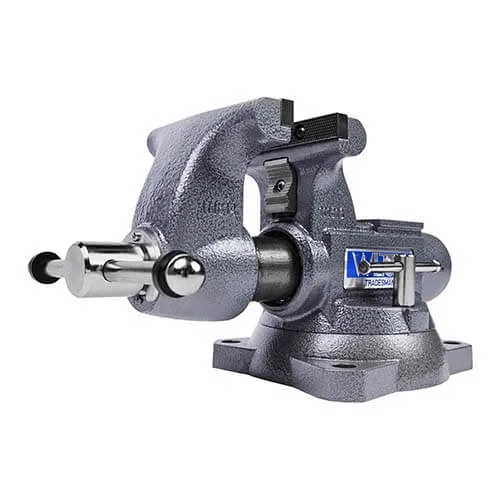
The Wilton Tradesman 1755 wins because its documentation is the most complete in the category: the manual publishes jaw width, opening, throat depth and pipe capacity, footnotes how the opening figure was derived, and specifies the exact mounting hardware down to bolt diameter and grade. The Yost 855-D2 is the value pick, a 60,000 PSI ductile iron combination vise with a reversible front jaw that trades throat depth for opening in a way you can read straight off the spec sheet. The Yost ADI-6 is the one for a specific buyer: it publishes an austempered ductile iron grade tied to an ASTM designation and a jaw load figure, which matters if you bend and beat on stock, and is more casting than most home benches will ever load. Skip the Olympia Tools 38-616 6 inch Mechanic's Bench Vise: its own listing gives jaw width and opening but no throat depth, states a 30,000 psi casting without naming the alloy, and swivels 270 degrees rather than 360. Across all four, clamping force claims are rare and the only vise standard anyone cites has been withdrawn. Best for: anyone who wants to buy on published specification instead of casting weight.
Our picks at a glance
- Wilton Tradesman 1755 Bench Vise - Buy. The most completely documented vise here, with a mounting specification precise enough that you can size the bolts before the box arrives.
- Yost Model 855-D2 Multi-Purpose Reversible Combination Vise - Buy. A 60,000 PSI ductile iron combination vise whose reversible front jaw makes the opening-versus-throat trade visible as two published numbers instead of a marketing line.
- Yost Model ADI-6 6 Inch Austempered Ductile Iron Bench Vise - It depends. The only vise here that ties its casting to a named ASTM specification and publishes a jaw load figure, which is either exactly what you need or more metallurgy than your bench will ever load.
- Olympia Tools 6 in. Mechanic's Bench Vise 38-616 - Skip. A widely stocked 6 inch vise whose own listing publishes the two least useful numbers and leaves out the one that decides what fits.
The verdict in 30 seconds
What mattered most
- Jaw width (published)
- Jaw opening (published)
- Throat depth (published)
- Casting material stated by maker
- Load or clamping figure published
- Mounting specification published
A bench vise is one of the few shop tools where the number everyone quotes is the least useful one. Jaw width tells you how wide a flat surface the jaws present. Throat depth and jaw opening tell you what will actually fit. Manufacturers are inconsistent about publishing all three, and they are far more inconsistent about publishing what the casting is made of and how hard you may load it. We picked four vises that are on sale now and read the manuals, the spec tables and the mounting templates rather than the product blurbs, so the comparison rests on documents that ship with the tools.
The most completely documented vise here, with a mounting specification precise enough that you can size the bolts before the box arrives.
Best for: Someone building or drilling a bench who wants the hole size, bolt diameter and bolt grade in writing before they commit.
- The manual publishes jaw width, maximum opening, throat depth, pipe jaw capacity and weight in one table, and footnotes that the opening figure is based on lead screw engagement with half the nut thread length.
- Mounting is specified exactly: four 11/16 inch holes, four 5/8 inch cap bolts two inches longer than the benchtop, minimum Grade 5, secured with flat washers and nuts.
- Jaw inserts and pipe jaw inserts are listed as replacement parts with their own part numbers, as is the complete swivel base assembly.
- The Tradesman manual does not state the casting material or a grade, so a buyer comparing metallurgy on paper gets nothing from the document that ships with the tool.
- No clamping force or load rating appears anywhere in the manual.
- Wilton states in the same document that its published specifications are given as general information and are not binding.
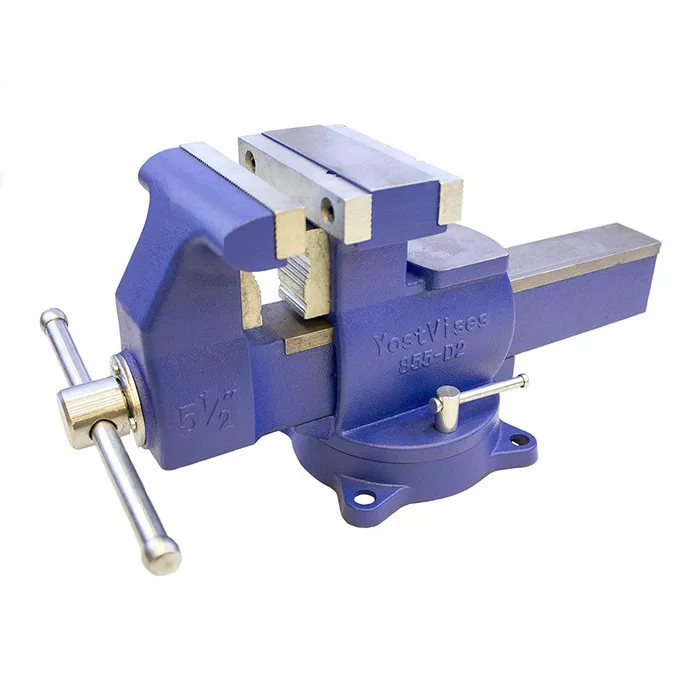
A 60,000 PSI ductile iron combination vise whose reversible front jaw makes the opening-versus-throat trade visible as two published numbers instead of a marketing line.
Best for: A home or maintenance bench that needs one vise to hold both wide assemblies and pipe without buying two.
- Yost publishes both configurations: 6 inch jaw opening with 3.75 inch throat depth normally, 9-3/4 inch opening with 2.75 inch throat when the front jaw is reversed.
- The casting grade is stated plainly as 60,000 PSI ductile iron, and the two anvil surfaces are given as measured areas rather than described as large.
- It is the only vise here whose listing names a specific standard clause and a national stock number, citing Fed. Spec. GGG-V-410B Type IV and NSN 5120-00-293-0110.
- The federal specification it cites was withdrawn, so the citation is a design reference rather than a live conformance claim.
- The product page describes serrated jaws and a reversible main jaw but does not state that the top jaws are replaceable, unlike the larger 880-D2 in the same family.
- The base has four mounting tabs and Yost states that mounting hardware is not included, with no bolt diameter given on the page.
- No weight is published on the product page.
Amazon had no buyable listing for this when we last checked. The link still works if it returns.
Check price on Amazon Read our detailed assessment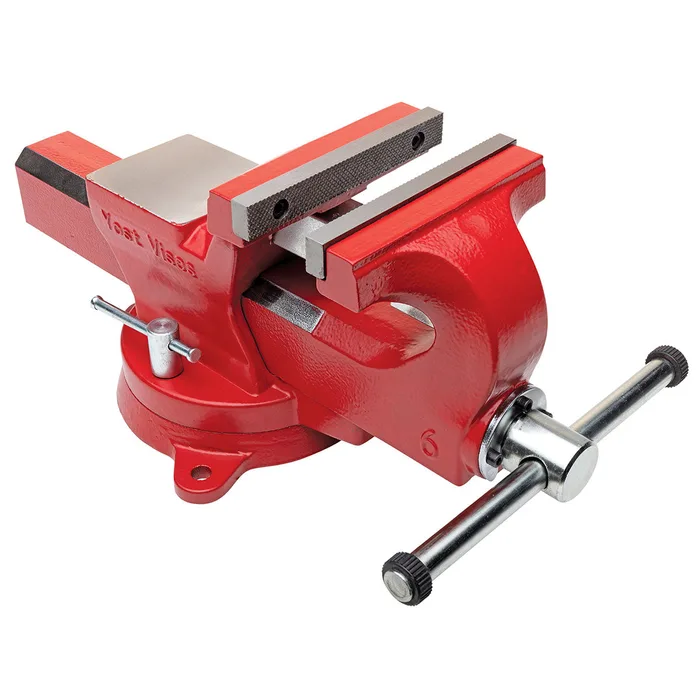
The only vise here that ties its casting to a named ASTM specification and publishes a jaw load figure, which is either exactly what you need or more metallurgy than your bench will ever load.
Best for: Someone who bends, forms and hammers stock regularly and wants a published material grade and load figure rather than a weight.
- Yost publishes the material as 130,000 PSI tensile austempered ductile iron and cites ASTM A897, the standard specification for austempered ductile iron castings.
- The manual gives a jaw rating in two units: able to withstand a clamping force of 10,000 pounds or a torque of 240 ft-lb without distortion of the vise or any components.
- Hardened serrated machinist jaws and pipe jaws are both replaceable, with the serrated jaws specified at Rockwell C 52 to 58.
- At 42 lb for a 6 inch jaw it is lighter than several cast vises of the same jaw width, so how well it works depends heavily on the bench under it.
- The base has three mounting holes rather than four, and Yost publishes a backing plate recommendation but no bolt diameter.
- The web listing carries no dimensions at all; jaw width, 7.8 inch opening and 3.7 inch throat depth appear only in the downloadable manual.
- Stock varies by size and by retailer, so confirm availability before planning a bench around it.
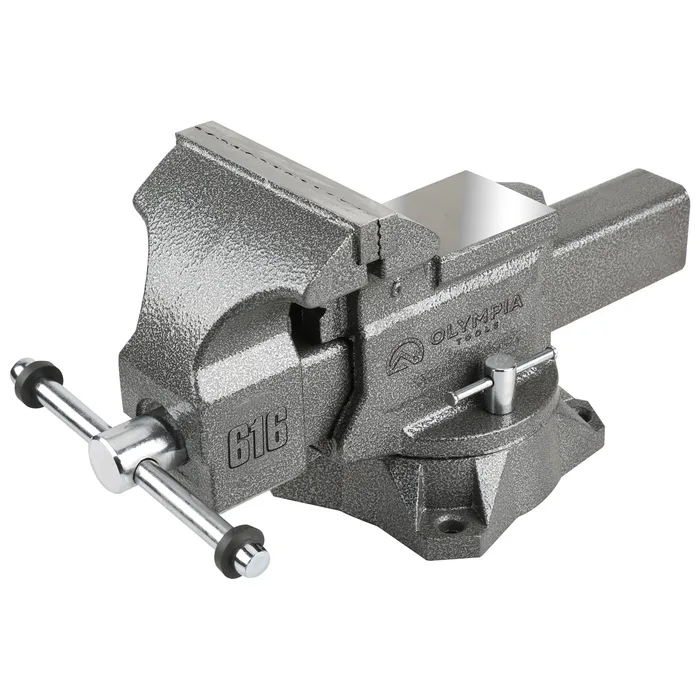
A widely stocked 6 inch vise whose own listing publishes the two least useful numbers and leaves out the one that decides what fits.
Best for: Almost nobody at this size; a buyer on a tight budget is better served by a smaller vise with a published throat depth than a 6 inch one without.
- Jaw faces are described as hardened steel and replaceable, which is not universal at this end of the market.
- The listing does publish a casting figure, 30,000 psi tensile strength, rather than saying nothing about the material at all.
- A spindle guard is fitted to keep dirt and chips off the screw.
- Olympia publishes 6 inch jaw width and 6 inch jaw opening but no throat depth on its own product page, which is the figure that decides how deep a part can sit between the jaws.
- The 30,000 psi figure is given without naming the alloy, and it sits at the bottom of the range published by the other makers here, who state 60,000 to 130,000 PSI.
- The base swivels 270 degrees rather than the full 360 the others publish.
- The pipe jaws are described as permanent, so unlike the replaceable top jaws they cannot be renewed when the serrations round over.
Amazon had no buyable listing for this when we last checked. The link still works if it returns.
Check price on Amazon Read our detailed assessment| Criteria | Tradesman 1755 Bench Vise Top pick | Model 855-D2 Multi-Purpose Reversible Combination Vise | Model ADI-6 6 Inch Austempered Ductile Iron Bench Vise | 6 in. Mechanic's Bench Vise 38-616 |
|---|---|---|---|---|
| Verdict | Buy it | Buy it | It depends | Skip it |
| Best for | Someone building or drilling a bench who wants the hole size, bolt diameter and bolt grade in writing before they commit. | A home or maintenance bench that needs one vise to hold both wide assemblies and pipe without buying two. | Someone who bends, forms and hammers stock regularly and wants a published material grade and load figure rather than a weight. | Almost nobody at this size; a buyer on a tight budget is better served by a smaller vise with a published throat depth than a 6 inch one without. |
| Price tier | $$$ · premium | $$ · mid-range | $$$ · premium | $ · budget |
| Jaw width (published) | 5-1/2 in (140 mm) | 5-1/2 in | 6 in | 6 in |
| Jaw opening (published) | 5 in (127.5 mm), footnoted as half nut thread engagement | 6 in, or 9-3/4 in with the front jaw reversed | 7.8 in | 6 in |
| Throat depth (published) | 3-3/4 in (95.3 mm) | 3.75 in, or 2.75 in reversed | 3.7 in | Not published on the maker's page |
| Casting material stated by maker | Not stated in the manual | 60,000 PSI ductile iron | 130,000 PSI austempered ductile iron, ASTM A897 designation cited | 30,000 psi tensile casting, alloy not named |
| Load or clamping figure published | None | None | Jaws rated 10,000 lb clamping force or 240 ft-lb torque without distortion | None |
| Mounting specification published | Four 11/16 in holes, four 5/8 in Grade 5 cap bolts 2 in longer than the benchtop | Four mounting tabs, hardware not included, no bolt size given | Three mounting holes, 18 x 18 in backing plate advised, bolts to protrude 1 in | Four lug base, no bolt specification published |
| Swivel base | 360 degrees, hand-tightened lockdown nuts only | 360 degrees, gear type lock with two lockdown bolts | 360 degrees, interlocking geared, two lockdowns | 270 degrees, swivel lock lever |
| Replaceable jaws stated | Jaw inserts and pipe jaw inserts, each with a part number | Serrated jaws and reversible main jaw; page does not state replaceable | Hardened serrated machinist and pipe jaws, Rockwell C 52-58 | Hardened steel jaw faces replaceable; pipe jaws permanent |
Which one is right for you?
- Someone building or drilling a bench who wants the hole size, bolt diameter and bolt grade in writing before they commit. Buy it Wilton Tradesman 1755 Bench Vise
- A home or maintenance bench that needs one vise to hold both wide assemblies and pipe without buying two. Buy it Yost Model 855-D2 Multi-Purpose Reversible Combination Vise
- Someone who bends, forms and hammers stock regularly and wants a published material grade and load figure rather than a weight. It depends Yost Model ADI-6 6 Inch Austempered Ductile Iron Bench Vise
- Almost nobody at this size; a buyer on a tight budget is better served by a smaller vise with a published throat depth than a 6 inch one without. Skip it Olympia Tools 6 in. Mechanic's Bench Vise 38-616
How we judged the field
Five things decide whether a bench vise is right for you, and only one of them is the number on the box. First, throat depth, because it sets how far down into the jaws a part can drop before it fouls the body, and it is the figure most often missing from a listing. Second, jaw opening, and specifically how the maker derived it: Wilton footnotes its 5 inch opening on the 1755 as being based on lead screw engagement with half the nut thread length, which is more honesty about a capacity figure than most tools of any kind offer. Third, the casting, since a published grade such as 60,000 PSI ductile iron or an ASTM A897 austempered ductile iron designation tells you something a stated weight never will. Fourth, mounting, because an undermounted vise tears the bench apart before the casting ever complains. Fifth, jaws: whether they are replaceable, how hard they are, and whether the maker sells covers for work you do not want marked.
The field splits along how much a maker is willing to write down. At one end are the vises with a real manual: Wilton publishes a full dimensional table and a mounting template with bolt diameters and a bolt grade, and Yost publishes technical statistics tables and jaw load figures in downloadable manuals for most of its industrial and professional models. At the other end are vises sold on a bullet list, where jaw width and opening appear and throat depth does not. We took one from each end and two from the middle: the Wilton Tradesman 1755 for the most complete documentation, the Yost 855-D2 as the mid-priced combination vise that publishes both of its configurations, the Yost ADI-6 as the one vise here with a named material standard and a load figure, and the Olympia Tools 38-616 as the popular 6 inch vise whose listing shows exactly which numbers get left out.
Wilton Tradesman 1755 Bench Vise
Buy itThe Wilton Tradesman 1755, stock number 28806, is the vise to buy if you want to know what you are getting before it arrives. Its manual publishes a 5-1/2 inch jaw width, a 5 inch maximum opening, a 3-3/4 inch throat depth, a 1/4 to 3 inch pipe jaw capacity and a 51.5 lb shipping weight, and it footnotes how the opening was measured. The mounting template is specific in a way almost nothing else in the category is: four 11/16 inch holes, four 5/8 inch cap bolts two inches longer than your benchtop, minimum Grade 5, flat washers and nuts. Jaw inserts and pipe jaw inserts each carry their own part number, and the swivel base is a serviceable assembly. The warranty runs for the product’s lifetime with no end date and covers manufacturer’s defect only. The gap is material: the manual never states what the castings are, and no clamping or load figure appears. Wilton also notes that its published specifications are general information and not binding. For a buyer who wants the mount and the service parts nailed down, that gap is acceptable.
Yost Model 855-D2 Multi-Purpose Reversible Combination Vise
Buy itThe Yost 855-D2 earns the value slot because it publishes the trade-off instead of hiding it. Normally it gives a 6 inch jaw opening with a 3.75 inch throat depth; reverse the front jaw and you get 9-3/4 inches of opening but the throat drops to 2.75 inches. That is the whole opening-versus-throat argument in two pairs of numbers on the maker’s own page. The castings are stated as 60,000 PSI ductile iron, the jaws are 5.5 inches wide and serrated, pipe capacity runs 1/8 to 3 inches, and the two anvil surfaces are given as measured areas rather than adjectives: 3.5 by 3.7 inches lower, 5.2 by 2.5 inches upper. The base is a 360 degree gear type lock with two lockdown bolts and four mounting tabs, with hardware not included. Two things to know. Yost cites Fed. Spec. GGG-V-410B Type IV, a document withdrawn. And the page stops short of calling the top jaws replaceable, though the larger 880-D2 in the same family does. For a one-vise bench that must hold pipe and wide assemblies, it is the sensible buy.
Yost Model ADI-6 6 Inch Austempered Ductile Iron Bench Vise
It dependsThe Yost ADI-6 is the only vise here with a metallurgy claim you can chase to a standards document. Yost states 130,000 PSI tensile austempered ductile iron and cites ASTM A897 with the grade designation, and the manual adds a jaw rating: able to withstand a clamping force of 10,000 pounds or a torque of 240 ft-lb without distortion of the vise or any components, with serrated jaws hardened to Rockwell C 52 to 58. The technical statistics give a 6 inch jaw width, a 7.8 inch opening, a 3.7 inch throat depth, 0.75 to 3.5 inch pipe capacity and 42 lb. Machinist and pipe jaws are both replaceable, the guide rails are adjustable, and the base is an interlocking geared 360 degree swivel with two lockdowns. The catch is that 42 lb is light for a 6 inch vise, so the bench matters more than usual, the base has only three mounting holes, and none of the dimensions appear on the web listing at all. It is right for someone who genuinely loads a vise hard, and more casting than most benches will ever ask for.
Olympia Tools 6 in. Mechanic’s Bench Vise 38-616
Skip itThe Olympia Tools 38-616 is a real product, widely stocked, and the reason to skip it is what its own listing does and does not say. It publishes a 6 inch jaw width and a 6 inch jaw opening, a four lug base, a 30,000 psi tensile strength casting, hardened steel replaceable jaw faces, permanent pipe jaws, a spindle guard, a polished anvil and an anvil horn. It does not publish a throat depth, which is the number that decides whether a 6 inch vise is actually a 6 inch vise for your work. The 30,000 psi figure is given without naming the alloy, and it is the lowest published here against 60,000 PSI ductile iron on the 855-D2 and 130,000 PSI austempered ductile iron on the ADI-6. The base swivels 270 degrees rather than 360 and the pipe jaws cannot be renewed. None of that is an accusation about how it is made; it is what the maker chose to print. If throat depth is the spec that matters, buy from a maker who prints it.
Sources
Specs in this review come from these pages.
- Wilton Tradesman Vise operating instructions and parts manual, models 1745 / 1755 / 1765 (wiltontools.com)
- Yost Model ADI-6 owner's manual and technical statistics (cdn.shopify.com)
- Yost Vises, Model 855-D2 product specification (yostvises.com)
- Olympia Tools, 6 in. Mechanic's Bench Vise 38-616 product specification (olympiatools.com)
- ASTM A897/A897M, Standard Specification for Austempered Ductile Iron Castings (store.astm.org)
- Defense Logistics Agency ASSIST Quick Search, federal specification status (GGG-V-410B) (quicksearch.dla.mil)
Wilton Tradesman 1755 Bench Vise vs Yost Model 855-D2 Multi-Purpose Reversible Combination Vise: which should you buy?
The Wilton Tradesman 1755 and the Yost 855-D2 are close on the dimensions that matter and far apart on what the maker will commit to paper. Their throat depths are effectively identical, 3-3/4 inches for the Wilton and 3.75 inches for the Yost in its normal configuration, and both are 5-1/2 inch jaw vises with pipe jaws. The Yost opens further, 6 inches against the Wilton’s 5, and reversing its front jaw takes it out to 9-3/4 inches at the cost of dropping the throat to 2.75 inches, which no fixed-jaw vise can do at any depth. The Wilton counters with the paperwork: a footnoted opening figure, a mounting template that names hole size, bolt diameter, bolt grade and bolt length, individually numbered jaw and pipe jaw inserts, and a lifetime warranty with no end date.
Choose on which uncertainty bothers you more. If you want to know the casting grade, the Yost states 60,000 PSI ductile iron and the Wilton manual states nothing, so the Yost wins outright on material transparency. If you want to know that the vise will still be repairable and correctly mounted in ten years, the Wilton wins: it is the only one here that tells you what bolts to buy and gives you a part number for every wear item. There is also a bench question underneath this. A vise you cannot mount properly is worse than a smaller vise you can, so before either purchase, check that the underside of your benchtop is clear where the bolts have to land, and plan on a backing plate if the top is thin. Both makers say some version of this, and both mean it.
What to look for
- Throat depth before jaw width: it sets how deep a part can sit between the jaws, and it is the figure most often absent from a listing, so treat its absence as information.
- How the opening was measured: Wilton footnotes its maximum opening as being based on lead screw engagement with half the nut thread length, which is the kind of caveat that tells you the number is real rather than rounded up.
- A named casting grade, not a weight: 30,000 psi, 60,000 PSI ductile iron and 130,000 PSI austempered ductile iron are all published figures in this category, and only the last one here comes tied to an ASTM designation you can look up.
- A mounting specification you can act on: the useful ones give hole diameter, bolt diameter, bolt grade and a bolt length rule, or a backing plate size, because the bench is what fails first.
- Replaceable jaws and pipe jaws: check both separately, since several vises list replaceable top jaws alongside pipe jaws described as permanent.
- Maker-supplied jaw covers in your jaw width: soft caps in aluminium, rubber-faced aluminium or plastic are sold as first-party accessories in matched sizes, so you do not have to improvise a fix for serration marks.
Our final take
Buy the Wilton Tradesman 1755 if you value knowing exactly what you are bolting to what, and accept that its manual will not tell you what the castings are. Buy the Yost 855-D2 if you want the material grade in writing and a reversible jaw that turns one vise into two capacities, and you can live with a citation to a federal specification that no longer exists. Take the Yost ADI-6 only if you load a vise hard enough to care about an ASTM A897 casting and a 10,000 pound jaw rating. Leave the Olympia 38-616, not because of how it is made, but because a 6 inch vise sold without a published throat depth asks you to guess at the number that decides whether your work fits.
Questions, answered
Is jaw width the number I should be shopping on?
No, and it is the number every listing leads with. Jaw width only tells you how wide a flat the jaws present to the work. What decides whether a part fits is jaw opening, which is how far the jaws separate, and throat depth, which is how far down the work can sit before it hits the body of the vise. All three makers who publish a throat depth here land between 3.7 and 3.75 inches on vises with jaw widths of 5-1/2 and 6 inches, so jaw width did not predict throat depth at all. Read the throat depth first, then the opening, then the jaw width.
Does a vise publish how hard it can clamp, and does that number mean anything?
Rarely, and the ones that do are not directly comparable. Yost publishes figures on some listings, such as a maximum clamping force of 7,868 lb for one of its ductile iron mechanics vises, and its manuals state jaw ratings, but the units change from model to model: the ADI-6 manual gives 10,000 pounds or 240 ft-lb, while the all steel 904-HV manual gives a load of no less than 1,600 inch pounds. Wilton's Tradesman manual publishes no clamping figure at all, and neither does the Olympia listing. There is no shared test method behind these numbers, so treat them as one maker's internal benchmark rather than a specification you can rank across brands.
Should I be hammering on the anvil?
The makers provide the surface and market it, but none of them publish a limit for it. Yost describes an extra-large anvil surface designed to take a beating on its heavy duty mechanics vises and gives the measured area of both anvils on the 855-D2; Olympia advertises a polished anvil and an anvil horn for shaping. What the manuals actually say about striking is narrower: wear eye and face protection when striking vise-held objects, never use the vise as a press to force one object into or out of another, and never hit the spindle handle with a hammer or a cheater bar. Wilton adds that the tommy bar is engineered to bend under excessive clamping pressure so the vise does not take the damage. So light forming on the anvil is clearly contemplated; heavy anvil work on a casting with no published rating is your risk, not a documented capability.
Do the serrated jaws mark the work, and do makers sell a fix?
Serrated hardened jaws are the default because the serrations are what stop the work rotating, and they will leave a pattern on anything softer than they are. Yost specifies its serrated jaws at Rockwell C 52 to 58, so they are meaningfully harder than mild steel or aluminium. The fix is a maker-supplied accessory rather than only an aftermarket one: Yost sells magnetic aluminium jaw caps, rubber-faced magnetic caps, non-magnetic aluminium caps and plastic universal covers, sized to jaw width from 2-1/2 inches up to 8 inches, described as protecting fine work from serrated jaw facings. Some models also ship with top jaws that are reversible from serrated to smooth, which is worth checking before you buy a separate set of covers.
Will a vise mounted on my existing bench pull out?
That is the failure mode makers write the most about, and it is the bench that gives way rather than the vise. Wilton's mounting template for the 1755 and 1765 calls for four 11/16 inch holes, four 5/8 inch cap bolts two inches longer than the benchtop, minimum Grade 5, secured with flat washers and nuts, and tells you to check that the underside of each hole is clear of legs, brackets and drawers. Yost approaches it differently and asks for a backing plate, an 18 by 18 by 2 inch piece of wood or an 18 by 18 by 1/4 inch metal plate under the benchtop, with bolts protruding at least an inch past it and a flat washer, lock washer and locking nut on each. Both tell you to recheck the nuts periodically, and both forbid welding the base to anything. Neither makes those instructions optional.
Deciding between the top two? See our head-to-head: Wilton Tradesman 1755 Bench Vise vs Yost Model 855-D2 Multi-Purpose Reversible Combination Vise.
More Tools & DIY reviews
 The Best Benchtop Planers: 4 Compared (and One to Skip)
  The Best Block Planes: 4 Compared for Fine Woodworking
  The Best Brad Nailers: 4 Compared (and One to Skip)
  The Best Caulk Guns: 4 Compared (and One to Skip)
  The Best Circuit Breaker Finders: 4 Compared (and One to Skip)
  The Best Circular Saws: 4 Compared (and One to Skip)