Explained
Adjustable Wrenches, Explained
After reading, you'll understand what jaw clearance is, why head and jaw tip thickness are two different numbers, what the standard actually requires, and how to read a spec block that is mostly missing.
In this guide
First time buyers usually pick an adjustable wrench on length and price, because that is all most listings give them. The two figures that decide whether the tool works are jaw clearance and head thickness, and both are governed by a current international standard that almost no manufacturer quotes. Once you know what the standard requires, a spec block stops being a wall of numbers and becomes a short list of the things a maker chose not to tell you.
The 30-second version
- There is a live standard, ISO 6787:2018, and it sets jaw clearance, head thickness, hardness and a torque test for every size.
- Jaw slop is regulated but never published, so the ceiling exists at 0.25 to 0.50 mm depending on length, and no maker prints what its own tool measures.
- An adjustable is a derated tool by design, tested at 0.8 times the torque of the equivalent fixed wrench, which is the real basis of the rounding folklore.
- Pull direction matters, because the fixed jaw is the strong one and makers tell you in writing to load it rather than the movable jaw.
- Wide opening does not have to cost strength, and thin jaws sometimes do, which is why jaw tip thickness and head thickness are separate published numbers.
The products this guide is about
Our verdict on each, with the full reasoning on the companion review.
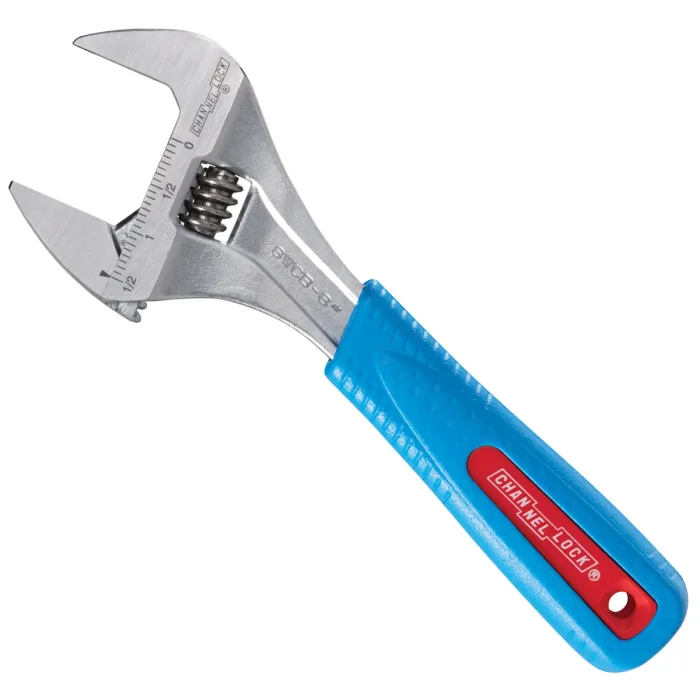
- Buy Channellock 8WCB 8-inch CODE BLUE WideAzz Adjustable Wrench An 8 inch wrench that really does open as far as a 12 inch one, at under half the weight, with the head dimension printed. Amazon
- Buy Crescent ATWJ210VS 10-inch Wide Jaw Adjustable Wrench The only adjustable wrench here whose maker prints a jaw thickness at every size and ties the tool to a named standards body.
- It depends KNIPEX 86 03 250 Pliers Wrench, 250 mm The alternative answer to the whole category, and the only tool here whose maker treats jaw play as a design target rather than a marketing line. Amazon
- Skip Milwaukee Tool 48-22-7412 12-inch Adjustable Wrench Probably a decent wrench, but Milwaukee's page publishes almost nothing you can check, including the jaw capacity. Amazon
What actually matters
- Jaw clearance - the slack between the movable jaw and the fixed jaw, measured under a light force. ISO 6787:2018 caps it at 0.25 mm on a 100 or 150 mm wrench, 0.28 mm at 200 and 250 mm, 0.30 mm at 300 and 375 mm, 0.36 mm at 450 mm and 0.50 mm at 600 mm.
- Head thickness - how thick the whole head is at the joint, which decides whether the tool fits between a fastener and whatever is behind it. The standard caps it at 15 mm on a 200 mm wrench and 20 mm on a 300 mm one.
- Jaw tip thickness - a separate and smaller number, capped at 8.5 mm on a 200 mm wrench, because the tips have to reach into places the head does not.
- Torque test - not a rating you use in service but a survival test: 230 N.m for a 200 mm wrench, 319 N.m at 250 mm, 609 N.m at 300 mm, applied in both directions with no permanent deformation afterwards.
- Hardness - at least 40 HRC across the whole head, tested on the head rather than the handle, which is why the alloy a maker names is worth reading.
- Maximum opening - the standard sets a minimum rather than a maximum, 24 mm for a 200 mm wrench and 34 mm for a 300 mm one, which is why wide jaw designs can go 60 percent past it and still be in spec.
- The knurl - the ribbed worm you spin to move the jaw. A four thread knurl engages more of the rack than a two thread one, which is the mechanism makers point to when they talk about jaws not backing off.
The specs, in plain English
Green flags vs red flags
Green flags
- The spec block prints a jaw thickness or a head thickness, not just an overall length.
- A standard is named somewhere on the page, whether ISO 6787, DIN 3117 or an ANSI or ASME field.
- The material is a specific alloy such as chrome vanadium or heat treated forged alloy steel.
- A four thread knurl or a stabilising tension spring is mentioned, meaning the maker has thought about the jaw backing off.
- The scale is described with its units and which face they are on, which suggests it was engraved rather than added in the photo studio.
Red flags
- The maximum jaw opening appears in the marketing artwork but not in the written specification.
- The material is given as Metal, Steel or Alloy with no further detail.
- The stated overall length does not match the size in the product name.
- A relative performance claim such as four times the torque appears with no test method and no absolute figure.
- The page cites a standard by an edition year that has since been replaced, which happens more often than you would expect.
Who's who: the brands
- Channellock - An American brand whose adjustable wrenches are made in Spain, known for wide jaw models that publish capacity, weight and joint thickness to two decimal places.
- Crescent - The name that became the generic term for the tool, and the only adjustable wrench maker in our comparison that prints a jaw thickness at every size and carries an ANSI field in the spec block.
- IREGA - A Spanish adjustable wrench maker that publishes jaw thickness figures down to 4.5 mm on its slim jaw models, and sells left turning versions.
- Bahco - A Swedish hand tool brand with a long history in adjustable wrenches.
- KNIPEX - A German pliers maker whose Pliers Wrench is the standard alternative answer, built around parallel smooth jaws and a stated zero backlash grip.
How to read a listing without getting fooled
Start by finding the maximum jaw opening and the length, and check that both appear in the written specification rather than in a photograph. Then look for a thickness of any kind. If the maker prints a head or joint thickness, compare it against the ceiling for that length, 15 mm at 200 mm and 20 mm at 300 mm, and you will immediately know whether you are looking at a slim tool or an average one. Next look for a named standard or an ANSI or ASME field, since that is the only strength claim most makers ever make. Then read the material line: a specific alloy is a real answer and a generic word is not. Finally, ignore every relative claim you see, because four times the torque and sixty percent wider are only meaningful next to the baseline they were measured against, and that baseline is almost never given.
How much should you spend?
This is a category where budget genuinely buys a working tool. A budget wrench from a name brand will be a plain forged head with a chrome or phosphate finish, and in the case of one brand here it is also the best documented tool in the comparison, so cheap does not mean unmeasured. Mid range buys you a wide jaw or slim jaw design, a better finish, a published origin, and usually a lighter tool for the same opening, which is the upgrade most people actually feel. Premium in this category mostly means leaving the adjustable wrench behind for a parallel jaw pliers wrench or an insulated model tested to a high voltage standard, and both of those are answers to specific problems rather than general upgrades. The one thing more money reliably buys is a thinner head at a given capacity.
Questions, answered
What size adjustable wrench should I own if I only buy one?
Buy in the 8 to 10 inch range, then decide on opening rather than length. The standard only requires a 200 mm wrench to open to 24 mm and a 250 mm one to 27 mm, but current wide jaw designs reach 39 mm at both lengths, so the size on the handle no longer tells you the capacity. An 8 inch wide jaw model will cover most household and automotive fasteners while still fitting under a sink. Go longer only when you know you need the leverage, because length adds weight faster than it adds reach.
Is a wide opening wrench weaker than a normal one?
Not necessarily, and at least one maker publishes the opposite. Crescent states that each of its wide jaw wrenches meets the ASME performance requirements for the next size up, which is a strength claim rather than a capacity one. What does trade away strength is extreme thinness: specialist slim jaw models get down to about 4.5 mm of jaw thickness where a normal wrench of similar opening is nearer 9 mm, and that is a deliberate compromise for access. Read the jaw thickness and the opening as two separate decisions, because they are.
Why do some wrenches have the jaw on the other side?
Because the fixed jaw is the strong one and the movable jaw is not. Tool makers tell you in writing to adjust the wrench tightly and pull so the load falls on the fixed jaw, which is easy when the geometry lets you turn that way and impossible when it does not. Some manufacturers solve it by selling a mirrored left turning wrench, and others by making the jaw reversible so you can flip it. If you find yourself constantly pushing rather than pulling on a particular job, that is what those models are for.
Can I put a pipe on the handle for more leverage?
Tool makers say no, and they say it in the same breath as two other warnings worth heeding. Manufacturer safety guidance is not to use a hammer or an extension on an adjustable wrench, not to pull on one that has a loose fit after adjusting, and not to use one to free a rusted fastener or to give the final tightening. The reason is structural rather than fussy: the wrench is tested at four fifths the torque of the fixed wrench of the same size and is allowed measurable slack between its jaws. A bent handle or a spread fixed jaw means the wrench should be discarded, not straightened.
Or jump to the head-to-head: Channellock 8WCB 8-inch CODE BLUE WideAzz Adjustable Wrench vs Crescent ATWJ210VS 10-inch Wide Jaw Adjustable Wrench.