Explained
Air Compressors, Explained
After reading, you'll be able to size a compressor to the tool you own, and know which of its published numbers to ignore.
In this guide
Compressor listings lead with gallons and horsepower, and both are poor guides. The figure that decides whether the machine can run your tool is further down the page.
The 30-second version
- Airflow at 90 PSI is the spec, because air tools are rated at roughly that pressure and a compressor's output falls as pressure climbs.
- Horsepower was legally discredited, since a mid 2000s class action settlement required continuous-output ratings and retired peak, max developed and breakdown-torque figures.
- Usable air is pressure times volume, so a 6 gallon tank at 165 PSI holds more real work than the same tank rated to 150.
- Decibels are logarithmic, which makes 79 dB roughly four times as loud to the ear as 60 dB rather than a third louder.
- Nobody states a measurement distance, so the dB figures on these spec sheets can be compared only loosely, since sound falls off sharply with distance.
The products this guide is about
Our verdict on each, with the full reasoning on the companion review.
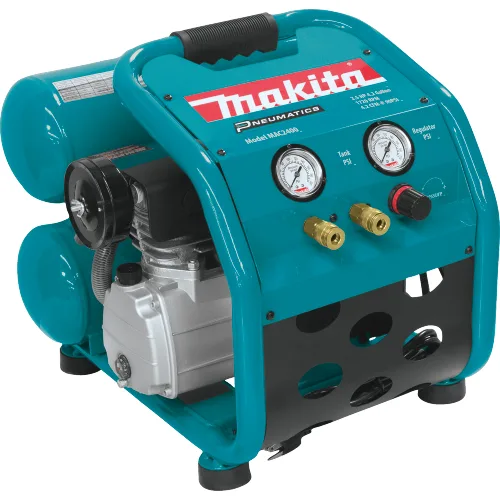
- Buy Makita MAC2400 2.5 HP Big Bore Air Compressor The most air at working pressure by a wide margin, and the only spec sheet here that gives you a running horsepower figure as well as a peak one. Amazon
- Buy California Air Tools 8010 Ultra Quiet 1.0 HP Air Compressor Sixty decibels, which is the only spec in this comparison that changes whether you can use the tool in a room with other people in it. Amazon
- It depends DEWALT DWFP55126 6 Gallon 165 PSI Pancake Compressor The most stored pressure here at 165 PSI, which buys you more usable shots per cycle than the airflow figure suggests.
- Skip CRAFTSMAN CMEC6150K 6 Gallon 150 PSI Pancake Compressor Matches the DeWalt on airflow while being louder with less pressure, and its own horsepower figure cannot be pinned down.
What actually matters
- SCFM at 90 PSI - standard cubic feet per minute delivered at working pressure. Match it against the published appetite of your tool. Brad nailers want a fraction of a CFM, framing nailers more, and sanders or impact wrenches far more again.
- Maximum pressure - how much the tank holds when full. It multiplies with tank volume to give usable stored air, which is why 165 PSI in six gallons beats 150 PSI in six gallons by more than the pressure difference suggests.
- Running versus peak horsepower - running or rated horsepower is continuous output. Peak is a fraction of a second at startup and describes nothing you can use. A spec sheet that gives both is being straight with you.
- Duty cycle - the proportion of a period the pump may run, written like 70/30. Rarely published. Its absence does not mean the compressor is continuous-rated; it means the maker has not said.
- Noise in dB - almost always quoted without a distance or a test standard. Treat large gaps as real and small ones as noise, and remember a 10 dB rise is roughly a doubling of loudness.
- Pump type - oil-lubricated pumps generally deliver more air, run quieter for that air and last longer, in exchange for oil changes and keeping the machine level. Oil-free pumps trade lifespan for zero upkeep.
The specs, in plain English
Green flags vs red flags
Green flags
- Airflow is quoted at 90 PSI, not only at 40.
- A running or rated horsepower figure appears alongside any peak figure.
- A duty cycle is published as a ratio.
- Maximum pressure is stated clearly next to tank volume.
- The pump type and its speed in RPM are given.
Red flags
- Horsepower leads the listing and airflow is hard to find.
- A peak horsepower figure appears with no running figure anywhere.
- Airflow is quoted only at 40 PSI.
- A decibel number is presented as a headline feature with no distance stated.
- Two retailers list materially different horsepower for the same model number.
Who's who: the brands
- Makita - Oil-lubricated pumps with a cast iron cylinder and the unusual habit of publishing running horsepower next to maximum. Heavy, loud and long-lived.
- California Air Tools - Built the ultra-quiet niche around 60 dB oil-free pumps and large tanks. Publishes duty cycle, which almost nobody does, while still printing a peak horsepower figure.
- DEWALT - Portable oil-free pancakes with high maximum pressure. Strong on stored air, thin on published pump disclosure.
- CRAFTSMAN - Value pancakes usually sold as accessory kits. The horsepower listings for a single model can disagree by a factor of four.
- Rolair - A contractor-focused compressor brand that is worth checking if you want an oil-lubricated portable.
How to read a listing without getting fooled
Find the airflow figure at 90 PSI first, and if the listing only gives 40 PSI, treat that as an answer in itself. Compare it against the published air consumption of the tool you own. Then read maximum pressure alongside tank size, because the two multiply. Take horsepower as decoration unless a running figure is given. Read the decibel number last, and only trust large gaps.
How much should you spend?
Budget buys a 6 gallon oil-free pancake at around 2.6 SCFM, which covers tyres, brad and finish nailing. Mid-range buys either more pressure or much less noise, rarely both. Premium buys an oil-lubricated pump that doubles the working airflow, and asks you to accept the weight and the noise that come with it.
Questions, answered
Will a pancake compressor run an impact wrench?
Briefly, then it will not. Impact wrenches and air sanders are continuous-demand tools that want several CFM at 90 PSI, and a typical pancake delivers around 2.6. You will get a few seconds from the tank and then wait for the pump. Match the compressor's airflow to the tool's published consumption rather than hoping the tank covers the gap.
Does a bigger tank mean a better compressor?
It means longer bursts, not more air. The pump's CFM sets how much air exists per minute; the tank only decides how much is banked before you have to wait. A large tank on a weak pump is a deliberate design for intermittent work, and it is exactly what the 8 gallon California Air Tools unit is.
Is an oil-free compressor worse?
Not for the work most people do. Oil-free pumps trade lifespan and noise for having no maintenance at all, which for occasional use is a good bargain. Oil-lubricated pumps earn their upkeep in sustained use, where they run cooler, deliver more air and last considerably longer.
Why do two shops list different horsepower for the same compressor?
Because horsepower on a consumer compressor is not tied to a single defined measurement, so a peak figure, a rated figure or something in between can all end up on a listing. The Craftsman here appears as 0.2 HP in one place and 0.8 HP in another. Read the airflow figure instead, which is defined and comparable.
Or jump to the head-to-head: Makita MAC2400 2.5 HP Big Bore Air Compressor vs California Air Tools 8010 Ultra Quiet 1.0 HP Air Compressor.