Explained
Solar Path Lights, Explained
After reading, you'll understand how bright a solar path light really is, how long it will run, and how well it will survive the weather.
In this guide
Most disappointing solar path lights were never meant to light a path. Multi-packs often rate each light at a few lumens, run on tiny batteries and carry low weather ratings, but the photos make them look bright. Placement and season matter as much as the hardware. This guide explains the numbers so you can tell a path light from a garden decoration before you buy.
The 30-second version
- Lumens are the headline, and lights under 10 lumens mostly mark an edge rather than light the ground.
- Battery size sets runtime, so compare mAh and whether the cell is replaceable.
- IP65 or higher is the target, for lights that sit in wet beds and sprinkler zones.
- Metal and glass last longer, than thin plastic bodies and acrylic lenses.
- Sun exposure decides everything, because a shaded panel cannot fill even a large battery.
The products this guide is about
Our verdict on each, with the full reasoning on the companion review.
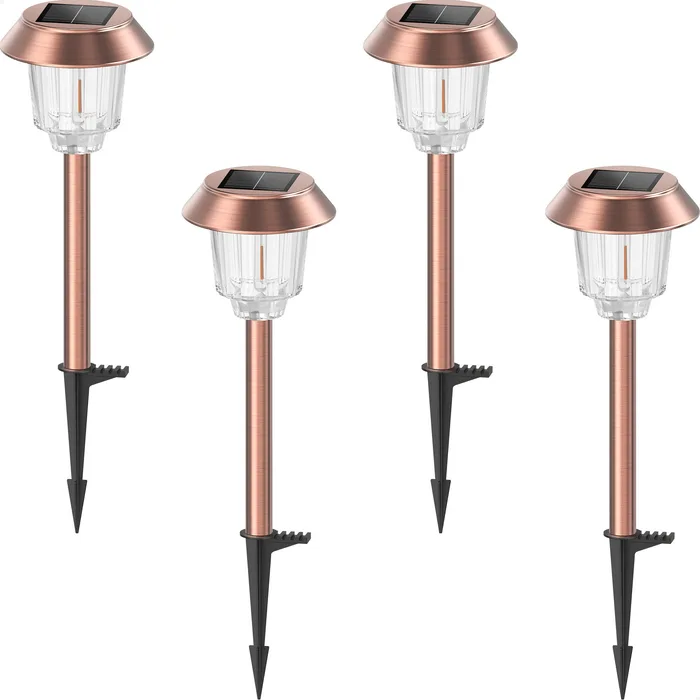
- Buy SUNVIE Solar Pathway Lights (SPL-YAWC) Stainless steel and glass path lights with a 10 to 40 lumen dimmer, IP65 and a replaceable battery. Amazon
- Buy XMCOSY+ High Lumens Solar Pathway Lights A stainless steel and bubble glass 6 pack with an IP65 rating, a 1000mAh battery and a 10 or 25 lumen switch.
- It depends Linkind SP3 Solar Pathway Lights The brightest headline rating here at 200 lumens, in a plastic body with an IP54 splash-proof rating. Amazon
- It depends Ring Smart Lighting Solar Pathlight A motion-activated smart path light with IP66, a lithium battery and Ring app control. Amazon
- It depends Moonrays Black Stake Light (26245) A simple matte black stake light with a glass lens, rated at 15 lumens for up to 8 hours.
- Skip Gigalumi Grid Solar Pathway Lights A cheap multi-pack of lantern-style lights rated at just 3 lumens each, with IP44 and a 6 month warranty.
What actually matters
- Lumens - The total light output. Compare it directly across listings, since photos are often exposed to look brighter.
- Battery capacity - Measured in mAh at a given voltage. Bigger numbers store more energy for long nights.
- Battery chemistry - Ni-MH AA and AAA cells are common and easy to replace; lithium cells store more in less space. Always replace like with like.
- IP rating - The second digit describes water protection. IP65 resists water jets, while IP44 only covers splashing.
- Panel type - Monocrystalline panels are usually more efficient than polycrystalline ones. Panel size also matters.
- Brightness modes - A dimmer or low mode stretches runtime. It helps most in winter or partial shade.
- Warranty - It shows how long the maker expects the light to last. Six months is short for an outdoor product.
The specs, in plain English
Green flags vs red flags
Green flags
- A specific lumen rating per light, not per pack.
- Battery capacity and chemistry are listed.
- An IP65 or higher rating is stated.
- Metal body and glass lens are described.
- A warranty of at least one year.
Red flags
- Lumens are missing or given for the whole pack.
- Ratings conflict between the headline and the spec table.
- IP44 or no weather rating at all.
- Tiny AAA batteries under 200mAh.
- A warranty of six months or none stated.
Who's who: the brands
- SUNVIE - Known for outdoor and landscape lighting, including metal and glass solar path lights.
- Linkind - Known for bright, low-cost solar path lights and spotlights, including smart color models.
- Ring - Known for security cameras and smart lights that work together in the Ring app.
- Moonrays - Known for solar and low-voltage garden lights sold through hardware stores.
- XMCOSY+ - Known for solar and string lighting, including stainless steel path lights.
How to read a listing without getting fooled
Start with lumens per light and check that the figure is not a pack total. Then find the battery line for capacity, voltage and chemistry, and look for whether it is replaceable. Read the IP rating and the materials together, since a metal body with IP65 is a very different product from plastic with IP44. Check the runtime claim and the charging hours it assumes, which are usually based on full summer sun. Finally, look for the warranty, and be wary when the headline and spec table disagree.
How much should you spend?
Budget multi-packs keep the price per light very low by using tiny batteries, low lumen ratings and plastic parts, so they often work better as decoration than lighting. Mid-range sets add metal and glass, larger batteries, IP65 ratings and brightness control, and usually last longer. Smart solar lights cost more per fixture and may need a hub, but add motion sensing and app control. Compare the price per light against lumens and warranty rather than the pack price.
Questions, answered
Should I charge solar path lights before first use?
Yes, give them a full day of direct sun with the switch on before judging brightness. Gigalumi recommends 12 hours of charging for the first use. New batteries often perform better after a few charge cycles.
Can solar path lights stay out in winter?
Lights with a good weather rating can, but runtime will drop with shorter days. SUNVIE rates its lights for rain, snow and frost and suggests dimming them in winter. Brush snow off the panels so they can charge.
Why does one light in a set stay dimmer than the others?
Usually it gets less sun, often from shade, a nearby wall or a dirty panel. A porch or street light near the sensor can also confuse the dusk-to-dawn switch. Moving the light or cleaning the panel usually fixes it.
Do solar path lights need any wiring?
No, they are self-contained and push into the ground on stakes. The Ring pathlight also mounts with screws and can be topped up over Micro USB. There is no connection to household power.
Or jump to the head-to-head: SUNVIE Solar Pathway Lights (SPL-YAWC) vs XMCOSY+ High Lumens Solar Pathway Lights.