Explained
Chainsaw Chaps, Explained
After reading, you'll understand what the standard on the label was actually tested to, how much of your leg each style covers, and when a pair has to be retired.
In this guide
Most first-time buyers assume chaps are armour and that more layers means more protection. Neither is quite right. The pad is a bundle of long loose fibres that get dragged into the saw's drive sprocket and jam it, so what matters is that the pad is intact, clean, and positioned over the part of the leg a chain can reach. That reframes the whole purchase: length and coverage geometry beat layer count, care instructions are a safety feature rather than laundry advice, and the certification on the label tells you a lab actually ran a saw into the material.
The 30-second version
- The pad jams the saw, it does not absorb the cut, so the fibres have to be free to move and the pad has to be uncut.
- ASTM F1897 is the US standard, and a genuine UL mark with a file number is the evidence that a third party actually tested it.
- OSHA's rule is an employer duty in logging, so it does not bind you at home, but it is still the benchmark worth buying to.
- Fit decides coverage, because a hem that stops above the boot top or drags on the ground leaves leg unprotected regardless of layer count.
- Cut the pad and the pair is finished, though shell-only damage can and should be patched to keep bar oil out of the fibres.
The products this guide is about
Our verdict on each, with the full reasoning on the companion review.
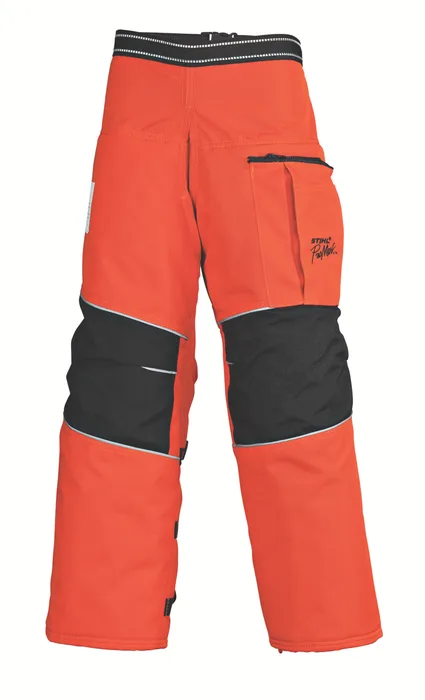
- Buy STIHL Pro Mark Wrap Chaps Professional wrap chaps that carry the protective pad around the lower leg instead of only across the front of it.
- Buy Husqvarna Technical Apron Wrap Chainsaw Chaps The default homeowner chap: UL certified, apron wrap coverage, a wedge pocket, and available almost anywhere saws are sold. Amazon
- It depends Clogger Zero Gen2 Light and Cool Men's UL Chainsaw Pants Certified chainsaw trousers built for climbers and all day sawyers, which is a different job from a chap you buckle on and take off.
- Skip Oregon Protective Chainsaw Chaps, Black, One Size Fits All (563979) UL Classified and cheap, but a single fixed length sold as one size fits all gives up the one variable that decides where the pad sits. Amazon
What actually matters
- Coverage geometry - whether the pad sits only across the front, wraps onto the sides, or carries around the back of the leg is the single biggest difference between products. Most homeowner chaps are front-only aprons, and a chain that comes across the inside of the thigh or the back of the calf meets nothing.
- Length - the hem should finish around the boot top, roughly at the second or third lace hook, and OSHA's logging rule asks for coverage from the thigh to the top of the boot. A garment sold in one universal length cannot do that for every buyer.
- Third party certification - a UL mark plus an ASTM F1897 reference means a lab ran a chainsaw into the material on a standardised rig. Without it you are trusting a seller's description of fabric they did not test.
- Shell toughness and coating - the outer fabric is what keeps bar oil, sawdust and abrasion off the pad. Oil that soaks into the pad acts as an adhesive and reduces cut-through protection, so a coated high-denier shell is protecting the protection.
- Care and cleaning - bleach and harsh cleaning can reduce cut-through protection and a pressure washer can damage the pad. Instructions differ sharply between brands, from hand wash only to machine wash and tumble dry, so the label is not boilerplate.
- Retirement criteria - knowing when to stop using a pair matters as much as buying the right one. Numerous shell holes, sawdust worked into the layers, a shell caked with oil, a repair stitched through the pad, or a cut in the pad itself all end a garment's service life.
- Standard family on the label - US-market goods should reference ASTM F1897 and European goods EN ISO 11393-2. The test methods differ enough that a European class does not convert into an ASTM result.
The specs, in plain English
Green flags vs red flags
Green flags
- A label naming ASTM F1897 with a UL mark and a file number you can look up.
- The garment is sold in several discrete lengths rather than one universal size.
- The maker states the coverage type plainly, such as full wrap, apron wrap or front only.
- A high denier coated outer shell, and a shell fabric specified on the product page rather than just described as durable.
- Clear published washing and retirement instructions, including what to do if the pad is cut.
Red flags
- A listing that claims OSHA or ASTM compliance without naming a certifier or a file number.
- One size fits all sizing on a garment where hem position determines coverage.
- A UL logo image on a marketplace listing with no matching mark visible on the product label itself.
- Care instructions that permit bleach, or no care instructions at all.
- A seller advertising the pad as reusable or repairable after a chain strike.
Who's who: the brands
- STIHL - Saw maker whose Pro Mark wrap chaps carry nine layers of Avertic Pro and wrap the lower leg, sold through its dealer network.
- Husqvarna - The mainstream default, with UL certified apron wrap chaps sold through its dealer network and clear certification detail on its own product pages.
- Clogger - Specialist in lightweight breathable chainsaw trousers, aimed at climbing arborists and all day sawyers.
- Notch - Arborist supply brand offering chainsaw chaps in more than one coverage style.
- Oregon - Saw chain maker whose protective range leans budget and mass retail, with UL Classified apron chaps sold widely through general hardware channels.
How to read a listing without getting fooled
Start at the certification line and ignore the marketing above it. You want a named standard, ASTM F1897 for the US, and a named certifier, which in practice means UL. If the listing says meets or exceeds a standard without naming who tested it, treat that as unverified. Next find the coverage word: apron, apron wrap, full wrap or full calf wrap, and translate it as front only, front plus sides, or front plus back. Then find the length table, and check whether the maker publishes real length options or one universal size with a snap adjustment at the waist, because a waist adjustment moves the whole pad rather than shortening the hem. Layer count and denier are worth reading last, since eight thin layers and five thick ones can both pass the same test. Finally read the care instructions before you buy, because they vary from hand wash only to machine wash and tumble dry, and following the wrong one degrades the pad.
How much should you spend?
Budget tier gets you a UL Classified front apron chap, often in a single universal length, from a mass retail brand. That is genuine certified protection and it is far better than bare legs, but the money saved comes out of fit range and coverage geometry. Mid-range is where most people should land: a UL certified apron wrap from a saw manufacturer, sold in real size bands, with a proper coated shell and useful details like a wedge pocket. Premium splits two ways rather than simply buying more protection. Heavy full-wrap chaps from a specialist maker cost more because the pad goes all the way around the leg and comes in more lengths. Certified chainsaw trousers cost more again because you are buying a garment you wear all shift, and that money buys breathability and freedom of movement rather than extra coverage, since many are front-protection designs unless you pay for a 360 degree option.
Questions, answered
Do more layers mean more protection?
Not directly. Layer counts in this category range from five to eight and the products all pass the same test, because layer count depends on how thick and what type each layer is. A five layer aramid pad and an eight layer warp knit pad can both stop the chain at the standard's test speed. Use the certification to confirm the material works, then judge products on coverage, length options and shell quality.
Can I wash chainsaw chaps in a machine?
It depends on the brand, and this is one instruction genuinely worth reading. Oregon says its 563979 chaps are machine washable, while Husqvarna specifies cold water, mild detergent, hang drying and never chlorine bleach. Follow the label on your own pair, avoid bleach, and keep a pressure washer away from the pad.
Are European chaps rated to EN ISO 11393 as good as ASTM certified ones?
They are tested to a real standard, but the two are not interchangeable and there is no direct conversion, because the test rigs and methods differ. If you are buying in the US, buy something certified to ASTM F1897 so the label matches the benchmark your regulator and your insurer recognise.
Should I buy chaps or chainsaw trousers?
Chaps if you saw occasionally, work on the ground, and value being able to strap them on and take them off. Trousers if you climb, work in a harness, or run a saw for hours at a time, because a chap that lives in the shed because it is too hot protects nobody. Cost is a factor too: a chain strike retires a whole pair of trousers, whereas a chap is a cheaper item to replace. Check the coverage either way, since many trousers are front protection unless you specifically order a 360 degree calf version.
Or jump to the head-to-head: STIHL Pro Mark Wrap Chaps vs Husqvarna Technical Apron Wrap Chainsaw Chaps.