Explained
Checked Luggage, Explained
After reading, you'll understand how to check a suitcase's size and weight against airline limits, what the shell material tells you, and how to read a luggage warranty for airline damage.
In this guide
First-time buyers shop checked luggage by the inch figure in the name, such as 28 or 29 inch, and that number tells you little. It may be the case height without wheels, and it says nothing about width and depth, which count just as much toward an airline's limit. The second trap is capacity: a bigger case feels like better value until it weighs in over 50 lb or measures oversize. The third is the word lifetime on a warranty that excludes the most likely cause of damage. Cabin bag rules are a separate subject, covered in our carry-on luggage guide.
The 30-second version
- Add up three numbers, because airlines such as American and Delta limit a standard checked bag to 62 linear inches of height plus width plus depth.
- Count the wheels, since the whole bag is measured and a maker's case size can be several inches smaller than its overall size.
- Weigh the empty case, as a 13 lb suitcase leaves noticeably less of a 50 lb allowance than an 11 lb one.
- Read the exclusions, because many luggage warranties cover defects only and leave out damage from airline handling.
- Keep large cases closed, as the expander that helps a medium bag can push a large one over the size limit.
The products this guide is about
Our verdict on each, with the full reasoning on the companion review.
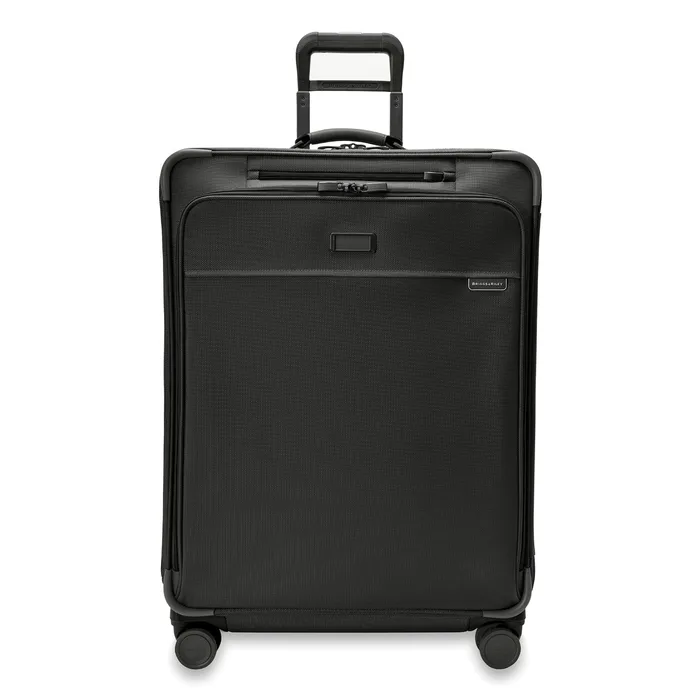
- Buy Briggs & Riley Baseline Large Expandable Spinner A ballistic nylon softside that measures 29 x 20 x 12 inches outside and carries a lifetime guarantee that includes airline damage.
- Buy Travelpro Maxlite Air V2 Large Check-In Hardside Spinner A 100% polycarbonate large hardside that the maker measures at 62 linear inches including wheels and carry handles, and 10.9 lb empty.
- It depends Away The Large A 100% polycarbonate hardside at 29 x 20.5 x 12.5 inches with five years of free repairs that include airline mishandling, but heavy and not expandable.
- Skip Delsey Paris Helium Aero 32-Inch Expandable Check-In A big polycarbonate case whose listed exterior already exceeds 62 linear inches closed, with a warranty that excludes airline handling.
What actually matters
- Linear inches - The sum of exterior height, width and depth, and the figure airlines use for size limits. A case can be 29 inches tall and still fail if it is wide and deep.
- Overall versus case dimensions - Overall includes wheels and handles; case size is the packing body only. Compare the overall figure with the airline limit and the case figure with what you need to pack.
- Empty weight - Sometimes called tare weight, it is what the suitcase weighs before packing. It comes straight out of your allowance on every flight.
- Shell material - Polycarbonate flexes and recovers, ABS is stiffer and usually cheaper, aluminium is rigid and heavy, ballistic nylon is a woven fabric that resists abrasion. The maker's stated material is the only reliable guide, since blends look alike in photos.
- Capacity in litres - A rough measure of packing space that lets you compare cases of different shapes. Check whether it is interior, exterior or expanded, since these can differ by tens of litres.
- Warranty scope - A limited warranty usually covers manufacturing defects in parts like wheels, zippers and handles. Cover for airline damage is a separate promise that only some makers offer, sometimes for a set number of years.
- Expansion - A zip gusset that adds depth, often around 2 inches. It adds litres, linear inches and the temptation to pack past the weight limit.
The specs, in plain English
Green flags vs red flags
Green flags
- The spec table gives exterior dimensions and states that wheels and handles are included.
- The three exterior numbers add up to 62 inches or less with the case closed.
- The shell material is named plainly, such as 100% polycarbonate or ballistic nylon.
- The warranty page says in writing whether airline or carrier damage is covered, and for how long.
- Weight and capacity in litres are both published on the maker's page.
Red flags
- Only one size number is given, such as 28 inch, with no width or depth.
- The exterior dimensions total more than 62 inches before expansion.
- The shell is described only as hardshell, durable composite or PC-style.
- The product page shows more than one warranty length for the same suitcase.
- The warranty excludes handling by third parties and the listing still leads with the word lifetime.
Who's who: the brands
- Briggs & Riley - Premium ballistic nylon and hardside luggage sold with a lifetime repair guarantee that includes airline damage.
- Travelpro - Mid-range lightweight luggage with spec tables that list case and overall dimensions separately.
- Away - Direct-to-consumer polycarbonate suitcases with repair coverage that includes airline mishandling for the first five years.
- Delsey Paris - A long-established French brand with a wide polycarbonate range in many sizes, including some above the standard airline limit.
- Monos - Polycarbonate cases with full published specs; its Check-In Large is listed at 30 x 21 x 11 inches including wheels, 10.3 lb and 97.3 litres.
How to read a listing without getting fooled
Start with the dimensions row and find the words that say what is included. If it reads overall, or includes wheels and handles, add the three figures and compare with 62. If it only gives case size, look for a second row or an FAQ; some makers publish both. Next find weight and subtract it from 50 lb. Then capacity: note whether it is one number or a range, and whether the range reflects expansion. Check the material line for a named plastic or fabric. Last, open the warranty page itself, not the badge on the product page, and search it for airline, carrier and third party. If the product page and warranty page disagree on length of cover, go by the documentation that ships with the bag.
How much should you spend?
In the budget tier you mostly find ABS or ABS and polycarbonate blends, short warranties and thin spec tables; sizes and weights may be missing altogether. The mid-range tier is where pure polycarbonate shells, published overall dimensions and limited lifetime warranties become normal, and it is the sensible place for most people who fly a few times a year. The premium tier adds repair programmes, cover for airline damage and better hardware, and sometimes extra weight. Paying more does not buy a lighter or larger case as a rule; in our comparison the lightest case was a mid-range one. What the top tier buys is someone to fix the bag.
Questions, answered
Is a 30 inch suitcase too big to check?
Not by height alone. What matters is the total of height, width and depth with wheels. A case 30.5 inches tall can come to 62 linear inches if it is 19.5 wide and 12 deep, as one in our comparison does. A 31.5 inch case with similar width and more depth goes over. Do the sum from the maker's exterior figures.
What does 62 linear inches look like in practice?
Typical combinations are around 29 x 20 x 12 inches or 30 x 21 x 11 inches including wheels. Makers' capacity figures for the hardsides in that envelope that we looked at ran from about 97 to 114 litres. Cases marketed as extra large or 31 inches and up deserve a closer look at the numbers.
Is polycarbonate better than ABS?
For a checked bag, polycarbonate is generally the safer choice because it flexes on impact where stiffer plastics are more prone to crack. ABS keeps cost down and is common in budget cases, often blended with polycarbonate. Blend ratios are usually not published, so two ABS+PC cases can behave differently. If the maker states 100% polycarbonate, that removes the guesswork.
How much should an empty large suitcase weigh?
The four large cases we compared ranged from 10.9 lb to 13.6 lb by their makers' figures. Softside ballistic nylon sat at the heavy end and polycarbonate at the light end. There is no official standard, so the useful test is your own packing: if you regularly reach the high 40s in pounds, a pound or two of case weight is worth chasing.
Or jump to the head-to-head: Briggs & Riley Baseline Large Expandable Spinner vs Travelpro Maxlite Air V2 Large Check-In Hardside Spinner.