Explained
Luggage Scales, Explained
After reading, you'll understand what capacity and graduation tell you, why an accuracy figure is rare, and how much margin to leave at the check-in desk.
In this guide
First-time buyers tend to read 110 lb / 0.1 lb on a listing and assume the scale is accurate to a tenth of a pound. It is not a promise of that. The first number is the most the scale should lift and the second is the size of the step on the display. How close the reading is to the true weight is a third number, and most makers do not publish it.
The 30-second version
- Graduation is not accuracy, it is the display step, and a scale can show tenths of a pound while being off by more than that.
- Most makers publish no tolerance, so a stated figure of any size is a point in a scale's favor.
- Leave a margin, because one maker's own manual recommends packing at least 1.2 lb under the airline allowance.
- Match the attachment to your bags, since a strap handles thick or padded handles that a hook may not seat on.
- Check the battery before you buy, because a replaceable CR2032 or AAA cell can be swapped on a trip and a sealed rechargeable one cannot.
The products this guide is about
Our verdict on each, with the full reasoning on the companion review.
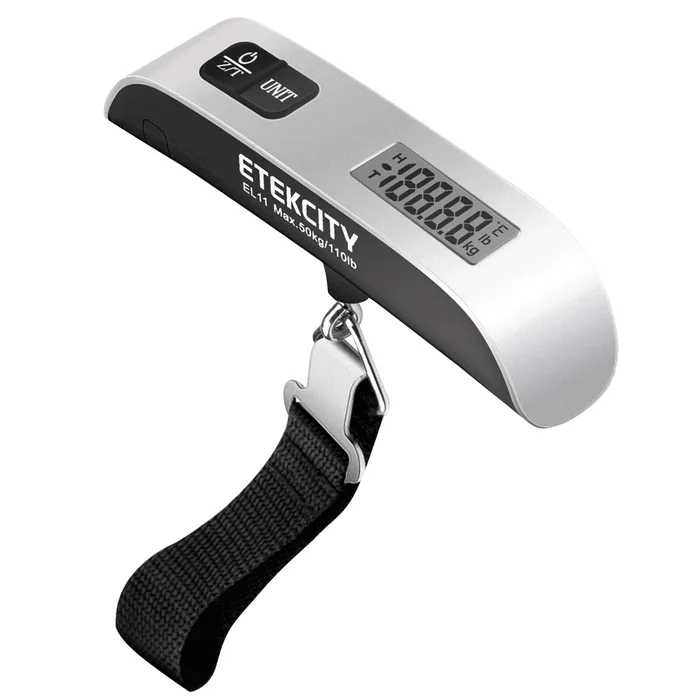
- Buy Etekcity EL11 Luggage Scale A 110 lb strap scale with a published 0.1 lb graduation, a zero/tare button and a single replaceable CR2032 cell.
- Buy Heys xScale PRO II A slim 3.3 oz hook scale and the one model of the four whose maker states an accuracy figure.
- It depends Taylor Kinetic Powered Digital Luggage Scale A battery-free digital strap scale you charge by pressing a button, with the most candid manual of the four.
- Skip Travelon Stop & Lock Luggage Scale with Tape Measure A mechanical dial scale with a locking needle and a 39 inch tape measure, limited to 75 lb.
What actually matters
- Capacity - The most weight the scale should lift. Most digital models state 110 lb / 50 kg, while mechanical dials are often lower, such as 75 lb.
- Graduation - The smallest step the display shows, such as 0.1 lb. It tells you the resolution of the readout and nothing about how true the reading is.
- Accuracy tolerance - How far the reading may be from the real weight. Few makers state it, so its absence on a listing is normal and worth noticing.
- Attachment - A strap loops around the handle and clips back to the scale, while a hook slips under it. Straps suit more handle shapes and hooks are quicker.
- Power source - Coin cells and AAAs are replaceable by the owner. Rechargeable and kinetic designs remove the spare battery but add their own quirks.
- Hold function - The scale locks the reading once it is stable so you can put the bag down and read it. Without a lock you are reading a display at arm's length under load.
- Zero and tare - A button that sets the display to zero before a lift. On luggage scales this stands in for calibration, which makers generally do not offer as a user procedure.
The specs, in plain English
Green flags vs red flags
Green flags
- The maker publishes the graduation in the specs or the manual.
- An accuracy figure is stated in writing, even a modest one.
- The battery is a standard type the owner can replace.
- A hold or lock function and a zero button are both described.
- A downloadable manual and a stated warranty term are on the maker's own site.
Red flags
- A listing that gives capacity and no graduation.
- Words such as high precision with no number attached.
- A sealed rechargeable battery with no way for the owner to replace it.
- A brand with no product page or manual of its own.
- A mechanical dial with no stated graduation, bought to check a bag that sits near the limit.
Who's who: the brands
- Etekcity - A maker of household and travel scales that publishes capacity, graduation and a downloadable manual for its luggage scale.
- Heys - A luggage brand whose xScale line is its long-running handheld scale family, sold with a stated accuracy figure.
- Taylor - A measurement brand founded in 1851, now a division of Lifetime Brands, known for kitchen and bathroom scales and thermometers.
- Travelon - A travel accessories brand that sells mechanical, coin cell and rechargeable luggage scales.
How to read a listing without getting fooled
Start with the pair of numbers that usually appear together, such as 110 lb / 50 kg and 0.1 lb / 50 g. The first is capacity and the second is graduation. Then look for the word accurate followed by a number. If you find one, that is the tolerance. If you find only phrases such as high precision, the maker has not committed to anything. Next check the battery line for the type and count, and whether the cells are included. Look for hold, lock or data lock, and for tare or zero. Last, open the manual if the maker offers one, because details such as how the battery is accessed, how to zero the scale and what the error codes mean tend to live there and not on the product page.
How much should you spend?
Luggage scales sit low on the price ladder. The budget tier covers basic coin cell digital scales and mechanical dials, and the best documented model in this comparison sits there. The mid-range tier adds things such as a backlit display, a slimmer body, AAA or battery-free power and brand name warranties. Paying more does not reliably buy a tighter accuracy claim, because most makers at every tier publish none. Spend on the documentation and the battery arrangement you prefer, not on the tier.
Questions, answered
Why might my scale and the airport scale disagree?
They are different classes of device. Check-in scales are used to compute charges, which generally makes them commercial weighing devices subject to state weights and measures rules based on NIST Handbook 44. A handheld travel scale is a consumer gadget with no such oversight, and its reading also depends on how steadily you lift. Taylor's manual lists a bag touching your body, a pulled strap at zero and a cold scale after a flight as things that affect the reading.
What is the right way to weigh a bag with a handheld scale?
Turn the scale on and confirm it reads zero with the strap or hook hanging free. Attach it to the top handle, lift smoothly until the bag is just clear of the floor, and keep the bag from touching you or the furniture. Hold still until the reading locks, then set the bag down and read it. If two lifts give slightly different numbers, Taylor's manual notes that the true weight lies between them.
Is a mechanical dial scale more reliable than a digital one?
It has fewer things to go flat, since there is no battery. That does not make its reading closer to the truth. The dial scale in our comparison publishes no graduation or tolerance, has a lower capacity than the digital models, and has to be read by eye. For a rough check it is fine, and for a bag near the limit a digital readout with a published step is easier to act on.
Can I pack a luggage scale in my carry-on?
The makers describe these as compact tools meant to travel with you, and Taylor's recommended margin explicitly allows for bringing the scale along. Coin cell, AAA and battery-free scales raise no unusual battery questions for most travelers. If your scale has a built-in rechargeable lithium battery, check your airline's and your departure country's battery rules before you pack it. Our carry-on luggage guide covers size limits for the bag itself.
Or jump to the head-to-head: Etekcity EL11 Luggage Scale vs Heys xScale PRO II.