Explained
Travel Towels, Explained
After reading, you'll know what size and weight suits your trip, how to read absorbency claims, and how to wash a towel without ruining it.
In this guide
A travel towel is a synthetic towel designed to be light, to pack small and to dry quickly, which are three properties cotton does not have. The compromise is texture: the same thin flat fibres that dry in an hour also feel nothing like the towel in your bathroom, and every product in this category sits somewhere on that line.
The 30-second version
- Weight and packed size are the whole point, so treat a missing figure as a missing answer.
- Absorbency is quoted as a multiple of dry weight, which only means something read alongside the weight.
- Flat fabric dries fast, pile feels better, and you cannot have both.
- A hang loop prevents the smell, because packed-damp synthetic fibre is what causes it.
- Never use fabric softener, since it coats the fibres and stops them absorbing.
The products this guide is about
Our verdict on each, with the full reasoning on the companion review.
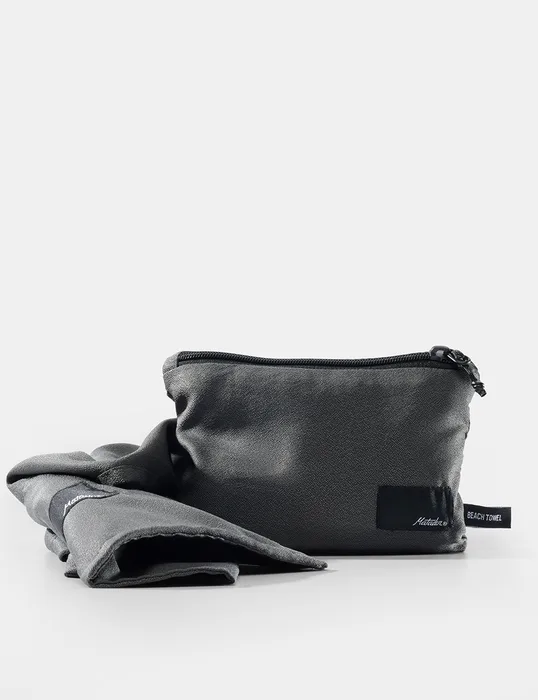
- Buy Matador NanoDry Packable Beach Towel A full-size towel at 155 grams that packs into its own pocket.
- Buy Dock and Bay Quick Dry Towel Every dimension and weight published, for the towel and for its pouch.
- It depends Sea to Summit Tek Towel A deep pile that actually feels like a towel, at the cost of drying speed.
- Skip Nomadix Original Towel The most absorbent and the largest, and it will not say how heavy it is.
What actually matters
- Weight - in grams or ounces. The spread across otherwise similar towels is large, from around 150 grams to nearly 500.
- Packed size - the folded dimensions or the pouch dimensions, which determine whether it goes inside the bag or on the outside.
- Towel dimensions - unfolded length and width. Full-size is around 60 by 30 inches; hand and face sizes are roughly half that.
- Absorbency - usually stated as a multiple of the towel's dry weight, typically two to four times.
- Fibre and construction - microfibre, nanofiber or a deep pile, in recycled polyester and nylon blends, with certification where claimed.
- Carry system - a separate zipped pouch, a moulded case, or a pocket built into the towel itself.
- Fittings - a hang loop with a snap closure for drying, and sometimes a zip pocket for valuables.
The specs, in plain English
Green flags vs red flags
Green flags
- Weight published in grams for every size.
- Packed size or pouch dimensions given.
- Fibre blend stated as percentages, ideally with a certification.
- An absorbency multiple quoted.
- Care instructions that mention fabric softener.
Red flags
- No weight anywhere on the page.
- No packed size on a product sold for travel.
- Fabric described only as quick-dry or microfibre.
- One size with no smaller option.
- No washing guidance on a synthetic towel.
Who's who: the brands
- Matador - Ultralight travel brand publishing weight and packed dimensions for everything, using nanofiber towels that pack into their own pockets.
- Dock and Bay - Quick-dry towel specialist publishing fibre percentages, towel and pouch dimensions, weights and complete care instructions for each size.
- Sea to Summit - Australian outdoor brand offering several towel fabrics from ultralight to deep pile, with RCS certified recycled content and moulded cases.
- Nomadix - Made from post-consumer recycled polyester, marketed on absorbency, odour resistance and sand resistance in a single large size.
- PackTowl - Part of Cascade Designs alongside MSR and Therm-a-Rest, and one of the longest-established names in quick-dry outdoor towels.
How to read a listing without getting fooled
Find the weight first, in grams, because that is the number that decides whether the towel comes with you, and treat its absence as a serious omission on a product sold for travel. Then find the packed size, either as folded dimensions or as the dimensions of the pouch, and hold it against the space you actually have. Read the absorbency multiple next, and do the arithmetic against the weight, because four times the weight of a very light towel can be less water than twice the weight of a heavy one. Then decide between flat and pile honestly, based on whether you want the towel to dry fast or feel good, since no product does both. Look for a hang loop, which is what stops the towel smelling. And read the care instructions, particularly for a warning about fabric softener, because a maker who mentions it has thought about the towel's second year as well as its first.
How much should you spend?
Travel towels are inexpensive and the price differences within the category are small relative to what you get. The mid-range covers essentially all of the good options here, and the choice within it is about weight, size and texture rather than quality, so buy on the specification rather than the price. Paying a little more buys either extreme lightness and clever packing, or a deep pile that feels like a real towel, and both are legitimate reasons. The cheapest end of the market is where towels arrive with no published weight, no packed size and no fibre blend, and that is the only genuinely poor value here, because those three figures are what separate a travel towel from a thin ordinary one. If you travel often, owning two, a large one and a hand-sized one, costs little and covers everything.
Questions, answered
How long do these towels take to dry?
Hung up in moving air, a flat microfibre or nanofiber towel is usually dry within an hour or two, and a deep pile takes considerably longer because it holds more water. Dock and Bay describes its fabric as drying twice as fast as cotton, which is the comparison that matters. What slows all of them down dramatically is leaving them folded or stuffed in a bag, which is why the hang loop matters so much and why wringing the towel out properly before hanging it roughly halves the time.
Do they get less absorbent over time?
They can, and it is almost always the wash rather than the wear. Fabric softener leaves a coating on the fibres that repels water, which is exactly the opposite of what a towel should do, and both Sea to Summit and Dock and Bay warn against it explicitly. Detergent residue from overdosing does the same thing more slowly. If a towel has become water-repellent, a hot wash with a small amount of detergent and no softener, or a wash with a little white vinegar, usually strips the coating and restores it.
Are they any good as a beach towel to sit on?
The large ones are, and sand resistance is a real differentiator. A thin synthetic towel is less comfortable on hard sand than a thick cotton one, but it shakes clean rather than carrying half the beach home, which is why Nomadix markets sand resistance specifically. Size matters more than fabric for this use: 60 by 30 inches covers a person, and Dock and Bay's 200 by 90 centimetre Extra Large is sized to cover a sun lounger, which is a different requirement again.
Can I use one at the gym or the pool?
Yes, and it is one of the better uses because the towel is used briefly and then packed. A hand or face size is usually enough for the gym, and a full size for the pool. The key habit is the same as for travel: get it out of the bag and hung up as soon as you are home, because a synthetic towel sealed damp in a gym bag overnight is the fastest route to the smell that makes people throw them away.
Or jump to the head-to-head: Matador NanoDry Packable Beach Towel vs Dock and Bay Quick Dry Towel.