Explained
Travel Pillows, Explained
After reading, you'll know which shape suits your sleeping posture, what the fill materials mean, and which specifications to check before buying.
In this guide
Sleeping upright fails for a mechanical reason: as you fall asleep the muscles holding your head lose tone, your head rotates forward, your airway narrows and you wake with a jerk. A travel pillow is an attempt to take over the job those muscles have given up, and the designs differ in where they take the load from.
The 30-second version
- Head drop is the problem, and a plain collar only prevents sideways movement.
- A flat back matters, because filling behind the neck tilts your head forward.
- Memory foam supports better, fibre packs better, and only fibre goes in the washing machine.
- Anchoring to the seat is the mechanical answer, since it takes the load off your neck entirely.
- Published weight and packed size are rare, and an unstated weight is rarely a light one.
The products this guide is about
Our verdict on each, with the full reasoning on the companion review.
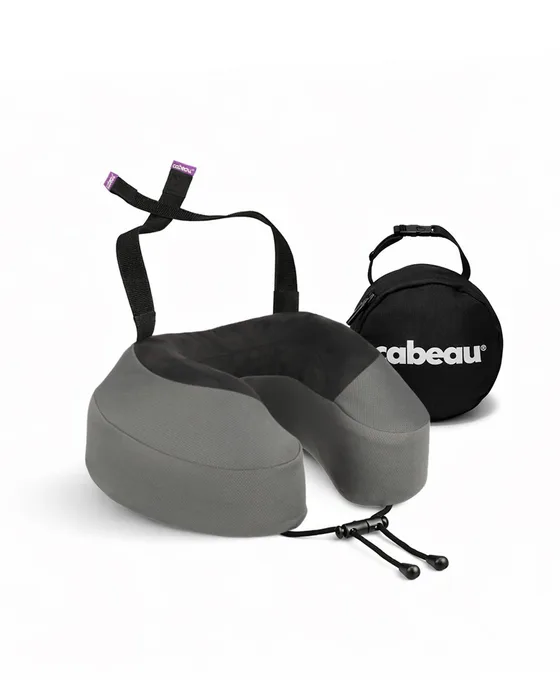
- Buy Cabeau Evolution S3 Neck Pillow The only one anchored to the seat, with a lifetime warranty and a case included.
- Buy Ostrichpillow Go Neck Pillow Named foam, certified fabrics, published dimensions and the best packing of the four.
- It depends BCOZZY Travel Neck Pillow The only one that goes in the washing machine whole, and the only one sized by neck.
- Skip Trtl Travel Pillow 133 grams of fleece around a single strut, which supports one direction and no others.
What actually matters
- Support direction - whether the pillow resists forward rotation, sideways lean, or both. This is the single most important match to how you actually sleep.
- Back profile - how much filling sits behind the neck. A flat back keeps your head against the seat; a bulky one pushes it forward.
- Fill material - memory foam holds shape under load and cannot be washed; fibre and down alternatives are lighter, pack smaller and go in the machine but soften over time.
- Washability - cover only or the whole pillow. For something pressed against your face for hours, this matters more than it first appears.
- Packed size and weight - whether it compresses, by how much, and whether a case or a luggage clip is included.
- Fit and adjustment - a front clasp, a strap, or sizing by neck circumference. One-size-fits-all fits fewer people than it claims.
- Certifications and warranty - Oeko-Tex Standard 100 for the fabrics, and warranty terms that range from lifetime to none in this category.
The specs, in plain English
Green flags vs red flags
Green flags
- A flat back described explicitly.
- A named fill material or supplier, not just memory foam.
- Clear separation of what washes and what does not.
- Published dimensions, packed size or weight.
- Sizing options, or an adjustable clasp or strap.
Red flags
- Fill described only by a trade name.
- No weight and no dimensions anywhere on the page.
- Machine washable claimed without saying whether the filling is included.
- One size fits all, with nothing adjustable.
- A returns window presented as the warranty.
Who's who: the brands
- Cabeau - Known for the Evolution line of memory foam neck pillows with a seat strap system and a lifetime warranty on registration.
- Ostrichpillow - Spanish design brand using BASF memory foam and Oeko-Tex certified fabrics, with heavy compression for packing and published dimensions.
- BCOZZY - Patented overlapping-arm design giving chin support, sized by neck circumference and fully machine washable.
- Trtl - Scottish brand whose fleece wrap with an internal support strut is the lightest approach in the category, sold in warm and cool versions.
- Therm-a-Rest - Outdoor brand whose compressible and inflatable pillows aim at camping and backpacking rather than seated travel.
How to read a listing without getting fooled
Work out first which way your head falls, because that single fact rules out half the category. Then look at the pillow in profile and check how much filling sits behind the neck, since a thick back is the most common design flaw and the better makers call out their flat backs deliberately. Read the fill material and see whether it is a substance or a name: BASF memory foam is a supplier, down alternative is a marketing term. Check whether the whole pillow washes or only the cover, and if it is memory foam assume the cover only. Look for a published weight or packed size, and treat their absence as a sign the answer is not flattering. Check whether anything adjusts, a clasp, a strap or a size option, because necks vary more than manufacturers pretend. And read the warranty carefully, since a hundred-day money-back guarantee is a returns policy, not a warranty.
How much should you spend?
Travel pillows are cheap relative to the flight, and the money buys support mechanism and warranty rather than better stuffing. The budget end buys a light, clever single-direction design that is genuinely worth carrying if weight is your priority. The mid-range buys a proper memory foam collar with named materials, certified fabrics, published dimensions and a multi-year warranty, which is where most people should buy. The premium tier buys a seat-anchored system, a case and a lifetime warranty, and it is worth the difference specifically if your head falls forward, because no amount of additional foam solves that. What is never worth paying for is a bulky U-shape with a thick back and no published materials, which is most of what is sold in airport shops.
Questions, answered
Will a travel pillow help with neck pain after flying?
It can prevent the cause, which is hours of your head hanging at an angle your neck was not designed to hold. A pillow that stops forward rotation does more for this than one that only catches sideways lean, since the forward position loads the back of the neck continuously. What no pillow fixes is a cramped seat, dehydration or sitting still for nine hours, so treat it as one part of arriving in better shape. Persistent neck pain after travel is worth raising with a clinician rather than solving with accessories.
How do I keep it clean on the road?
Use the case. Most of these include one, and a pillow clipped bare to the outside of a backpack has been on airport floors, overhead bins and train luggage racks before it reaches your face. Between trips, wash whatever is washable: the whole pillow if it is fibre-filled, the cover if it is memory foam. Wipe a memory foam core with a damp cloth and let it air dry completely, because foam that is put away damp will smell.
Can I use one in a car?
Yes, and a seat-strap design works well on a car headrest, which is often easier to wrap than a plane seat. The obvious warning is that these are for passengers, not drivers: anything that restricts your ability to turn your head and check mirrors and blind spots is dangerous. For children in car seats, follow the car seat manufacturer's guidance rather than adding an aftermarket pillow, since anything between the child and the harness changes how the restraint behaves.
Is an inflatable pillow a reasonable alternative?
For packing, yes, and for support, usually not. An inflatable packs to almost nothing and weighs very little, which is why they persist. The problem is that air moves: press on one side and the pressure goes somewhere else, so the support shifts as your head does, which is the opposite of what you want. They also tend to be loud to inflate on a quiet cabin and slowly lose pressure overnight. If packed size is the priority, a light structured design like the Trtl gives more support for similar bulk.
Or jump to the head-to-head: Cabeau Evolution S3 Neck Pillow vs Ostrichpillow Go Neck Pillow.