Explained
Travel Backpacks, Explained
After reading, you'll understand why two 40 litre bags can be very different sizes, which parts of a harness actually carry weight, and what to check before trusting a carry-on claim.
In this guide
First-time buyers usually shop by litres, and litres are the least reliable number on the page. Makers measure volume in different ways, and some headline a capacity the bag only reaches when expanded past carry-on depth. The second trap is the hip belt: nearly every listing shows one, but only some are padded and connected to a frame that can take load. The third is the phrase carry-on compliant, which each maker defines for itself.
The 30-second version
- Dimensions beat litres, because airlines measure the outside of the bag and makers do not measure volume the same way.
- A hip belt needs a frame, since padding around the hips only helps if a frame or frame sheet carries the load down to it.
- Expandable bags have two sizes, and the larger one is often deeper than cabin limits allow.
- Empty weight is part of your allowance, so a 2 kg bag leaves less room than a 1.5 kg bag on any airline that weighs cabin luggage.
- Warranties differ in kind, from limited multi-year defect cover to repair of damage for any reason, so read the terms and not the headline.
The products this guide is about
Our verdict on each, with the full reasoning on the companion review.
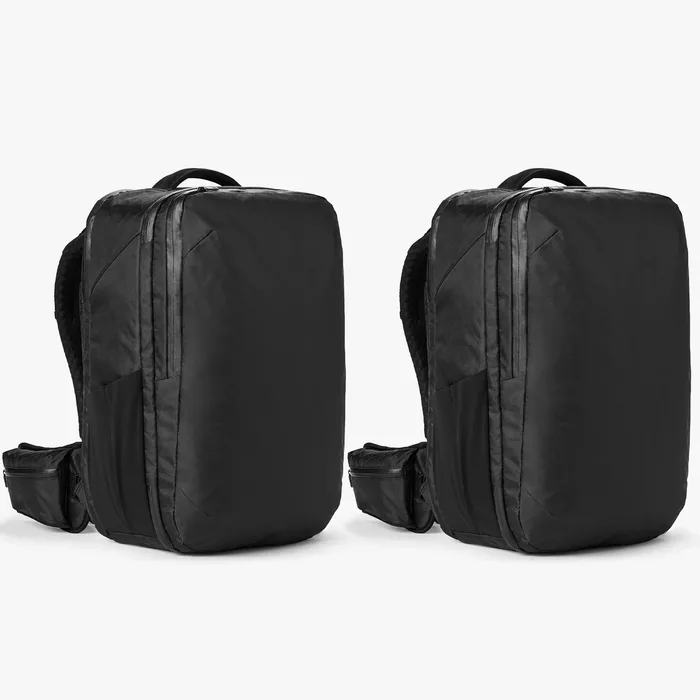
- Buy Tortuga Pro Backpack 40L A full 40 L clamshell bag with a height-adjustable harness and an included weight-bearing hip belt, in the slimmest shell of the four.
- Buy Osprey Farpoint 40 A 40 L travel pack with a wire frame and a padded hipbelt, closer to a hiking pack than the luggage-style bags here.
- It depends Peak Design Travel Backpack 45L An expandable bag with access from the top, both sides, front and rear, built around camera and packing cubes, that is 35 L in its carry-on shape.
- Skip Nomatic Travel Duffel Bag 40L A well-organised 40 L duffel that converts to backpack carry, sold at a premium price without the suspension of a real travel pack.
What actually matters
- External dimensions - This is what a gate agent or a sizer checks. A depth of 8 in leaves margin under a 9 in limit, while 9.5 in relies on the bag squashing.
- Empty weight - The bags in our comparison with confirmed weights run from 3.42 to 4.5 lb before packing. On a low cabin weight limit, the lighter bag lets you carry more of your own things.
- Hip belt - A padded belt that wraps the hip bones can take load off your shoulders. A narrow webbing strap only steadies the bag.
- Frame or frame sheet - This is the stiff structure inside the back panel. Without it the bag sags away from the belt and the weight stays on your shoulders.
- Opening style - Clamshell and panel openings let you pack flat and find things quickly. Top-loading bags carry well but are slower to live out of.
- Laptop sleeve - Look for a stated device size and where the sleeve sits. A sleeve against your back that is reachable without opening the main compartment is easiest at security.
- Warranty - Bags get dragged, dropped and overstuffed. Whether the maker covers only manufacturing defects or damage in use, and for how long, changes the real cost of ownership.
The specs, in plain English
Green flags vs red flags
Green flags
- Height, width and depth are all published, in both the normal and any expanded state.
- The hip belt is described as padded and the page names a frame or frame sheet.
- A stated laptop size limit, not just the words laptop sleeve.
- An empty weight on the spec sheet.
- Warranty terms you can read in full, including what is excluded.
Red flags
- A carry-on claim with no external dimensions beside it.
- A headline litre figure that only applies when the bag is expanded.
- Waist straps with no mention of padding, frame or load transfer.
- Fabric described only by fibre type, with no denier or coating detail.
- A lifetime claim in reviews or adverts that the written warranty does not match.
Who's who: the brands
- Tortuga - A carry-on backpack specialist whose bags are sized to airline limits and sold with pack-style suspension.
- Osprey - A hiking pack maker whose travel packs use framed, adjustable harnesses and carry the All Mighty Guarantee.
- Peak Design - A camera gear company known for expandable bags with multi-side access and camera cube compatibility.
- Nomatic - Known for heavily organised travel bags and luggage with many dedicated pockets.
- Cotopaxi - Makes the Allpa series of suitcase-style travel packs, including a 35 L version.
How to read a listing without getting fooled
Start with the external dimensions and check whether they describe the bag as packed or as expanded. Then find the empty weight. Next, read the harness section word by word: padded hip belt, frame or frame sheet, load lifters and torso adjustment are specific claims, while comfortable carry and ergonomic straps are not. Check the laptop sleeve for a size limit. Treat the litre figure as a rough guide, and if the description and the spec table disagree, trust the table and assume the smaller number. Finish with the warranty page itself, not the badge on the product page.
How much should you spend?
Mid-range travel backpacks from established pack makers can already include a real frame, a padded hip belt and a strong guarantee, so more money does not automatically buy a better carry. The premium tier mostly adds coated or technical fabrics, more organisation, dedicated electronics compartments and features such as expansion or adjustable harnesses. Budget bags in this size usually save money on the suspension first, which is the part you feel after an hour. Decide how far you will walk with the bag loaded, then pay for structure before pockets.
Questions, answered
Is a travel backpack better than a rolling carry-on?
It depends on the ground you cover. A backpack is easier on stairs, cobbles, buses and trains, and it keeps your hands free. A roller is easier on your body in airports and on smooth pavements, and it usually protects pressed clothes better. Our carry-on luggage comparison covers the wheeled options.
Can I use a hiking daypack or backpacking pack instead?
You can, and the carry will be good, but most hiking packs load from the top and have little or no laptop protection. Their external straps and pockets can also catch on conveyor belts if the bag is checked. Travel packs trade a little carrying performance for panel access and a stowable harness. Our hiking daypacks comparison covers the trail-first designs.
Do packing cubes help in a travel backpack?
Yes, especially in bags with one large compartment and few internal pockets. Cubes keep clothes from sliding to the bottom when the bag is upright on your back, and they make a clamshell bag quick to repack. See our packing cubes comparison for sizes.
Should I also carry a smaller bag?
Many one-bag travellers add a small sling or packable daypack for days out, so the big bag can stay in the room. Check that your airline allows a personal item in addition to the cabin bag. Our sling bags comparison covers compact options.
Or jump to the head-to-head: Tortuga Pro Backpack 40L vs Osprey Farpoint 40.