Explained
Wheelbarrows, Explained
After reading this you'll know exactly which wheelbarrow or cart design fits your yard and your loads, and how to read a listing without being fooled by a big number.
In this guide
"Wheelbarrow" now covers a whole family of tools, from a one-wheel steel tub you tip by hand to a four-wheel cart that dumps a quarter-ton at the pull of a pin. The trap is assuming they're interchangeable: buyers fixate on tray size and end up with a tool that's clumsy for their real job. The right choice comes down to what you move (dense material versus bulky-but-light) and where you move it (open lawn versus tight garden beds).
The 30-second version
- Wheel count is the biggest decision. one wheel is nimble but balances on your arms, four wheels carry the weight and dump themselves, and dual wheels sit awkwardly in between.
- Volume and weight rating are two different numbers. a big tray tells you how much bulky material fits, not how much weight the frame can safely take.
- Steel and poly each win different jobs. steel shrugs off dense, abrasive loads without cracking, while poly is lighter, rust-proof, and easy to rinse but flexes under weight.
- Tires are a maintenance choice. pneumatic rides softer under heavy loads but can go flat, while flat-free never punctures but rides firmer.
- Match the tool to the task, not to a spec sheet. buy for the loads you actually haul and the paths you actually use, and a single "do-everything" barrow is usually the worst of the bunch.
The products this guide is about
Our verdict on each, with the full reasoning on the companion review.
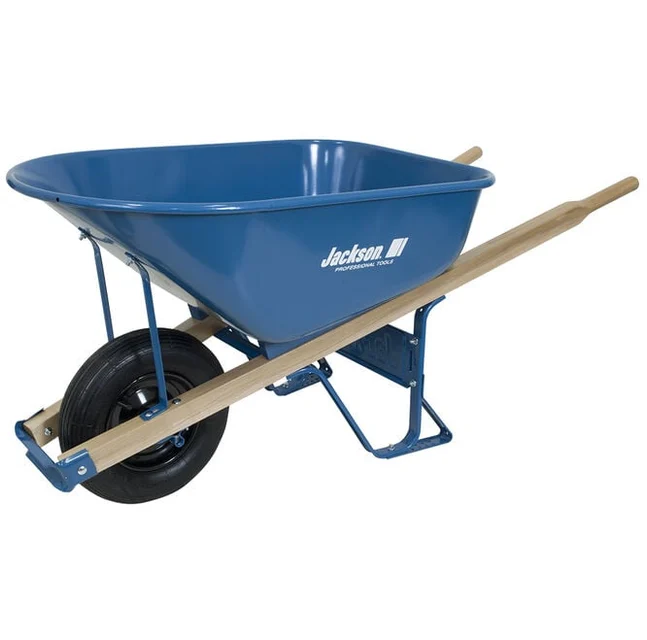
- Buy Jackson M6T22 6 Cu. Ft. Steel Contractor Wheelbarrow The seamless-steel workhorse that shrugs off wet concrete, gravel, and everything you'd never trust to plastic.
- Buy Gorilla Carts 7 Cu. Ft. Heavy-Duty Poly Yard Dump Cart (GCG-7) Four wheels, a 1,200 lb rating, and a quick-release bed that dumps the load so your back never has to.
- It depends WORX Aerocart WG050 8-in-1 Yard Cart A clever convertible that dumps, dollies, and moves plants — as long as you don't ask it to haul like a real barrow.
- Skip True Temper RP810 8 Cu. Ft. Dual-Wheel Poly Wheelbarrow The dual-wheel poly barrow promises the best of both worlds and lands awkwardly between them.
What actually matters
- Wheel configuration decides how the tool feels to use: one wheel pivots in place and threads gates, four wheels stand on their own and never make you balance, and dual front wheels resist side-tipping while loading but stay clumsy to dump.
- Load rating vs tray capacity matters because they measure different things: capacity is volume (how much fits), rating is weight (what the frame handles). Dense material hits the weight limit long before the tray looks full.
- Tray material is really a question of what you haul: steel for dense, heavy, abrasive loads; poly for lighter, bulky material where rust-proofing and easy rinsing help.
- Tire type trades convenience against ride: flat-free tires are maintenance-free but firmer, pneumatic tires cushion heavy loads but need occasional air or a patch.
- Unload effort compounds over every trip: a pin-release or forward-tilting design empties the load for you, while a classic barrow makes you lift and tip each time.
- Footprint and maneuverability determine whether the tool even reaches your work: a wide four-wheel cart won't fit through a narrow gate or between raised beds the way a single-wheel barrow will.
- Build quality and assembly decide how long it lasts: seamless trays and welded joints outlast bolt-together frames that can loosen and rattle over time.
The specs, in plain English
Green flags vs red flags
Green flags
- A seamless steel tray or a stated weight rating that clearly matches the heavy material you plan to haul
- A self-dumping design (pin-release bed or forward-tilting geometry) if you move volume and want to spare your back
- A wheel setup that fits your space: one wheel for tight beds and gates, four wheels for open ground
- Welded joints or a reputation for a solid frame, plus tires suited to how the tool will be stored and used
- Honest, separate figures for both volume (cu ft) and weight rating, rather than one headline number
Red flags
- A huge tray paired with a modest or unstated weight rating, which tempts overloading and strains the frame
- A poly tray marketed for heavy dense loads like concrete, gravel, or wet soil, where plastic tends to flex and crack
- A wide four-wheel footprint bought without checking it clears your gates and paths first
- Lots of folding or convertible parts if you mainly need to move weight, since joints add rattle and rarely haul like a dedicated barrow
- A listing that leads with cubic feet and stays vague about the load rating, wheel type, or tray material
Who's who: the brands
- Jackson - Long-standing maker of contractor-grade steel wheelbarrows known for durable, seamless-steel trays.
- Gorilla Carts - Best known for four-wheel poly dump carts with quick-release beds and high stated weight ratings.
- True Temper - Broad line of homeowner wheelbarrows in both steel and poly, including dual-wheel designs.
- WORX - Makes convertible multi-function yard carts with flat-free tires and low-lift, forward-dumping geometry.
How to read a listing without getting fooled
Start by separating the two big numbers: cubic feet is volume, the weight rating is what the frame can actually carry, and a listing that shouts one while hiding the other is steering you. Next, pin down the wheel setup and tray material, because those decide how the tool behaves far more than tray size does; a single steel-tray barrow and a four-wheel poly dump cart are almost different tools. Check the tire type and whether it's pneumatic or flat-free, then look for how it unloads, since a pin-release or tilt-forward bed saves your back on every trip. Finally, find the actual dimensions and weigh the footprint against your gates and paths. If the page emphasizes one impressive figure and stays quiet about frame strength, wheels, and material, assume the quiet parts are the weak ones.
How much should you spend?
Spend according to the loads you truly move rather than on the biggest tray you can find. A solid steel single-wheel barrow and a good four-wheel dump cart both sit in sensible mid-range territory, and for most homeowners that's where the value lives; each does its own job well without paying for features you won't use. Stepping up in price makes sense when you want a genuine self-dumping mechanism, a tougher frame for regular heavy hauling, or flat-free tires that end tire maintenance for good. Convertible, do-everything carts tend to cost more than a plain barrow and a plain dump cart bought separately, so they're only worth the premium when storage space and versatility matter more to you than raw capacity. The one place spending more rarely pays off is a large-tray design with a weak frame, where the extra size just invites overloading.
Questions, answered
One wheel, two wheels, or four wheels, which should I get?
It depends on your space and your back. Four wheels are the most stable and the least effort: the cart stands on its own, never balances on you, and often dumps with a pin, which makes it the easy choice for open ground and big loads. A single wheel is the most maneuverable, pivoting in place and threading gates and garden beds, but it puts the load on your arms over rough ground. Dual front wheels resist tipping sideways while you load, but you still lift and tip to unload, and that tip is clumsier than a single wheel's clean roll-forward dump.
Does a bigger tray mean I can carry more weight?
Not necessarily. Cubic feet measures volume; the weight rating is a separate limit set by the frame, axle, and wheels. A big tray filled with light mulch is fine, but pack it with wet soil and the weight climbs faster than a light frame can handle. Match the tool to the material: high volume of light debris favors a large tray, while dense heavy loads favor a strong frame and a higher stated weight rating over sheer size.
Steel or poly tray, which lasts longer?
It depends on the load. A seamless steel tray takes dense, abrasive, heavy material like gravel and wet concrete without flexing and generally outlasts poly for hard use, though it can dent and eventually rust if the coating is scratched. Poly is lighter, rust-proof, and rinses clean, but it flexes and can crack under dense loads or in cold weather. Poly is fine for leaves, mulch, and light soil; choose steel if you regularly haul heavy material.
Flat-free or pneumatic tires?
Pneumatic (air-filled) tires roll softest over bumps and cushion heavy loads, but they can puncture and lose pressure, so you'll top them up now and then or patch a flat. Flat-free tires, made of solid foam or polyurethane, never go flat and are maintenance-free, though they ride a little firmer. For heavy dense loads most people prefer a good pneumatic tire; for a barrow that sits in the shed for months between uses, flat-free saves the hassle.
Are wheelbarrows hard to assemble?
Most arrive partly assembled and need the wheel, legs, and handles bolted on, typically a 20-to-45-minute job with basic tools. Steel single-wheel barrows are the simplest; four-wheel dump carts have more hardware, and convertible carts have the most parts to fit. The common owner tip is to leave every bolt finger-tight until the whole frame is together, then tighten everything down so the holes line up cleanly.
Or jump to the head-to-head: Gorilla Carts 7 Cu. Ft. Heavy-Duty Poly Yard Dump Cart (GCG-7) vs Jackson M6T22 6 Cu. Ft. Steel Contractor Wheelbarrow.