Explained
Cordless Lawn Mowers, Explained
After reading this, you'll be able to look at any cordless mower listing and know whether it can actually handle your lawn - or just a marketing photo of one.
In this guide
Cordless mowers have quietly caught up to gas: the best ones now cut as well or better, with no fuel, no pull cord, and a fraction of the noise. The catch is that the category stretches from serious gas replacements down to lightweight machines that only work on a tiny, flat patch - and the spec sheets make them all sound similar. Voltage numbers, runtime claims, and deck sizes are easy to misread, and the battery platform you choose matters more than most buyers realize.
The 30-second version
- Battery capacity beats voltage. The amp-hour (Ah) rating of the included pack tells you how long you can mow; the voltage number on the box is mostly branding.
- Deck width sets your mowing time. A 21–22 inch deck is the suburban sweet spot; a 16-inch deck means roughly a third more passes over the same lawn.
- Self-propulsion is near-essential for anything bigger than a small flat lawn - and drive systems feel very different between brands, so how they engage matters.
- You're buying a battery platform, not just a mower. Packs only work within one brand's ecosystem, and they're the most expensive part of the machine.
- Runtime claims assume ideal grass. Tall, thick, or damp lawns can cut real-world runtime dramatically, so judge by owner reports, not headline minutes.
The products this guide is about
Our verdict on each, with the full reasoning on the companion review.
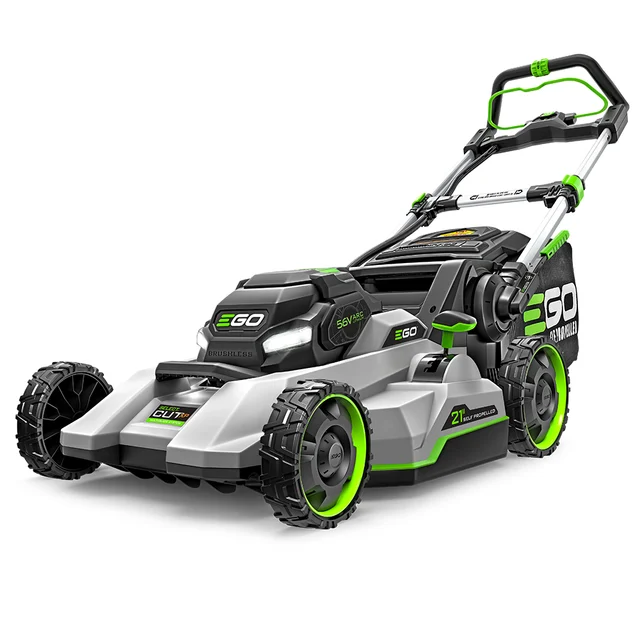
- Buy EGO Power+ 21" Select Cut XP Self-Propelled Mower (LM2156SP) The benchmark cordless mower - gas-level torque, a large included battery, and a cut that thick lawns can't rattle. Amazon
- Buy Toro 60V Max 22" Recycler with Personal Pace & SmartStow (21466) A mower-company mower: adaptive Personal Pace drive, excellent mulching, and vertical SmartStow storage at a fair price.
- It depends Milwaukee M18 FUEL 21" Self-Propelled Dual Battery Mower (2823-22HD) Arguably the most powerful mower here - but its flagship price only pencils out if you already live on the M18 platform. Amazon
- Skip Sun Joe 48V IONMAX 16" Cordless Lawn Mower (24V-X2-16LM) Cheap and light, but the narrow deck, push-only drive, and short working runtime make it a false economy for most lawns.
What actually matters
- Cut quality in thick grass - the clearest dividing line between mowers that replace gas and ones that imitate it. Look for stacked-blade or high-torque designs that hold speed when grass gets tall or damp instead of bogging down.
- Included battery capacity - the amp-hour rating of the pack in the box determines whether you finish your lawn on one charge or stand around waiting for a recharge. Bigger lawns need bigger packs, full stop.
- Deck width and material - a 21–22 inch steel deck balances speed and maneuverability for most lawns; narrow plastic decks multiply your passes and rarely age well.
- Drive system feel - adaptive systems that match your walking pace, and truly variable-speed systems, are far more pleasant than two-speed or push-only designs, especially on slopes.
- Battery ecosystem - your mower's packs can power the same brand's trimmers, blowers, and snow tools later. If you already own a brand's tool batteries, a compatible mower can flip the value math entirely.
- Storage footprint - vertical-storage designs fold and stand against a garage wall without draining anything, reclaiming serious floor space over traditional flat-parked mowers.
- Weight and maneuverability - powerful dual-battery machines can be genuinely heavy; if you'll ever push with the drive off or lift it onto a shelf, mass matters.
The specs, in plain English
Green flags vs red flags
Green flags
- A high-capacity battery included in the kit, with the amp-hour rating stated plainly
- A 21–22 inch steel deck with a blade you can sharpen or replace cheaply
- Adaptive or truly variable self-propel drive rather than a fixed-speed lever
- Vertical storage that doesn't require draining or tipping rituals
- Long separate warranties on both the tool and the battery
- The brand has a broad outdoor tool lineup sharing the same battery
Red flags
- Runtime advertised in minutes with no mention of battery capacity or grass conditions
- A narrow plastic deck under 17 inches marketed for 'most lawns'
- Push-only drive on a mower aimed at anything beyond a small flat yard
- A tiny included battery that quietly forces a costly second-pack purchase
- Voltage math that adds small packs together to advertise a big number
- Owner reports of the mower stalling or shutting down in tall or damp grass
Who's who: the brands
- EGO - The cordless-first brand that set the benchmark - strong 56V platform, excellent cut quality in thick grass, and a deep outdoor tool lineup.
- Toro - A generations-old mower company gone battery - known for natural-feeling adaptive drive, excellent mulching decks, and vertical storage.
- Milwaukee - Jobsite tool giant whose mowers run on the huge M18 battery platform - maximum power and build quality at flagship prices, best for existing M18 owners.
- Greenworks - Broad value-focused battery lineup across several voltages - solid mid-market options, but watch which battery platform a given mower belongs to.
- Ryobi - Home-center favorite with a massive shared-battery ecosystem - approachable prices and wide availability, with performance a step below the premium tier.
- Sun Joe - Budget brand known for light, inexpensive compact mowers - fine for tiny flat lawns, but narrow decks and short real-world runtime limit them beyond that.
How to read a listing without getting fooled
Start with what's actually in the box: the battery's amp-hour rating and whether a charger is included - 'tool-only' listings look cheap until you price the pack. Treat the big voltage number as branding, and be suspicious of listings that add two small batteries together to advertise a doubled voltage. Runtime claims come from ideal, short, dry grass; owner reports in thick or damp grass are the honest number. Check deck width and material (steel over plastic), whether self-propulsion is adaptive, variable, or fixed, and what the bag capacity really is. Finally, read the warranty fine print - good brands warranty the battery separately from the mower, and the battery is the part that matters.
How much should you spend?
The cordless mower market has a clear shape: a budget tier of light, narrow, push-only machines that only make sense on tiny flat lawns; a premium middle where the genuine gas replacements live; and a flagship tier whose extra cost mostly buys platform power and jobsite build quality. The value sweet spot for most suburban lawns is the premium middle - a self-propelled 21–22 inch steel-deck mower with a properly sized battery included. Spending up to the flagship tier is rational mainly if you already own that brand's tool batteries, which lets you amortize the cost across a fleet. Spending down to the budget tier is usually a false economy: the money saved comes back as extra passes, recharge breaks, and an early replacement. Remember that batteries drive the price - a slightly costlier kit with a much bigger pack is often the better deal than a cheap kit that needs a second battery by August.
Questions, answered
Is a cordless mower really powerful enough to replace my gas mower?
For most residential lawns, yes. Owner reports on current premium models describe cutting torque and tall-grass performance comparable to residential gas mowers - with far less noise, no exhaust, and no oil, spark plug, or carburetor maintenance. The gap that remains is at the bottom of the market: budget cordless machines still struggle where gas would power through, so the 'cordless can't cut it' reputation mostly comes from underpowered entry-level models.
What do voltage and amp-hours actually mean, and which matters more?
Voltage is roughly how forcefully power is delivered; amp-hours are how much energy the battery stores. For how long you can mow, amp-hours matter more. For how the mower handles thick grass, motor and deck design matter more than either number. Compare included battery capacity between kits, and treat the voltage on the box as a brand label rather than a performance score.
How much lawn can I mow on one charge?
It depends on battery size, deck width, and - most of all - grass conditions. A large-capacity pack on a wide deck can cover a big suburban lot in one session; a small pack on a narrow deck is a small-patch machine. Tall, thick, or damp grass can cut effective runtime dramatically on any battery mower, so owners of larger properties commonly keep a second pack charged and swap mid-mow.
Should I buy a mower from the same brand as my power tools?
If that brand makes a well-reviewed mower, it's a strong tiebreaker - sometimes decisive. Batteries are the most expensive part of a cordless mower, and packs only work within one brand's platform. Owning compatible packs already can make a flagship-tier mower better value than a cheaper rival. Starting from scratch, weigh the brand's whole outdoor lineup, since your mower batteries can later power a trimmer, blower, or snow tool.
Do cheap compact cordless mowers make sense for anyone?
Only for genuinely tiny, flat, frequently trimmed lawns. Light weight and easy storage are real advantages in that niche. But narrow decks multiply passes, push-only drive gets old fast, and owner reports consistently describe runtime collapsing in tall or damp grass. For most buyers, a modest stretch up to a self-propelled 21-inch machine transforms the weekly experience and won't need replacing when the lawn - or your patience - grows.
How long do mower batteries last, and what happens when they wear out?
Quality lithium packs typically hold useful capacity for many seasons of weekly mowing, degrading gradually rather than dying suddenly. Store them indoors out of extreme heat and cold, avoid leaving them at empty for long stretches, and they'll last longer. When one fades, you buy a replacement pack rather than a new mower - which is why battery warranty length and the brand's platform health are worth checking before you buy.
Or jump to the head-to-head: EGO Power+ 21" Select Cut XP Self-Propelled Mower (LM2156SP) vs Toro 60V Max 22" Recycler with Personal Pace & SmartStow (21466).