Explained
Fire Pits, Explained
After reading, you'll know exactly what to look for in a fire pit, what the marketing words really mean, and which trade-offs actually matter for how you'll use it.
In this guide
Shopping for a fire pit sounds simple until you hit the wall of options: smokeless bowls, secondary-burn designs, propane knobs, stainless versus heavy steel, and a lot of confident-sounding claims. The single biggest fork is fuel type, wood or gas, and almost everything else flows from that choice. Most people get tripped up by the word smokeless, which is relative rather than literal, and by overestimating how much of their yard a fire pit will actually warm.
The 30-second version
- Fuel type decides everything else. Wood gives you real flames, crackle, and the option to cook; propane gives you instant, ash-free, deck- and ban-friendly convenience with no embers.
- "Smokeless" means much less smoke, not zero. A good secondary-burn design cuts smoke dramatically once the fire is hot and the wood is dry, but expect some at startup and when you add fresh logs.
- Heat warms a circle, not a yard. Bigger bowls throw more usable heat; compact pits are for close-in ambiance, so size up if real warmth is the goal.
- Weight is a livability spec, not a footnote. Decide up front whether you'll move and store it or leave it put, because a two-person lift changes how often you actually use it.
- Materials and warranty signal how long it lasts. Stainless or heavy-gauge steel plus a lifetime warranty help separate long-lasting pits from ones that warp and rust sooner.
The products this guide is about
Our verdict on each, with the full reasoning on the companion review.
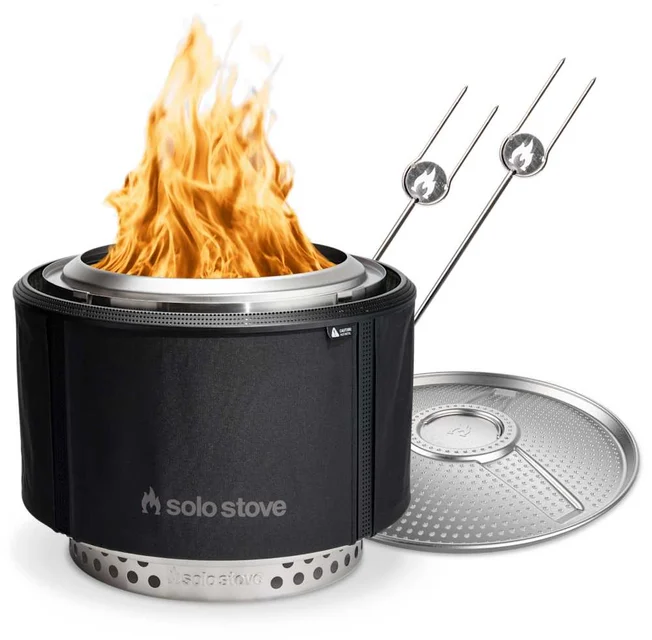
- Buy Solo Stove Bonfire 2.0 The smokeless wood-burning pit that gets the balance of size, weight, and clean burn right for most patios.
- Buy Breeo X Series 24 A heavy, American-made smokeless pit built to cook on and last decades - if you never plan to move it. Amazon
- It depends Outland Living Cypress Fire Pit Easy-start propane with no smoke, no ash, and no wood run - as long as you can live without real embers. Amazon
- Skip BioLite FirePit+ A clever battery-fan campfire-and-grill that's overkill for a fixed patio and underpowered as its centerpiece.
What actually matters
- Fuel type - wood for authentic flames and cooking, propane for instant on/off and no ash; this choice drives cost, cleanup, portability, and where you're allowed to use it.
- Secondary (smokeless) burn - a genuine double-wall, airflow-hole design is what actually reduces smoke from a wood pit; without it, "smokeless" is just a label.
- Heat output for your space - firebox size and bowl diameter determine whether you warm a small circle or a whole seating group.
- Build material and gauge - 304 stainless resists rust; thick-gauge steel resists warping and lasts longer; thin coated steel is cheaper but shorter-lived.
- Weight and portability - the difference between a one-person carry you store each winter and a permanent fixture you position once.
- Cleanup design - a removable ash pan or base plate matters more over a season than almost any headline spec.
- Deck and burn-ban compatibility - CSA-approved propane units are often permitted where wood fires aren't, which can be the deciding factor for deck dwellers.
The specs, in plain English
Green flags vs red flags
Green flags
- A genuine double-wall body with visible airflow vents, not just the word "smokeless" on the box
- 304 stainless or heavy-gauge steel paired with a clearly written warranty
- A removable ash pan or base plate for tip-and-empty cleanup
- CSA certification on propane units, which can widen where you can use it
- A weight and size that honestly match how you'll use it, whether that's a portable carry or a permanent centerpiece
- Clear clearance and deck-use guidance from the maker, a sign they take safety seriously
Red flags
- "Smokeless" marketing with no double-wall or secondary-burn design to back it up
- Thin, no-name coated steel with a short or vague warranty
- A tiny firebox sold as a patio centerpiece, which will underwhelm on heat for a group
- Low-smoke performance that depends entirely on a battery you have to keep charged
- Paying a premium for portability features you'll never use on a stationary patio
- No mention of clearances, deck safety, or local-code guidance anywhere in the listing
Who's who: the brands
- Solo Stove - Popularized the lightweight, double-wall smokeless bowl; known for low-smoke burns and easy portability.
- Breeo - American-made, heavy-gauge smokeless pits built to cook over and last; the heavy-duty end of the wood category.
- Outland Living - Portable propane pits, listed as CSA approved, favored for decks and burn-ban areas where wood fires aren't allowed.
- BioLite - Battery-fan fire-and-grill hybrids aimed at camping and tailgating; clever and packable but small for fixed-patio duty.
How to read a listing without getting fooled
Start by ignoring the word "smokeless" and looking for the mechanism behind it: a double-wall body with airflow vents is real, a claim with no visible design isn't. Next, separate the livability specs from the marketing. Weight tells you whether you'll actually move it; ash-pan or base-plate wording tells you how annoying cleanup will be; steel grade and warranty tell you how long it lasts. On propane units, check for CSA certification if you plan to use it on a deck or during bans, and treat BTU as a rough heat hint rather than gospel, since flame shape and wind change the real-world feel. Be skeptical of any listing that leans hard on portability features or accessory bundles while going quiet on clearances, materials, and warranty, because the quiet parts are usually where the compromises hide.
How much should you spend?
Fire pits sort cleanly into tiers, and the right spend depends almost entirely on how you'll use it. Budget propane pits are a legitimate choice when convenience, deck use, and ban-friendliness matter more than authentic embers, and they don't demand a premium to do that job well. In the mid-range, lightweight double-wall wood bowls hit the value sweet spot for most patios: a genuinely low-smoke fire, a one-person lift, and easy cleanup without heirloom pricing. Spending up to the premium tier is worth it only for a specific buyer, the person who wants a heavy, cook-over-it, buy-it-for-life centerpiece and plans to leave it in one spot for years. Where it's usually not worth paying more is portability features on a pit that will never move, or accessory bundles that quietly push a mid-range pit into premium territory. Prices also swing with season and bundles, so match the tier to your use case rather than chasing the highest number.
Questions, answered
Are smokeless fire pits actually smokeless?
No, "smokeless" is relative. Double-wall pits use a secondary burn that dramatically cuts smoke once the fire is hot and you're using dry, seasoned wood. Expect some smoke at startup, when you add fresh logs, or when the wood is damp. They're far cleaner than a traditional open pit, not literally smoke-free.
Propane or wood-burning, which should I choose?
It comes down to what you value. Wood pits give you real flames, crackle, the smell of a fire, and the option to cook over them, at the cost of smoke, ash, and hauling wood. Propane trades all of that for instant on/off convenience, zero ash, no wood storage, and easier use on decks and during many burn bans. Neither is universally better; pick the trade-off you'll actually enjoy.
How far should a fire pit be from my house and other structures?
As a general rule, keep a fire pit well clear of your home, fences, overhanging branches, railings, and anything flammable, with plenty of open space above it. Always follow your manufacturer's clearance instructions and local code, which take priority. Place it on a stable, non-combustible surface and use a heat shield or barrier mat on decks.
Will a fire pit actually keep me warm?
It warms a circle around it rather than a whole yard. Bigger bowls push noticeably more heat than compact units, and propane pits give steady, controllable warmth for their size. Small fireboxes are the weakest heaters, better for ambiance than for warming a group. For real warmth, size up and sit close.
Is it safe to leave a fire pit burning unattended?
Not safely. Never leave any fire pit, wood or gas, burning unattended, and keep children and pets at a safe distance the whole time it's lit. Keep water or a fire extinguisher within reach, let wood fires burn down and fully extinguish the ashes before you leave, and shut gas units off completely at the tank. Check that embers are cold-out, not just dimmed, before walking away.
Are fire pits allowed during burn bans?
Often the two types are treated differently: wood-burning pits are usually restricted first, while CSA-certified propane units are frequently still permitted because they produce no embers or wood smoke. Rules vary widely by city, county, fire district, and HOA, so always check your local restrictions, and watch for temporary bans during dry or high-wind conditions, before lighting up.
Or jump to the head-to-head: Solo Stove Bonfire 2.0 vs Breeo X Series 24.