Explained
Grill Brushes, Explained
After reading, you'll know which cleaning tool suits your grates, when to use it, and how to tell when it needs replacing.
In this guide
Cleaning a grill grate means removing carbonised food and grease from hot metal, and the traditional tool for it, a wire bristle brush, has a well-documented failure mode: bristles break off, stick to the grate and end up in food. Everything else in this category is an attempt to do the same job without that risk.
The 30-second version
- Wire bristles can break off into food, which is why the category has moved to nylon and wood.
- Scrape hot, brush cold, since nylon melts on a hot grate and residue lifts more easily while warm.
- Wood scrapers cut their own profile, matching the spacing of your particular grate bars.
- Round bars need bristles or coils, because a flat scraper cannot reach around them.
- Inspect the head every time, and replace it at the first sign of a loose bristle.
The products this guide is about
Our verdict on each, with the full reasoning on the companion review.
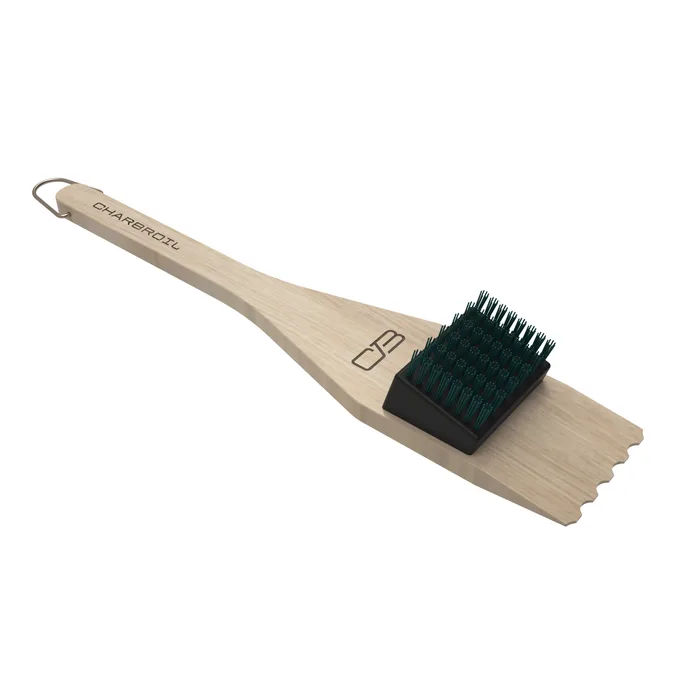
- Buy Char-Broil SAFER Combo Grill Brush Bristles tested to 15,000 cycles with no fallout, plus a scraper for hot grates.
- Buy Weber Wood Grill Scraper No bristles at all, in hardwood that cuts its own grooves to match your grates.
- It depends Pit Boss Deluxe Wood Scraper and Brush A scraper, a nylon brush and a pair of grate lifters on one handle.
- Skip Oklahoma Joe's Blacksmith Rake and Brush A firebox ash rake with a brush attached, sold as a grill brush.
What actually matters
- Bristle material - stainless wire, grit-infused nylon, or none at all. This is the safety decision and it should be the first thing you read.
- Tested durability - a published cycle count against breakage and fallout, which is rare and is the strongest evidence a maker can offer.
- Hot or cool use - wood and metal scrapers work on hot grates; nylon bristles are for cool ones only and will deform if used hot.
- Grate profile - flat cast iron suits a scraper; round stainless bars need bristles, a coil or a mesh head to reach the sides.
- Handle length - a few inches is fine on a kettle, and an offset smoker needs enough reach to clear a firebox without leaning over it.
- Replaceable heads - whether the wearing part can be swapped rather than replacing the whole tool.
- Extras - grate lifters and scrapers for ash beds solve real problems on smokers; most other additions do not.
The specs, in plain English
Green flags vs red flags
Green flags
- Bristle material named specifically.
- A published durability or fallout test with a cycle count.
- Clear guidance on hot versus cool grate use.
- A handle length in inches.
- Replacement heads available separately.
Red flags
- Bristle material not stated at all.
- Extra reach claimed with no length published.
- Safety implied by the product name with nothing behind it.
- No guidance on whether it can be used hot.
- Feature lists padded with bottle openers.
Who's who: the brands
- Char-Broil - Sells the SAFER line of grit-infused nylon brushes with published fallout testing, in combo and replaceable-head versions.
- Weber - Offers both traditional detail brushes and a bristle-free hardwood scraper with conforming notches, alongside grate cleaners and scrubbers.
- Pit Boss - Pellet grill and smoker brand whose cleaning tools combine wood scrapers, nylon brushes and grate lifter hooks.
- Oklahoma Joe's - Offset smoker specialist whose Blacksmith range includes extra-long rakes and scrapers built for firebox ash rather than grate brushing.
- GrillArt - Known for bristle-free coil and mesh brush heads, an approach that reaches round bars without individual fibres to shed.
How to read a listing without getting fooled
Start with the head material, because it is the safety decision and because everything else follows from it. If it is nylon, look for a durability or fallout test with a number attached, and treat its absence as the norm rather than a red flag, since only one maker here provides one. If it is bristle-free, check what the head is made of and whether it conforms to grates. Then work out which grate temperature the tool is for, and be aware that a combination product usually means the nylon half is for cool grates and the scraper half for hot. Match the design to your grates, since a flat scraper is excellent on cast iron and limited on round bars. Look for a handle length in inches if you have a large grill or a smoker, and note that nobody in this comparison publishes one. Finally check whether the head is replaceable, because the head always wears out first.
How much should you spend?
Grill cleaning tools are cheap, and the sensible strategy is to buy a good one and replace it often rather than buying an expensive one and keeping it too long. The budget end covers nearly the whole category and includes both the best-tested nylon brush and the best bristle-free scraper here, which is unusual and means there is little reason to spend more for general grate cleaning. Paying up buys specialised reach for offset smokers, which is worth it only if you own one, and replaceable-head systems, which are worth it if you clean a grill several times a week. Whatever you buy, treat the head as a consumable: a worn brush is both less effective and, in the case of wire, more likely to shed.
Questions, answered
How do I check my grate for stray bristles?
Look at it in good light after brushing, and run a folded paper towel or a clean cloth across the bars before cooking. A stray bristle will catch on the fabric where it is very hard to see against metal. Do this every time if you use a wire brush, and be particularly careful with a brush whose bristles have started to splay or look shorter on one side, which is the visible sign that it is shedding. If you find one bristle, replace the brush.
Is it safe to burn the grate clean instead?
Running the grill hot for ten or fifteen minutes before cooking carbonises residue, which then comes off far more easily with any tool and kills surface bacteria at the same time. It is a good habit and it is not a substitute for physically removing the debris, which still has to be scraped or brushed off before food touches the grate. It also does nothing for grease that has run below the grate, which is a separate cleaning job and a flare-up risk.
Can I use a grill brush on cast iron?
Yes, but gently and without soap, because you are trying to remove food without stripping the seasoning. A nylon brush or a wood scraper is the right choice; an aggressive wire brush will take the polymerised layer off along with the debris. Scrape while the grate is still warm, wipe with a lightly oiled cloth afterwards, and accept that cast iron is meant to look dark rather than shiny. Pit Boss's description of gently removing caked-on grease is aimed at exactly this case.
What cleans the parts a brush cannot reach?
A narrower detail brush for burner tubes and the angled bars above them, and a scraper or a putty knife for the grease that collects in the bottom of the cookbox. Weber sells an 18 inch detail brush specifically for this, separate from its grate tools, because the geometry is different: you need something long and thin rather than wide and stiff. On a gas grill this matters for flare-ups as much as for cleanliness, since it is accumulated grease below the grate that catches fire.
Or jump to the head-to-head: Char-Broil SAFER Combo Grill Brush vs Weber Wood Grill Scraper.