Explained
Cordless Leaf Blowers, Explained
After reading this you'll know exactly which spec numbers matter, which are marketing fluff, and how to match a cordless blower to your yard and the batteries you already own.
In this guide
Cordless leaf blowers finally clear leaves well enough that most homeowners no longer need a gas model, but the spec sheets are full of big numbers that don't all mean what they seem. The single biggest trap is buying on air speed (MPH) when air volume (CFM) is what actually moves a pile of leaves. Get a handful of terms straight and the whole category suddenly makes sense.
The 30-second version
- CFM moves leaves, MPH moves dust. so weight air volume (CFM) far more heavily than the headline speed number when you're clearing a real yard.
- The battery platform is half the decision. because a blower that shares batteries with tools you already own is a very different value than one that forces you onto a new system.
- Advertised runtime is a best-case number. usually quoted on the lowest setting, so look at what owners report during realistic mixed use and how fast turbo drains the pack.
- Quiet is a feature, not a bonus. since a low-noise model is one you can actually run early morning or near neighbors without complaints.
- Cheap, low-voltage blowers hit a hard ceiling. so they're fine for a patio or garage floor but will frustrate you the moment you point them at a leaf-covered lawn.
The products this guide is about
Our verdict on each, with the full reasoning on the companion review.
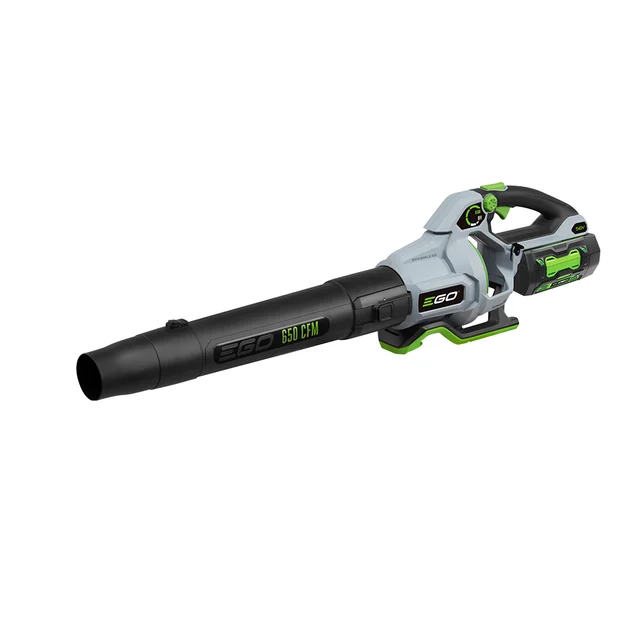
- Buy EGO POWER+ 650 CFM Blower (LB6504) The most polished all-rounder, with strong airflow, long runtime, and variable-speed control that suits both delicate beds and heavy fall cleanup. Amazon
- Buy RYOBI 40V HP Brushless Whisper Series 730 CFM Blower (RY404100) The most air for the money, and quiet enough to run early on a Saturday without annoying the neighbors. Amazon
- It depends Milwaukee M18 FUEL Blower (2724-20) A compact, well-built blower that makes total sense if you already own M18 batteries and near-zero sense if you don't. Amazon
- Skip WORX 20V Power Share Turbine Blower (WG547) Fine for a patio and a garage floor, but underpowered and short on runtime for anything resembling a real yard. Amazon
What actually matters
- Airflow (CFM) is the volume of air the blower moves, and it's the number that decides whether you push a whole pile of leaves in one pass or nudge them a few inches at a time.
- Air speed (MPH) is how fast the air exits the nozzle; it helps unstick wet, matted, or stuck-on debris but does little for bulk leaf clearing on its own.
- Real-world runtime determines whether you finish the yard on one charge or stop to swap batteries, and it drops sharply the moment you hold the turbo trigger.
- Battery ecosystem matters because voltage and brand lock you into a platform; sharing packs across a mower, trimmer, and drill saves real money over time.
- Noise level affects when and where you can work, and cordless models vary a lot among themselves, from tolerable to genuinely quiet.
- Handling and balance decide whether a long fall cleanup is comfortable or a wrist-aching chore, especially on heavier high-airflow tools.
- What's in the box changes the true cost: a full kit with battery and charger versus a bare tool that assumes you already own compatible packs.
The specs, in plain English
Green flags vs red flags
Green flags
- Strong CFM figure paired with a reasonable MPH, rather than one huge number propping up the marketing
- A brushless motor and a battery platform you already own or plan to build out
- Variable-speed control plus a turbo mode, so you can match power to the task
- Sold as a full kit with a decent-sized battery and charger, so there's nothing extra to buy
- A quiet noise rating if you have close neighbors or an HOA
- A tool-and-battery warranty that runs several years, signaling the maker stands behind it
Red flags
- A listing that leads with MPH and buries or omits CFM entirely
- A very low-voltage (small-platform) tool being pitched for full-yard leaf clearing
- Runtime claims with no mention of which setting they were measured on
- A bare-tool price that looks cheap until you realize you'd be buying into a whole new battery system
- No variable speed, so it's all-or-nothing power that wastes battery and blasts flower beds
- Vague or missing warranty terms, especially on the battery
Who's who: the brands
- EGO - Premium 56V outdoor platform known for refined, powerful handhelds across a broad tool lineup.
- RYOBI - Value-focused 40V line with a wide, affordable range; its Whisper Series is a standout for quiet operation and strong airflow per dollar.
- Milwaukee - Pro-grade M18 platform prized for durable, compact builds; blowers are often sold bare, making them a smart add for existing M18 owners.
- WORX - Budget 20V Power Share ecosystem; light and cheap, best suited to patios and hard surfaces rather than clearing a full leaf-covered lawn.
- DEWALT - Well-known 20V/60V FlexVolt platform popular with DIYers who already own the batteries and want capable, no-fuss tools.
How to read a listing without getting fooled
Start by finding the CFM number and treat it as the headline spec; if a listing shows a giant MPH figure but hides CFM, assume the airflow is weak. Next, check which setting any runtime claim refers to, because the box number is almost always the lowest, most flattering setting rather than the power you'll actually use. Confirm the voltage and battery family, then ask whether you already own compatible packs or would be starting a new platform from scratch, since a cheap bare tool can quietly become the expensive option. Finally, look for variable speed, a turbo mode, a real noise rating, and what's actually included in the box. Read the whole picture together, not any single hero number in isolation.
How much should you spend?
Spend based on how much yard you have and how often you'll clear it. A small patio or deck only needs a light, inexpensive tool, and paying up for one is wasted money. But the moment you're clearing an actual leaf-covered lawn, the cheapest low-voltage blowers become a false economy: owners commonly find them underpowered with very short runtime. The value sweet spot sits in the mid-tier, where a capable 40V-class kit gives you enough airflow, decent runtime, and a battery you can share with other tools without paying the full premium. Stepping up to a top-tier model is worth it when you want the longest runtime, the most refined controls, and you're already committed to that battery ecosystem; it's not worth it if you'd only ever use the blower a few times a season. And remember the hidden cost of a bare tool: its low sticker price only makes sense if you already own the batteries.
Questions, answered
Is CFM or MPH more important?
For clearing leaves, CFM (air volume) matters most. It's what moves large piles across a wide path. MPH (air speed) helps dislodge stuck-on or wet debris with a concentrated jet, but on its own a high MPH number doesn't move much. The best blowers post strong figures on both, but if you have to choose, favor CFM.
Can a cordless blower really replace a gas one?
For most residential yards, yes. Makers say today's strong 40V-to-56V models match or beat small gas blowers on airflow, without the fumes, pull cords, or noise. The trade-off is runtime: on very large properties or long fall sessions you'll swap or recharge batteries, which is why two-battery kits are appealing.
Does buying a bare tool ever make sense?
Only if you already own compatible batteries. A bare tool's low price assumes you have the platform's packs from a drill, saw, or other tool. If you'd be buying into a whole new battery system just for a blower, a full kit that includes a battery and charger is usually the better deal.
Why do some cheap blowers get such short runtime?
Small, low-voltage platforms pair a modest battery with a power-hungry motor, so the high setting drains the pack quickly, sometimes in around fifteen minutes or less, and recharging can be slow. They're designed for quick hard-surface tidying, not sustained leaf clearing, and pushing them past that is where owners get frustrated.
How much does noise really vary?
Quite a bit. Cordless blowers are generally quieter than gas, but among themselves they vary a lot. A model with a low published noise rating is easier to run early morning or near neighbors, which is a genuine advantage if you have an HOA or close lot lines.
How big a battery (Ah) do I need?
It depends on your yard. For quick cleanups a smaller pack is fine, but for a medium-to-large yard or heavy fall leaves, a larger amp-hour battery or a spare keeps you working without a mid-job recharge. Larger packs add weight and cost, so match the size to how long you actually run the tool at a stretch.
Or jump to the head-to-head: EGO POWER+ 650 CFM Blower (LB6504) vs RYOBI 40V HP Brushless Whisper Series 730 CFM Blower (RY404100).