Explained
Lawn Spreaders, Explained
After reading, you'll understand broadcast and drop spreaders, how to size a hopper, and which build details help a spreader survive fertilizer and salt.
In this guide
Most spreader problems show up as stripes, burned edges or a rusted spreader by the second season. They usually trace back to the wrong type, plastic wheels that bounce, no edge control, or a spreader stored dirty. Settings confuse people too, since bags list some spreaders and not others.
The 30-second version
- Broadcast spreaders suit most lawns, while drop spreaders trade speed for precision.
- Pneumatic tires give a more even spread, because the spinner keeps a steady speed over bumps.
- Edge control protects beds and paving, so check whether a deflector is included or extra.
- Size the hopper to your lawn, using the maker's stated coverage where it is published.
- Clean and dry the spreader after every use, since fertilizer and salt corrode metal parts.
The products this guide is about
Our verdict on each, with the full reasoning on the companion review.
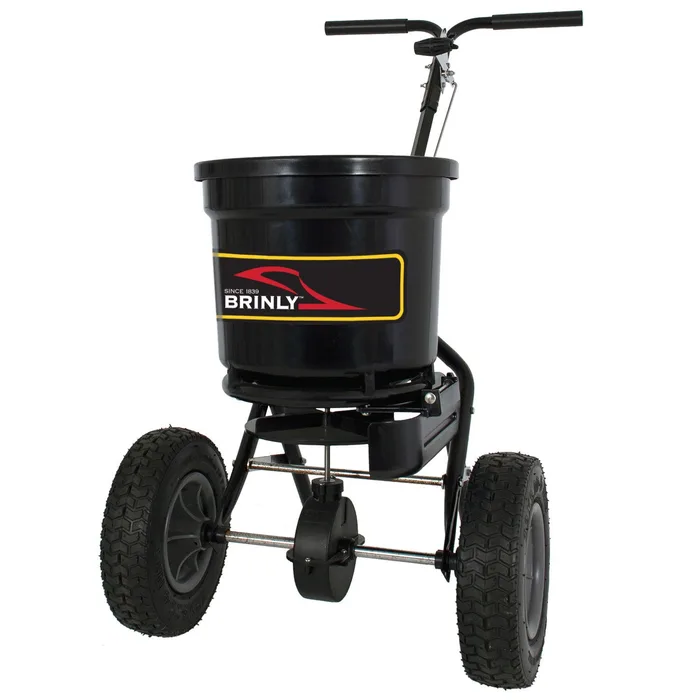
- Buy Brinly 50 LB. Push Spreader with Side Deflector & Hopper Cover (P20-500BHDF-A) A US-made 50 lb push broadcast spreader with big pneumatic tires, stainless hardware and a side deflector included. Amazon
- Buy EarthWay 40lb Residential Broadcast Spreader (2600A-Plus) A compact 40 lb broadcast spreader with EarthWay's EVEN-SPREAD three-hole drop, side-spread control and pneumatic tires.
- Buy Chapin TurfPro 80 Pound Broadcast Lawn Spreader (89200A) A big-hopper residential spreader rated for 18,000 sq. ft., with 12-inch pneumatic tires and an adjustable edge baffle. Amazon
- It depends Agri-Fab 85 lb. Push Spreader Deluxe (45-0531) A light 85 lb-capacity push spreader that covers about a quarter acre per fill, with edge control as an extra.
- It depends RYOBI 18V ONE+ Power Spreader (P2402BTL) A battery-powered handheld spreader with a 1-gallon tub for small lawns, sold as a bare tool.
- Skip Scotts Turf Builder EdgeGuard DLX Broadcast Spreader (76232B) The familiar big-box spreader, with EdgeGuard edge control but plastic wheels, no mechanical warranty and weak owner ratings. Amazon
What actually matters
- Spreader type - Broadcast spreaders throw granules wide and cover ground fast. Drop spreaders lay a narrow band for precision.
- Hopper capacity - Bigger hoppers mean fewer refills. They also mean more weight to push when full.
- Tires - Pneumatic tires roll smoothly and keep the spread steady. Plastic wheels are lighter but bounce and slip.
- Edge control - Deflectors and baffles block one side of the spread. That keeps product off beds, paving and water.
- Gearbox - An enclosed gearbox keeps grit and moisture away from the drive gears. Open gears wear and jam sooner.
- Materials - Poly hoppers, coated frames and stainless hardware resist corrosion. This matters most if you spread salt.
- Warranty - A stated term shows what the maker will cover. Some spreaders offer only a satisfaction guarantee.
The specs, in plain English
Green flags vs red flags
Green flags
- Pneumatic tires and an enclosed gearbox.
- A deflector or side-spread control included in the box.
- Stainless hardware and a coated frame.
- A stated warranty term in years.
- A rate chart or calibration guide for different products.
Red flags
- Capacity stated only in square feet of one brand's product.
- Plastic wheels on a full-size push spreader.
- No mechanical warranty, only a refund guarantee.
- Edge control sold separately without saying so up front.
- Product images that show a different model number.
Who's who: the brands
- Brinly - US maker of lawn attachments known for push and tow spreaders built in the USA.
- EarthWay - Spreader specialist known for its EVEN-SPREAD drop system and commercial broadcast models.
- Chapin - Maker of sprayers and TurfPro and SaltPro spreaders for home and pro use.
- Agri-Fab - Lawn attachment maker known for push and tow spreaders, sweepers and rollers.
- Scotts - Lawn care brand whose spreaders are designed around its own fertilizer settings.
How to read a listing without getting fooled
Start with the type: broadcast for most lawns, drop for precision work. Then check hopper capacity and, if published, coverage in square feet, and note whether capacity is stated in pounds or only in one brand's product. Look for tire type and size, an enclosed gearbox and corrosion-resistant hardware. Check whether edge control is included or sold separately. Finally, find the warranty term on the maker's site, and read the FAQ, since some spreaders carry only a satisfaction guarantee.
How much should you spend?
Budget spreaders include handhelds and basic push models, often with plastic wheels and short or missing warranties. Mid-range push spreaders add pneumatic tires, enclosed gearboxes and edge control, and usually a 1 to 2 year warranty. Premium residential models add stainless hardware, included deflectors and US manufacture, while commercial spreaders go further for daily use. For most homeowners, a mid-range or premium residential push spreader is the best value over several seasons.
Questions, answered
Can I use a lawn spreader for ice melt?
Many broadcast spreaders are rated for ice melt and salt, including several here. Check the maker's list of approved materials. Clean the spreader thoroughly afterward, since salt is very corrosive.
How do I avoid stripes when spreading?
Overlap passes according to the maker's spread width guidance and walk at a steady pace. Close the gate when you stop or turn. Spreading half the rate in two perpendicular directions also helps.
Should I fill the spreader on the lawn?
Filling on a hard surface like a driveway makes spills easy to sweep up. Scotts recommends filling on the driveway for this reason. Sweep any spills back into the bag rather than washing them into drains.
Do I need to calibrate a new spreader?
Many spreaders come preset, but checking the output over a measured area improves accuracy. Use the maker's calibration steps or rate chart. Recheck if you switch products or the spreader gets bumped.
Or jump to the head-to-head: Brinly 50 LB. Push Spreader with Side Deflector & Hopper Cover (P20-500BHDF-A) vs EarthWay 40lb Residential Broadcast Spreader (2600A-Plus).