Explained
Reptile Thermostats, Explained
After reading, you'll understand which of the three thermostat types your heat source requires, why the probe position matters more than the price, what a wattage rating does and does not promise, and what to look for in a unit's documented failure behaviour.
In this guide
Most first-time buyers pick a reptile thermostat on price or brand, plug it in, and never learn that they bought the wrong category of device. The three types are not tiers of quality, they are three different ways of delivering power, and manufacturers state clearly that only one of them is appropriate for a bulb that produces light. The second thing that trips people up is the probe: a thermostat is only as good as the spot it is measuring, and a probe taped to the glass or sitting directly under a lamp will give you a confident, precise, useless number. The third is that a thermostat is a mains switching device, so the interesting question is not how accurate it is but what it does when it breaks.
The 30-second version
- There are three types, not three price tiers, and on/off, pulse proportional and dimming are matched to different heat sources by the manufacturers themselves.
- If it makes light, you need dimming, because on/off and pulse control both interrupt power in a way that flickers a lamp and shortens its life.
- The probe placement rule changes with the heat source, hanging in free air for an emitter, on top of the mat under the substrate for a mat, and in the basking area but shaded for a lamp.
- The wattage number is a ceiling, not a target, and where a per-outlet cap exists it binds separately from the total, so add everything up before you plug in.
- Ask what happens when it fails, because a stuck-on heat source is both an animal-safety and a fire-safety problem, and only some units document a cutoff or a second relay.
The products this guide is about
Our verdict on each, with the full reasoning on the companion review.
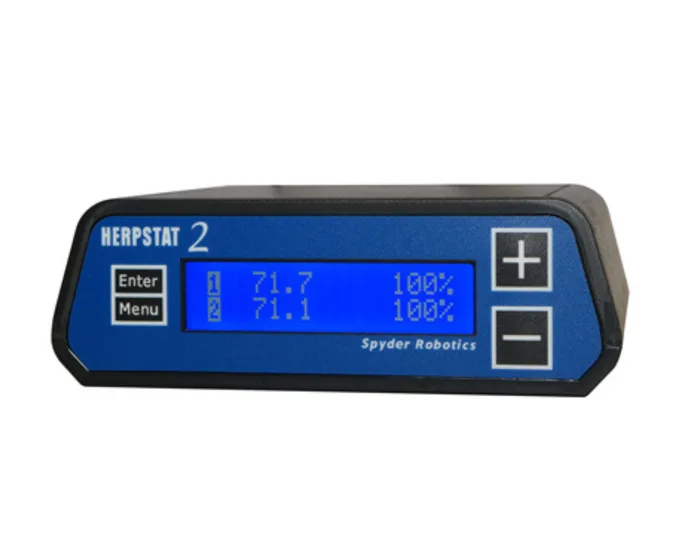
- Buy Spyder Robotics Herpstat 2 Two independent outputs, each switchable between dimming and pulse proportional control, with an internal safety relay behind them.
- Buy Zoo Med ReptiTemp Dimming Thermostat (RT-600P) A proper dimming thermostat for basking bulbs, with adjustable ramping and separate day and night setpoints, at a price a first-time keeper will actually pay. Amazon
- It depends Inkbird ITC-306T A cheap on/off day and night controller that is good for heat mats and wrong for anything that lights up. Amazon
- Skip Zoo Med ReptiTemp 500R Remote Sensor Thermostat A widely sold analog dial thermostat that gives you no readout, no alarm and no published cutoff on a device that can fail with the heat stuck on.
What actually matters
- Control type - this is the first and most consequential decision, because on/off, pulse proportional and dimming deliver power in fundamentally different ways. Manufacturers publish which heat sources each type may drive, and getting it wrong shortens lamp life at best and stresses the animal at worst.
- Documented failsafes - a thermostat can fail with the heater stuck on, so the useful question is what the maker says the unit does about it. Look for an internal safety relay, an over-temperature cutoff, sensor-failure detection or a fast-blow fuse, and check whether any of it is enabled by default.
- Maximum load rating - every unit here has a published watt or amp limit, and exceeding it is a genuine fire risk rather than a warranty technicality. Where a unit has a per-outlet cap as well as a total, both apply at once.
- Probe quality and reach - the probe is the thermostat's only contact with reality, so you want it waterproof, replaceable, and on a lead long enough to reach the position the manufacturer recommends. Probes drift and probes get chewed, and a non-replaceable probe turns into a dead unit.
- Alarms and readouts - a numeric display and a settable high and low alarm are what let you notice a problem before your animal does. Check the factory default on the alarm band, because a wide default is close to no alarm at all.
- Day and night control - separate daytime and nighttime setpoints, ideally with a ramp between them, let you provide the temperature drop many species need without unplugging anything by hand. Some makers do this in the unit, others expect you to add a timer.
- Warranty and support - reptile thermostats run continuously for years, so a longer warranty versus a one year warranty can be a real difference in expected life and in what the maker believes about its own product. Repairability, including a user-replaceable fuse, matters more here than in most small appliances.
The specs, in plain English
Green flags vs red flags
Green flags
- The listing names the control type explicitly as on/off, pulse proportional or dimming rather than just saying digital or precise
- A downloadable manual exists and includes a wattage limit, probe placement guidance and a description of what the unit does in an error condition
- The probe is described as replaceable and waterproof, with a stated cable length
- There is a settable high and low temperature alarm, and the documentation states the default band so you can judge whether it is tight enough
- The maker publishes a multi-year warranty and sells spare fuses or probes, which suggests the unit is meant to be kept running rather than replaced
Red flags
- The listing says it works with any heat source including bulbs, mats and emitters without naming a control type
- No wattage or amperage rating appears anywhere in the listing or on the housing
- No manual, no instruction sheet and no manufacturer website behind the brand name
- A non-replaceable or permanently attached probe, or a probe with no stated waterproof rating
- No visible UL, ETL or CSA mark on a mains-switching device sold very cheaply, especially from a brand with no traceable manufacturer
Who's who: the brands
- Spyder Robotics (Herpstat) - US-built keeper-grade controllers with selectable dimming and pulse modes, multi-output models and a documented internal safety relay.
- Vivarium Electronics - US brand aimed at rack and breeder setups.
- Microclimate - UK designer and manufacturer whose lineup splits by type into on/off, Pulse B2 and Dimmer B1, with published user guides.
- HabiStat - UK brand with the most explicit type-to-heat-source guidance in the category, plus a digital dimming unit that documents a safety cut out and a super fast blow fuse.
- Zoo Med - The mainstream US pet-trade name, spanning the analog on/off ReptiTemp 500R and a newer dimming thermostat built for basking bulbs.
How to read a listing without getting fooled
Start at the bottom of the listing, not the top. Find the control type first, and if the page does not tell you whether the unit is on/off, pulse or dimming, treat that as the answer to a different question and move on. Next find the load rating and note whether it is given in watts or amps, whether the word resistive appears, and whether there is a per-outlet cap in addition to a total. Then look for the probe: length, whether it is waterproof, and whether it is replaceable. After that, hunt for the failure language, which is usually buried in a manual rather than on the product page, and search that manual for the words relay, fuse, alarm and error. Finally, count the outputs and probes separately, because two sockets driven by one probe is a very different product from two independently controlled channels, and listings often blur the two.
How much should you spend?
Budget units are plug-in on/off controllers, often borrowed from home brewing and incubation, and analog dial thermostats from the pet trade. They are appropriate for heat mats and cable, and the digital ones give you a readout and an alarm that the analog ones do not, which is a large difference for little money. Mid-range is where dimming control becomes available from mainstream pet-trade brands, along with day and night setpoints, ramping and a replaceable waterproof probe. This is the sweet spot for a single enclosure heated by a basking bulb. Premium buys you the specialist controllers: multiple independently configurable outputs, selectable dimming or pulse control on each, temperature logging, and documented hardware failsafes such as an internal safety relay. The jump is worth it once you have more than one enclosure or a mixed heat setup, because two separate units leave you with two things to check.
Questions, answered
Do I still need a thermometer if I have a thermostat?
Yes, and manufacturers say so. Microclimate notes that a thermometer will only agree with the thermostat if it sits in exactly the same position as the sensor, so a separate thermometer is what tells you about the rest of the gradient. Zoo Med's dimming thermostat sheet goes further and recommends checking surface temperatures with a non-contact infrared thermometer to confirm they are within safe limits. Think of the thermostat as controlling one point and the thermometer as auditing it.
Can I run two heaters from one thermostat?
Usually yes, within the wattage limit, but understand what you are getting. On a single-channel unit both heaters follow the same probe and the same setpoint, which is fine if they are doing the same job and a problem if they are not. Zoo Med's 500R has two receptacles but one dial and a combined 500 watt ceiling, and Inkbird's ITC-306T has two sockets sharing one control channel. If you need two heat sources at genuinely different temperatures, you need two independent channels, not two sockets.
Why does my thermostat show the right temperature but the animal still looks too hot or too cold?
Often because the probe is measuring something other than what you care about. A probe taped to the glass reads the wall, not the air. A probe sitting directly under a basking lamp reads radiant heat and reports a falsely high number, which makes the thermostat cut power and leaves the enclosure cool. A probe on the cool end while your basking spot runs unchecked reports a number that is accurate and irrelevant. Move the probe to the position the manufacturer specifies for your heat source, then verify with a separate thermometer.
How do I know a cheap thermostat is electrically safe?
Look for a third-party listing mark such as UL, ETL or CSA on the housing and the plug, and be sceptical of a mains-switching device sold very cheaply with no traceable manufacturer behind it. Note that a CE or UKCA mark is a manufacturer's own declaration of conformity rather than independent testing, so it tells you something different from a UL or ETL listing. Beyond the mark, follow the electrical advice makers do publish: supply the unit through a GFCI or RCD, use a drip loop so water cannot run down the cord into the outlet, and keep the controller itself outside the enclosure and away from other heat sources.
Or jump to the head-to-head: Spyder Robotics Herpstat 2 vs Zoo Med ReptiTemp Dimming Thermostat (RT-600P).