Explained
Aquarium Air Pumps, Explained
After reading this you will know why one pump is silent and another buzzes, why the gallon rating on the box lies in a tall tank, and how to plumb a pump so it can never flood your floor.
In this guide
An aquarium air pump is a small vibrating rubber diaphragm that pushes air down a thin tube into your tank, driving air stones, sponge filters, and under gravel plates. Nearly every pump on the shelf moves enough air on day one, which is why the box tells you almost nothing useful. The two things that decide whether you are still happy in a year are how loud it is in a quiet room and whether it can push air all the way to the bottom of your tank, and neither is well described by the gallon rating printed on the packaging.
The 30-second version
- Noise is the number one long-run complaint, and it comes from two places: the diaphragm design inside the pump, and whatever the pump is standing on. A cheap pump on foam can easily beat a good pump bolted to a glass cabinet panel.
- A check valve plus a pump mounted above the waterline is what stops back siphoning, the failure where water climbs the airline after a power cut and empties your tank onto the carpet. Both together, not one or the other.
- Pressure beats flow ratings, because flow is measured with nothing attached and no water pushing back. Water depth is the real load, so a pressure figure in kPa tells you more than a gallon range ever will.
- Diaphragms are consumables, so a pump with a published repair kit is a multi-year purchase and a sealed one is a disposable item on a timer. This is the single spec most buyers ignore.
- Too much air is a real problem too, in shrimp, betta, and nano tanks. Either buy a pump with a flow dial or budget for a cheap inline valve you can pinch the bubble rate down with.
The products this guide is about
Our verdict on each, with the full reasoning on the companion review.
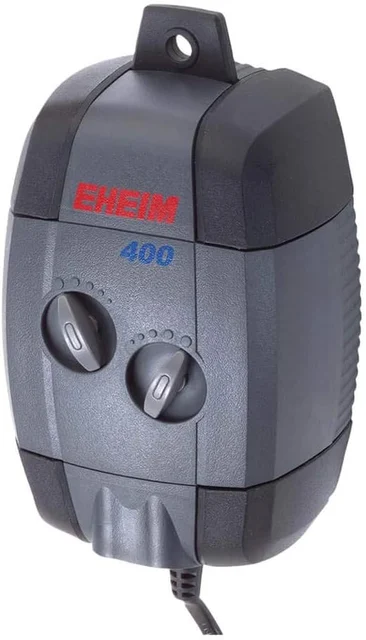
- Buy EHEIM Air Pump 400 The pump you buy when you want to forget the pump exists: two individually adjustable outlets, real pressure, and a design built around quiet running. Amazon
- Buy Fluval Q1 Air Pump A well damped, rebuildable mid size pump with enough pressure to keep sponge filters working near the bottom of a tall tank. Amazon
- It depends hygger Quiet Mini Air Pump (1.5W) A piezoelectric pump with no motor and almost no noise, which is close to ideal in a betta tank and useless in a tall one. Amazon
- Skip Marina 200 Air Pump Stocked widely and cheap, but a basic hard-shell pump with no flow control that is easy to out-buy. Amazon
What actually matters
- Noise in your actual room. An air pump runs twenty four hours a day, usually in the room where you relax. Manufacturers all print the word quiet, so ignore it and look instead for physical evidence: a suspended or rubber damped motor, a double walled body, wide soft feet, or a hanging tab that lets you lift the pump off the furniture entirely.
- Pressure at depth, measured in kPa. Every extra inch of water depth adds resistance the pump has to overcome. A pump that bubbles happily in a shallow bowl can stall completely with the same air stone sitting at the bottom of a tall tank. If a listing gives a pressure figure, that is the most useful number on the page.
- Back siphon protection. When the pump stops, the airline is just a tube connecting your tank to the floor. A one way check valve, plus mounting the pump higher than the water surface, closes that failure permanently. Some pumps include valves in the box, which is a small sign the maker has thought about owners.
- Serviceability. Rubber diaphragms stiffen and tear, and internal flap valves go sticky. Both are cheap parts. A brand that sells replacement diaphragm sets or a repair module turns a buzzy three-year-old pump into a ten minute fix rather than landfill.
- Number of outlets and flow control. Two outlets let you run a sponge filter and an air stone from one pump. Independent dials on each outlet let you balance them without extra hardware. Without dials you will be adding inline valves, which works fine but is one more thing to buy and one more joint to leak.
- Pump type. Most pumps are diaphragm pumps: a motor swings an arm that flexes rubber. A smaller group are piezoelectric, using a vibrating ceramic plate with no motor at all. Piezo pumps are very quiet and low pressure, which makes them excellent in nano tanks and unsuitable for anything deep.
- What ships in the box. Airline tubing, an air stone, diffusers, and check valves are all cheap individually but add up, and their absence is often how a budget pump stays a budget pump.
The specs, in plain English
Green flags vs red flags
Green flags
- A pressure figure in kPa published alongside the flow rating, rather than only a gallon range.
- Visible acoustic design: a suspended motor assembly, a double walled or baffled body, wide soft rubber feet, or a hanging tab.
- Non-return valves and airline included in the box, which means back siphoning was considered before you got there.
- A replacement diaphragm set or repair module sold as a stocked spare part for that exact model.
- Independent flow dials on each outlet, so a sponge filter and an air stone can run at different rates without extra hardware.
- Realistic positioning about tank size and depth rather than a single optimistic maximum gallon number.
Red flags
- The word silent doing all the work on the packaging with no damping, suspension, or baffling you can actually see.
- A gallon rating only, with no pressure spec, on a pump being sold for tall or heavily filtered tanks.
- A sealed body with no published spare parts, which makes the pump disposable once the diaphragm ages.
- A hard plastic shell with small hard feet, which turns whatever shelf you stand it on into a soundboard.
- Owner reports clustering around the pump getting noticeably louder within the first year.
- No flow control on the pump and no mention of inline valves, in a pump aimed at shrimp or betta keepers.
Who's who: the brands
- EHEIM - German aquatics specialist whose air pump line is described by the maker as very quiet, with rubber feet, adjustable outlets and a spare parts service.
- Fluval - Mainstream aquatics brand whose Q series air pumps are aimed at quiet running and list repair parts.
- Tetra - A very widely stocked name in fishkeeping. Its Whisper line is a common first pump: inexpensive, easy to find, adequate in shallow tanks.
- Marina - Budget mass-market line sold in many pet shops. Convenient and inexpensive, but basic, with less damping than premium designs.
- hygger - Value-focused online brand that sells a piezoelectric mini pump described by the maker as very quiet and low flow, so it suits small shallow setups.
- Aqua Culture and other store brands - Supermarket and big-box own-label pumps. They move air and cost very little, but offer little damping and few spare parts.
How to read a listing without getting fooled
Start by finding the pressure figure. If the listing gives you kPa, that is the number that tells you whether the pump can work at your tank's depth, and you can largely ignore the gallon range beside it. If there is no pressure figure at all, treat the tank rating as a shallow-water claim and assume it gets optimistic as depth increases. Next, read the noise claim as a physical description rather than an adjective: quiet means nothing, but a suspended motor, a baffled or double walled chamber, wide soft feet, and a hanging tab are things you can verify from photos. Then check whether outlets have their own dials, because two outlets with no flow control is a different product from two outlets you can independently balance. Search the brand and model plus the word diaphragm to see whether spare parts exist, since that determines whether year three is a repair or a replacement. Finally, look at what is in the box: airline, an air stone, diffusers, and especially check valves. When reading owner reviews, weight the ones written six months or more after purchase, and discount day-one noise reports entirely, because every diaphragm pump is quiet when new. Watch for the pattern where a reviewer complains about weak output and mentions a deep tank or a large sponge filter, which is usually a pressure mismatch rather than a defective unit.
How much should you spend?
Air pumps span a wide range, and unusually for aquarium gear, spending more genuinely buys something measurable. What drives cost is acoustic engineering (a suspended motor, a baffled body, real damping), pressure capability, the presence of flow dials, and whether the maker stocks spare diaphragms. The value sweet spot for most people is the mid-range: a well damped, rebuildable pump with enough pressure to run a sponge filter at substrate level, which costs less than the premium option while doing much of the same work. Stepping up to the premium tier is worth it in exactly one situation, which is when the tank shares a room where you sleep, work, or take calls, because the last bit of noise is the thing you cannot fix afterwards with foam. Stepping down to the cheapest tier is defensible for a quarantine tank, a garage grow-out, or any setup where nobody is listening and the water is shallow. What is never worth it is buying the cheapest pump for a bedroom tank and then buying a second pump six months later, which is the most common way people end up spending more overall. Two accessories are worth spending on regardless of pump tier: a check valve for every line, which costs almost nothing, and something soft for the pump to stand on, which costs nothing at all.
Questions, answered
Why does my air pump get louder after a few months?
Two causes dominate. The rubber diaphragm stiffens and develops small tears, which turns a soft hiss into a flapping rattle, and the internal flap valves go sticky, which disrupts the pump's rhythm. Both are consumable parts, so a pump with a published repair kit can be brought back close to new in about ten minutes. There is also a third cause that is not the pump at all: a bare shelf or a glass cabinet panel acts as a soundboard and amplifies vibration that the pump itself is barely making. Before you buy a replacement, stand the existing pump on a folded towel, a mouse pad, or a scrap of closed cell foam. That change alone often does more than upgrading.
Do I really need a check valve?
Yes, on every air line, without exception. When the pump stops, whether you unplug it or the power drops, water climbs back up the tubing and can siphon out of the tank through the pump, which is usually sitting on the floor or inside a cabinet. A one way check valve fits inline between the pump and the tank and costs almost nothing. The arrow printed on it must point toward the tank. The most reliable setup pairs the valve with mounting the pump above the tank's waterline, or running the airline up over the rim and back down before it enters the water, so gravity cannot start a siphon at all and the valve becomes a backup rather than your only defense.
How do I know a pump is powerful enough for my tank?
Look for a pressure figure in kPa rather than only a gallon rating. Flow ratings are measured with nothing attached and no water pushing back, so they flatter small pumps. Water depth is the real load. If you are running a sponge filter, an under gravel plate, or an air stone more than about a foot or more below the surface, choose a pump whose specification lists pressure and treat that as the real rating. A nano pump rated for fifteen gallons can still fail in a tall fifteen gallon tank, because the gallon number says nothing about how deep those gallons are.
Do I need an air pump at all if I already run a filter?
Not always. A hang on back or canister filter that agitates the surface is already exchanging gas with the air. An air pump earns its place when you run air driven sponge filters, when the tank is heavily stocked or warm (warmer water holds less oxygen), during medication that depresses oxygen levels, or in a quarantine tank where a sponge filter is the whole filtration system. It is also cheap insurance for a tank you care about, which is why many owners run one alongside a filter rather than instead of one.
What is the single cheapest way to make my pump quieter?
Change what it sits on. Most of what you hear is not the pump itself but vibration transferred into furniture, and a cabinet panel or a glass shelf works exactly like the soundboard of an instrument. Put the pump on closed cell foam, a folded towel, or a mouse pad, or better still hang it in free air if it has a hanging tab. After that, check that the airline is not pressed tight against a hard surface along its run, since tubing transmits vibration too. These cost nothing and routinely beat spending on a nominally quieter model.
Are the silent piezoelectric mini pumps worth it?
In the right tank, yes, and they are very quiet, because there is no motor or swing arm to buzz. The catch is that low pressure is inherent to the design, not a quality problem. They are excellent for betta tanks, shrimp setups, and small planted nanos in shallow water. They will not drive a large sponge filter, a protein skimmer, an under gravel plate, or anything in a tall tank, and no amount of repositioning changes that. Buy one knowing exactly what it cannot do and it is a great piece of kit; buy one as a general purpose pump and it will disappoint you.
Or jump to the head-to-head: EHEIM Air Pump 400 vs Fluval Q1 Air Pump.