Explained
Protein Skimmers, Explained
After reading, you'll understand why a skimmer only works in salt water, how to read a tank-size rating that is quietly optimistic, and which numbers on the spec sheet actually predict whether the thing will fit and perform.
In this guide
Protein skimmers look simple and are surprisingly easy to buy wrong. The first trap is buying one for a freshwater tank, where the physics does not cooperate. The second is trusting a headline gallon rating that assumes a tank far more lightly stocked than yours. The third is discovering, after it arrives, that your cabinet has two inches less clearance than you need to lift the collection cup out.
The 30-second version
- Skimmers are saltwater equipment, because the fine bubbles they depend on only stay fine when dissolved salts stop them merging together.
- Rate by bioload, not gallons, since the same tank lightly or heavily stocked presents completely different loads to the same skimmer.
- Check what the rating includes, because some makers state display volume excluding the sump while others describe total system volume.
- Measure height twice, once for the skimmer body and again for the clearance you need above it to lift the cup out.
- Expect a break-in period, because a brand new skimmer foams unpredictably for days before it settles into a stable rhythm.
The products this guide is about
Our verdict on each, with the full reasoning on the companion review.
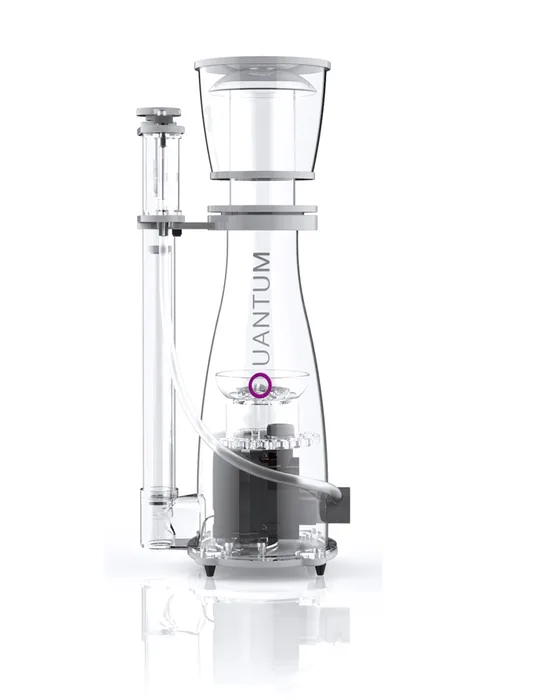
- Buy NYOS Quantum 120 A small-footprint in-sump skimmer with a hybrid impeller and genuinely independent water and air adjustment, rated by NYOS for 100 to 500 litres.
- Buy Reef Octopus Classic 110-INT A straightforward acrylic in-sump skimmer whose maker publishes three honest bioload numbers instead of one optimistic headline figure. Amazon
- It depends TUNZE Comline DOC Skimmer 9004 An in-tank skimmer on a magnet mount that needs no sump and no plumbing, but is rated for a small marine tank and lives in plain sight. Amazon
- Skip Coralife Marine Filter with Protein Skimmer A hang-on-back filter and skimmer combo sold on one vague 30 gallon number, with no published pump wattage, no air figure and a cartridge you keep buying. Amazon
What actually matters
- Bioload rating - This is the maker's estimate of how much waste the skimmer can process, expressed as a tank volume. A brand that publishes separate lightly, moderately and heavily stocked figures is giving you something you can actually plan against.
- Footprint - The floor area the skimmer occupies in your sump, and the constraint that most often kills a purchase. Two skimmers with the same rating can have very different shapes, so measure your sump chamber in both directions first.
- Total height and cup clearance - The body height is only half the problem, because you have to lift the collection cup straight up to empty it. Add several inches of headroom above the stated height before you decide it fits.
- Sump water level - In-sump skimmers are designed to run in a specific water depth, and performance drifts if your level is well above or below it. Reef Octopus, for example, publishes a recommended 7 to 8 inch sump water height for the Classic 110-INT.
- Pump and impeller type - The pump is what shreds air into bubbles, and needle wheel and pinwheel impellers exist specifically to make lots of small ones. Wattage tells you running cost, while the quoted air draw tells you more about skimming potential.
- Adjustment method - You set skimmate wetness by changing the water level inside the body, which means the adjuster is a part you will touch often. Gate valves and calibrated screws move in small repeatable steps, which is what you want.
- Break-in behaviour - New skimmers behave oddly while manufacturing residues wash off and the tank chemistry settles. Coralife's manual says a new unit may take up to 72 hours to adjust, and treating that as a fault is a common new-owner mistake.
The specs, in plain English
Green flags vs red flags
Green flags
- The maker publishes separate lightly, moderately and heavily stocked ratings instead of one gallon figure.
- Footprint, body diameter, neck size and total height are all listed, not just a single overall dimension.
- A recommended sump water height is stated, so you can check it against your own setup before buying.
- The pump is named as a specific model with a wattage and an air draw figure.
- Adjustment is by a gate valve or calibrated screw rather than a friction-fit tube you have to wrestle.
Red flags
- One large gallon number with no stocking context and no explanation of what it assumes.
- No published pump model, wattage or air draw, so you cannot compare it to anything.
- The listing sells it for freshwater and saltwater alike, which is a warning sign.
- A very short overall body on a unit claiming a large tank rating, since foam needs height to form and dry.
- A skimmer bundled into a filter that needs a proprietary cartridge, which turns your skimming into a subscription.
Who's who: the brands
- NYOS - A German marine brand whose Quantum in-sump skimmers use a Hybrid Wheel impeller and compact footprint.
- Reef Octopus - Brand whose Classic 110-INT page states separate light, medium and heavy bioload ratings.
- TUNZE - A German maker whose Comline internal skimmers mount inside the tank on magnet holders and come with unusually explicit derating guidance.
- Bubble Magus - A value-focused brand whose Curve series lists specifications on its site; check each model for pump, wattage and rating.
- Coralife - A mass-market aquarium brand whose skimmers are mostly hang-on-back and combination units aimed at beginners.
How to read a listing without getting fooled
Work through a skimmer listing in a fixed order. First confirm it is specified for salt water, which makers generally state. Next find the tank rating and look immediately for the qualifier: if you see three numbers for light, medium and heavy stocking, use the one that matches your tank, and if you see one number, assume it describes a lightly stocked system and mentally derate it. Check whether the figure includes the sump, since Reef Octopus explicitly excludes it and other makers may not. Then move to the physical numbers: footprint, body diameter, neck size and total height, and add clearance for lifting the cup. Confirm the required sump water level against what your sump actually runs at. Finally, look at the pump specification, because a named model with a wattage and an air draw figure means the maker is prepared to be measured, and a listing with none of that is asking you to take its word for it.
How much should you spend?
Budget tier buys you small hang-on-back units and filter and skimmer combos, and at that level you should expect thin specifications, a single vague tank rating and modest performance. Mid-range is where the category becomes worth buying: solid in-sump skimmers with named pumps, full dimensional specs, published bioload figures and adjusters that move in small steps, which covers most home reef tanks comfortably. Premium buys refinement rather than raw capability at the same tank size: quieter operation, lower power draw, finer independent control of water and air, better materials and a smaller footprint for the same rating. Recirculating and larger external models sit at the premium end too, but those are answers to a different question, which is a big or heavily stocked system. For a typical home reef, the mid tier is the sweet spot, and the money is better spent on the right size than on the fanciest body.
Questions, answered
Will a skimmer work on a brackish tank?
It depends on how brackish, and you should treat it as a grey area rather than a yes. Skimming relies on dissolved salts keeping small bubbles from merging, so foam quality falls away as salinity drops. Manufacturers specify these units for sea water, not for a partial salinity, so you are outside the stated design range and outside any performance claim. If you run a brackish system, test it on your own water before assuming it will pull anything useful.
Does a protein skimmer lower nitrate and phosphate?
Only indirectly. A skimmer pulls organic waste out of the water column before it decomposes, which means less material is available to break down into nitrate and phosphate later. It does not reach out and grab nitrate or phosphate that is already dissolved. That is why makers sell separate phosphate removing media alongside skimmers, and why water changes and nutrient export still matter.
Should I run my skimmer wet or dry?
Dry skimmate is thick and dark and removes less volume but more concentrated waste, while wet skimmate is pale and watery and removes more total volume. You choose between them by raising or lowering the water level inside the skimmer body. Most people settle somewhere in between and adjust toward dry when the tank is lightly fed and toward wet after heavy feeding or a big cleanup. Change it in small steps and give it a day before judging.
Do I need a skimmer if my reef is lightly stocked?
Not necessarily, and plenty of small, lightly stocked marine tanks run well on water changes and good flow alone. A skimmer earns its place as fish load, feeding and tank volume go up, because that is when organics accumulate faster than changes can remove them. If you are undecided, look at your feeding schedule and fish count rather than the tank's gallon rating. You can always add one later, provided you leave the space for it.
Or jump to the head-to-head: NYOS Quantum 120 vs Reef Octopus Classic 110-INT.