Explained
Aquarium Thermometers, Explained
After reading, you'll understand why a thermometer that reads to a tenth of a degree can still be two degrees wrong, and which features actually protect a tank.
In this guide
Most first time buyers pick an aquarium thermometer the way they pick a wall clock: whichever one looks tidy on the glass. Then they discover that two thermometers on the same tank disagree, and have no way to work out which one is lying. The confusion is usually the same three things: mistaking a fine display for a precise measurement, not realising an external sensor is reading glass rather than water, and assuming any device with a screen must have an alarm. This guide untangles those.
The 30-second version
- Accuracy and resolution are different things, and a display that shows tenths tells you nothing about how close the number is.
- Many makers publish no tolerance, so the ones that do print a plus or minus figure deserve extra credit.
- External sensors read the glass, which is why sunlight, a cold wall or a warm cabinet can shift the number.
- A high and low alarm is the feature that protects, but only if it can reach you when you are not standing at the tank.
- Two cheap thermometers beat one expensive one, because agreement between independent instruments is the only check most owners can run.
The products this guide is about
Our verdict on each, with the full reasoning on the companion review.
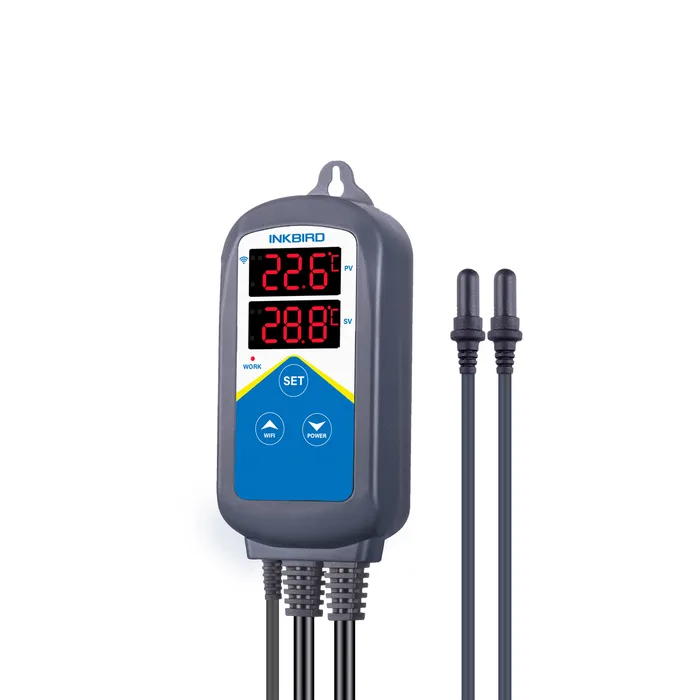
- Buy Inkbird ITC-306A WiFi Aquarium Temperature Controller A twin probe controller that reads the water, shouts when it drifts, and can pull the plug on a stuck heater.
- Buy JW Pet Fusion Standing Aquarium Thermometer A spirit filled glass column on a weighted finned base, with a published tolerance and nothing to run out of battery. Amazon
- It depends hygger HG073 External Aquarium Thermometer A big, cordless digital display that sticks to the outside of the glass and can flash at you when the water leaves a band you set.
- Skip Fluval Edge Thermometer An adhesive liquid crystal strip that reads the glass in coarse steps over a narrow band, with no tolerance we could confirm.
What actually matters
- Stated tolerance - the plus or minus figure is the only honest statement of how wrong the device can be. If a listing does not have one, assume the maker did not want to commit to a number.
- Sensor coupling - a probe hanging in the water column reads the water. A sensor pressed against the outside of a pane reads a surface that is heated by the tank on one side and cooled by the room on the other.
- Alarm channel - a buzzer is loud but local, an app push travels but depends on a network, and a flashing display is not really an alarm. The best devices do more than one.
- Default alarm limits - many alarm capable devices ship with the window set to the extremes of their measuring range. Until you narrow it, the alarm is decorative.
- Range versus useful range - a wide advertised range is easy to publish. What matters is the accuracy the maker claims inside the narrow band a tank actually occupies, roughly 20 C to 30 C.
- Power and consumables - button cell devices can fade quietly and can display plausible numbers on a weak battery. Mains devices need an outlet. Glass thermometers have no hidden failure mode.
- Placement and flow - a tank is not one temperature. Water near the heater reads warmer than a still corner, and an external sensor depends on circulation to reflect the whole tank.
The specs, in plain English
Green flags vs red flags
Green flags
- The maker publishes a plus or minus accuracy figure, and states it separately from display resolution.
- The sensor goes in the water, or the device is a controller with a submersible probe.
- Both a high and a low alarm are settable, and the alarm is audible or reaches a phone.
- There is a documented way to apply a calibration offset.
- The listing states power source, battery type and warranty terms rather than leaving them blank.
Red flags
- The only precision claim in the listing is the number of decimal places on the display.
- The word accurate appears repeatedly with no figure attached to it anywhere.
- It is an external or adhesive product being sold on the promise of measuring water temperature.
- An alarm is advertised but the manual reveals it is a flashing display and nothing more.
- The stated measuring range is impressively wide but no accuracy is claimed anywhere inside it.
Who's who: the brands
- Inkbird - Known for affordable temperature controllers with probes, settable alarms and app connectivity, sold across aquarium, brewing and reptile use.
- hygger - An aquarium equipment specialist whose thermometers lean toward large external displays and with settable alert limits on its larger models.
- Fluval - A long established aquatics brand under Hagen, with a broad range of aquarium equipment and a small selection of simple thermometers including adhesive strips.
- JW Pet - A Petmate brand best known for inexpensive glass aquarium thermometers with a weighted base and a printed safe zone band.
- Zoo Med - A reptile and aquarium accessory maker that also sells aquarium thermometers.
How to read a listing without getting fooled
Read the listing backwards. Skip the headline claims and go straight to the specification block or the downloadable manual, and look for a plus or minus figure. If you find one, check what temperature band it applies to, because some makers publish a tighter tolerance in a mid range band and a looser one at the extremes. Then find the word alarm and read what the manual says happens, not what the bullet point says, because flashing display and audible buzzer are both marketed as alarms. Next, establish where the sensor lives: in the water, on the glass or inside the housing. Finally, check the mundane entries, battery type, power input, mounting method and warranty length, since those decide whether the device is still doing its job a year from now. If the page has none of this and the manual is not downloadable, that absence is itself the answer.
How much should you spend?
This is a category where spending more buys capability rather than accuracy. At the budget tier you can get a spirit filled glass thermometer with a published tolerance, a submersible digital with a suction cup, or an external display with settable limits, and any of them will read a tank adequately. Moving to the mid range tier mainly adds capability; what it buys is a controller with in water probes, an audible alarm, phone notifications and the ability to cut power to a heater, which is the feature set that actually prevents a loss. Premium tier spending in this space generally means laboratory grade handheld meters, which are excellent references for checking your other thermometers but are not designed to sit on a tank monitoring it around the clock. The best value move for most owners is not to trade up at all: buy the alarm capable device, then add a second budget thermometer as an independent cross check.
Questions, answered
Where in the tank should the thermometer go?
Away from the heater and away from the filter outflow, ideally in the area with the least direct flow so you are seeing the general body of water rather than a warm plume. Keep it out of direct sunlight and away from the pane closest to an exterior wall or a radiator. If you are running a controller, its probe should be in circulating water so it responds to real changes rather than a stagnant pocket.
How often should a thermometer be replaced?
Glass thermometers do not drift much and can be kept until they break or the scale becomes illegible. Digital units are more about the battery than the sensor: some makers recommend changing the battery periodically, and a weak cell can produce a plausible but wrong reading rather than an obvious failure. If a digital unit starts disagreeing with a reference it used to match, change the battery first before assuming the sensor has failed.
Can I use an infrared thermometer on an aquarium?
Only as a rough surface check, and with caveats. An infrared thermometer reads the temperature of the topmost layer it can see, and a water surface with evaporation happening is usually cooler than the body of the tank. It also cannot read through glass, so pointing it at the side of the tank measures the pane. It is fine for spotting a large problem quickly and poor for the small differences that actually matter in fishkeeping.
What does it mean if my two thermometers disagree?
It means at least one of them is wrong, and you now know something you did not know before. Start by ruling out placement, since a probe near the heater and a strip on a sunlit pane can legitimately differ by a degree or more in the same tank. Move them next to each other, wait several minutes and read again. If they still disagree, add a third instrument or run an ice point check on whichever ones are submersible, and trust the majority.
Or jump to the head-to-head: Inkbird ITC-306A WiFi Aquarium Temperature Controller vs JW Pet Fusion Standing Aquarium Thermometer.