

Pets
The Best Aquarium Thermometers: 4 Compared (and One to Skip)
We compared four aquarium thermometers on what the maker actually publishes for accuracy, whether the thing has a real high and low alarm, and where the sensor sits relative to the water.
The short version
The Inkbird ITC-306A wins because it is the only one here that both watches the water and does something about it, with an audible alarm, an app push, the ability to cut heater power when the water runs hot, and a published accuracy of plus or minus 1 C. The JW Pet Fusion Standing Aquarium Thermometer is the value pick and the one to buy two of: a spirit filled glass column with a published tolerance of plus or minus 1.5 F, no battery, nothing to fail silently. The hygger External Aquarium Thermometer suits someone who wants a big at a glance number and settable limits on a cheap budget, but its alarm is only a flashing display and it sticks to the outside of the glass. Skip the Fluval Edge Thermometer and adhesive liquid crystal strips generally: this one reads in coarse steps over a narrow band, and we could not confirm any tolerance. Two cheap thermometers that agree with each other are stronger evidence than one expensive one you have never checked. Best for: anyone whose tank depends on a heater staying honest.
Our picks at a glance
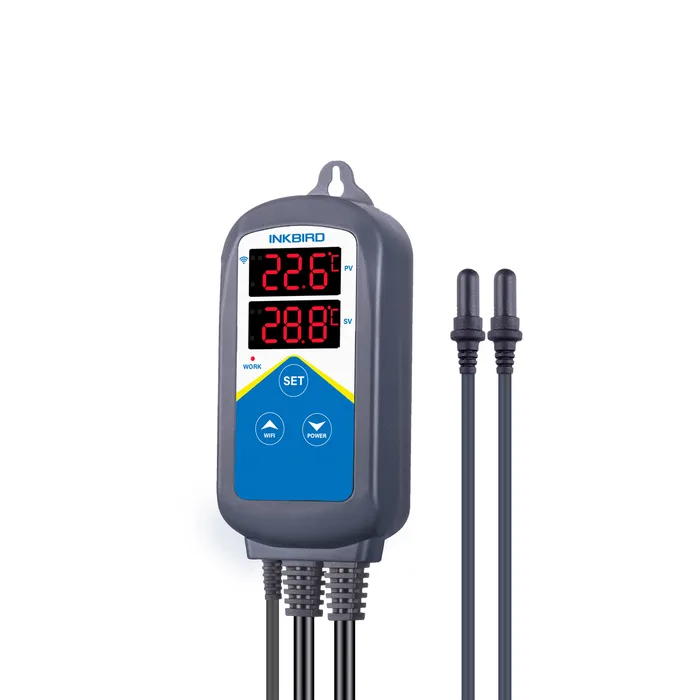
- Inkbird ITC-306A WiFi Aquarium Temperature Controller - Buy. A twin probe controller that reads the water, shouts when it drifts, and can pull the plug on a stuck heater.
- JW Pet Fusion Standing Aquarium Thermometer - Buy. A spirit filled glass column on a weighted finned base, with a published tolerance and nothing to run out of battery.
- hygger HG073 External Aquarium Thermometer - It depends. A big, cordless digital display that sticks to the outside of the glass and can flash at you when the water leaves a band you set.
- Fluval Edge Thermometer - Skip. An adhesive liquid crystal strip that reads the glass in coarse steps over a narrow band, with no tolerance we could confirm.
The verdict in 30 seconds
What mattered most
- Type
- Stated accuracy
- Stated range
- High and low alarm
- Can cut power to the heater
- Power source
An aquarium thermometer exists for one reason: the dial on your heater cannot be trusted, and a heater that sticks on or quits is one of the more common ways a tank gets wiped out overnight. So the useful question is not which readout looks nicest on the glass. It is which arrangement will actually tell you something is wrong while there is still time to act. We looked at what each maker publishes, how the sensor is coupled to the water, and whether there is an alarm at all.
A twin probe controller that reads the water, shouts when it drifts, and can pull the plug on a stuck heater.
Best for: Anyone with fish they would be upset to lose who wants the failure caught, not just displayed.
- Publishes a real tolerance of plus or minus 1 C, which is tight enough for a tropical tank.
- High and low alarms are audible from the unit and pushed to the phone app, not just shown on screen.
- It sounds an alarm and cuts heater power when the water runs too hot, and a continuous heating alarm catches a heater that runs without reaching target.
- It is a controller, so it needs mains power and a spare outlet, and it is bulkier than a thermometer.
- App alerts only work while the WiFi link is up, and it accepts 2.4 GHz networks only.
- The alarm limits ship at their extremes, so it protects nothing until you sit down and set them.
- Inkbird lists a one year warranty.
Amazon had no buyable listing for this when we last checked. The link still works if it returns.
Check price on Amazon Read our detailed assessment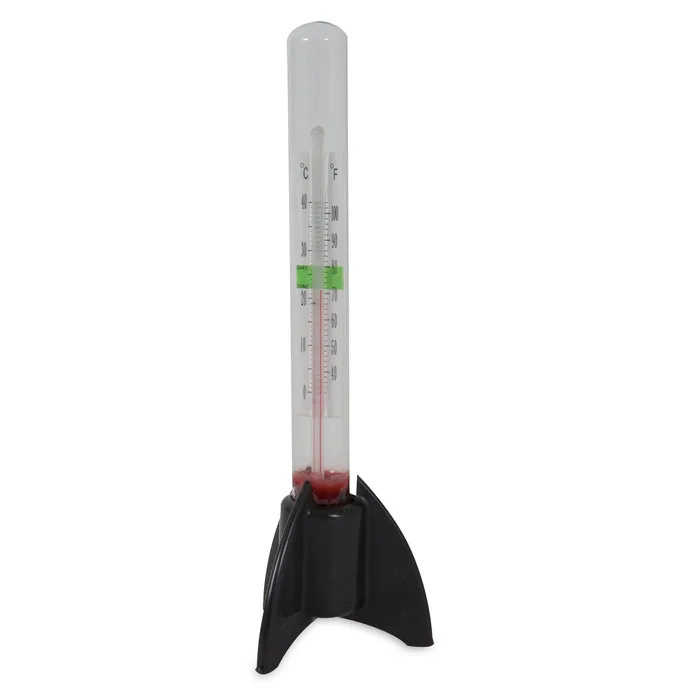
A spirit filled glass column on a weighted finned base, with a published tolerance and nothing to run out of battery.
Best for: The owner who wants an honest reference reading and is willing to look at the tank every day.
- JW Pet publishes a tolerance of plus or minus 1.5 F, a figure many makers in this category do not give.
- No battery, no electronics, no silent failure mode: if the column breaks you can see it.
- The weighted base with anchoring fins pushes into gravel and stays put instead of drifting to the back corner.
- Glass in a tank with a large cichlid, a pleco or a heavy scaping habit is glass waiting to break.
- No alarm of any kind, so it only helps when you are standing in front of it.
- You have to read a thin liquid column against a printed scale, which is harder in a dim or heavily planted tank.
- The maker does not publish a measurement range.
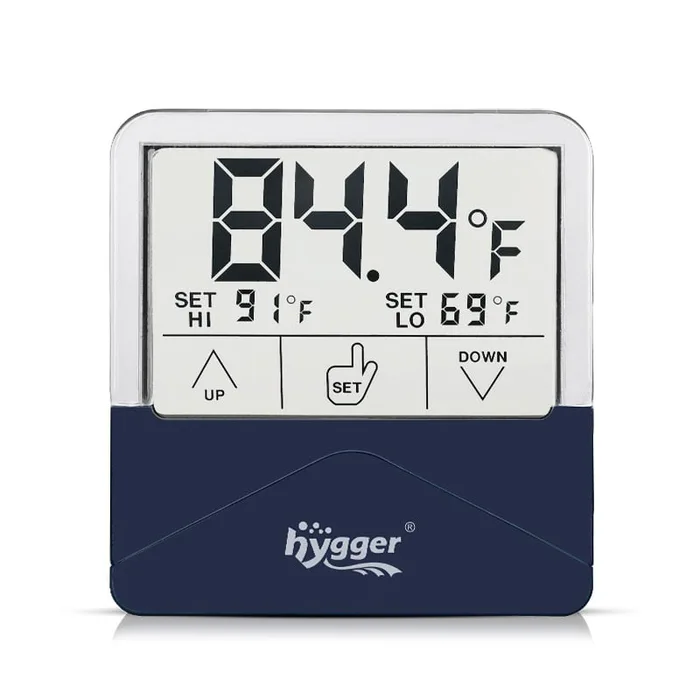
A big, cordless digital display that sticks to the outside of the glass and can flash at you when the water leaves a band you set.
Best for: Someone who wants a large, glanceable number and a rough drift warning on a tank they are near all day.
- hygger's page lists settable alert limits, though it does not give a measurement range or an accuracy figure.
- The large variant lets you set a high and a low limit; the small variant instead records the minimum and maximum temperature.
- Nothing goes in the water and there is no cable, so it does not clutter the tank or add another thing to clean.
- The alarm is only a flashing display. There is no beeping and no app, so it cannot wake you or reach you.
- The sensor reads through the tank wall, so the reading follows the glass more than the water.
- hygger's page gives no accuracy figure for the reading.
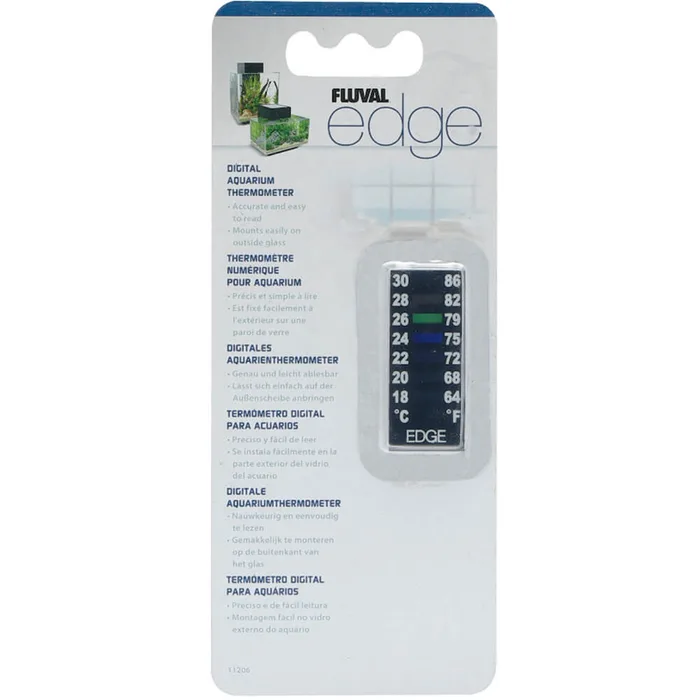
An adhesive liquid crystal strip that reads the glass in coarse steps over a narrow band, with no tolerance we could confirm.
Best for: A second opinion on a tank that already has a proper thermometer, and not much else.
- It costs almost nothing, adds no clutter and cannot break in a way that hurts the fish.
- It is genuinely easy to fit: peel, stick to the outside of the glass, done.
- As a rough sanity check that the heater has not died completely, it is better than no thermometer.
- The scale steps coarsely, so it cannot resolve the small drifts that matter most.
- It is a narrow band strip, and we could not confirm any accuracy or tolerance figure from Fluval.
- It measures the glass, not the water, so room air and sunlight on that pane both pull the reading.
- There is no alarm, no memory and no way to check it against anything.
| Criteria | ITC-306A WiFi Aquarium Temperature Controller Top pick | Fusion Standing Aquarium Thermometer | HG073 External Aquarium Thermometer | Edge Thermometer |
|---|---|---|---|---|
| Verdict | Buy it | Buy it | It depends | Skip it |
| Best for | Anyone with fish they would be upset to lose who wants the failure caught, not just displayed. | The owner who wants an honest reference reading and is willing to look at the tank every day. | Someone who wants a large, glanceable number and a rough drift warning on a tank they are near all day. | A second opinion on a tank that already has a proper thermometer, and not much else. |
| Price tier | $$ · mid-range | $ · budget | $ · budget | $ · budget |
| Type | Digital controller, twin in-tank probes | Liquid-in-glass, spirit filled, standing | External digital, sensor against the glass | Adhesive liquid crystal strip |
| Stated accuracy | Plus or minus 1 C | Plus or minus 1.5 F | Not confirmed | None confirmed |
| Stated range | Controls 0 C to 45 C | Not published | Alert limits settable, range not confirmed | Narrow band, not confirmed |
| High and low alarm | Yes, audible alarm plus app | No | Yes on the large size, flashing display only | No |
| Can cut power to the heater | Yes, cuts heater power on high temperature | No | No | No |
| Power source | Mains, 100 to 240 V AC, 10 A max | None needed | Replaceable button battery | None needed |
| Sensor location | Two probes submerged in the water | Whole unit sits in the water | Outside the glass | Outside the glass, adhesive |
| User calibration | Yes, offset adjustment built in | No | No | No |
Which one is right for you?
- Anyone with fish they would be upset to lose who wants the failure caught, not just displayed. Buy it Inkbird ITC-306A WiFi Aquarium Temperature Controller
- The owner who wants an honest reference reading and is willing to look at the tank every day. Buy it JW Pet Fusion Standing Aquarium Thermometer
- Someone who wants a large, glanceable number and a rough drift warning on a tank they are near all day. It depends hygger HG073 External Aquarium Thermometer
- A second opinion on a tank that already has a proper thermometer, and not much else. Skip it Fluval Edge Thermometer
How we judged the field
Five things decide whether an aquarium thermometer is worth owning. First, a published tolerance, because a maker that will not commit to a plus or minus figure is telling you something. Second, resolution kept separate from accuracy, since a display that shows 0.1 degree steps says nothing about whether the number is right. Third, sensor coupling: a probe in the water is measuring the water, while anything taped to the outside is measuring glass that is also touching room air, sunlight and the back of a cabinet. Fourth, whether there is a high and low alarm, and if so whether it is audible, app based or merely a flashing digit. Fifth, the boring practicalities that decide whether it is still working in a year: power source, battery life, cable length if there is a cable, and how it mounts.
The field splits cleanly by sensor coupling, and that split maps almost exactly onto usefulness. Liquid in glass instruments sit in the water and are genuinely accurate for the money, but they are fragile and passive. Digital units with an in tank probe are the middle ground, and the ones worth having are the models that add limits and an alarm. External units, whether a smart adhesive display or a plain liquid crystal strip, are the convenient option and the least trustworthy, because they read a surface rather than a volume. We picked one of each so the trade offs are visible side by side, and made the top pick a controller rather than a bare thermometer, because a device that only reports a problem is a device that needs you to be in the room.
Inkbird ITC-306A WiFi Aquarium Temperature Controller
Buy itThe ITC-306A is not really a thermometer, it is a thermostat with a display, and that is exactly why it sits at the top. Two probes go in the water and plug into a box that sits between your outlet and your heater. Inkbird publishes an accuracy of plus or minus 1 C, which is tight enough for a tropical tank. What matters more is what happens when things go wrong. Set a high limit and a low limit, and when either is crossed the unit sounds an alarm, and Inkbird says it turns the heating power off when the water runs too hot. A continuous heating alarm catches the opposite failure, a heater running flat out and never reaching target. The catch is that the app half needs a 2.4 GHz network and a live connection, and no alarm protects anything until you set the limits yourself. For anyone whose stock would be painful to replace, that setup session is the best half hour you will spend on the tank.
JW Pet Fusion Standing Aquarium Thermometer
Buy itThe Fusion Standing thermometer is the cheapest thing in this comparison that publishes a number: JW Pet states an accuracy of plus or minus 1.5 F, which is a real commitment. It is a spirit filled glass column, the red kind rather than the silvery mercury kind, held in a clear sleeve on a weighted base with anchoring fins that push into gravel so it stands upright where you put it instead of migrating behind the filter. There is a printed green safe zone band to make a glance easier. The trade off is obvious and unavoidable: it is glass, it is passive, and it will never tell you anything you did not walk over and look at. A boisterous cichlid or a determined pleco can knock it over or crack it, and reading a thin column against a scale is harder in a dim planted tank than reading a lit digit. Buy it as the honest reference reading in the tank, and seriously consider buying two, because two cheap instruments that agree are stronger evidence than one you have never questioned.
hygger HG073 External Aquarium Thermometer
It dependsThe HG073 is the interesting middle case. It is a cordless digital display that tapes to the outside of the tank with adhesive, reads through the glass, and comes in two sizes that do different jobs: the large one lets you set a high and a low limit, the small one instead records the minimum and maximum temperature. hygger’s page lists settable alert limits but, as far as we could confirm, no accuracy figure. Two things stop it being a buy. The alarm, on the size that has one, is nothing more than the display flashing, and a narrow limit band may make it flash often. And it is reading a tank wall, so the number follows the glass as much as the water. It is a good glanceable readout for a tank you sit next to, and a poor watchdog for one you leave.
Fluval Edge Thermometer
Skip itThe Edge Thermometer is the product that shows why stick on strips keep disappointing people. It is a liquid crystal strip in a small blister, peeled and stuck to the outside of the glass, and Fluval sells it under the digital thermometer label even though there is nothing digital about it. The scale is a narrow band with coarse steps, so the finest change it can show you is larger than the drift that should worry you. We could not confirm any accuracy or tolerance from Fluval. Because it is bonded to the pane, its reading is a blend of tank water and whatever the room is doing to that side of the glass, which is why two strips on opposite ends of the same tank often disagree. None of this makes it useless as a rough confirmation that the heater has not died outright, and it costs about as much as a bag of gravel. It is just not the thing you should be relying on.
Sources
Specs in this review come from these pages.
- Inkbird - Aquarium Temperature Controller ITC-306A product page (inkbird.com)
- Inkbird - ITC-306A user manual (technical parameters and alarm behaviour) (inkbird.com)
- hygger - External Aquarium Thermometer HG073 product page and specification table (hygger-online.com)
- hygger - HG073 user manual (measurement range, deviation, battery, mounting) (hygger-online.com)
- Petmate - JW Fusion Standing Aquarium Thermometer product page (petmate.com)
- Fluval - Edge Thermometer (item 11206) product page (fluvalaquatics.com)
- US EPA - Mercury Thermometers (epa.gov)
- NIST - Calibration Services (nist.gov)
Inkbird ITC-306A WiFi Aquarium Temperature Controller vs JW Pet Fusion Standing Aquarium Thermometer: which should you buy?
The Inkbird ITC-306A and the JW Pet Fusion Standing thermometer are not really competing, and the honest recommendation is to run both. The Inkbird is the watchdog: it measures with a stated plus or minus 1 C, it sounds an alarm and sends a push when the water leaves the window you set, and it can cut power when the water runs hot. The JW Pet is the witness: a passive glass column with a stated plus or minus 1.5 F that has no firmware, no battery and no dependency on your router. Put them in the same tank and each one checks the other. If they read within a degree or so of one another you have earned some confidence in both, and if they diverge you have learned something important before your fish did.
If you genuinely have to pick one, the deciding question is how much of the day the tank is unattended. If you work from home, keep the tank in a room you occupy, and would notice a lethargic fish within a few hours, the glass thermometer plus a habit of actually looking at it covers most of the risk for very little money. If the tank sits in a room you visit twice a day, or you travel, or the livestock is expensive, buy the controller and take the extra step of setting the high and low limits the day it arrives, because it ships with them parked at their extremes. Whichever way you go, the first thing to buy after that is a second cheap thermometer, not a fancier single one.
What to look for
- A published plus or minus figure: if the listing tells you the display reads to 0.1 degrees but never states a tolerance, the maker has told you about the font size and nothing about the measurement.
- Where the sensor actually sits: a probe in the water measures water, while anything adhered to the outside of the pane is measuring glass that is also in contact with room air, sunlight and furniture.
- A high and a low alarm, not just a high one: a heater that quits is as dangerous as one that sticks on, and a low limit is the only thing that catches it before the tank cools out of range.
- How the alarm reaches you: a buzzer works only in earshot, an app alert works only while the connection holds, and a flashing digit works only when you are already looking at the tank.
- Whether the alarm limits are set by default: several devices ship with the window parked at the extremes of their range, which means they alarm at nothing until you configure them.
- Power and consumables: button cell units can fade silently and still show a number for a while, mains units need an outlet you can spare, and glass thermometers have no failure mode you cannot see.
Our final take
Buy the arrangement, not the object. A thermometer that only displays a number puts the entire burden of noticing on you, and the failures that kill tanks happen while nobody is watching. The Inkbird ITC-306A is the pick because it is the only option here that combines a published tolerance with an audible alarm, an app push and the ability to cut power when the water runs hot, and because it lets you calibrate out a known offset. Pair it with the JW Pet glass column, which costs almost nothing, needs no battery and gives you a second independent opinion. Skip the adhesive strip. And if you take one habit away from this, make it the cheap one: two thermometers that agree tell you far more than one that cost five times as much.
Questions, answered
Do I still need a thermometer if my heater has a temperature dial?
Yes, and that is the whole point of the category. A heater dial is a setting, not a measurement, and it tells you what the heater was asked to do rather than what the water is doing. When a heater's thermostat sticks closed it keeps heating while the dial still reads whatever you left it at. An independent thermometer is the only thing in the system that can contradict the heater. If you only own one temperature device on the tank, it should be the one that is not attached to the heating element.
Is a display that reads to 0.1 degrees more accurate than one that reads to 1 degree?
No, and this is the single most common misunderstanding in the category. Resolution is how finely the number is printed; accuracy is how far the number can be from the truth. Some makers list a display step that is easy to mistake for accuracy. A unit can show 78.3 F and still be two degrees out. Always look for a plus or minus figure, and treat a bare 0.1 degree claim as a formatting decision rather than a performance one.
Can I check an aquarium thermometer at home?
Partly. The ice point method used for kitchen thermometers works: pack a glass with crushed ice, add just enough water to fill the gaps, stir, and a correct instrument reads 0 C or 32 F. It only tells you about one point, though, and that point is far below the 24 C to 27 C most tropical tanks sit at, so a thermometer can pass the ice test and still be off at tank temperature. It also only works with something you can dunk, which rules out stick on strips and any external unit that is not waterproof. The practical version for most owners is comparison: put two or three thermometers in the same tank and see whether they agree.
Are aquarium glass thermometers still made with mercury?
The glass thermometers sold for aquariums today are spirit filled, which is why the column is coloured, usually red or blue, rather than silvery. The JW Pet Fusion column in this comparison is visibly a red liquid fill. Mercury is silvery grey and mercury fever thermometer sales have been restricted in many places, with the US EPA maintaining guidance on both restrictions and cleanup. If you have inherited an old thermometer with a silver column, do not just bin it, and do not vacuum a spill. Check your local household hazardous waste rules first.
Is an app alarm as good as a buzzer?
It is better in one way and worse in another. An app alert can reach you when you are not home, which a buzzer cannot, and that is the scenario where a tank is most likely to be lost. But it depends on a chain that can quietly break: the device's WiFi link, your router, your internet connection, the vendor's servers and your phone's notification settings. The Inkbird ITC-306A does both, which is the right answer, and it accepts 2.4 GHz networks only. Whatever you buy, test the alarm on purpose once, by setting a limit deliberately close to current tank temperature, so you know it fires.
Deciding between the top two? See our head-to-head: Inkbird ITC-306A WiFi Aquarium Temperature Controller vs JW Pet Fusion Standing Aquarium Thermometer.
More Pets reviews
 Best Automatic Pet Feeders: What Reviewers Actually Recommend (and One to Skip)
  The Best Bird Cages: 4 Compared (and One to Skip)
  The Best Cat Litter Deodorizers: 4 Compared (and One to Skip)
  The Best Cat Litter Mats: 4 Compared (and One to Skip)
  The Best Cat Nail Caps: 4 Compared (and One to Skip)
  The Best Cat Scratching Posts: 4 Compared (and One to Skip)