

Pets
The Best Bird Cages: 4 Compared (and One to Skip)
We compared four widely sold bird cages on the two specs that decide whether a cage is safe at all, bar spacing and what the metal actually is, then on usable width, door security, tray design and mess control.
The short version
The Prevue Pet Products Playtop Bird Home 3153 is the best all-round choice for a medium parrot: 30 inches of width, 3/4 inch bar spacing in 9 gauge wire, a double-locking front door and a metal tray. If your bird is small, the Prevue Large Flight Bird Cage F050 is the value pick and gives you the most horizontal room here, 36 inches of interior length on 1/2 inch spacing, though it drops to a plastic tray and Prevue does not list double locks on it. Both of those picks are Prevue because bar spacing is species-specific, so the two cover different birds and never compete for the same buyer, and because Prevue publishes exact spacing per model. The Kings Cages SLUX 1816 is the one that depends on your floor plan: it is better built than its size suggests, with 3mm bars and a roof playpen door, but the footprint is only 18 by 16 inches. Skip the Yaheetech 61 Inch Parrot Cage with Play Top, where the cage body is only 17.9 inches square and the finish is described as painted iron rather than a stated bird-safe coating. Width beats height for almost every bird, so buy the widest cage that fits your room and your species' bar spacing. Best for: anyone matching one cage to one bird and unwilling to guess on spacing or metal.
Our picks at a glance
- Prevue Pet Products Playtop Bird Home 3153 - Buy. A wide, well-latched medium-parrot cage with 3/4 inch spacing, a metal tray and seed guards included.
- Prevue Pet Products Large Flight Bird Cage F050 - Buy. The most usable width per dollar for small birds, on 1/2 inch spacing, with the corners cut in the tray and latches.
- Kings Cages SLUX 1816 Bird Cage - It depends. Heavier bar stock, four access points and a roof playpen, wrapped around a footprint of only 18 by 16 inches.
- Yaheetech 61 Inch Parrot Cage with Play Top - Skip. The headline height is mostly stand and playtop, leaving a cage body under 18 inches square for birds as large as conures.
The verdict in 30 seconds
What mattered most
- Bar spacing
- Overall size (L x W x H)
- Cage interior
- Wire gauge / bar thickness
- Finish as stated by maker
- Tray
A bird cage is one of the few pet purchases where getting a number wrong can injure the animal. Bar spacing that suits a conure can trap a budgie's head, and spacing that suits a budgie will not hold a macaw. On top of that, cage metal matters more than it does for any other pet enclosure, because a parrot spends hours a day with its beak on the bars. We looked at four cages that turn up constantly in pet shops and online listings, checked every spec against the maker's own page, and sorted them by which bird they actually fit. Two of the four are Prevue, and we say plainly below why: bar spacing is a species spec rather than a preference, covering small birds and medium parrots takes two different spacings, and Prevue publishes the exact figure on its product pages.
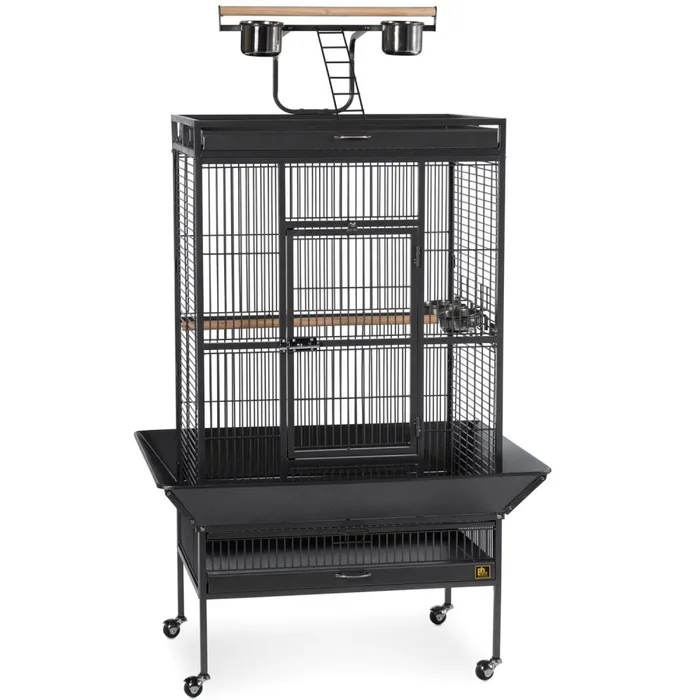
A wide, well-latched medium-parrot cage with 3/4 inch spacing, a metal tray and seed guards included.
Best for: One conure, quaker, or similarly sized parrot in a home with floor space to give it.
- Prevue lists 30 inches long by 22 inches wide with a 29-1/2 by 21-1/2 by 36 inch interior, so the bird gets real lateral room.
- Bar spacing of 3/4 inch in 9 gauge wire suits the medium and large birds Prevue rates it for.
- The front door is listed with double locks, and rounded-corner seed guards plus separate top and bottom debris trays come in the box.
- 3/4 inch spacing is too wide for a budgie, canary or finch, so this is not a one-size cage.
- At 63 inches tall with a playtop it occupies a corner of the room permanently and is awkward to move alone.
- Only two eucalyptus perches are included, both 7/8 inch, so you will buy varied-diameter perches separately.
- The playtop adds mess above the seed guard line, which the guards do not catch.
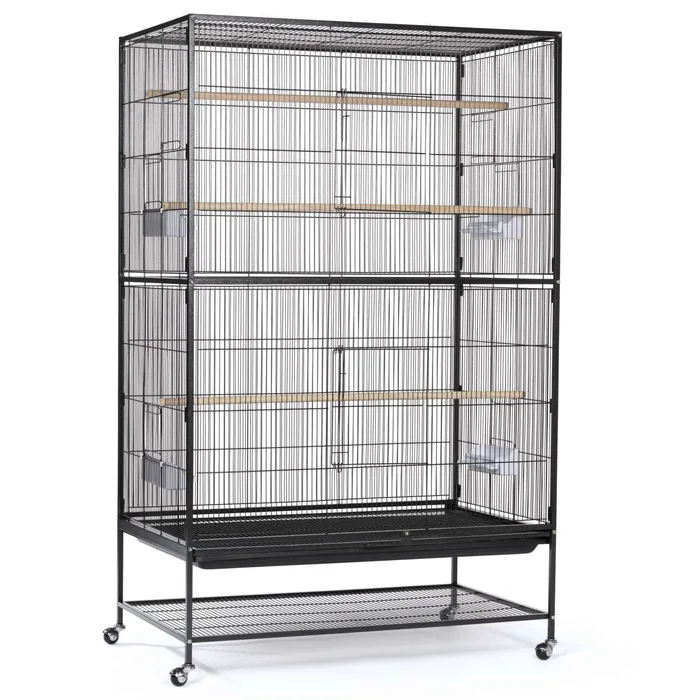
The most usable width per dollar for small birds, on 1/2 inch spacing, with the corners cut in the tray and latches.
Best for: A pair of budgies, a small finch or canary flock, or anyone who would rather buy width than fittings.
- Interior is listed at 36-1/8 by 22-1/8 by 47 inches, which is more flying length than anything else in this group.
- Half-inch wire spacing is the small-bird figure, and Prevue rates the cage for canaries, parakeets and other small to medium birds.
- Two large hinged front doors plus six small side doors make reaching perches, cups and nests straightforward, and the stand rolls on casters.
- The tray is plastic rather than metal, so it scratches and stains faster.
- Prevue does not describe the doors as double-locking the way it does on the Playtop Bird Home, so latch-picking birds may need added quick links.
- No seed guard is listed for it, and a wide flight cage throws seed a long way.
- The four included cups are plastic, where the 3153 ships with stainless steel.
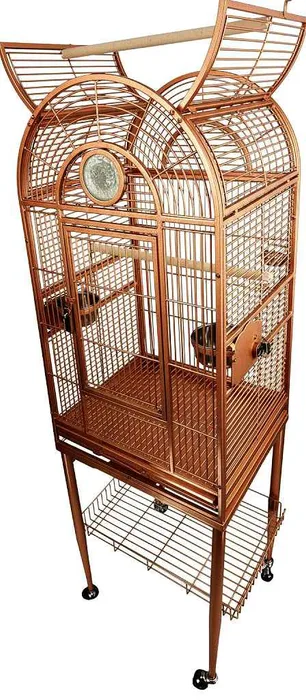
Heavier bar stock, four access points and a roof playpen, wrapped around a footprint of only 18 by 16 inches.
Best for: A small apartment where a wide flight cage will not fit and build quality matters more than square inches.
- Bars are listed at 3mm on 1/2 inch spacing, thicker stock than most small-bird cages use.
- Four openings including a roof playpen door and two feeder doors, each feeder door with its own stainless steel bowl.
- Slide-out grill and tray, flanged rolling casters and a lower storage shelf make daily cleaning and moving easy.
- The 18 by 16 inch footprint gives a small bird far less lateral distance than a flight cage of similar price.
- The seed guard is sold as an add-on rather than included.
- It is a tall, narrow format, which favours the room's floor plan over the bird's wingspan.
- Kings Cages now sells through the Bonka Bird Toys storefront, so availability by model and colour is narrower than it once was.
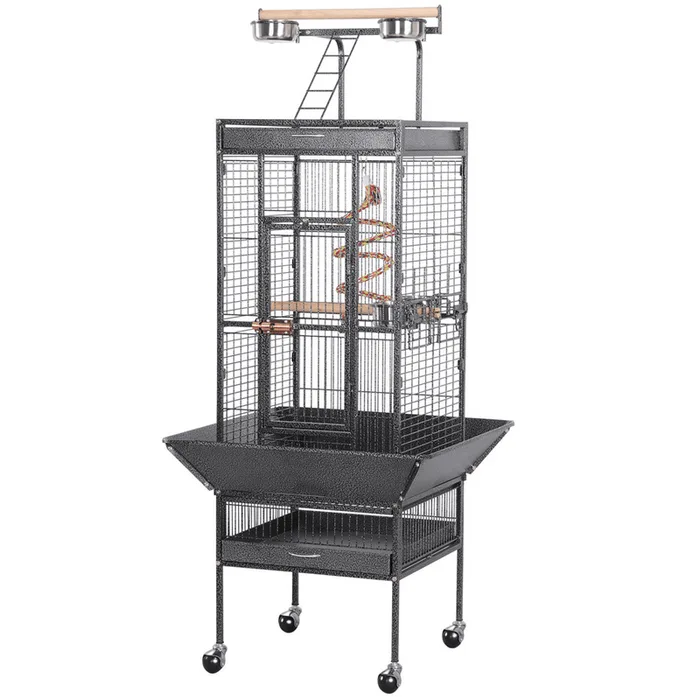
The headline height is mostly stand and playtop, leaving a cage body under 18 inches square for birds as large as conures.
Best for: Almost nobody at this size, though the same body would be defensible if it were sold as a single small-bird cage.
- Four heavy-duty 360 degree swivel casters make it easy to move between rooms.
- Slide-out tray with a detachable mesh panel between the bird and the droppings.
- Bar spacing of 1.5 cm, about 0.6 inch, is close enough for the small end of the species list.
- Yaheetech lists the cage body at 45.5 by 45.5 by 77.5 cm, roughly 17.9 by 17.9 by 30.5 inches, while the 61 inch figure is the whole assembly including stand and playtop.
- That body is marketed for cockatiels and conures as well as finches, and 18 inches square is cramped for the larger birds on that list.
- The finish is described as a painted iron cage with a hammer paint finish; the page calls the paint non-toxic but states no powder coat or metal specification.
- The feeder doors use hook locks, a latch style many parrots learn to lift.
| Criteria | Playtop Bird Home 3153 Top pick | Large Flight Bird Cage F050 | SLUX 1816 Bird Cage | 61 Inch Parrot Cage with Play Top |
|---|---|---|---|---|
| Verdict | Buy it | Buy it | It depends | Skip it |
| Best for | One conure, quaker, or similarly sized parrot in a home with floor space to give it. | A pair of budgies, a small finch or canary flock, or anyone who would rather buy width than fittings. | A small apartment where a wide flight cage will not fit and build quality matters more than square inches. | Almost nobody at this size, though the same body would be defensible if it were sold as a single small-bird cage. |
| Price tier | $$ · mid-range | $ · budget | $$$ · premium | $ · budget |
| Bar spacing | 3/4 in | 1/2 in | 1/2 in | 1.5 cm (about 0.6 in) |
| Overall size (L x W x H) | 30 x 22 x 63 in | 37 x 23 x 60 in | 18 x 16 x 57 in | 25.8 x 25.8 x 61.3 in |
| Cage interior | 29-1/2 x 21-1/2 x 36 in | 36-1/8 x 22-1/8 x 47 in | 31 in interior height | 17.9 x 17.9 x 30.5 in body |
| Wire gauge / bar thickness | 9 and 9 gauge | 8 and 12 gauge | 3mm bars | Not stated |
| Finish as stated by maker | Powder-coated steel mesh | Powder-coated steel mesh | Powder-coated | Painted iron, hammer paint |
| Tray | Metal, top and bottom trays | Plastic, pull-out | Slide-out grill and tray | Slide-out tray |
| Door security | Front door with double locks | Two front doors, six side doors | Four openings incl. roof playpen | Button lock front, hook feeder locks |
| Seed guard | Included, rounded corners | Not listed | Optional add-on | Mesh panel above tray |
Which one is right for you?
- One conure, quaker, or similarly sized parrot in a home with floor space to give it. Buy it Prevue Pet Products Playtop Bird Home 3153
- A pair of budgies, a small finch or canary flock, or anyone who would rather buy width than fittings. Buy it Prevue Pet Products Large Flight Bird Cage F050
- A small apartment where a wide flight cage will not fit and build quality matters more than square inches. It depends Kings Cages SLUX 1816 Bird Cage
- Almost nobody at this size, though the same body would be defensible if it were sold as a single small-bird cage. Skip it Yaheetech 61 Inch Parrot Cage with Play Top
How we judged the field
Five things decide whether a bird cage is worth owning, and the first two are safety rather than convenience. Bar spacing comes first, because it is the spec that can physically injure a bird: too wide and a head goes through, too narrow and toes and beaks get caught, and the right figure changes with the species. Metal comes second. A parrot chews its bars for hours a day, and the Merck Veterinary Manual lists galvanised mesh and chains among the usual zinc sources in pet birds, adding that galvanised wire is mainly zinc but that some may also contain lead. That makes what a maker says on its own spec sheet, powder-coated steel versus simply painted iron, a fact worth reading rather than assuming. Third is usable width, because birds move sideways. Fourth is door security, since many parrots open simple latches. Fifth is the boring maintenance stuff: slide-out trays, seed guards and casters, which decide whether you clean the cage properly or resent it.
The field splits cleanly by bird size, and that is how we picked. There is a small-bird tier at 1/2 inch spacing, a medium-parrot tier at 3/4 inch, and a large-parrot tier with wider spacing that most buyers never need. We took the strongest mainstream option in the medium tier, the widest sensible option in the small tier, one premium small-bird cage that trades footprint for build quality, and one very commonly bought budget play-top cage whose marketing spans more species than its dimensions support. We verified every dimension, spacing, gauge and finish claim on the maker’s own product page, and we did not carry any number over from a similar model in the same line, because cage lines do not share one construction.
Two of the four cages here are Prevue, and that is a decision rather than an oversight. Bar spacing is a species spec, so any four-cage list that covers both small birds and medium parrots has to carry at least two spacings, and the cages in each band are effectively different products that never compete for the same buyer. We did go looking for an independent cage to fill one of those bands, held to the same standard we hold Prevue to: exact bar spacing in inches, interior width, depth and height for the cage body alone, bar material and coating, latch type, tray material and whether the stand rolls, all published on the manufacturer’s own page. None of the obvious candidates cleared it. A&E Cage Company’s own site is a brochure with no per-model spec sheets. The Vision cage name now redirects to a reptile and rodent products company. The flight cages sold through Bird Cages 4 Less do publish bar spacing and bar diameter, but give exterior dimensions and an interior height only, with no interior width or depth, and on a retailer’s listing rather than the maker’s. Prevue publishes spacing, wire gauge and full interior dimensions on nearly every model, which is exactly why it takes two of the four slots. If a rival checked out to the same standard, it would be in this piece instead.
Prevue Pet Products Playtop Bird Home 3153
Buy itThe 3153 is the cage most people with a conure, quaker or similarly sized parrot should be looking at. Prevue lists it at 30 inches long by 22 inches wide by 63 inches high, with an interior of 29-1/2 by 21-1/2 by 36 inches, and that 30 inch length is the number that matters, because a bird moves sideways rather than up. Bars sit on 3/4 inch spacing in 9 gauge wire, the spacing Prevue pairs with its medium and large bird rating. The front door is listed with double locks, the seed guards have rounded corners, and there are separate top and bottom debris trays so playtop mess does not land on your floor. The tray is metal rather than plastic. The downsides are physical: it is tall, heavy and becomes a permanent piece of furniture, and the two included perches are both 7/8 inch, so you will buy varied diameters yourself. If you want one cage for one medium parrot, this is it.
Prevue Pet Products Large Flight Bird Cage F050
Buy itThe F050 gives you more usable width than anything else here. Prevue lists it at 37 inches long, 23 inches wide and 60 inches high, with an interior of 36-1/8 by 22-1/8 by 47 inches, and the wire sits on 1/2 inch spacing, the small-bird figure Prevue rates for canaries, parakeets and other small to medium birds. Wire gauge is listed as 8 and 12. Two large hinged front doors plus six small side doors mean you can reach any perch, cup or nest without contorting, and the stand rolls on casters. The compromises show up in the fittings rather than the frame. The tray is plastic, not metal. Prevue does not list a seed guard for this model, and it does not describe the doors as double-locking the way it does on the Playtop Bird Home, so a bird that fiddles with latches may need quick links added. The four included cups are plastic. For a pair of budgies or a small finch flock, none of that outweighs 36 inches of horizontal room.
Kings Cages SLUX 1816 Bird Cage
It dependsKings Cages builds the SLUX 1816 better than its footprint suggests. It is listed at 18 inches wide, 16 inches deep and 57 inches tall with a 31 inch interior height, on 1/2 inch bar spacing with 3mm bars, which is thicker stock than most small-bird cages use. There are four ways in: a large front door, two feeder doors each with its own stainless steel bowl, and a roof door that opens onto a playpen. The grill and tray both slide out, the casters are flanged, and there is a storage shelf underneath for the bag of pellets you currently keep on the floor. The catch is the footprint. Eighteen by sixteen inches is a small floor for a bird that wants lateral distance, and the seed guard is an add-on rather than an inclusion. Kings also sells through the Bonka Bird Toys storefront now, so model and colour availability is narrower than it once was. This is the cage for a small apartment where a wide flight cage will not fit.
Yaheetech 61 Inch Parrot Cage with Play Top
Skip itThe number in the name is doing a lot of work. Yaheetech lists the whole assembly at 65.5 by 65.5 by 155.7 cm, roughly 25.8 by 25.8 by 61.3 inches, but gives the cage body itself as 45.5 by 45.5 by 77.5 cm, about 17.9 by 17.9 by 30.5 inches. The rest is stand and playtop. That is a smaller living space than a budget flight cage, and the listing markets it for finches, lovebirds, canaries, cockatiels, conures and parakeets. A cockatiel or a green-cheek in an 18 inch square box is cramped. Bar spacing is given as 1.5 cm, about 0.6 inch, which is reasonable for the small end of that list. The finish is described as a painted iron cage with a hammer paint finish, and the page does not state powder coating or a bird-safe metal specification, which matters given how much of a parrot’s day is spent with a beak on the bars. The feeder doors use hook locks, a style many parrots learn to lift. The casters and slide-out tray are genuinely fine. The cage is simply smaller than it sounds.
Sources
Specs in this review come from these pages.
- Prevue Pet Products - Playtop Bird Home 3153 specifications (prevuepet.com)
- Prevue Pet Products - Large Flight Bird Cage F050 specifications (prevuepet.com)
- Yaheetech - 61 Inch Parrot Cage with Play Top specifications (yaheetech.shop)
- Merck Veterinary Manual - Toxicoses of Pet Birds (merckvetmanual.com)
- World Parrot Trust - Budgerigar species profile, housing (parrots.org)
- RSPCA - Bird environment and housing guidance (rspca.org.uk)
- Bird Cages 4 Less - flight cage listing, spec detail checked against Prevue (birdcages4less.com)
Prevue Pet Products Playtop Bird Home 3153 vs Prevue Pet Products Large Flight Bird Cage F050: which should you buy?
Both cages worth buying here are Prevue, so it is worth stating why rather than leaving you to wonder. Bar spacing is species-specific, and these two cover different size bands: the Playtop Bird Home 3153 is on 3/4 inch spacing and Prevue rates it for medium and large birds, while the Large Flight Bird Cage F050 is on 1/2 inch spacing for small birds. They do not compete, and you will only ever be shopping one of them. Prevue also publishes exact spacing, wire gauge and interior dimensions per model, which is what let us verify both cages properly, and we could not verify an independent alternative to that standard. Put a budgie in the 3153 and the spacing is a hazard. Put a conure in the F050 and the spacing is safe but the 8 and 12 gauge wire and lighter fittings are not what you want under a beak that strong. So the first question is not which cage is better, it is which one your bird’s head fits.
If you keep small birds and both are open to you, the F050 wins on the number that matters most, giving 36-1/8 inches of interior length against the 3153’s 29-1/2. The 3153 wins on everything around the frame: a metal tray instead of plastic, seed guards in the box, a double-locking front door, stainless cups and a second debris tray. A reasonable way to decide is to ask how much the cage will be opened and cleaned by someone other than you. If it is a family cage that gets opened often, the 3153’s latches and trays are worth the narrower body. If it is your bird, you are diligent about latches, and you would rather spend on width than fittings, take the F050 and add a seed guard and quick links yourself.
What to look for
- Bar spacing first: it is the one spec that can injure the bird, and it changes by species, so match it to the maker’s own size rating rather than eyeballing the photo.
- Read the metal, not the brand: a maker’s flagship cage being powder-coated steel does not mean its budget model is, and a page that says only painted iron is telling you something by omission.
- Width over height: compare interior length and depth before you compare overall height, and subtract the stand and playtop from any headline figure.
- Count the latches: check the feeder doors and side doors, not just the front, and look for double locks or bolts rather than simple hooks that a parrot can lift.
- Slide-out tray and grille: a tray you can pull without opening the cage means you actually clean it daily, and a metal tray outlasts a plastic one under a wire grille.
- Seed guard and casters: rounded-corner guards catch what a bare cage throws across the room, and casters are what make a 60 inch cage possible to move for cleaning.
Our final take
Buy the widest cage your room and your bird’s bar spacing allow, and let everything else be a tiebreaker. For a medium parrot that is the Prevue Playtop Bird Home 3153, which pairs a 30 inch body with 3/4 inch spacing, double locks and a metal tray. For small birds it is the Prevue Large Flight Bird Cage F050, which trades the metal tray and seed guard for 36 inches of interior length. Those two picks share a brand because they do not share a bird, and because Prevue publishes the exact spacing before you buy. The Kings Cages SLUX 1816 earns its place only when floor space is the binding constraint. The Yaheetech 61 inch play-top cage is the one to walk past, not because it is badly made but because its usable body is far smaller than its name and its species list suggest.
Questions, answered
How do I know what bar spacing my bird needs?
Start from the cage makers' own ratings rather than a rule of thumb you read once. Prevue puts 1/2 inch spacing on its small-bird flight cages, 3/4 inch on cages it rates for medium and large birds, and wider spacing on its larger-parrot cages. The failure mode runs in both directions: spacing wide enough for a bird's head to pass but not its body is a strangulation risk, and spacing narrow enough to trap toes or a beak is its own hazard. If your bird sits between two categories, go narrower, because a small bird in a fine-barred cage is safe while a small bird in a wide-barred cage is not. Measure your bird's head at the widest point if you want a sanity check.
Is stainless steel worth paying for?
It avoids the zinc and lead concerns that come with galvanised wire and some cheap coatings. The Merck Veterinary Manual lists galvanised mesh, chains and bells among the common zinc sources in pet birds, and notes galvanised wire is mainly zinc but that some may also contain lead. Some US makers, such as Custom Cages, sell stainless bird enclosures. The catch is cost and weight, and stainless is usually a semi-custom order rather than something you carry out of a shop. For a budgie kept on a reputable powder-coated cage that is not being stripped by chewing, the upgrade is optional. For a heavy chewer like a cockatoo or macaw, it is worth the conversation.
Does cage height matter as much as width?
For most pet birds, no. Birds fly and hop horizontally far more than they climb vertically, so a 36 inch wide cage that is 30 inches tall beats an 18 inch wide cage that is 60 inches tall for the same bird. This is why the F050's 36 inch interior length is the standout number in this comparison and why the Yaheetech's 61 inch label is misleading once you subtract the stand. Height is genuinely useful for climbing species and for stacking perches at different levels, so it is not worthless. It is just the second number to check, not the first.
What makes a door latch parrot-proof?
Anything a bird can lift, slide or rotate with a beak and one foot is fair game, and hook-style latches on feeder doors are the classic weak point. Prevue lists double locks on the front door of its Playtop Bird Home, and bolted panels are harder for a bird to undo than clips. Feeder doors matter as much as the main door, because they are smaller, more numerous and often latched more casually. If a cage you otherwise like has weak latches, stainless quick links or padlocks fitted to each door are a cheap fix. Check them again after a few weeks, because a bird that has watched you open a door will try the same motion.
How big should the cage be compared to what welfare groups recommend?
Be prepared for a gap. The World Parrot Trust gives a housing minimum of 76 cm, about 30 inches, in length for a budgerigar, and its figures for larger species run to aviary scale, such as a minimum 2 m enclosure length for a green-cheeked conure. The RSPCA's guidance for an indoor cage where the bird spends most of its time is at least twice the bird's wingspan. Almost no commercially sold cage meets the aviary-scale numbers, which is the honest reason daily out-of-cage time matters so much. Treat the cage as the bird's bedroom and secure base rather than its whole world, and buy the widest one you can house.
Deciding between the top two? See our head-to-head: Prevue Pet Products Playtop Bird Home 3153 vs Prevue Pet Products Large Flight Bird Cage F050.
More Pets reviews
 The Best Cat Litter Deodorizers: 4 Compared (and One to Skip)
  The Best Cat Litter Mats: 4 Compared (and One to Skip)
  The Best Cat Nail Caps: 4 Compared (and One to Skip)
  The Best Cat Scratching Posts: 4 Compared (and One to Skip)
  The Best Cat Toys: 4 Compared (and One to Skip)
 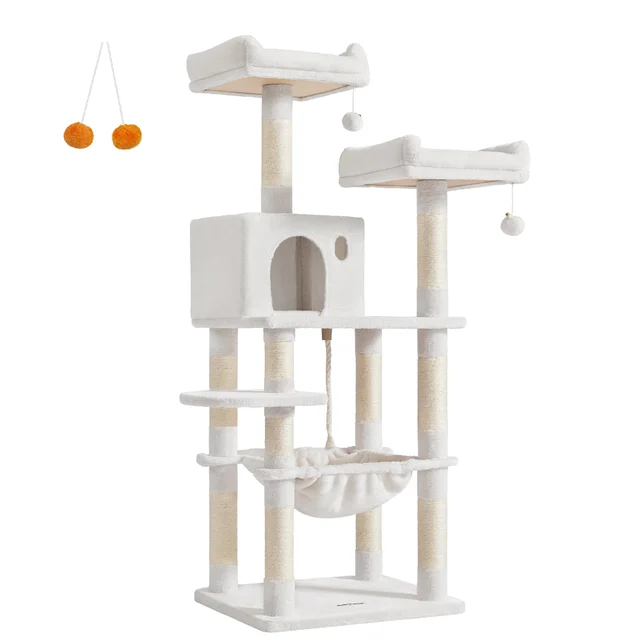 The Best Cat Trees: 4 Compared (and One to Skip)