

Pet Supplies
The Best Cat Scratching Posts: 4 Compared (and One to Skip)
We compared four cat scratchers and trees on surface material, height, base stability and long-term durability using independent testing and owner reports.
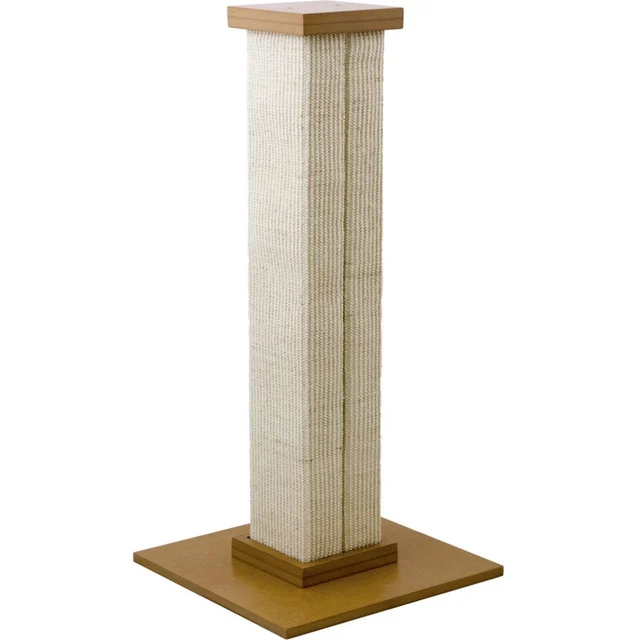
The short version
Scratching is not a behavior problem, it is claw maintenance, and cats do it on whatever nearby thing is tall, stable and shreddable. The SmartCat Ultimate Scratching Post wins because it is tall enough for a full stretch, heavy enough not to rock, and wrapped in woven sisal that wears more evenly than rope. The Armarkat B6203 is the better buy if you want climbing levels and a den alongside sisal posts, which matters most in multi-cat homes. The PetFusion Ultimate Cat Scratcher Lounge is cheap, popular and unusually durable for cardboard, but it is horizontal only, so it will not save your sofa arms. The Catit Vesper High Base looks the best and scratches the worst, with seagrass posts many cats decline and a mold risk in humid rooms. Best for: buy the SmartCat post if you have one cat and a furniture problem, and the Armarkat tree if you have climbers or a multi-cat household.
Our picks at a glance
- SmartCat The Ultimate Scratching Post - Buy. The tall, heavy, woven-sisal post that every other post gets measured against.
- Armarkat Classic Real Wood Cat Tree B6203 - Buy. A five-level real-wood tower that adds climbing and hiding without giving up sisal posts.
- PetFusion Ultimate Cat Scratcher Lounge - It depends. Cats take to the curved cardboard immediately, but it is a consumable that never offers a vertical stretch.
- Catit Vesper High Base Cat Tree - Skip. The best-looking tower in this group, with the weakest scratching surface and the highest price.
The verdict in 30 seconds
What mattered most
- Scratching surface
- Vertical stretch
- Base stability
- Expected lifespan
- Extras
- Assembly
Cats scratch to stretch, shed old claw sheaths and mark territory, so the fix for a shredded sofa corner is almost never a smaller, cheaper post. It is a taller, heavier, sisal-covered one placed where the cat already scratches. We compared four popular options: a single tall post, a multi-level wood tree, a cardboard lounger and a designer tower. Two are straightforward recommendations, one works only for certain cats, and one costs the most while scratching the worst.
The tall, heavy, woven-sisal post that every other post gets measured against.
Best for: Anyone whose main goal is redirecting a cat away from furniture in a very small footprint.
- Tall single-run sisal post built for a full-body stretch
- Heavy two-piece wooden base that owners report stays planted under hard scratching
- Woven sisal fabric that owners report wears down more evenly than wrapped sisal rope
- Plain tan-and-wood look that will not blend into a styled room
- One surface only, with no perch, den or climbing value
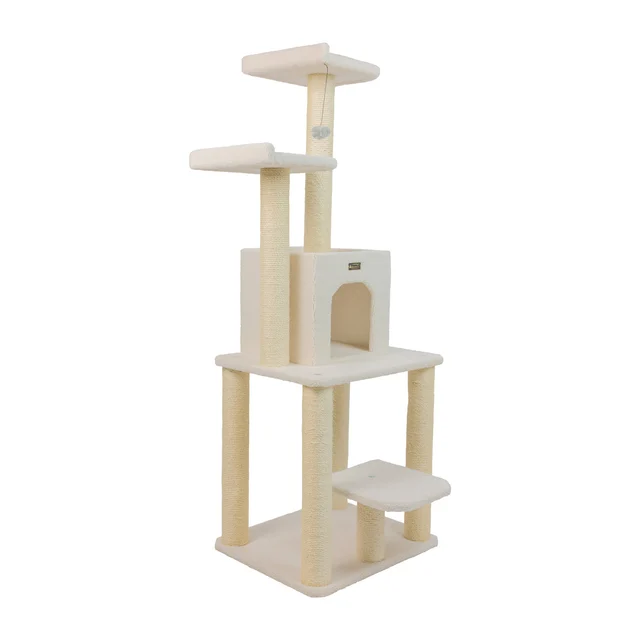
A five-level real-wood tower that adds climbing and hiding without giving up sisal posts.
Best for: Multi-cat homes and climbers that want height, perches and a den as well as a scratching surface.
- Five levels with a condo and two perches, so multiple cats can spread out
- Sisal-wrapped support posts double as full-height scratching surfaces
- Pressed-wood base is wide at 24 by 20 inches, which helps steadiness at this height
- Faux fleece platforms trap hair and are awkward to deep clean
- Assembly is a real project, and the hardware wants re-tightening after a few months
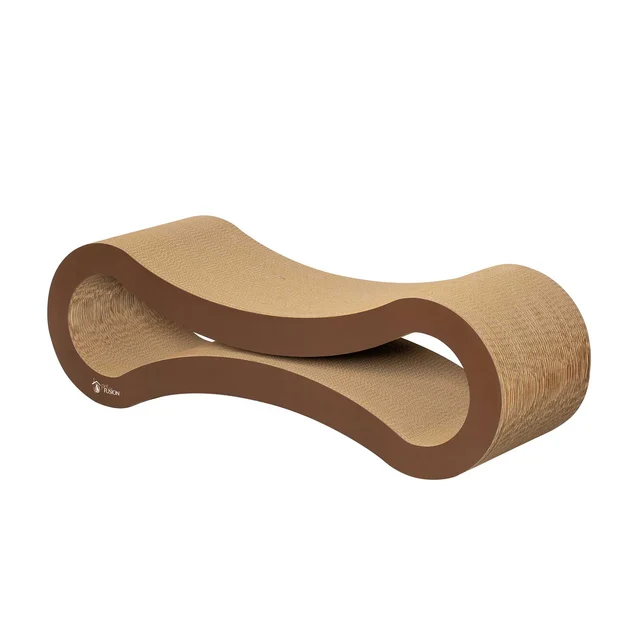
Cats take to the curved cardboard immediately, but it is a consumable that never offers a vertical stretch.
Best for: Cats that already scratch rugs and carpet, or as a cheap second option alongside a tall post.
- Dense corrugated stock that owners commonly report lasting a long while
- Reversible, so you get two full scratching surfaces before it is spent
- Doubles as a lounger, which gets hesitant cats using it quickly
- Horizontal only, so it does nothing for cats that target sofa arms and door frames
- Sheds cardboard crumbs and eventually has to be replaced
Amazon had no buyable listing for this when we last checked. The link still works if it returns.
Check price on Amazon Read our detailed assessment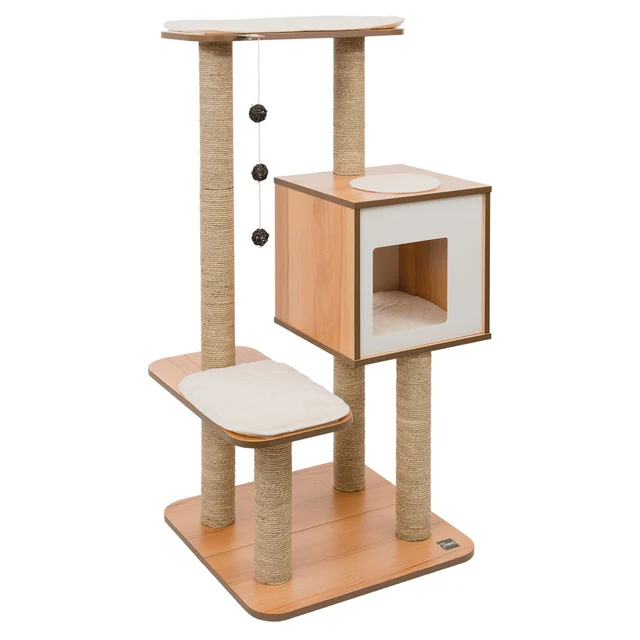
The best-looking tower in this group, with the weakest scratching surface and the highest price.
Best for: Design-led homes with a cat that has already proven it will scratch seagrass.
- Genuinely furniture-like, with a wood-look finish that suits modern rooms
- Replacement posts, cushions and parts are sold separately
- Posts are wrapped in seagrass, which plenty of cats ignore in favor of sisal
- Natural seagrass can go moldy in humid rooms, so keep it dry
- Highest price tier in this group for a tower whose posts are seagrass
| Criteria | SmartCat The Ultimate Scratching Post Top pick | Armarkat Classic Real Wood Cat Tree B6203 | PetFusion Ultimate Cat Scratcher Lounge | Catit Vesper High Base Cat Tree |
|---|---|---|---|---|
| Verdict | Buy it | Buy it | It depends | Skip it |
| Best for | Anyone whose main goal is redirecting a cat away from furniture in a very small footprint. | Multi-cat homes and climbers that want height, perches and a den as well as a scratching surface. | Cats that already scratch rugs and carpet, or as a cheap second option alongside a tall post. | Design-led homes with a cat that has already proven it will scratch seagrass. |
| Price tier | $ · mid-range | $ · mid-range | $ · budget | $$ · premium |
| Scratching surface | Woven sisal fabric | Sisal rope on wood posts | Corrugated cardboard | Seagrass posts plus a sisal mat |
| Vertical stretch | Full adult stretch in one run | Sisal-wrapped posts across five levels | None, horizontal only | Posts across four levels |
| Base stability | Heavy two-piece base | Wide pressed-wood base | Sits flat on the floor | Four-level wood-look MDF frame |
| Expected lifespan | Long-lasting woven sisal | Posts wear first | Consumable, replace when spent | Frame lasts, seagrass posts may wear sooner |
| Extras | None | Condo and two perches | Lounging surface, catnip included | Cube den, memory foam cushions, sisal mat |
| Assembly | Bolt the post to the base | Long multi-step build | None, unbox and place | Moderate panel-and-pole build |
| Price tier | $ · mid-range | $ · mid-range | $ · budget | $$ · premium |
Which one is right for you?
- Anyone whose main goal is redirecting a cat away from furniture in a very small footprint. Buy it SmartCat The Ultimate Scratching Post
- Multi-cat homes and climbers that want height, perches and a den as well as a scratching surface. Buy it Armarkat Classic Real Wood Cat Tree B6203
- Cats that already scratch rugs and carpet, or as a cheap second option alongside a tall post. It depends PetFusion Ultimate Cat Scratcher Lounge
- Design-led homes with a cat that has already proven it will scratch seagrass. Skip it Catit Vesper High Base Cat Tree
How we judged the field
We do not run a lab. What we do is read across independent testing, long-run owner reports and veterinary behavior guidance, then look for the points where all three agree. For scratchers, they agree on more than you would expect.
Four things decide whether a scratcher gets used. Surface comes first: an owner survey published in a veterinary journal found cats used rope and sisal surfaces most often, even though carpet-covered posts were the ones most commonly offered to them. Height comes second, because the whole point of the behavior is a full-body stretch, and a post shorter than the cat’s reach gets abandoned. Stability comes third: reviewers and owners describe the same failure mode, where a post rocks once under a hard pull and the cat never touches it again. Durability comes last, and it is where price differences actually show up, since woven sisal fabric tends to wear more evenly than sisal rope, and rope tends to outlast cardboard.
We also weighted placement realism. A scratcher that has to live in a spare room because it is ugly, or one that cannot go next to the sofa because of its footprint, fails no matter how well it is built.
This is the post other posts get compared against, and the reasons are unglamorous. It is built tall enough for a full stretch, which is a common reason a post gets used instead of ignored. The base is a heavy two-piece wooden platform, and owner reports commonly describe no rocking or tipping, including in multi-cat homes.
The surface is woven sisal fabric rather than wrapped sisal rope. That matters more than it sounds: rope unwinds and frays into loose loops, while the woven fabric wears down evenly and keeps offering resistance. Owners report long service from a single post, with little fraying after months of hard scratching.
What you give up is everything else. There is no perch, no hideaway, nothing to climb. It is a tan sisal column on a plain wooden base, and it looks exactly like that in a living room. If your problem is a cat destroying the sofa, this fixes it. If your problem is a bored cat with nowhere to climb, it does not.
The Armarkat exists because scratching is only half of what cats want from vertical space. Five levels, a condo and two perches give a cat somewhere to climb, hide and survey the room, and the support posts are wrapped in sisal so the climbing frame doubles as full-height scratching surface.
Build quality is the reason it survives owner reports better than most towers in its range. The base is pressed wood and wide at 24 by 20 inches, and reviewers describe it as steady for its height once assembled properly. Multi-cat households are where it earns its place, since two cats can use different levels without negotiating.
Two caveats. The platforms are faux fleece, which traps hair and does not deep clean easily, and assembly is a genuine project with hardware that benefits from re-tightening a few months in. Cats that only want to scratch and never climb are better served by a single post.
PetFusion Ultimate Cat Scratcher Lounge
It dependsCardboard scratchers usually disintegrate. This one does not, at least not quickly. The corrugated stock is dense enough that owners commonly report long use, and because it is reversible you get two full surfaces before it is spent. The curved lounger shape also does something clever: cats lie on it, and cats that lie on a thing tend to start scratching it.
The limitation is structural, not a quality issue. It is a horizontal scratcher. If your cat targets rugs, doormats and the carpet in front of the sofa, this redirects that behavior neatly and cheaply. If your cat targets sofa arms, chair backs and door frames, a horizontal pad does nothing for it, because the cat is looking for a vertical stretch this cannot provide.
Treat it as a companion product rather than a solution. It also sheds cardboard crumbs around itself, and it is a consumable, so budget for replacing it.
Everything about this tower is designed well except the part cats use. The walnut-look laminate finish genuinely looks like furniture, the cube den and removable memory foam cushions look comfortable, and replacement parts are sold separately, which is rare and welcome.
Then you get to the posts, which are wrapped in seagrass rather than sisal. Owner reports split hard here: some cats take to it, many walk past it and go back to the sofa, and behavior guidance consistently ranks sisal above seagrass for claw grip. Natural seagrass rope can also go moldy in humid rooms, so keep this one dry. You are paying the most in this group for the least reliable scratching surface.
If you want a tower that looks like furniture, that goal is legitimate, but check whether your cat will use seagrass before committing at this price tier.
SmartCat The Ultimate Scratching Post vs Armarkat Classic Real Wood Cat Tree B6203: which should you buy?
These two solve different halves of the same problem, and the choice comes down to what your cat is actually doing.
Buy the SmartCat post if the trigger for this purchase was damage. It is the more reliable scratcher of the two: taller usable sisal in one uninterrupted run, a heavier base, and a surface material that wears more slowly than the rope on the Armarkat’s posts. It takes up almost no floor space, so you can put it directly beside the furniture being shredded, which is the placement that actually works.
Buy the Armarkat if the trigger was a bored or crowded cat. It gives climbing height, a den and two perches alongside sisal posts, and in a two-cat or three-cat home it does more per square foot of floor than any single post can. It costs more, takes real effort to assemble, and its posts will need replacing or rewrapping sooner, but it buys enrichment as well as claw maintenance.
If you can only have one item and you have one cat with a furniture habit, the post wins. If you have several cats or a climber, the tree wins.
What to look for
- Sisal over everything else. Woven sisal fabric first, sisal rope second. Skip carpet-covered posts: they snag claws and teach the cat that carpet in general is fair game.
- Height that clears a full stretch. Measure your cat standing on hind legs with front paws extended, then buy taller. Roughly 30 inches is the working minimum for an average adult cat, more for large breeds.
- A base heavier than you think it needs. One wobble is enough to put a cat off a post permanently. Weighted or wide-footprint bases beat clever designs.
- Vertical and horizontal, not one or the other. Cats have a preferred angle. Offering both is cheaper than guessing wrong.
- Placement over aesthetics. The scratcher goes next to the furniture being damaged and near where the cat sleeps, not in the spare room.
- Replaceable surfaces. Posts that can be rewrapped or replaced stretch the life of an otherwise sound frame.
Our final take
The category rewards boring engineering. The SmartCat Ultimate Scratching Post has no features, no styling and no versatility, and it is still the most reliable way to stop a cat shredding a sofa, because it gets height, weight and surface material right and then stops. That is our pick.
The Armarkat B6203 is the better buy for homes with climbers or multiple cats, trading some scratching durability for levels, perches and a den. The PetFusion lounge is worth adding as a second, horizontal option, especially for rug scratchers, as long as you accept it is a consumable. The Catit Vesper High Base is the one to walk past: it is the most expensive here, and seagrass posts plus a mold risk make it the least dependable at the job you are buying it for.
Questions, answered
Sisal or cardboard: which do cats actually prefer?
Both get used, but for different motions. An owner survey published in a veterinary journal found cats used rope and sisal surfaces most often, even though carpet posts were the ones most commonly offered. Sisal gives claws something to catch and pull against, which is what makes a vertical stretch satisfying. Cardboard wins on price and on cats that like to lie down and shred horizontally. The practical answer is to offer one of each and watch which one the cat goes to first.
How tall does a scratching post need to be?
Tall enough that the cat can reach up with front paws fully extended and still have sisal above the claws. For an average adult that means roughly 30 inches of usable surface, and more for big breeds. Short posts are the most common reason a cat ignores a new scratcher and goes back to the sofa arm, which happens to be exactly the right height.
Why does my cat ignore the post I bought?
Usually one of four things. The post wobbled once and the cat wrote it off. It is too short for a full stretch. It is covered in carpet, which snags claws and feels like the floor. Or it is in the wrong room. Move the scratcher directly beside whatever is being damaged, and next to where the cat sleeps, since the first stretch of the day is prime scratching time.
Are carpet-covered posts and trees worth buying?
Generally no, at least not for the scratching surface. Carpet loops catch claws in a way many cats find annoying rather than satisfying, and a carpet post looks and feels like the carpet on your floor, which teaches the cat that floor carpet is also fair game. Carpet and fleece are fine on the platforms of a cat tree, where cats sit and sleep. Keep sisal on the parts meant to be clawed.
How many scratchers does one cat need, and do they replace nail trims?
Plan on at least two: one vertical near the furniture being targeted, one horizontal near a sleeping spot. Multi-cat homes want more, spread across rooms, because scratching is partly territorial marking. Scratching sheds the outer claw sheath but it is not a substitute for routine nail care, and this is general product information rather than veterinary advice. If claws look overgrown, if a cat suddenly stops scratching, or if a paw seems sore, talk to a veterinary professional.
Deciding between the top two? See our head-to-head: SmartCat The Ultimate Scratching Post vs Armarkat Classic Real Wood Cat Tree B6203.
More Pet Supplies reviews
 The Best Cat Toys: 4 Compared (and One to Skip)
  The Best Cat Trees: 4 Compared (and One to Skip)
  The Best Cat Window Perches: 4 Compared (and One to Skip)
  The Best Deshedding Tools for Dogs and Cats: 4 Compared (and One to Skip)
  The Best Dog Beds: 4 Compared (and One to Skip)
  The Best Dog Blow Dryers: 4 Compared (and One to Skip)