Explained
Cat Litter Deodorizers, Explained
After reading, you'll understand what each type of litter deodorizer actually does, why fragrance is the wrong feature to shop for, and how to spot the two or three words on a label that should stop you buying.
In this guide
Most first-time buyers shop this category by smell, which is exactly backwards. The pleasant scent on the shelf is a feature designed for the human nose, and it is also the feature most likely to make a cat start going somewhere else. The other trap is vagueness: a surprising number of products describe what they do at length and never say what they contain. Learn to find the active ingredient and most of the decision makes itself.
The 30-second version
- Scooping beats every product, because removing the source is the only approach that works on all of the smell rather than some of it.
- Fragrance is a risk, not a benefit, since veterinary house-soiling guidance says cats often find scented litter and deodorizers offensive.
- Cats process phenols differently, so essential oils in a product a cat stands in and grooms off deserve much more caution than they usually get.
- Minerals do the real work, with zeolite suited to ammonia and sodium bicarbonate better matched to acidic odors.
- If the label hides the active, you have learned enough about the product to put it back on the shelf.
The products this guide is about
Our verdict on each, with the full reasoning on the companion review.
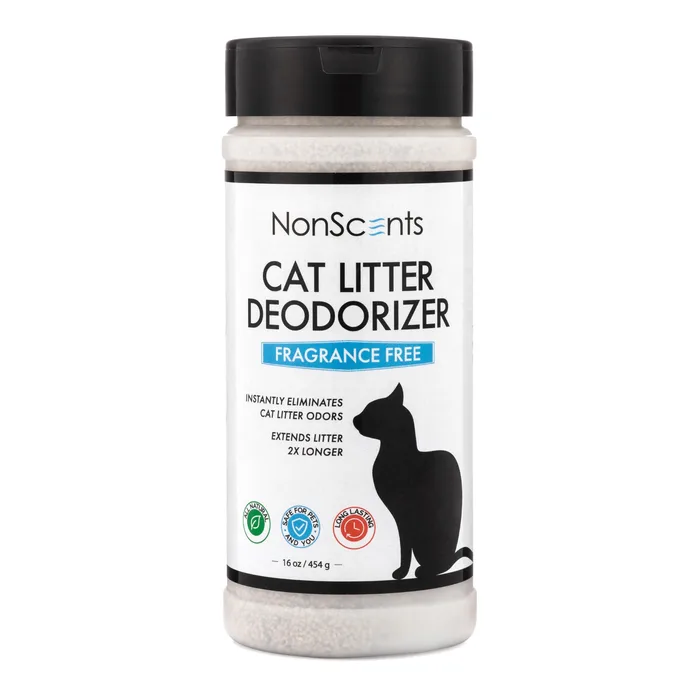
- Buy NonScents Cat Litter Deodorizer A fragrance-free zeolite granule you shake over the litter, and one of the few additives in this category with peer-reviewed chemistry behind it. Amazon
- Buy Arm & Hammer Pure Baking Soda, 13.5 lb Resealable Bag Plain sodium bicarbonate in a resealable bag, which is the same deodorizing active the brand discloses in its cat-specific powder, without the fragrance.
- It depends Zero Odor Litter Spray Odor Eliminator, 16 oz A sprayed liquid you mist onto soiled litter once or twice a day, from the product family used in a published feline litter box behavior study. Amazon
- Skip Rocco & Roxie Litter Box Odor Eliminator, 12 oz Absorbent corncob granules carrying what the maker calls a proprietary blend of essential oils, mixed into the exact material a cat digs in and then grooms off its paws. Amazon
What actually matters
- Active ingredient - this is the whole decision, and it is usually one of five things: sodium bicarbonate, zeolite, activated carbon, an enzyme or bacterial culture, or fragrance. Anything that will not name it is asking you to buy on faith.
- Fragrance status - a moisture-activated scent that releases every time the cat digs is a design goal for the manufacturer and a potential aversion trigger for the cat. Fragrance free is the safer default in a box.
- Essential oil content - cats are deficient in the enzyme glucuronyl transferase and are unusually sensitive to phenolic compounds. Oil blends in a litter additive are hard to assess when the front of the pack does not name the oils, which is reason enough to be cautious.
- Particle size and dust - coarse granules sit on the litter and stay put, while fine powders can billow when a cat digs. Cats with asthma or any respiratory history may do better with granules.
- Dose and coverage - a jar that treats one small box for a month is a different proposition from a bag you portion by eye. Work out how much you actually need per litter change before comparing anything.
- Litter compatibility - some additives are meant to sit on top, some to be mixed through, and a few change how well a clumping litter clumps. The maker's instructions are the only reliable guide.
- Whether it is even the right tool - if the underlying issue is too few boxes, infrequent scooping or a medical problem, no additive fixes it. Ask your vet before you treat a change in litter box habits as a smell problem.
The specs, in plain English
Green flags vs red flags
Green flags
- The active ingredient is named on the pack or in the maker's own ingredient disclosure.
- The label says fragrance free and the ingredient list contains no fragrance entry.
- The material is a coarse granule rather than a fine powder, so it does not cloud when a cat digs.
- The maker gives a dose per box size and a reapplication interval instead of vague sprinkle to taste instructions.
- The brand publishes a full ingredient list or safety data sheet you can read before buying.
Red flags
- Essential oils are listed as the active and the individual oils are not named.
- The pitch leans on a moisture-activated or long-lasting scent that releases when the cat uses the box.
- Claims of working at the molecular level with no stated mechanism or ingredient.
- The only evidence offered is customer reviews, with nothing about what is actually in the product.
- Phenol, pine oil or a phenolic disinfectant appears anywhere in the ingredients of something going near a cat.
Who's who: the brands
- Arm & Hammer - The Church & Dwight baking soda brand, which sells both plain sodium bicarbonate and a cat-specific deodorizer powder whose disclosed formula is bicarbonate plus a flow aid and a fragrance system.
- NonScents - A brand of Oxiscience LLC selling fragrance-free zeolite granule deodorizers for litter boxes and other odor spots such as trash cans and kennels.
- Zero Odor - Known for sprayed liquid odor eliminators sold by room and by application, including a litter-specific version that is applied to soiled litter directly.
- Rocco & Roxie - A pet supply brand best known for enzymatic stain and odor sprays, whose litter box additive uses corncob granules with a proprietary essential oil blend.
- Fresh Step - The Clorox cat litter brand, whose lineup is built mostly around litters rather than standalone additives.
How to read a listing without getting fooled
Start at the back of the pack, not the front. Find the ingredient list, and if there isn't one, look for the brand's ingredient disclosure page or safety data sheet, which larger manufacturers publish and smaller ones often do not. Identify the single active that does the deodorizing and note where fragrance sits in the list, because a fragrance entry near the top of a short list tells you what you are really buying. Convert the pack size and the stated dose into how many litter changes it covers, since a jar and a bag can look similar and last very differently. Treat phrases like proprietary blend, molecular level and natural formula as placeholders where information should be, and be equally skeptical of a peer-reviewed citation until you check who funded it. Finally, check whether the product is meant to be sprinkled on top or mixed through, because using it the wrong way is the most common reason people conclude an additive does nothing.
How much should you spend?
This is a category where spending more buys transparency and convenience more than it buys performance. At the budget tier you are buying a bulk bag of a single commodity ingredient, usually sodium bicarbonate, with no dosing guidance and no shaker top, and it will do a real if partial job for very little. The mid-range is where the cat-specific products sit: a labeled jar, a shaker cap, a named mineral, and often a fragrance you did not want. Premium pricing in this category tends to reflect packaging, brand and scent rather than a better active, so treat a big step up in price with suspicion unless the ingredient genuinely changes. The most cost-effective approach is to fix scooping frequency and box count first, then test the cheapest unscented mineral, and only move up if that is not enough.
Questions, answered
Is activated carbon a better choice than zeolite?
They are complementary rather than ranked. Activated carbon adsorbs a broad range of volatile organic compounds, which covers many of the sulfur-containing molecules that give a litter box its sharpest note. Zeolite has a particular affinity for ammonium, so it targets a different part of the problem. Carbon's practical drawbacks in a litter box are that it is black, it tracks onto floors, and it saturates. Some products combine the two for that reason.
Can I use a household air freshener or plug-in near the litter box instead?
It is a poor substitute and it carries its own concerns. An air freshener adds scent to the room without removing anything from the box, and the smell still returns as soon as it fades. Diffusers and plug-ins that disperse essential oils are a separate issue, because the Merck Veterinary Manual notes that microdroplets from active diffusers settle on a pet's coat and are then swallowed during grooming. If you want to improve the air near a box, ventilation and more frequent scooping do more than fragrance.
Will an additive stop my cat's litter from clumping properly?
It can, depending on how much you use and where you put it. A layer sprinkled on the surface generally has little effect, whereas a large volume mixed all the way through a clumping litter can interfere with how tightly clumps form and make scooping messier. Start with the smallest dose the maker suggests and watch the clumps for a week before increasing it. If your litter starts crumbling, cut the dose rather than the litter.
My cat has asthma. Does that change what I should buy?
It makes the dust question more important than the odor question. Fine powders can be stirred into the air every time a cat digs, and anything that adds airborne particles to a box a cat puts its face into is worth avoiding when the airway is already reactive. Coarse granules that stay on the surface are the safer form factor, and fragranced products are worth ruling out entirely. This is a case to raise with your vet before changing anything, since litter and additive choice can interact with how well the condition is controlled.
Or jump to the head-to-head: NonScents Cat Litter Deodorizer vs Arm & Hammer Pure Baking Soda, 13.5 lb Resealable Bag.