Explained
Cat Window Perches, Explained
After reading this you will be able to look at any cat window perch listing and tell whether its hardware, its load path, and your own window can actually keep a cat off the floor.
In this guide
A cat window perch is really a suction-cup product with a cushion attached, and the listings almost always sell you the cushion. The pictures show plush fleece and a contented cat in the sun, while the part that decides whether the thing stays up is four pieces of rubber and the angle they are pulled at. The other half of the decision is not about the product at all: suction needs smooth, clean, uncoated glass with enough flat span, and frosted, textured, or heavily coated windows defeat every suction perch on the market no matter what the listing claims.
The 30-second version
- Buy the mount, not the cushion. Cup diameter and cup mechanism predict real-world holding far better than fabric, colour, or the weight number printed on the box.
- Braced beats hung. A rigid arm pushing back against the glass loads the cups in shear, which suction resists well; cords and straps load them in peel, which suction resists badly.
- Check your glass before you check the reviews. Frosted, patterned, textured, or heavily low-emissivity glass disqualifies more buyers than any product flaw, and no perch design gets around it.
- Treat the weight rating as a ceiling, not a working load. The number assumes perfect glass, fresh cups, and ideal conditions, so buy well above your cat's weight rather than close to it.
- Every one of these is a monthly chore. Sun, dust, and temperature swings all let air creep back into the cups, so pick a perch that is not annoying to take down, clean, and remount.
The products this guide is about
Our verdict on each, with the full reasoning on the companion review.
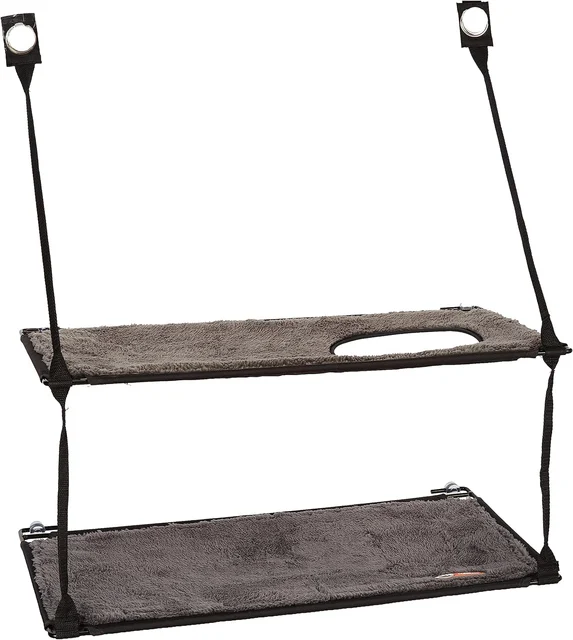
- Buy K&H Pet Products EZ Mount Double Stack Kitty Sill Cat Window Perch The best suction hardware in the category, on steel-framed shelves that give two cats one window. Amazon
- Buy AMOSIJOY Foldable Cat Window Perch with Metal Frame Cordless bracing loads the cups in shear, keeps the glass clear, and the reversible cover covers both seasons. Amazon
- It depends PEFUNY Cat Window Hammock Tensioned mesh deck with a removable flannel mat: excellent value, if your cat will sit on mesh. Amazon
- Skip Oster Sunny Seat Window-Mounted Cat Bed A thin fabric sling on the smallest cups here, with a failure mode that drops your cat. Amazon
What actually matters
- Suction cup mechanism. A cup with a screw-down or push-and-turn centre actively pulls air out as you tighten it, creating and holding a real vacuum. A plain press-on cup only traps whatever air you squeezed out by hand, and it starts losing grip from the moment you mount it. Mechanism matters more than how many cups a product has.
- Cup diameter. Holding force scales with the sealed area, so a large cup carries far more than a small one and, just as importantly, fails gradually rather than all at once. Big cups creep and sag as a warning; small cups tend to release without one.
- Load path. This is the single biggest predictor of owner outcomes. Cord- or strap-suspended designs hang the outer edge of the deck from cups mounted higher on the glass, prying at the cup edge. Braced designs run a rigid arm from the deck back to a bracket flat on the glass, so the cups are loaded along the glass rather than away from it.
- Deck rigidity. Steel rod, structural tube, or a tensioned mesh panel holds its shape under a heavy cat. Loose fabric folds into a deep taco, and a lot of cats refuse a perch that swallows them, so a sagging deck is a comfort failure as well as a structural one.
- Your window. Smooth, uncoated, untextured interior glass with a flat span wide enough for the brackets, plus enough thickness if the maker specifies a minimum. This is a measurement you make with your hand and a tape before you order, not something you discover after delivery.
- Cover removability. Shed hair plus window condensation is a laundry problem, not a spot-clean one, so a cover that zips or pulls off for the machine is the difference between a perch you keep and one that gets thrown out in year two.
- Fold-flat design. If the perch does not collapse against the glass, your curtains and blinds will win the argument eventually and the perch will come down for good.
The specs, in plain English
Green flags vs red flags
Green flags
- Large-diameter cups with a visible screw-down or push-and-turn mechanism, described by size rather than just by count
- A rigid brace or bracket arm running back to the glass instead of cords or straps hanging from cups above
- A metal frame, steel rod, or tensioned panel under the padding rather than fabric alone
- The maker states glass requirements up front: minimum thickness, minimum flat span, no textured or coated panes
- The cover zips or pulls off for the washing machine, and the frame folds flat against the glass
- Replacement suction cups are sold separately, which means the maker expects them to be a wear part and treats them as one
Red flags
- Small press-on cups sold on quantity ('six powerful cups!') with no mechanism described
- A high weight rating as the headline claim, with nothing said about cup size or how the load reaches the glass
- A fabric sling with no rigid deck under it, photographed only with a small cat sitting perfectly centred
- No mention anywhere of glass type, coatings, or the need to remount periodically
- Owner reports that cluster around the perch releasing from the window rather than around comfort or fabric wear
- A design that has been widely copied, where listings vary in build quality and you cannot tell what will actually arrive
Who's who: the brands
- K&H Pet Products - US pet brand whose window perches use EZ Mount suction cups and steel frames; the double-stack version gives two cats one window or gives an older cat a landing step.
- AMOSIJOY - Known for the cordless braced design: a metal-pipe frame braced against the glass, a reversible plush-or-mesh cover, and a stated glass thickness minimum you have to actually meet.
- PEFUNY - Budget hammock specialist that answers sag with a tensioned mesh deck and a removable flannel mat, on four cups.
- Oster - Household name attached to the long-lived Sunny Seat style of thin fabric sling on small press-on cups; reports of lookalikes, and the one shape in this category we would not put a cat on.
- Kitty Cot and similar sling brands - A cluster of look-alike suspended mesh cradles sold under many names; construction and cup quality vary enormously from listing to listing, so judge the hardware rather than the label.
How to read a listing without getting fooled
Start at the bottom of the listing, not the top. Find the suction cups: you want a diameter and the word screw, twist, or push-and-turn, not just a count. Six small press-on cups are worse than two large mechanical ones, so treat cup quantity as a distraction until you know the mechanism. Next, work out how the cat's weight reaches the glass. Look at the product photo from the side: if cords or straps run up from the outer corners to cups higher on the window, that is a suspended design and the top cups are being pried at. If a rigid arm runs back to a bracket sitting flat on the pane, that is a braced design and the load travels along the glass. Then look under the padding for a frame, since a plush photo can hide a piece of fabric with nothing structural behind it. Treat the weight rating as marketing until you have checked those three things. Finally, hunt the specification block for glass requirements, minimum thickness, minimum flat span, warnings about textured or coated panes, and measure your own window against them before adding to cart. When you read owner feedback, sort it by failure mode rather than by star count: complaints about a cat refusing the surface are a fit problem you can predict, while complaints about the whole assembly coming off the window are a hardware problem you cannot fix.
How much should you spend?
The money in this category buys hardware, not comfort. Moving up from the cheapest options gets you larger cups with a real vacuum mechanism, a metal or steel-rod frame instead of loose fabric, and a cover that survives the washing machine, and that is exactly the difference between a perch still on the window next year and one that ends up in a cupboard. The value sweet spot sits in the middle of the range, where braced or steel-framed designs from established pet brands live; that is where you stop paying for failure modes and start paying for engineering. Below that, the savings come out of the mount, which is the one component whose failure drops your cat. There is one honourable exception: a tensioned-mesh budget hammock is genuinely good value if your cat already chooses firm, cool surfaces and is not at the heavy end. Spending above the middle tier mostly buys looks, a second level, or a nicer cover rather than more holding power, so it is worth it if the window is somewhere you sit and look at every day, or if you have two cats and want one product instead of two. What is never worth economising on is the glass prep and a spare set of cups, both of which cost almost nothing next to the perch itself.
Questions, answered
Do suction cup cat perches actually hold, or is that wishful thinking?
They hold on the right glass with the right cups. A large cup with a mechanism that actively pulls air out will carry far more than a house cat weighs when the load is shear. What defeats them is peel force from a suspended design, film and dust on the glass, and the daily temperature swing of a sunny window letting air creep back in. That is why braced designs with big push-and-turn cups have a much better owner track record than slings on small press-on cups, and why every manufacturer tells you to remount regularly.
How do I know whether one will work on my window?
Check three things by hand before ordering. The interior glass has to be smooth, not frosted, patterned, or textured. It needs a flat span wide enough for the brackets, which rules out heavily divided panes and narrow sashes. And it should not be a heavy low-emissivity coating, the kind that feels faintly slick and runs warm in sun, because those defeat suction more often than not. If any of those fail, no suction perch will stay up, and you should look at windowsill-mounted or wall-mounted perches instead.
What actually makes suction cups fail, and how do I stop it?
Three causes: film on the glass, air creeping back into the cup, and the rubber taking a permanent set so it no longer springs back into a dome. The fix is a routine, not a product. Once a month take the perch down, clean the glass with a mild detergent and dry it fully, clean and dry the cups, then remount and press or twist the air out. If a cup has lost its dome, most manufacturers suggest a few minutes in hot water to restore the shape before remounting. Replacement cups are cheap, and buying a spare set before you need one is sensible.
How much weight can these really take?
Treat the printed number as a ceiling under ideal conditions on perfect glass, not as your working load. Owner reports point the same direction: buy something rated well above your cat rather than close to it, and assume real capacity drops as glass condition, temperature, and cup age work against you. Braced designs also tend to degrade more gradually as they approach their limit, sagging or creeping first, while suspended ones are more likely to let go all at once.
Will two cats share one perch?
Only if the product was designed for it, and most were not. A single deck rated for one average cat is being asked to hold roughly double when a second one jumps up, usually off-centre, which is the worst case for a suspended design. If you have two cats, look for a two-level perch with a pass-through so neither has to displace the other, or mount two separate perches in different windows. Doubling up on a budget hammock is where owner reports get noticeably worse.
My cat ignores the perch. Is it the product or the cat?
Usually it is movement or surface. Cats reject perches that shift or creak on landing, which is why braced designs get adopted faster than hung ones. They also have firm surface preferences: a cat that kneads before settling generally refuses bare mesh, and a cat that seeks out cool tile in August will avoid deep fleece. Once the perch is stable and the surface suits, placement is the last variable, and a window with bird traffic or afternoon sun wins over a quiet one every time. Give it a couple of weeks before concluding it failed.
Or jump to the head-to-head: K&H Pet Products EZ Mount Double Stack Kitty Sill Cat Window Perch vs AMOSIJOY Foldable Cat Window Perch with Metal Frame.