Explained
Dog Blow Dryers, Explained
After reading, you'll understand how to compare dog dryers on airflow, speed, heat and safety, and which numbers to ignore.
In this guide
First-time buyers often shop dog dryers like human hair dryers, looking for heat and settings. The dryers groomers rely on work differently: they move a large volume of air and use little added heat. Spec sheets mix CFM, peak HP, RPM and wind speed, which are not directly comparable. This guide sorts out the terms and what a good listing should state.
The 30-second version
- Airflow dries the coat, so CFM matters more than heat.
- Peak HP is a marketing-friendly number, so compare CFM and amps alongside it.
- Variable speed helps nervous dogs, because you can start gently.
- Heat near the skin needs limits, and a good page states them.
- A safety listing and a motor warranty say more about build than adjectives do.
The products this guide is about
Our verdict on each, with the full reasoning on the companion review.
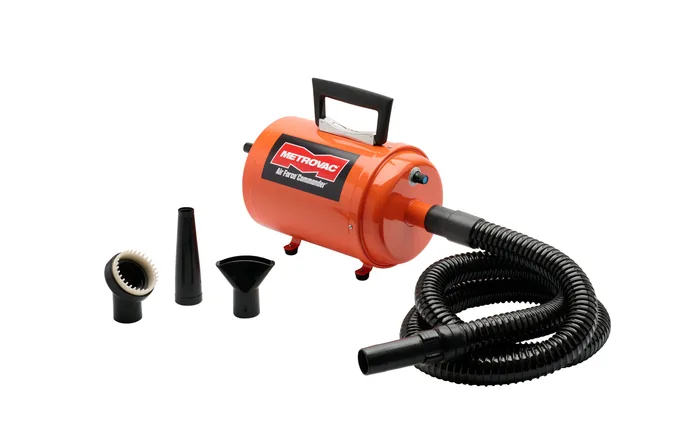
- Buy Metro Air Force Commander Variable Speed Pet Dryer (AFTD-3V) An all-steel, American-made force dryer with variable speed and the strongest stated airflow here.
- Buy XPOWER B-55 Home Pet Dryer A light, two-speed home force dryer with a full spec sheet and a safety listing.
- It depends Chris Christensen Xtreme Pro Dryer A compact steel high-velocity dryer built for grooming rooms, with variable speed and a two-year warranty.
- Skip iPettie Breeze B540S Dog Hair Dryer with Brush A cheap handheld dryer with a slicker brush on the front that publishes very little about itself.
What actually matters
- Airflow (CFM) - It is the volume of air the dryer moves. More air strips water faster from thick coats.
- Speed control - Variable or multi-speed lets you match power to the dog and the body part. Start low around the head.
- Heat - Force dryers rely on air rather than heat. Any dryer that heats should state its temperature and protection.
- Electrical draw - Amps tell you what the dryer asks of your circuit. High-draw units can trip breakers on shared circuits.
- Housing - Steel resists knocks and lasts in daily use. ABS plastic is lighter and cheaper.
- Safety listing - ETL, CETL or UL marks mean a lab tested the product to a safety standard. It is worth checking on anything used near water.
- Warranty - Motor coverage matters most. Read what is excluded, such as hoses and nozzles.
The specs, in plain English
Green flags vs red flags
Green flags
- A stated CFM figure.
- Variable speed or at least two speeds.
- A named safety listing such as ETL, CETL or UL.
- Thermal or overheat protection.
- A multi-year motor warranty with clear exclusions.
Red flags
- No wattage, voltage or airflow listed.
- Only wind speed in m/s with no airflow volume.
- High heat settings with no stated protection.
- No warranty on the product page.
- A 220 to 240V model sold to US buyers.
Who's who: the brands
- Metro - Sells steel-bodied Air Force pet dryers from its MetroVac store and markets them as made in the USA.
- XPOWER - A California maker of air movers that also sells home and professional pet dryers with full spec sheets.
- Chris Christensen - A grooming brand that sells its own professional dryers, including the steel Xtreme Pro.
- iPettie - Sells low-cost pet grooming gadgets, including handheld brush dryers.
How to read a listing without getting fooled
Start with the voltage, because a 220 to 240V dryer will not run on a standard US outlet. Then find CFM, which is the best single measure of drying power, and read HP and RPM as supporting numbers rather than the headline. Check how speed is controlled and whether the page states any heat setting and the protection behind it. Look for a named safety listing, the amp draw, the housing material and the hose length. Finish with the warranty and what it excludes, since hoses and nozzles are often left out.
How much should you spend?
Budget dryers split into two kinds: small home force dryers with real spec sheets, and handheld brush dryers that list very little. The first kind is worth buying; the second rarely is. Mid-range adds more airflow and sometimes a speed dial. Premium buys steel housings, variable speed, longer motor warranties and groomer features such as wall mounting. For one dog bathed at home, a well-documented home force dryer covers most needs, and the premium tier pays off with heavy double coats or frequent baths.
Questions, answered
Can a force dryer hurt my dog's ears or eyes?
A strong air stream aimed at the face is unpleasant and can be harmful, which is why groomers keep the nozzle away from the eyes and ears and use the lowest speed around the head. A variable speed dial makes that easier. Use a towel to dry the face instead.
Why is my dog dryer so loud?
High-velocity dryers move a lot of air through a small nozzle, which makes noise. Running at a lower speed reduces it, and many dogs get used to the sound with short, positive sessions.
How often should I clean or change the filter?
Check the intake filter after each use, because pet hair clogs it and reduces airflow. Metro lists an easy-change filter and XPOWER includes a spare filter set with the B-55. Follow the maker's manual for your model.
Will a force dryer work on short-coated dogs?
Yes. It dries short coats quickly, and nozzles like XPOWER's curry nozzle are aimed at them. Use a lower speed, since there is less coat between the air and the skin.
Or jump to the head-to-head: Metro Air Force Commander Variable Speed Pet Dryer (AFTD-3V) vs XPOWER B-55 Home Pet Dryer.