Explained
Dog Chew Toys, Explained
You will be able to look at any chew toy and judge whether it will survive your dog without putting their teeth or gut at risk.
In this guide
A chew toy has one job: give your dog something safe to destroy. The trap is that the toys marketed hardest at strong chewers win on durability by being harder than tooth enamel, which moves the breakage from the toy to the dog. This guide explains the materials, the hardness test, the wear indicators and the sizing logic so you can read past the word indestructible.
The 30-second version
- Nothing is indestructible. Every chew toy is a durability curve, not a guarantee. The realistic goal is a toy that lasts weeks or months and fails in a way you can see coming.
- Hardness matters more than durability. If you cannot dent the surface with your thumbnail, the material is harder than enamel and the tooth is what gives way. Firm rubber passes that check, rigid nylon does not.
- Size up, not brand up. A toy comfortably larger than the back of your dog's mouth gives less leverage and is far harder to swallow. Most failure stories involve a toy one size too small.
- Shape decides where destruction starts. Dogs attack thin edges, protruding knobs and molding seams. Simple, seamless geometry lasts longer than an aggressive-looking design covered in nubs.
- A wear indicator beats a judgment call. A toy that changes color or exposes an inner layer when it is chewed through tells you exactly when to retire it. Without one, you owe the toy a weekly hand check.
The products this guide is about
Our verdict on each, with the full reasoning on the companion review.
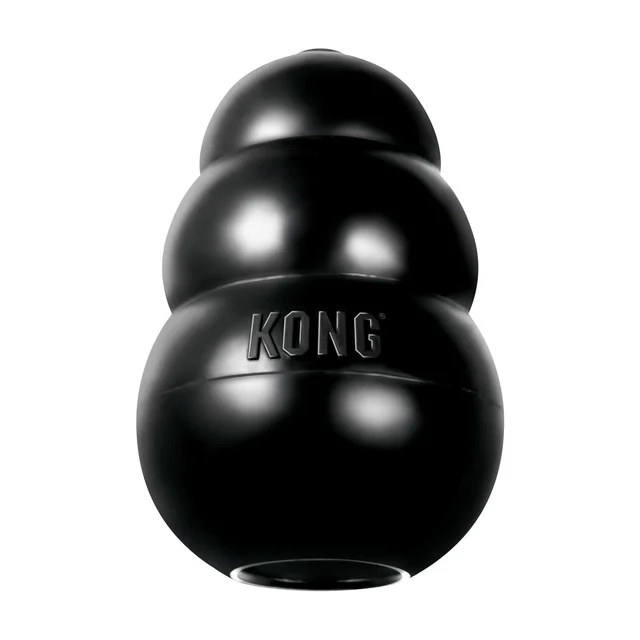
- Buy KONG Extreme Dog Toy The default answer for most power chewers: firm natural rubber that gives just enough, in more sizes than anything else here. Amazon
- Buy Goughnuts MaXX 50 Ring The heaviest-duty rubber ring in common circulation, and the only one here that tells you when to take it away. Amazon
- It depends West Paw Zogoflex Toppl A brilliant food puzzle that West Paw itself rates for moderate chewers, not for the dog you bought it for. Amazon
- Skip Nylabone Power Chew Textured Dog Chew It outlasts almost everything, and that is exactly the problem: rigid nylon does not yield, so something else has to. Amazon
What actually matters
- Hardness relative to teeth. The single most useful filter in the category. Press a thumbnail into the surface: if it leaves no mark, the material is too hard to chew on. That rules out rigid nylon, antlers, hooves and real bones, and it is why dense natural rubber dominates the safe end of the market.
- Material and how it fails. Firm rubber loses chunks you can see and feel. Softer thermoplastics can be bitten through or split in half. Rigid nylon frays into stiff shards that do not soften in the gut. What happens at the end of the toy's life matters more than how long that life is.
- Size and fit. Manufacturers publish weight bands, but weight is a proxy for jaw strength rather than a measurement of it. The toy must be too big to sit between the back molars and too big to swallow whole. When your dog sits at the top of a band, move up.
- Geometry and seams. Destruction starts wherever a dog can get purchase. Rings, spheres and rounded cones with no thin edge give a dog almost nothing to work with. Knobs, flanges, ridges and visible mold lines give them a starting point.
- Wear indicator and replacement policy. Some makers build a contrasting inner layer that appears once the outer surface is chewed through, converting an inspection into a visible signal. A lifetime or one-time replacement guarantee also changes the real cost of ownership if your dog is genuinely destructive.
- Enrichment value. A hollow toy that takes wet food or peanut butter and freezes solid occupies a dog far longer than a plain chew, and works off some of the drive that makes them destructive in the first place. Stuffable toys need cleaning, so check how easily you can get a brush inside.
- Supervision requirements. Some toys are designed to be left down all day and some are food puzzles meant to be used and taken away. Buying an enrichment toy for unattended chewing is one of the most common mismatches in this category.
The specs, in plain English
Green flags vs red flags
Green flags
- You can dent the surface with a thumbnail, so the toy yields before the tooth does
- Dense natural rubber, or a firm formulation the maker specifically positions for the toughest chewers
- Simple, seamless shape with no thin edges, knobs or visible mold lines to grab
- A visible wear indicator, or at minimum a clearly stated retirement rule
- A lifetime or one-time replacement guarantee on damaged toys
- Clear sizing guidance with several sizes above your dog's weight band available
Red flags
- The word indestructible with nothing behind it, and no guidance on when to throw the toy away
- Rigid material that shows no mark under a thumbnail, including nylon bones, antlers, hooves and real bones
- Ends or edges that fray into stiff, sharp fragments instead of crumbling
- Only one size offered, or a top size that stops well below your dog's weight
- Aggressive-looking designs covered in knobs, spikes and thin flanges that hand a dog a starting point
- A food puzzle rated by its own maker for moderate chewers being marketed to you as a heavy duty chew
Who's who: the brands
- KONG - The default name in rubber chews. Its black Extreme line pairs firm natural rubber with a stuffable cavity, across a wide range of sizes.
- Goughnuts - Specialist in very dense rubber rings and sticks, known for a red inner safety layer that signals retirement and a lifetime replacement policy.
- West Paw - Makes pliable Zogoflex toys that lean toward food puzzles and enrichment, backed by a replacement guarantee. Most are rated for moderate rather than extreme chewers.
- Nylabone - The widest range of rigid nylon chews, cheap and long-lasting, but rigid enough that veterinary dental guidance argues against them for strong-jawed dogs.
- Benebone - Flavored nylon chews with ergonomic shapes designed to be easier for a dog to hold. Same rigid-material caveat applies as with any nylon bone.
- Tuffy - Layered fabric toys with an in-house toughness scale. Useful for tug and fetch with strong dogs, but fabric is a supervised toy rather than a solo chew.
How to read a listing without getting fooled
Start at the material, not the marketing. Find out what the toy is actually made of and whether it yields, because durability claims are meaningless if the toy wins by outlasting the tooth. Then look at the maker's own chew rating and treat it as internal only: a top-tier rating from a brand whose whole range is soft is not the same as a top-tier rating from a brand that builds for destroyers. Read the sizing chart as a floor rather than a recommendation, and check whether a size exists above your dog's weight band. Next, look at the shape in the product photos for thin edges, knobs and mold seams, since that is where a dog will start. Finally, find the two sentences most listings bury: how the maker tells you to know when to throw the toy away, and whether they will replace it if your dog wrecks it. A listing that leads with the word indestructible and never mentions retirement is telling you the safety thinking was not done.
How much should you spend?
Budget chews are almost always rigid nylon, and that is the one place where cheap is a real cost rather than a bargain: a fractured tooth means anesthesia and either extraction or a root canal, which dwarfs anything you saved. The mid tier is where firm natural rubber lives, and for most dogs described as strong chewers that is the correct place to stop. It buys a material that yields under a bite, sensible sizing, and usually a stuffable cavity that turns one purchase into both a chew and an enrichment toy. Stepping up to premium buys three specific things: denser rubber, a built-in wear indicator, and a lifetime replacement policy. Those are worth paying for when you have evidence you need them, meaning your dog has already destroyed a mid-tier rubber toy, or sits at the very top of the size range, or you would rather read a color change than run a weekly inspection. If your dog has never beaten a firm rubber toy, spending up mostly buys reassurance. A better use of the same money is a second mid-tier toy so one can always be stuffed and waiting in the freezer.
Questions, answered
Is any dog toy really indestructible?
No. The word is marketing. Every toy in the category is a durability curve, and independent testing plus large volumes of owner reports converge on the same pattern: dense natural rubber lasts longest among the materials that are still safe for teeth, and even the best of them eventually loses chunks. Buy for how the toy fails, not for a promise that it will not.
How hard is too hard?
Press your thumbnail into the surface. If it leaves no mark at all, the material is harder than tooth enamel, and under load the tooth is the part that gives way. Rigid nylon bones, antlers, hooves and real bones all fail that check, while firm rubber passes it. This is general product information rather than veterinary advice, so talk to your vet about what is right for your individual dog, especially if your dog already has dental problems or a history of swallowing pieces.
What size should I buy?
One size larger than the weight chart suggests. The toy should be clearly too big to sit between your dog's back molars, which is where the crushing force is, and clearly too big to swallow. A larger toy also gives the dog less leverage to start a tear. If your dog is at the top of a weight band or has destroyed toys before, move up rather than staying at the recommendation.
When should I throw a chew toy away?
As soon as the surface is compromised: pieces missing, cracks, sharp edges, an exposed inner layer, or a remaining size small enough to swallow. Toys with a colored safety layer make this obvious. For everything else, run your hand over the entire surface once a week, and inspect dark toys in daylight where missing chunks are easy to spot. If your dog swallows a piece of any toy, contact your vet or an emergency clinic rather than waiting.
Are rubber toys or nylon bones better?
Firm rubber, for nearly every dog. Nylon does last longer in raw hours, which is why it sells, but it lasts by refusing to yield, and worn nylon ends splinter into stiff fragments rather than crumbling. Rubber costs more up front and it does get destroyed eventually, but it fails visibly and it stays on the right side of the hardness question.
Can I leave my dog alone with a chew toy?
Only after you have watched them with it. Supervise any new toy for the first several sessions to learn how your particular dog attacks it, then keep supervising anything not explicitly rated for power chewers, including most food puzzles. A correctly sized firm rubber toy is the closest thing to a safe unattended chew, and even that needs regular checking.
Or jump to the head-to-head: KONG Extreme Dog Toy vs Goughnuts MaXX 50 Ring.