Explained
Dog Food Storage Containers, Explained
After reading this you will be able to look at any pet food container and tell, from the closure design alone, whether it will still be airtight in three years.
In this guide
A dog food container has exactly one job: keep air, moisture, light, and insects away from an expensive bag of kibble for a month at a time. Almost every listing claims to do that, and most of them do for about a year before the closure quietly gives up. The confusing part is that the spec people shop on, capacity in quarts or pounds, is the one that matters least, while the part that decides everything, how the lid loads the seal, is barely described at all.
The 30-second version
- The closure is the product. A threaded lid that screws down and compresses a gasket ring behaves nothing like a snap lid held by two plastic clips, even when both are sold as airtight.
- Buy for the bag, not the pet. Most guidance favors setting the whole sealed bag inside the container, so mouth width and internal shape matter as much as the quart rating on the box.
- Airtight is a claim, not a standard. No regulator defines the word for pet storage, so judge it by whether the gasket is squeezed under load or just resting against plastic.
- Mobility is a freshness feature. A full large container that cannot be rolled or dragged never gets emptied and washed, and rancid fat film on the inside is what makes a dog turn picky.
- Premium materials buy looks, not seal quality. Stainless resists odor and food oils and looks right in a kitchen, but the best plastic containers seal at least as well for a fraction of the outlay.
The products this guide is about
Our verdict on each, with the full reasoning on the companion review.
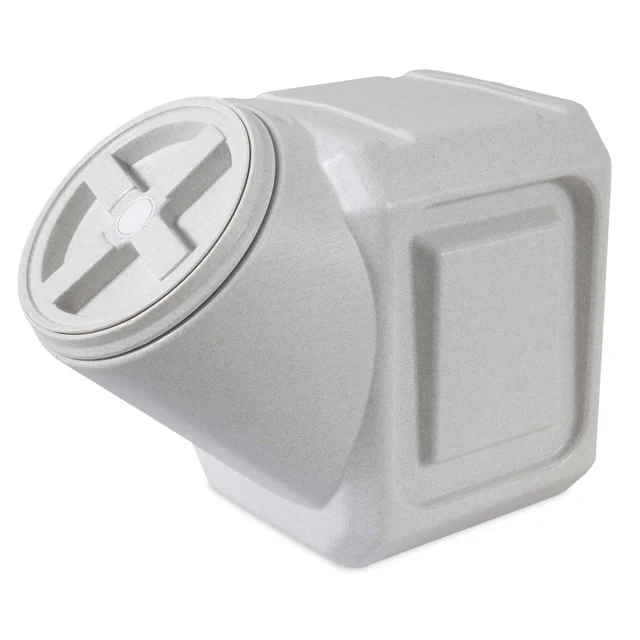
- Buy Gamma2 Vittles Vault Outback Stackable Pet Food Storage Container A threaded gasket lid that keeps sealing years after latch style containers have given up. Amazon
- Buy IRIS USA WeatherPro Airtight Pet Food Container with Wheels The easiest container to actually live with indoors, with a gasketed lid that punches above its price. Amazon
- It depends simplehuman Pet Food Can Beautifully made stainless storage that earns its place in a visible kitchen and nowhere else. Amazon
- Skip Van Ness Pet Food Container with Fresh-Tite Seal The cheapest option on the shelf, and the one whose lid you will end up checking every single time. Amazon
What actually matters
- Gasket compression, not just a gasket. Ask how the seal is loaded. A threaded or clamped lid squeezes a continuous gasket ring evenly all the way around. A snap lid resting on a foam strip depends on springy plastic tabs staying springy, and they do not.
- Mouth width and internal shape. If you plan to drop the original bag inside, which is what most pet nutrition guidance suggests, the opening has to swallow a folded bag without a fight. Tall narrow containers with small mouths force you to pour loose kibble instead.
- Material grade. Look for food grade, BPA free plastic (usually HDPE or polypropylene) or stainless steel. Storage totes borrowed from the hardware aisle are frequently neither, and thin plastic splits under the weight of a large bag.
- Wall thickness and body rigidity. Thick walls resist cracking when a full container gets dragged, and they matter more than anything else if rodents are a possibility. Thin translucent bodies flex, and flex is what eventually breaks a seal seat.
- Latch and hinge quality. In latched designs these are the parts that fail, usually first and usually in a cold garage. Metal pins and thick tabs outlast thin flexing clips by years.
- Mobility. Casters or a shape that tilts and walks. Capacity you cannot move is capacity you never clean.
- Opacity. Light speeds up the oxidation of the fats in kibble. An opaque body protects better; a translucent one lets you check the level without breaking the seal. Keeping the bag inside gets you both.
The specs, in plain English
Green flags vs red flags
Green flags
- The lid threads on, or clamps down with a lever, so the gasket is visibly compressed rather than resting
- Photos show a continuous gasket ring seated in a channel, not a foam strip stuck to the lid
- Thick walls, a squared tapered body, and food grade HDPE or stainless called out explicitly
- A wide mouth that a folded sealed bag drops into, described with actual opening dimensions
- Wheels on the large sizes, or a shape you can tilt and walk when full
- Long term owner reports, at the multi-year mark, still describing a tight seal rather than only first-week impressions
Red flags
- The word airtight with no visible gasket or closure mechanism anywhere in the photos
- Owner reports that split sharply on whether the lid seals at all, which means the tolerance is inconsistent unit to unit
- Repeated mentions of cracked clips, lids that are hard to seat, or bodies splitting under load
- Huge stated capacity paired with thin flexing walls and no mobility
- Sold as a general storage bin repurposed for pet food, with no food grade or BPA free claim
- Sharp internal corners and ribs, which trap the fat film you need to wipe out between bags
Who's who: the brands
- Gamma2 - Best known for threaded gasket lids on thick HDPE bodies, the design most often recommended for garages, porches, and pest prone storage.
- IRIS USA - High volume plastic storage specialist whose pet range pairs gasketed latch lids with casters and translucent bodies at accessible prices.
- simplehuman - Premium kitchen hardware brand; its pet can is stainless with a silicone gasket and a magnetic scoop, priced for visible kitchen placement.
- Van Ness - Long established budget pet supplies maker, widely stocked, with snap on clip lids that draw sharply mixed reports on seal consistency.
- Buddeez - Known for bag-in dispensers that hold the original sealed bag inside a rigid body, aimed at people who do not want to pour loose kibble.
- OXO - Kitchen storage brand whose push-button pop-top containers are popular for treats and small-dog portions rather than full bag storage.
How to read a listing without getting fooled
Start at the lid, not the headline. Scroll past the capacity claim and find a photo of the closure from the underside. You are looking for a continuous gasket ring seated in a groove and a mechanism that pulls the lid down onto it: threads, a lever clamp, or a locking handle. If all you can see is a rim and two side clips, treat the airtight claim as aspirational. Next check the opening. Listings quote quarts and pounds because those numbers sound decisive, but pounds is a guess based on average kibble density, and neither tells you whether a folded bag fits through the mouth, so look for actual opening dimensions or a photo with a bag going in. Then read the negative owner reports specifically, and read them for pattern rather than tone. One person who received a dented unit is shipping damage. Ten people describing a lid that is hard to seat, or clips that crack after a season, is a design tolerance problem, and that is the single most useful thing you can learn about a container before buying it. Finally, discount anything written in the first month of ownership. These products fail slowly. A gasket that flattens, a latch that loosens, a hinge that snaps in cold weather: none of that shows up in a first-week impression, so the reviews worth weighting are the ones written a year or more in.
How much should you spend?
This is a category where the cheapest option is the genuinely bad one and the most expensive option is optional. At the bottom of the market you are buying a snap lid with clips, thin walls, and inconsistent tolerances, which fails at the one job you bought it for. The step up from there is small in money and large in outcome: a modest mid-range budget buys a gasketed latch lid, a translucent body, casters on the larger sizes, and a container that is pleasant to use indoors. Spending a little more again gets you the threaded gasket design and thicker walls, which is the right call if the container lives in a garage, mudroom, basement, shed, or anywhere with humidity, temperature swings, or pests, since that closure is the one that does not fatigue. Above that tier you are paying for stainless steel and appearance rather than seal quality, which is a legitimate purchase when the container sits in a visible kitchen and a plastic bin would look wrong, and a poor one when it lives out of sight. Two smaller matched containers usually beat one very large one for the same outlay, because they stack, they are easier to move, and you can wash one while the other is in use. Weigh whatever you spend against the food: a container that ruins even a few large bags over its life has cost more than the gap between the tiers.
Questions, answered
Should I pour the kibble in or leave it in the bag?
Leave it in the bag and set the whole bag inside. The bag has a built in grease barrier that stops fat from soaking into the container walls, and it carries the lot code and best by date you would need if there is ever a recall. The container then does the airtight, pest proof, light blocking work around it. This is also why mouth width matters as much as the quart rating when you pick a size.
Does an airtight container really keep food fresher than a rolled up bag?
Yes, mainly by slowing two things. Oxygen and warmth oxidize the fats in kibble, which is what makes old food smell stale and taste off to a picky eater, and humidity encourages mold. A rolled and clipped bag does neither job well. A compressed gasket also keeps out pantry moths, ants, and rodents, which is the failure most owners actually encounter.
What size should I buy?
Match it to the bag you buy, not to your dog's weight. If you buy one large bag a month, get a container that swallows that whole sealed bag with room to close the lid comfortably. Too large costs you floor space; too small means you decant into a second bin and lose the point. If you feed more than one animal, two matched stackable containers beat one enormous one.
How often should I clean it, and how?
Between bags, not once a year. Kibble leaves a thin film of fat on the inside that goes rancid and transfers that flavor to the next batch, which is a common reason a dog suddenly turns picky. Wash with warm soapy water, rinse, and let it dry completely before refilling, because trapped moisture inside a sealed container is worse than no container at all. Never top fresh food onto old.
Will a container keep out ants, mice, and raccoons?
A compressed gasket seal handles ants, pantry moths, and moisture well, and it keeps a curious dog out. Rodents and raccoons are a different problem, because they attack the closure and the plastic itself. A threaded lid on a thick walled body is far harder for them than a clipped lid on a thin one. If you store food in a shed, barn, or open garage with known rodent pressure, that threaded design is the one best suited, and even then keep it off the ground and check the lid seat every time.
Is stainless steel worth it over plastic?
For seal quality, no. The best plastic containers seal as well or better. Steel earns its place on two narrower points: it does not absorb food oils or hold odor the way plastic slowly does, and it looks like furniture rather than storage, which matters if the container lives in an open plan kitchen. It is also heavy before you add food, and offers less capacity per unit of money. Buy it for the room it sits in, not for the food.
Or jump to the head-to-head: Gamma2 Vittles Vault Outback Stackable Pet Food Storage Container vs IRIS USA WeatherPro Airtight Pet Food Container with Wheels.