Explained
Dog Harnesses, Explained
After reading this, you'll be able to look at any dog harness listing and know whether it will actually help with pulling, fit your dog's body shape, and survive daily walks.
In this guide
A dog harness looks like the simplest purchase in the pet aisle - a few straps and a leash ring. But the difference between a harness that calms a puller and one your dog escapes from on a busy street comes down to a handful of design details most listings bury in jargon. The two things that trip up first-time buyers most: assuming "no-pull" on the label means anything specific, and ordering a size based on weight instead of chest measurement.
The 30-second version
- The front clip is the no-pull feature. A chest-mounted leash ring redirects a pulling dog sideways; a harness with only a back clip has no built-in pull control, no matter what the marketing says.
- Y-shaped chests beat horizontal straps. A Y-front leaves the shoulders free to move naturally, while a strap that crosses horizontally in front of the shoulders can restrict your dog's stride.
- Fit matters more than features. A loose harness chafes and lets dogs back out; measure chest girth at the widest point and use the two-finger rule under every strap.
- Harnesses manage pulling; training fixes it. Even the best no-pull design is a leverage tool that makes reward-based leash training easier - not a substitute for it.
- Hardware is where cheap harnesses fail. Owner reports show plastic buckles and lightly stitched D-rings are the usual failure points under a strong dog's daily pulling.
The products this guide is about
Our verdict on each, with the full reasoning on the companion review.
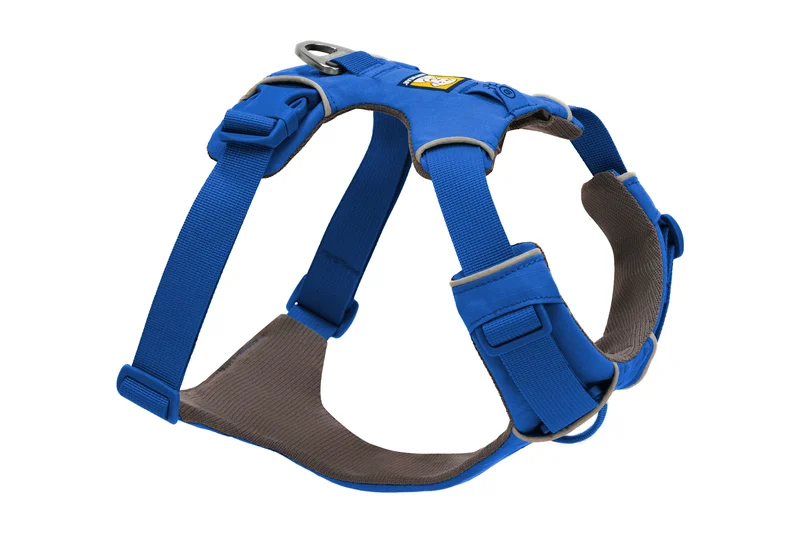
- Buy Ruffwear Front Range Harness The everyday benchmark: padded, durable, dual-clip, and comfortable enough for all-day wear. Amazon
- Buy 2 Hounds Design Freedom No-Pull Harness The trainer favorite: a dual-clip design with a tightening back loop that meaningfully reduces pulling. Amazon
- It depends Rabbitgoo Classic Fit No-Pull Dog Harness The budget vest that delivers most of the premium feature list - if you nail the sizing. Amazon
- Skip Julius-K9 IDC Powerharness A tough working-dog harness that is the wrong tool for everyday no-pull walking. Amazon
What actually matters
- Leash attachment points - a front (chest) clip gives you pull control, a back clip gives comfortable everyday walking, and having both lets you switch or run a double-ended leash for training.
- Chest shape (Y-front vs horizontal strap) - this determines whether your dog's shoulders can move freely; it matters most for active dogs and daily walkers.
- Adjustability - four or more adjustment points let you tailor fit to your dog's actual body shape; fewer adjusters mean the harness only fits dogs shaped exactly like the sizing chart assumes.
- Padding and lining at contact points - the girth strap behind the front legs and the chest panel are the chafe zones; padding or soft lining there is what makes long walks comfortable.
- Escape resistance - some dogs back out of harnesses under leash tension; snug fit, a well-placed girth strap, or a tightening martingale loop all reduce the risk.
- Hardware and webbing quality - metal rings and buckles at load-bearing points hold up to strong pullers; plastic saves weight and cost but is the common failure point.
- Visibility extras - reflective trim or stitching is worth having if any of your walks happen at dawn, dusk, or night.
The specs, in plain English
Green flags vs red flags
Green flags
- Both a front and a back leash attachment, so you can train and stroll with one harness
- Y-shaped chest that leaves the shoulders visibly free in product photos
- Padding or soft lining on the girth strap and chest panel
- Four or more adjustment points and a sizing chart based on chest measurement, not just weight
- Metal hardware at the load-bearing leash rings and buckles
- Owner reports that mention the same harness lasting multiple years with strong dogs
Red flags
- "No-pull" on the label but no front chest clip anywhere in the photos
- A horizontal strap crossing in front of the shoulders instead of a Y-front
- Sizing by weight only, with no chest-girth chart
- Plastic buckles at the points that take leash force, especially for a large or strong dog
- Repeated owner reports of dogs backing out or slipping free under leash tension
- Fraying stitching around D-rings mentioned in reviews within the first months of use
Who's who: the brands
- Ruffwear - Outdoor-focused premium brand known for padded, durable, hike-ready harnesses that owners keep for years - the everyday benchmark.
- 2 Hounds Design - US maker best known for a martingale-loop no-pull design that force-free trainers frequently recommend for leash training.
- Rabbitgoo - High-volume budget brand offering the full modern feature list - dual clips, padded vest, five adjusters - at entry-level prices.
- Julius-K9 - European working-dog brand with rugged, handle-topped harnesses popular with service handlers; its horizontal-chest style is a poor fit for no-pull walking.
- PetSafe - Mass-market pet brand whose Easy Walk pioneered the affordable front-clip harness; a common trainer starting point despite its minimal padding.
How to read a listing without getting fooled
Start with the photos, not the copy. Look for a front chest ring - if you can't see one, the "no-pull" claim is marketing. Trace the chest straps: do they form a Y down the breastbone, or a horizontal bar across the shoulders? Then check the spec list for the number of adjustment points and whether load-bearing hardware is metal. Find the sizing chart and confirm it's based on chest girth in inches or centimeters; a weight-only chart is a guessing game. Finally, skim owner reports for two specific phrases: anything about dogs "backing out" or "escaping" (a fit-and-design red flag) and anything about buckles or stitching failing (a durability red flag). Glowing first-week reviews tell you little - durability complaints cluster after months of daily use.
How much should you spend?
What drives the cost of a harness is mostly materials and construction: closed-cell foam padding instead of a token fabric layer, automotive-grade webbing, metal rather than plastic hardware, and more adjustment points all add up. The budget tier now includes the full modern feature list - dual clips, padded vests, reflective stitching - and for small dogs and mild pullers it's genuinely good value, with the trade-off that long-term durability is less certain and sizing takes more care. The value sweet spot for most owners is the mid-range, where you get trainer-grade no-pull mechanics and quality hardware without the premium price. Spending more is worth it if you walk daily, hike, or own a large, powerful dog: a premium harness that lasts several years typically works out cheaper than replacing budget harnesses that fray or crack. It's not worth spending more for a small, calm dog on short neighborhood walks, or before you've confirmed what size and style your dog actually needs.
Questions, answered
Do no-pull harnesses actually work?
They reduce pulling rather than eliminate it. A front clip redirects the dog sideways when tension builds, which makes pulling awkward and gives you leverage. Owners and trainers consistently report the lasting fix comes from pairing the harness with reward-based leash training - the harness is the management tool that makes training possible on real walks.
Is a harness better than a collar?
For attaching the leash on everyday walks, usually yes: a harness spreads force across the chest instead of concentrating it on the neck, which matters especially for small breeds, flat-faced breeds, and any dog that pulls. Most owners keep a flat collar for ID tags and clip the leash to the harness. Dogs with neck or trachea issues are typically walked on a harness on a veterinarian's advice.
How do I measure my dog for a harness?
Measure the chest girth at its widest point - usually just behind the front legs - with a soft tape measure, and use that against the brand's own chart rather than going by weight. Charts differ significantly between brands, so re-check every time. Once it's on, you should be able to slide two fingers flat under any strap, and the girth strap should sit a couple of finger-widths behind the front legs.
Can my dog escape a harness?
Some dogs can, especially if they balk and pull backward against the leash while the harness is loose. Escape risk drops sharply with a correct snug fit, and designs with a tightening martingale loop cinch when the dog backs up, making them notably harder to slip. If your dog is a known escape artist, prioritize fit, a martingale-style design, and owner reports that specifically praise escape resistance.
Should I leave the harness on all day?
Most owners take it off between walks. Constant wear can mat fur and chafe skin at the strap lines, especially in warm weather or on dogs with sensitive coats, and a harness left on unsupervised can snag on crates or furniture. Quick on-off is one reason to value a well-designed buckle layout.
Why do trainers dislike harnesses with a horizontal chest strap?
A strap that runs horizontally across the front of the shoulders can restrict the natural forward reach of the front legs - independent testing and canine-fitness practitioners generally prefer Y-shaped chest designs for unrestricted movement. Horizontal-strap designs also usually lack a front clip, so they offer no mechanical discouragement for pulling.
Or jump to the head-to-head: Ruffwear Front Range Harness vs 2 Hounds Design Freedom No-Pull Harness.