Explained
Dog Leashes, Explained
After reading this you will be able to pick up any leash, look at its clip, stitching and length, and know within seconds whether it is worth owning.
In this guide
A leash looks like the simplest thing you can buy for a dog: a strap with a hook on the end. What actually separates a leash you keep for a decade from one that fails in a parking lot is a short list of unglamorous details, mostly the clip, the stitching and the width of the webbing. The other thing that trips people up is buying one leash and expecting it to do two jobs, because street walking and open-field sniffing need completely different lengths.
The 30-second version
- The clip fails first. On almost every leash, the metal snap is the weakest and cheapest component, and it is the one thing worth inspecting before you look at anything else.
- Length is a decision, not a spec. Four to six feet handles sidewalks, shops and vet rooms; anything longer belongs in open space on a separate long line, and no single leash does both well.
- Padding is not a luxury. Thin unpadded nylon is perfectly comfortable right up until a big dog lunges, and then it burns your palm, which is why tubular or padded handles are worth the small premium.
- Material changes the feel more than the strength. Rope, flat webbing and coated biothane are all strong enough when the stitching and hardware are good, so choose on grip, weight and how easy it is to clean.
- Retractable leashes are the one category to skip. Independent reporting and veterinary accounts consistently tie them to line burns, finger injuries and neck jolts, and the constant tension quietly teaches a dog that pulling gives it more leash.
The products this guide is about
Our verdict on each, with the full reasoning on the companion review.
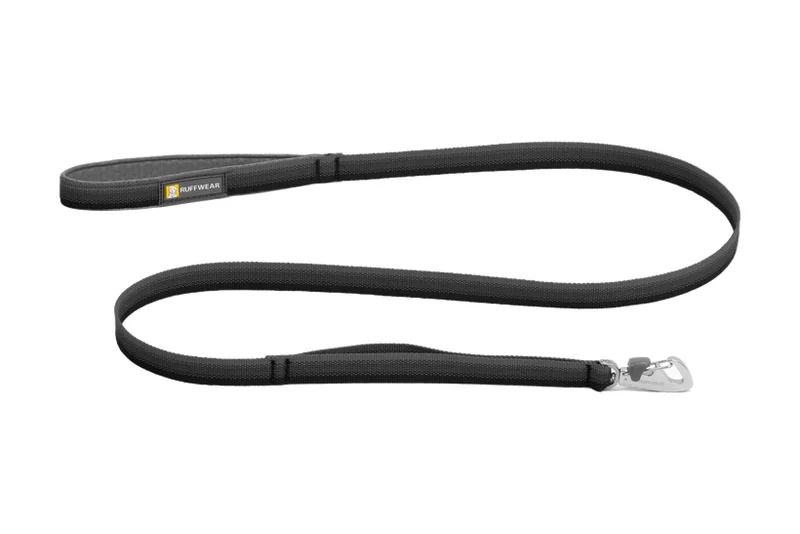
- Buy Ruffwear Front Range Leash The default everyday leash: comfortable webbing, a genuinely strong clip and very little that can fail in your hand. Amazon
- Buy Kurgo Quantum Leash 2.0 A multi-mode leash, and the waist and crossbody modes are the reason runners keep recommending it. Amazon
- It depends Mendota Pet Mendota Slip Leash A single piece of braided rope that has outlasted every gadget leash in shelters and gundog kennels, with one real caveat. Amazon
- Skip flexi New Classic Retractable Leash The best-built retractable on the market, and still the leash veterinarians and trainers spend the most time warning people about. Amazon
What actually matters
- Hardware quality. A cast or machined metal snap with a smooth, one-handed gate is a different class of part from a thin stamped swivel snap. Stamped snaps can pop open when a dog spins, and they corrode shut after a wet winter. If a listing brags about the webbing but says nothing about the clip, that is a tell.
- Handle comfort under load. The handle is where the whole force of a lunge lands. Padded neoprene or tubular webbing spreads that force; flat unpadded nylon concentrates it into a stripe across your fingers. If you walk a dog over about forty pounds, this is the difference between a pleasant walk and a rope burn.
- Stitching, specifically bar tacks. The dense box-and-cross stitch where the webbing loops back on itself at the handle and the clip is what actually holds a leash together. Frayed or single-row stitching at those two points is the real end-of-life signal, and it shows up long before the webbing itself wears out.
- Length matched to purpose. A short leash gives you control and nothing else; a long line gives freedom and no control. Buying one medium-long leash to compromise gets you a tangle in traffic. Own a standard walking leash and, if you want your dog to range, a separate long line.
- Attachment point on the dog. A leash is only half the system. Clipping to a collar concentrates every jolt on the throat; a harness spreads it across the chest. Long lines and dogs that pull belong on a harness, full stop.
- Visibility. Reflective trim running the full length of a leash does far more for a dark morning walk than a single reflective patch near the handle, because drivers see the moving line between you and the dog rather than one dot.
- Whether the design trains or untrains your dog. Some leashes are behaviorally neutral. Others actively teach something. A reel that keeps light tension on the line all walk long is running a training session in the wrong direction every single day.
The specs, in plain English
Green flags vs red flags
Green flags
- A cast or machined metal snap with a gate that opens smoothly with one hand, even wearing gloves
- Multiple dense bar tacks at both the handle and the clip end, not one row of straight stitching
- A padded or tubular handle rather than a flat strip of raw nylon
- Reflective trim or thread running the full length of the leash instead of a single patch
- A swivel where the clip meets the webbing, so the leash untwists as the dog circles
- A brand that publishes what the hardware is made of, rather than only the webbing's strength rating
Red flags
- A thin stamped swivel snap with a wire spring gate, especially on a leash sold for a large dog
- A strength number quoted for the webbing with no mention at all of the clip or stitching
- Plastic buckles or plastic hardware anywhere in the load path between your hand and the dog
- A retractable reel, particularly a thin cord version, sold as an everyday walking leash
- Glued or heat-sealed joins instead of stitched loops, or stitching that is already fraying in the product photos
- A single leash marketed as doing everything, from traffic-short to long-line freedom, with a sliding buckle that creeps under load
Who's who: the brands
- Ruffwear - Outdoor-first dog gear known for genuinely good metal hardware and padded tubular webbing; the default recommendation when someone wants one leash and no follow-up questions.
- Kurgo - Travel and active-dog gear, best known for convertible leashes that switch between hand-held, traffic-lead and waist or crossbody hands-free modes.
- Mendota Pet - A long-standing maker of braided rope slip leads that are common in shelters, grooming tables and gundog kennels because there is almost nothing on them to break.
- flexi - A well-known retractable brand; even so, retractables as a category are a design trainers and veterinarians often warn against.
- Blue-9 and similar training-focused makers - Smaller brands aimed at trainers, usually selling multi-length leashes, biothane long lines and well-specified hardware rather than fashion prints.
- Store-brand and marketplace nylon leashes - Fine for a light, well-trained small dog, but this is where stamped clips and single-row stitching live; inspect the hardware before trusting one with a strong dog.
How to read a listing without getting fooled
Product listings for leashes bury the important part. Start at the bottom of the spec list and find the clip: if the brand names the material and the type, that is a good sign, and if the page only says "heavy-duty hardware" it is usually a stamped snap. Next, treat any big strength number as a claim about the webbing only, since the webbing is essentially never what breaks. Zoom into the product photos at the handle and at the clip end and count the stitching: you want dense rectangular bar tacks, not one line of thread. Check the stated length in feet and ignore marketing words like "adjustable" until you know whether that means sewn loops, which stay put, or a sliding buckle, which can creep under load. Look at whether reflectivity is a full-length trim or a token patch. Finally, read owner reports for the specific failure they mention, not the star count: leash complaints are unusually consistent, and if several people mention the same carabiner or the same clip opening, that is a real defect rather than noise.
How much should you spend?
Leashes are one of the few categories where the useful spending range is narrow and the sweet spot sits in the middle. What you are paying for as you move up is hardware and construction, not fabric: a cast metal clip instead of a stamped one, real handle padding instead of a token strip, full-length reflective trim, and bar-tacked joins that survive years of a dog hitting the end of the line. That step up from bargain-bin to solidly mid-range is the price jump that most changes how long a leash lasts and how it feels in your hand. Above that, extra money mostly buys designer materials, prints, and convertible modes that most owners never fully use, so pay up only if you actually want hands-free walking or a particular material. Spending less makes sense in two cases: a simple rope slip lead is genuinely inexpensive and genuinely excellent for a trained dog, and a plain long line for open-field use needs length and a good clip more than it needs refinement. The one place to refuse to economize is any leash for a dog strong enough to pull you off your feet, where cheap hardware is the whole risk. And a well-built retractable is not worth its price at any level, because the problem is the design rather than the execution.
Questions, answered
How long should an everyday dog leash be?
Roughly four to six feet is the sweet spot for sidewalks, shops and vet waiting rooms. Shorter than that and the dog has no slack to move naturally beside you. Longer and you are constantly managing loose line near traffic. If you want your dog to sniff and range, buy a separate long line of about fifteen to thirty feet and use it in open space clipped to a harness.
Are retractable leashes really that bad?
The concerns are well documented rather than fashionable. Veterinary and emergency-clinic accounts consistently describe rope burns, deep cuts and finger injuries from people grabbing a moving line, plus neck and throat injuries when a dog hits the end of an extended lead at speed. A well-built model makes the mechanism itself more reliable but does not change the physics, and the constant light tension teaches a dog that pulling produces more leash. If you want distance, a long line on a harness gives you more real freedom with none of it.
Rope, flat webbing or biothane: does the material matter?
It changes how the leash feels far more than how strong it is. Rope is soft in the hand and sheds water well. Flat webbing is light, takes reflective trim easily and washes without fuss, though thin unpadded nylon can burn your palm. Coated biothane wipes clean and shrugs off mud and swamp water, which is why it dominates long lines. All three are strong enough when the stitching and hardware are good, and the clip is usually the first thing to fail on a cheap leash regardless of what the strap is made of.
Should I clip the leash to a collar or a harness?
Use a harness for anything with pulling potential, for any long line, and for flat-faced or small-necked dogs, because it spreads the load across the chest rather than the throat. A collar is fine for a trained dog on a short everyday leash. Keep ID tags on a collar even when you walk on a harness, since a harness can be wriggled out of.
Is a hands-free leash safe if my dog pulls?
Waist-worn modes suit dogs that already walk reasonably well. A hard lunge from a strong dog goes straight into your hips and can pull you off balance, which is how most hands-free injuries happen. A bungee section absorbs some of that shock. If your dog is still learning, use the same leash hand-held and switch to the waist belt once loose-leash walking is reliable.
How do I know when a leash needs replacing?
Check the two ends every few months rather than the middle. Look for fraying or popped threads in the bar tacks at the handle and at the clip, a gate that no longer snaps shut crisply, corrosion or grit in the swivel, and any stiffness or cracking in coated webbing. Those go long before the strap itself does, and a leash that fails does so at exactly the moment you most needed it to hold.
Or jump to the head-to-head: Ruffwear Front Range Leash vs Kurgo Quantum Leash 2.0.