Explained
Dog Car Restraints, Explained
After reading, you'll understand what "crash tested" does and does not mean, what Center for Pet Safety certification actually certifies, and which three specs on a listing decide whether a restraint is worth buying.
In this guide
First-time buyers get tripped up by a single assumption: that a product sold as a dog seat belt has to meet some safety rule. It does not. The federal standard everyone cites, FMVSS 213, is written for child restraint systems, and a pet product maker testing against it is borrowing a yardstick rather than complying with a rule. That leaves one nonprofit, the Center for Pet Safety, running an independent protocol and publishing a short list of products that passed. Once you know that, most of the category sorts itself out fast.
The 30-second version
- There is no mandatory federal standard for pet restraints, so "crash tested" is a marketing phrase rather than a pass or fail against a rule.
- CPS certification is the checkable claim, because the protocol number, test date and result are published on the organization's own list.
- How it connects matters as much as the harness, since anything that adds length between the dog and the belt adds distance the dog travels first.
- A tether or zipline is not a crash restraint, and CPS advises against them and excludes brands that sell them from its certification program.
- A strength-rated crate anchored properly is a real alternative, though CPS warns that cargo area anchors are not always rated for crash forces.
The products this guide is about
Our verdict on each, with the full reasoning on the companion review.
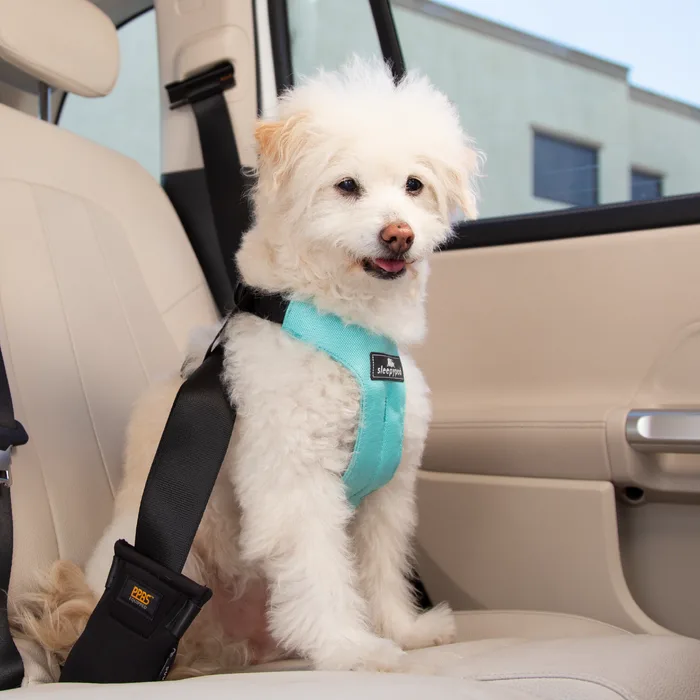
- Buy Sleepypod Clickit Sport Plus The certified harness that most owners should default to, with the vehicle belt running through the harness at three points.
- Buy Saker Bomber Harness A CPS certified harness built to work as trail gear too, with machined aluminum hardware instead of plastic.
- It depends Ruffwear Load Up Harness Honest, well documented maker testing and unusually good size coverage, but Ruffwear says outright that it would not pass CPS certification. Amazon
- Skip PetSafe Safety Seatbelt Tether A cheap, useful anti-distraction strap that shoppers keep buying as a crash restraint, which it does not claim to be. Amazon
What actually matters
- Independent certification - an outside body running a published protocol is the only claim a buyer can verify. Anything else relies on the maker's own account of a test you cannot see.
- Head excursion - how far forward the dog's head travels before the restraint stops it. CPS's harness work references the head excursion measurement used in FMVSS 213, and it is the criterion that separates a restraint from a leash.
- Attachment path - whether the vehicle belt runs through the harness or through an intermediate strap. Every inch of added strap is an inch the dog moves before the belt does anything.
- Fit and girth - a certification applies to specific tested sizes on a specific mannequin shape. A harness that slides or gaps is not the configuration that passed.
- Hardware load ratings - published buckle and D-ring ratings tell you what the metal was designed for. They are static ratings, not crash results, but their absence is informative.
- Harness versus collar connection - load has to be spread across chest and torso. Restraint makers say to attach to a harness, and the ones that do not are worth walking away from.
- Crash replacement policy - a company that offers to replace a harness after a collision is telling you it treats the product as single-use under load, which is the correct way to think about webbing.
The specs, in plain English
Green flags vs red flags
Green flags
- The product appears by name on the Center for Pet Safety certified list, with a test date and protocol number.
- The maker names the test standard, the lab, the crash pulse and the mannequin weights instead of just saying "crash tested".
- The vehicle seat belt runs through the harness itself rather than through an added strap.
- Sizing is published by girth measurement, with a chart, rather than by dog weight alone.
- There is a stated crash replacement program and published hardware load ratings.
Red flags
- A "crash tested" badge with no standard, lab, date or result anywhere on the page.
- Instructions or images that show the restraint clipped to a collar.
- Elastic or bungee sections, zipline runners, or any strap that adds length between the harness and the belt.
- A large pound figure presented as if it were a crash rating when it is a static strength rating.
- Claims of certification that you cannot find on the certifying organization's own published list.
Who's who: the brands
- Sleepypod - A brand with several products on the CPS certified list, covering the Clickit harness line plus carriers and mobile pet beds.
- Saker - Outdoor-focused harness maker whose Bomber harness is CPS certified and built around machined aluminum hardware.
- Ruffwear - Trail gear company that publishes unusually detailed sled test parameters for the Load Up and is explicit about not holding CPS certification.
- Kurgo - Widely stocked car harness brand. Check its listings for a named standard, lab and result, and check the CPS list for certification by product name.
- PetSafe - Mass-market pet brand whose seat belt tether is sold to reduce distracted driving rather than as a crash restraint.
How to read a listing without getting fooled
Start at the bottom of the listing, not the top. Ignore the badge and look for four things: the standard, the lab, the dummy weight and the result. If all four are present, you are reading a real test description, even if the product is not certified. If the page says only "crash tested", assume nothing has been independently verified and go check the CPS certified list by product name. Then read the sizing chart and note whether it is built on girth or on weight, because girth is what fits and weight is what markets. Finally, look at how the product meets the car: a harness the belt threads through, a loop, or a strap that adds length. That last detail changes the product category more than any material spec on the page.
How much should you spend?
Budget tier buys you tethers, elastic straps and simple nylon harnesses. These are anti-distraction accessories, and the good ones say so on the package rather than implying crash protection. Mid-range is where the certified and seriously tested car harnesses start, with padded vests or reinforced webbing, published sizing charts and metal hardware, and it is where most owners should be shopping. Premium buys machined aluminum hardware, dual-purpose trail and car designs, wider size coverage and modular accessories, which is worth it if you were going to buy a good walking harness anyway. Above that sits the crate route, where a strength-rated kennel plus proper anchor straps is a much larger outlay and only makes sense if you have the cargo space and will use it every trip.
Questions, answered
Why are so few harnesses certified?
Certification is voluntary and the bar is set by an independent protocol rather than by the manufacturer. CPS describes participation as a voluntary commitment by the maker to meet independently developed standards and to maintain quality control. When CPS ran its 2013 harness study, only one brand was described as offering crash protection, and head excursion limits were exceeded for sizes of other products. Brands can decline to submit, and some do.
Is a booster seat or car seat a restraint?
Not on its own. Most pet booster seats are containment products that hold a small dog up where it can see out, and they typically include a short tether inside. The tether is the restraint, and the same objection applies to it as to any other tether. If you use one, treat it as comfort and containment rather than crash protection, and keep it in the back seat.
Can I use the cargo area with a barrier instead?
A barrier keeps a dog out of the passenger cabin, which is a real benefit, but it is not a restraint and the dog still moves freely behind it. If you use the cargo area, CPS's advisory is worth reading first: it warns that cargo anchors are not always weight rated for crash forces and recommends checking anchor ratings with the vehicle manufacturer and using strength-rated anchor straps rather than tethers.
How often should I replace a car harness?
Immediately after any collision, even one that looks minor, and whenever the webbing, stitching or hardware shows damage. Look for pulled bar tacks, frayed or stiffened webbing, gouged buckle faces and any deformation in metal parts. Beyond that, replace when the fit no longer holds, because a harness that has stretched or that you have had to loosen past its adjustment range is not the configuration that was tested.
Or jump to the head-to-head: Sleepypod Clickit Sport Plus vs Saker Bomber Harness.