Explained
Heated Pet Beds, Explained
After reading, you'll understand what a safety listing on a heated pet bed actually covers, why low wattage is a feature rather than a compromise, and how to tell a real thermostat claim from a marketing one.
In this guide
First-time buyers usually shop this category on looks and size, then discover the specs that mattered were the ones in small print. Two beds that look identical can differ by an order of magnitude in wattage, target one temperature or a completely different one, and carry a safety mark that covers the whole appliance or only the plug pack. The vocabulary does not help: 'safety listed', 'self-warming', 'thermostatically controlled' and 'chew resistant' are all used loosely. Here is what each one means when a manufacturer is being precise.
The 30-second version
- A listing mark is about the whole product, so check whether the certification covers the finished bed or only a component such as the power adapter.
- Low wattage is the design goal, because these beds are meant to hold about 102°F under a sleeping animal, not to heat a room.
- Preset beats adjustable for most buyers, since a fixed thermostat aimed at body temperature removes the chance of leaving a pad on its highest setting.
- Self-warming means insulating, not heating, so it can only return warmth your pet has already produced.
- Outdoor and indoor products are not interchangeable, and the instruction sheet usually says so more bluntly than the sales page does.
The products this guide is about
Our verdict on each, with the full reasoning on the companion review.
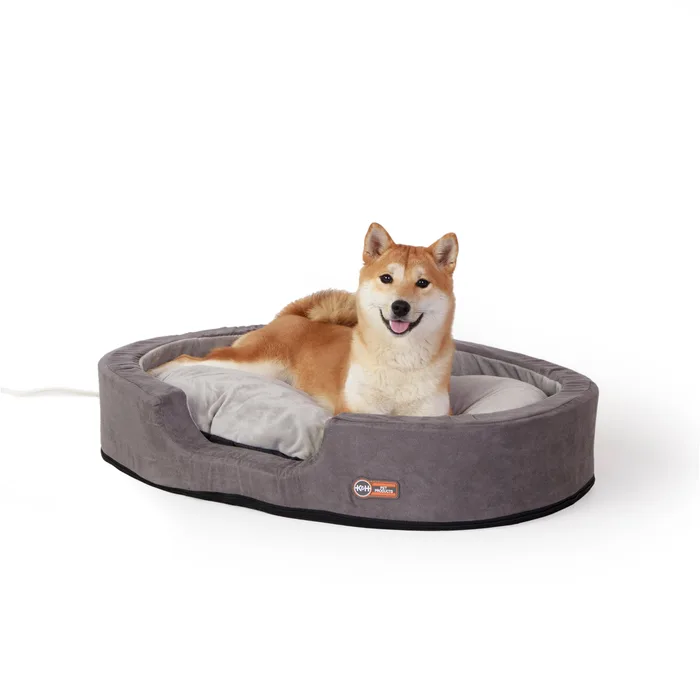
- Buy K&H Pet Products Thermo-Snuggly Sleeper Heated Pet Bed A 6 watt bolstered indoor bed with dual preset thermostats, MET listing, and a cover and pillow that both go in the wash. Amazon
- Buy API (Miller Manufacturing) Large Heated Pet Bed (12PB-L) A 28 by 43 inch cULus listed flat bed that runs the heater on 24 volts and fits the big dogs the bolstered beds leave out. Amazon
- It depends Furhaven ThermaNAP Faux Fur Self-Warming Pet Bed Mat A quarter-inch faux fur mat with no electrical parts that traps and returns your pet's own body heat. Amazon
- Skip Farm Innovators Heated Pet Mat (HM-80M) A rigid ABS plastic kennel mat that the manufacturer's own instructions tell you to keep off carpet and furniture. Amazon
What actually matters
- Safety listing - a mark from a lab OSHA recognises as a Nationally Recognized Testing Laboratory means the product was tested against a consensus standard. Verify that the listing is claimed for the specific model and size you are buying.
- Wattage - it tells you what the bed was designed to do. Indoor beds sit in the single digits to low tens of watts; kennel mats run many times higher because they are fighting outdoor air.
- Target surface temperature - a bed aimed at roughly 102°F is trying to match your pet, while a pad advertising a much higher maximum is relying on the animal to move away when it gets uncomfortable.
- Thermostat type - preset internal thermostats cannot be set wrong. Adjustable controls give you flexibility and give you a way to make a mistake.
- Cord construction - steel wrapping or a rigid anti-chew sleeve is the only part of the bed that protects against the most likely failure mode, which is teeth.
- Washability - a removable heater plus a machine-washable cover is the difference between a bed you keep and a bed you replace. 'Washable' on its own is not the same claim as machine washable, and some makers only say the former.
- Indoor or outdoor rating - outdoor products are built for hard surfaces in unheated spaces and often carry explicit warnings against carpet and furniture, which changes where you can use them.
The specs, in plain English
Green flags vs red flags
Green flags
- The listing mark and the standard are both named on the product page, for the exact model you are buying.
- Wattage is published per size rather than described as 'low wattage'.
- The maker states a target surface temperature near your pet's body temperature, around 102°F.
- The heater is removable and the cover is machine washable.
- The manufacturer publishes a real FAQ covering continuous use, extension cords and cord length.
Red flags
- Certification is described only as 'safety listed', shown as a logo with no lab or standard named, or claimed for a component such as the heating wire rather than the bed.
- The headline feature is a high maximum temperature, well above pet body temperature, with many settings.
- Wattage, cord length and dimensions are missing from the specification list.
- The sales page says indoor use while the downloadable manual says outdoor only.
- A brand claims a certification for its line rather than for the individual model.
Who's who: the brands
- K&H Pet Products - The most complete range of low-wattage indoor and outdoor heated beds, with wattage per size and MET listing to UL 499 stated on individual product pages. Lectro-Kennel is a K&H product line rather than a separate brand.
- API (Miller Manufacturing) - A heated-products brand covering pet, agricultural, bird and pond gear. Its Large Heated Pet Bed is the one non-K&H bed we found that publishes wattage, voltage and a cULus listing on the maker's own page, though it stops short of a target temperature.
- Furhaven - Best known for fabric beds, including the cordless ThermaNAP self-warming mats that trade real heat for washability and no electrical risk.
- Petmate (Aspen Pet) - Sells self-warming pet beds without electrical parts.
- Farm Innovators - A farm and livestock equipment maker whose heated pet mats are built as hard-shell ABS products for doghouses, kennels and barns.
How to read a listing without getting fooled
Start at the specification table, not the description. You want four numbers and one word: wattage for the exact size you are buying, cord length, outer dimensions, target surface temperature, and the name of the certifying lab. If the wattage is missing, the product is probably not engineered per size. If the certification is described without naming a lab or a standard, treat it as unverified until you find the mark on the manufacturer's own page. Then open the instruction sheet if one is downloadable, because that is where the real restrictions live: indoor versus outdoor, what surfaces are allowed, whether you may add your own blanket, and what the maker says about extension cords. It is common for the sales page and the manual to disagree, and the manual is the one written for the safety file.
How much should you spend?
Budget in this category buys you a self-warming mat with no electrical parts, which is a legitimate purchase rather than a compromise if your house is already warm. Mid-range is where the complete low-wattage indoor beds sit, with a bolster, a removable heater and a washable cover, and it is the tier most people should shop in. Premium mostly buys footprint and furniture value, such as very large flat beds, heated caves, pods and sofa-style beds; the heating hardware is usually no better than the mid-range beds, so pay it for the size or the shape you actually need rather than expecting warmer heat. Outdoor and kennel products often cost more than their indoor equivalents because of the weatherproof shell and heavier cord protection, which is worth paying for outdoors and wasted indoors.
Questions, answered
Does a brand's certification cover every bed it sells?
No, and this is the most common mistake in the category. Certification applies to a specific product, and often to specific sizes within it. A maker can have a listed flagship bed and an unlisted accessory in the same catalogue. Check the individual product page for the model and size you are buying, and look for the lab and the standard by name.
Is 12 volt DC safer than a mains-powered bed?
Running the heating element at low voltage does reduce the shock hazard at the pet's end, which is a real advantage. But it moves the mains electronics into an adapter, and some products are certified only at the adapter rather than as a whole appliance. A mains-powered bed that was tested as a finished product to UL 499 is not automatically the riskier choice. Read what the certification covers.
How much does it cost to run a heated pet bed?
Very little for an indoor bed, because the wattages involved are tiny: single digits to low tens of watts, comparable to a night light rather than a heater. That is why makers describe them as safe to leave plugged in continuously. Outdoor kennel mats are a different story at many times the wattage, since they are fighting cold air rather than just topping up a sleeping animal.
Can I put a blanket on top of a heated bed?
It depends on the product, and the manual will tell you. Some indoor beds are designed to work through a washable cover, and others say the opposite: Farm Innovators states that covering its heated mat with anything other than the supplied fleece will stop it working properly. Follow the maker's instruction rather than a general rule.
Why do so few heated pet beds publish a wattage?
Because a lot of them are sold by trading names rather than manufacturers, and a name with no product page has nothing to publish. It is a useful filter. A maker that prints watts, volts, cord length and the certifying lab for a specific model has a safety file behind the product and expects you to check it. A listing that offers a temperature range and a marketing claim about a certified component is telling you what it can say rather than what was tested. In practice that narrows the category down to a small number of brands very quickly.
Or jump to the head-to-head: K&H Pet Products Thermo-Snuggly Sleeper Heated Pet Bed vs API (Miller Manufacturing) Large Heated Pet Bed (12PB-L).