Explained
Pet Playpens, Explained
After reading this you will know exactly which playpen specs decide whether your dog stays put, and which ones are marketing noise.
In this guide
A playpen has one job: keep your pet where you left it while you are not watching. The listings, though, are full of panel counts, gauge numbers, and "total length" figures that say almost nothing about whether your dog can get out. Nearly every disappointed owner made one of three mistakes, which are buying too short, buying a wall design that hands a climber a foothold, or buying a travel pen and expecting it to work as containment.
The 30-second version
- Height is the spec that decides everything. A common owner rule of thumb is a pen roughly twice your dog's standing shoulder height, and undershooting it is the single most reported cause of escapes.
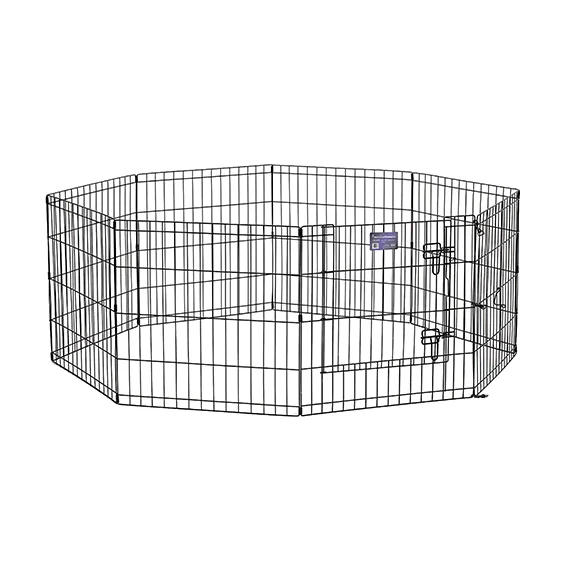
- Vertical bars beat horizontal rails. The cross wires that run along the top and bottom of folding wire panels work like ladder rungs, which is why agile dogs clear pens that looked far too tall.
- Every pen slides on hard floors. Rubber feet and wide bases help, but plan on a grippy mat, a wall to back against, or ground stakes outdoors, because a pen that walks across the room is a pen your dog is steering.
- Soft-sided pop-ups are travel gear, not containment. Fabric walls fold inward under pressure and mesh chews through, so treat them as a corral for a supervised calm adult dog and nothing more.
- Panel count is a footprint spec, not a security spec. More panels means a bigger enclosure, not a harder one to escape, and a pen with add-on panels available is one you will not have to replace.
The products this guide is about
Our verdict on each, with the full reasoning on the companion review.
- Buy MidWest Homes for Pets Foldable Metal Exercise Pen with Door The default pick: five heights, folds flat, metal wire that holds up to chewing, and cheap enough to overbuy on height. Amazon
- Buy Richell Convertible Indoor/Outdoor Pet Playpen 6 Panel Vertical slats give climbers nothing to grip, and the panels combine into a gate or divider when the puppy phase ends. Amazon
- It depends IRIS USA 34" Exercise 8-Panel Pet Playpen with Door Roomy plastic pen with vertical bars and rubber feet, capped at a fixed 34 inches that some dogs simply clear. Amazon
- Skip Petsfit Pet Pop Up Playpen Portable Small Dog Pen A genuinely good travel pen being sold as containment, which is the one thing soft-sided pens cannot do. Amazon
What actually matters
- Panel height is the first filter and the one most people get wrong. Measure your dog standing, from the floor to the top of the shoulder rather than the head, and shop at roughly double that. Folding wire pens are commonly sold in a ladder of heights from about 24 inches up to about 48 inches, which lets you overbuy containment cheaply. Rigid plastic pens are often locked to one height with no taller version, so a fixed 34 inch pen is a hard ceiling you cannot fix later.
- Wall design and climb resistance matter as much as raw height. Horizontal cross wires give a paw somewhere to hook. Molded panels with vertical slats only give a climber nothing to grip, which is the main reason to pay more for rigid plastic. If you buy wire and your dog is agile, assume you will also want the matching wire top from day one.
- Stability and anchoring decide whether the pen stays where you put it. Light panels on hardwood, tile, or laminate will travel when a bored dog leans on a wall. Look for ground stakes for outdoor use, a wide base or non-skid feet indoors, and plan to back the pen against a wall or set it on a rubber-backed mat regardless.
- Chew and accident resistance is the difference between a pen that survives teething and one that becomes a hazard. Metal and rigid plastic generally hold up to a puppy. Mesh panels and zipper pulls often do not, and swallowed hardware is a genuine risk, not a cosmetic complaint.
- A real latching door saves your back and your panels. Stepping over a tall wall while holding a squirming puppy is how panels get bent and hinges get strained. A step-through gate with a latch is worth the small premium over the doorless version of the same pen.
- Expandability and reconfiguration determine how long the pen stays useful. Accordion wire pens reshape into circles, ovals, squares, or wall-anchored half pens in seconds. Some plastic systems lock panels at fixed angles so the same set becomes a room divider or hallway gate after the puppy phase. Check whether add-on panels are sold separately before you buy.
- The job you are actually buying for. Unsupervised daytime containment, room division, and travel are three different products. Buying a travel pen for containment duty is the most common and most expensive mistake in this category.
The specs, in plain English
Green flags vs red flags
Green flags
- The same model is sold in several heights, so you can size up instead of hoping
- Panels use vertical slats or bars with no horizontal rail near the top
- A latching step-through door is standard rather than a separate upgrade model
- Add-on panels or a matching top cover are available from the maker
- Non-skid feet, a wide base, or included ground stakes show the maker thought about sliding
- The material wipes down or hoses off, because accidents are the whole reason you bought it
Red flags
- A single fixed height with no taller version and no factory top cover
- Fabric walls and mesh panels marketed for unsupervised daytime confinement
- Zippers, mesh, or fabric within reach of a teething puppy
- Listings that lead with total perimeter length and bury the height
- A weight rating far above what the panel construction plausibly resists, with no way to anchor the pen
- Owner reports clustering on the same follow-up purchase, such as needing a top cover or bricks to weigh it down
Who's who: the brands
- MidWest Homes for Pets - The default folding exercise pen, sold in heights from 24 to 48 inches with add-on panels and top covers sold separately.
- Richell - Molded plastic panels with vertical slats that convert the same set into a pen, divider, or gate.
- IRIS USA - Rod-connected plastic panels with vertical bars and rubber feet, with a roughly 5 by 5 foot footprint in the 8-panel model.
- Petsfit - Soft-sided pop-up pens with PVC floors and removable mesh tops, best understood as travel gear rather than containment.
- Frisco - Chewy house brand selling wire and plastic pens, check hardware reviews before buying.
- Carlson Pet Products - Better known for gates, with some pens and gate hybrids aimed at doorway and hallway blocking.
How to read a listing without getting fooled
Start at the bottom of the spec table, not the top. Find the panel height, and if the listing quotes only a total length or a panel count, that is a hint the height is not the selling point. Then zoom into the product photo and look at one panel edge on: you are checking whether there is a horizontal wire running along the top, because that single detail predicts climb-outs better than any number in the listing. Next, read the title carefully for the word door, since many wire pens are sold in near-identical doorless and step-through versions at different prices and the photos look almost the same. Check whether a top cover and add-on panels exist for that exact model, because a pen that cannot be extended or capped is a pen you will replace. Treat maker weight ratings as a guide to panel strength, not to escape resistance, since a calm large dog and a determined one behave completely differently against the same pen. Finally, scan owner reports for the follow-up purchase pattern. When a lot of people mention buying the top separately or weighting the pen down with something heavy, that cost and hassle are part of the real product.
How much should you spend?
This is a category where the cheap option is genuinely good, so the question is not how much to spend but what you are buying with the extra. Folding steel pens sit at the bottom of the range and deliver the one thing that matters most, which is height, for very little, and the smartest move most buyers can make is to spend the savings on a taller size rather than a fancier material. Step up to a mid-range rigid plastic pen when you want something floor-friendly and easy to rinse for small pets, understanding that you are usually accepting a fixed height in exchange. Pay premium money only for a specific structural advantage: vertical slat panels that defeat a climber, locking angles that turn the pen into a gate or divider later, or a finish you can stand to look at in a living room every day. Spending more buys you appearance, convertibility, and climb resistance. It does not buy you resistance to a large, pushy dog, since even the expensive pens slide when leaned on. Budget a little on top of whatever you choose for a grippy mat or a floor tray, and for a top cover if you are buying wire for an agile dog, because those two accessories fix the failures that make people replace a pen entirely.
Questions, answered
How tall should a dog playpen be?
A widely used rule of thumb is roughly twice your dog's standing shoulder height, measured to the top of the shoulder rather than the head. If your dog is young, athletic, or a known jumper, go one size taller than that suggests. Height is cheap to add at purchase and expensive to fix afterward, so when you are between two sizes, take the taller one.
Can dogs really climb out of wire exercise pens?
Yes, and it is the most common complaint about folding wire pens. The horizontal wires along the top and bottom of each panel act as rungs, and owners of small agile breeds regularly describe dogs going over pens that looked far too tall. Two fixes work: buy a taller pen than you think you need, or add the maker's wire top cover. Rigid plastic pens with vertical slats avoid the problem by design.
How many panels do I need?
Panels set the size of the enclosure, not its security. Count on enough room for your pet to stand, turn, stretch out, and keep a sleeping spot away from a pad or water bowl. Eight panels of typical width enclose an area roughly five feet across, which suits most puppies and small dogs. Check whether add-on panels are sold separately so you can grow the footprint without buying a second pen.
Do I need a mat or tray under a playpen?
Almost always. Wire feet and light plastic panels both slide on hardwood, tile, and laminate, and a sliding pen is a pen your dog can walk across the room. A rubber-backed mat or a matching floor tray adds friction and protects the finish, and it makes cleanup after accidents far easier during exactly the phase you bought the pen for.
Is a playpen better than a crate for a puppy?
They do different jobs. A crate is a small den for sleeping and short-term confinement, and its snug size is what makes house-training work. A playpen gives a puppy room to move, play, and use a pad while you are out of the room for longer stretches. Many owners run both, often with the crate door open inside the pen. If you can only buy one and you are house-training, start with the crate.
Are soft-sided pop-up pens ever worth buying?
Yes, for the job they actually do. They pack down to a couple of inches, weigh almost nothing, and often include a waterproof floor, which makes them good for camping, hotel rooms, and vet waiting areas with a calm supervised adult dog. What they cannot do is contain an unsupervised puppy, because the walls fold inward and the mesh and zippers are chewable. Buy one as travel gear, not as your daytime pen.
Or jump to the head-to-head: MidWest Homes for Pets Foldable Metal Exercise Pen with Door vs Richell Convertible Indoor/Outdoor Pet Playpen 6 Panel.