Explained
Puppy Pads, Explained
After reading, you'll understand which numbers on a puppy pad package can be checked, which claims cannot, and how to pick a size and build that fits your dog and your floor.
In this guide
First-time buyers usually pick a pad on count and price, discover it leaks or slides, and conclude that all pads are the same. They are not, but the differences hide behind vague words. Absorbency claims are stated in cups with no standard behind them, layer counts get quietly revised between production runs, and half the packaging is devoted to scent claims nobody has tested. The good news is that the specs that matter are few and easy to check on a maker's own page.
The 30-second version
- Size is the spec that decides everything, because a pad your dog can miss the edge of is a pad that failed regardless of how absorbent it is.
- A gel core is the real technology, and super absorbent polymer that locks liquid away is what separates a proper pad from a paper sheet.
- Layer counts are useful but soft, so read them alongside the backing description rather than treating six as automatically better than five.
- Attractant and odour claims are unproven, and none of the makers we checked publish data behind them, so do not let one decide a purchase.
- Pads have a genuine training cost, and if your goal is a dog that only goes outdoors, the right answer may be to skip pads entirely.
The products this guide is about
Our verdict on each, with the full reasoning on the companion review.
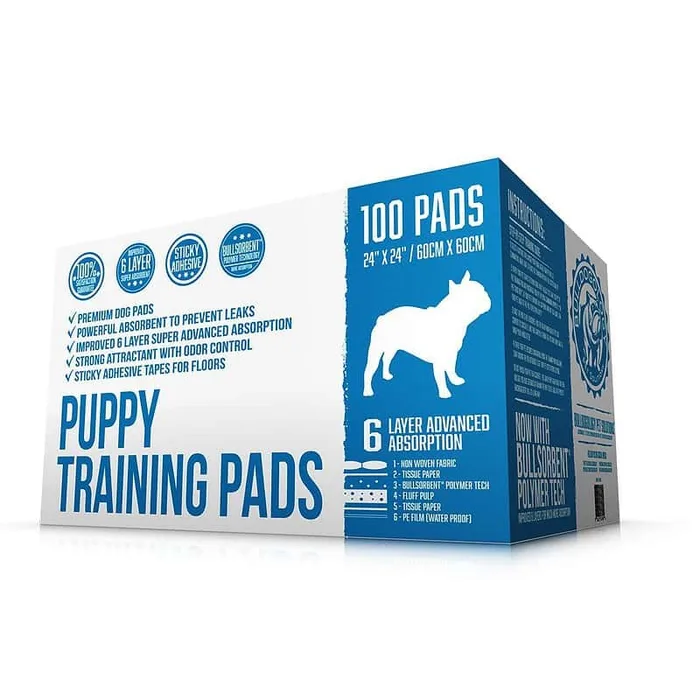
- Buy Bulldogology Premium Pet Training Pads (24 x 24 in) The only pad here whose maker publishes a polymer weight, a capacity figure and adhesive tabs on the same page. Amazon
- Buy HoneyCare All-Absorb Dog and Puppy Training Pads Six layers and a gel core in four clearly stated sizes, sold in bulk counts that keep the per-sheet cost low. Amazon
- It depends Pet Parents Pawtect Pads (2 pack) A washable fabric pad that pays for itself if you will actually launder it, and is useless to you if you will not. Amazon
- Skip Simple Solution All Day Disposable Training Dog Pads (Lavender Scent) Decent hardware sold on a use pattern that works against house-training, with perfume added for the human. Amazon
What actually matters
- Sheet dimensions - the single most common cause of a pad failing is the dog missing the edge or overhanging it. Measure your dog's stance, add margin, and check the number against your pad holder before ordering a hundred of anything.
- Super absorbent polymer - this is the granular material that turns urine into gel so it cannot run off when the pad is lifted or stepped on. A maker that states the polymer weight per pad is telling you something concrete; one that only says ultra absorbent is not.
- Layer count and backing - the layers control how much material sits between the surface and your floor, and the poly film backing is what actually stops liquid getting through. Six layers with a waterproof backing is the common premium build.
- Stated absorbency - a capacity figure in cups or millilitres lets you rank pads, but only when it is tied to a specific sheet size. Figures are not measured to any shared standard, so use them as a rough ranking rather than a guarantee.
- Anti-slip design - adhesive tabs, a rubberised or textured waterproof backing, or a framed holder all stop the pad travelling. On tile and hardwood this matters more than an extra cup of capacity.
- Disposable versus washable - washable fabric pads shift the cost from recurring to upfront and cut landfill volume, at the price of a laundry cycle after every use. It is a lifestyle decision, not a quality one.
- Wetness indicator - a colour-change strip that signals a full pad removes guesswork, especially for households where several people share pad duty. It is a convenience feature, not an absorbency feature.
The specs, in plain English
Green flags vs red flags
Green flags
- The maker publishes exact sheet dimensions for every size in the range, not just a size name.
- Absorbency is stated in cups or millilitres and tied to one specific sheet size.
- The core is described as super absorbent polymer, ideally with a stated weight per pad.
- There is a concrete answer to pad sliding: adhesive tabs, a grippy waterproof backing, or a compatible framed holder.
- The product page describes construction in detail and spends relatively little of its space on scent claims.
Red flags
- No sheet dimensions anywhere on the maker's own product page.
- Absorbency described only as ultra, maximum or 3x more absorbent with no unit and no reference point.
- A capacity figure quoted once and applied across every size in the range.
- Odour eliminating or attractant claims doing most of the selling, with no description of the core.
- All day or 24 hour protection framed as a reason to change the pad less often rather than as spare capacity.
Who's who: the brands
- Bulldogology - A direct-to-consumer pad specialist that publishes more construction detail than most, including polymer weight and adhesive tabs.
- HoneyCare (All-Absorb) - The All-Absorb line, sold under the HoneyCare name, built around large bulk counts and clearly stated sheet sizes.
- Pet Parents - Best known for washable fabric pads and other reusable pet gear rather than disposables.
- Simple Solution - A mass-market house-training brand whose pads are widely stocked and heavily marketed on scent and all day capacity.
- Frisco - Chewy's own-label line, and the default budget starting point for a lot of first-time puppy owners.
How to read a listing without getting fooled
Read a pad listing in this order. Find the sheet dimensions first, and if they are not there, treat that as a reason to look elsewhere rather than a detail to sort out later. Next find the core description and look for the words super absorbent polymer or gel; a weight in grams is better still. Then find the layer count and the backing description together, because the number means little without knowing whether the bottom layer is a proper waterproof film. Then look for a capacity figure and check which size it belongs to, because a number quoted once and applied to a whole range tells you nothing about the size you are buying. Finally, scan for how the pad stays put. Everything left over, the attractant, the carbon, the fragrance, the wetness indicator, is a bonus rather than a reason to choose one pad over another.
How much should you spend?
Budget pads compete on per-sheet cost and bulk count, and at this tier you are generally getting a genuine gel core and a waterproof backing but no adhesive tabs and often no published capacity figure. Mid-range disposables add features you can point at: a wetness indicator, a bigger stated capacity, sometimes a carbon layer, and they are what most large retailers stock at eye level. Premium disposables are where makers publish polymer weights, capacity figures tied to specific sizes and adhesive tabs, and where the per-sheet cost runs well above budget. Washable pads sit in their own bracket: the upfront cost of a two-pack is comparable to a mid-range box of disposables, but the cost per use collapses over months of laundering, which is the entire argument for them. The most cost-effective setup for high-volume households is usually a budget pad bought in bulk plus a framed holder, rather than a premium pad bought without one.
Questions, answered
What size pad should I actually buy?
Watch your dog squat and measure the footprint, then add several inches on each side for circling and for a male dog lifting a leg. Sizes in this category run from roughly 17 by 23 inches at the small end to 30 by 36 inches and beyond. Buying for the adult size rather than the puppy size saves you switching mid-training, and if you use a pad holder, the pad has to match the holder's frame rather than the other way round.
How often should a pad be changed?
Change it when it has been used, not when the stated capacity is reached. A pad that a puppy keeps returning to is teaching the puppy that a soiled surface is acceptable, which is the opposite of what you want. High capacity is best understood as insurance against an accident you were not there for, rather than permission to leave the pad down longer. If someone in the household struggles to tell, a pad with a wetness indicator helps.
Are pads safe if my dog chews them?
Any pad is a hazard if a dog shreds and swallows it, because the polymer core and the plastic backing are not food. Puppies that treat the pad as a toy should be supervised, and a framed pad holder that clamps the edges removes most of the temptation. If your dog has swallowed pad material, contact your vet rather than waiting to see what happens.
Can I use puppy pads for a senior or incontinent dog?
Yes, and it is one of the strongest uses for them, because the training objection does not apply to a dog that is no longer being house-trained. For this case, prioritise sheet size and capacity over anything else, and consider washable pads for bedding and crate liners since they will be in daily use indefinitely. Persistent incontinence in an adult dog is worth raising with a vet, since it can have a treatable cause.
Or jump to the head-to-head: Bulldogology Premium Pet Training Pads (24 x 24 in) vs HoneyCare All-Absorb Dog and Puppy Training Pads.